
Home / Service areas / Weed
Weed, 96094
Locksmith Help for Weed, California, and the Highway Crossroads
Weed lies north of Mount Shasta where Interstate 5 meets Highway 97, a town of local businesses, a college, travelers and wide open air. Here is what lock and key help looks like for 96094.
Weed, 96094
A crossroads town with a lot of traffic
Some towns are destinations and some are junctions. Weed is a little of both. Interstate 5 passes through, Highway 97 heads off toward the high country, and a steady stream of drivers stops for fuel, food or a night of sleep. That traffic shapes the sort of lock trouble people have here, and it means a good share of the callers are not locals at all.
A driver who has locked the keys in a rental or watched a fob vanish into a parking lot puddle is in a hurry and probably tired. They need clear, calm information more than a sales pitch. This page tries to give it: what can be done, what to prepare, and what to avoid.
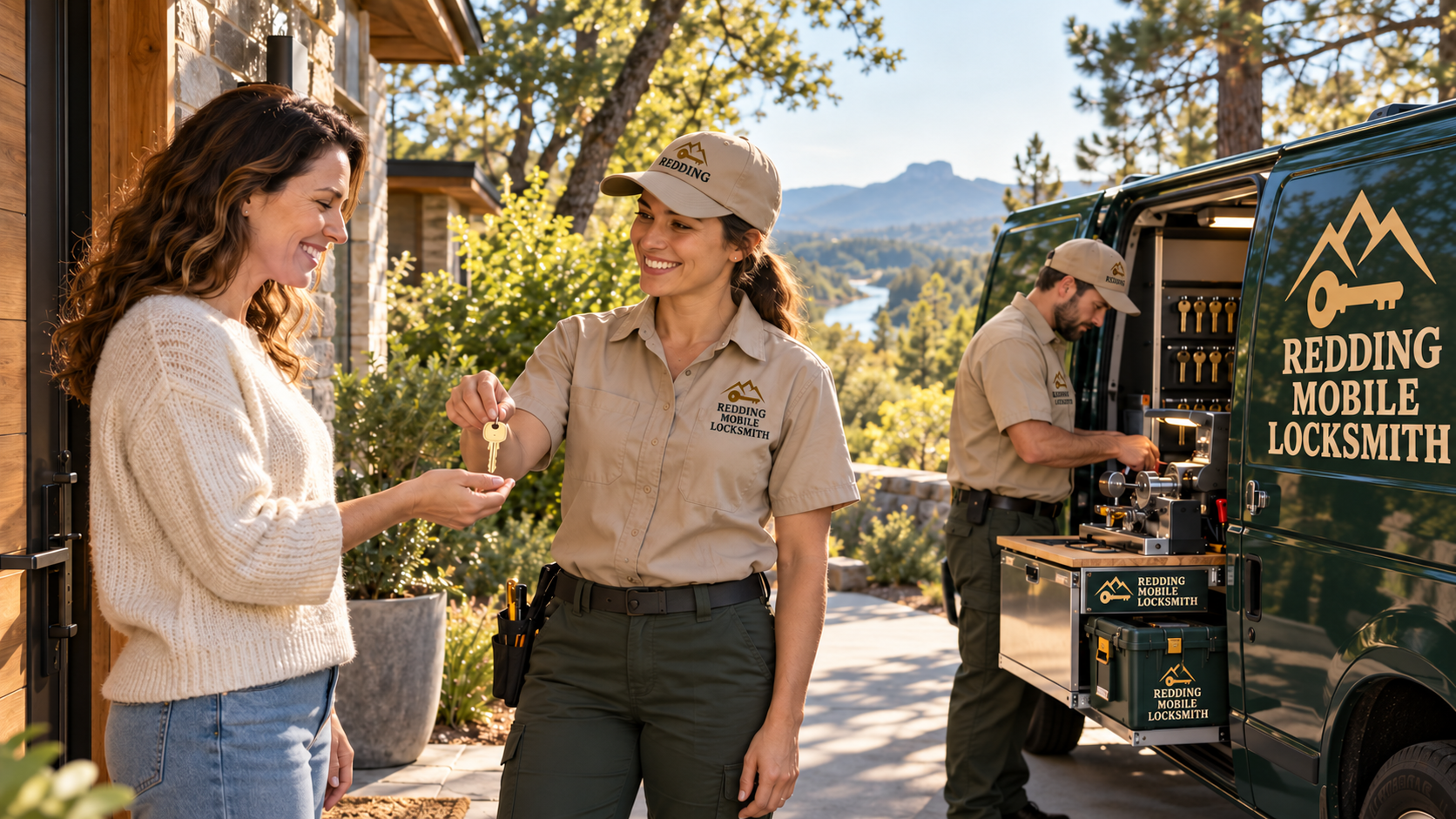
Redding Mobile Locksmith serves Weed, ZIP 96094, as one of seventeen communities across Shasta and Siskiyou counties. A branded team and service van carry professional tools, key cutting and programming equipment, and common hardware to wherever the lock happens to be.
Residents benefit from the same service. For people who live here, the same habits apply year round: know your keys, know your locks, and know what to do before you are standing in the wind with a dying phone.
Wind, open terrain and doors that slam
Weed has a reputation for wind, and wind affects hardware in ways that are easy to overlook. A gust catches a door and slams it, a latch hits its strike with more force than it was built for, and a closer that was set for calm air struggles to hold. Over months, those impacts loosen screws and bend plates.
There is also the matter of dust and grit. Fine particles blow into keyways and latch mechanisms, mixing with any oil and forming a paste that slows the moving parts. A lock in an exposed spot benefits from regular, light cleaning and the right kind of lubricant, not a heavy spray that holds the dirt.
If a door in your building slams, ask someone to look at the closer and the hinges. Our page on what a door closer is and why it matters explains how closers are adjusted for wind, and lock repair and adjustment describes the repair side.
A practical test is to open the door about halfway, let go, and watch what it does. A door that swings shut hard, or one that drifts open and stays there, needs its closer or hinges looked at. A door that stops and closes gently is doing its job. Five seconds of watching can tell you more than an hour of guessing about the lock.
Local businesses and the daily open and close
Weed has plenty of local businesses, from shops and eateries to service providers and small industrial spaces. Most have a pattern: someone opens, someone closes, and the lock gets turned dozens of times a week. That wears a cylinder, and a cylinder that has been turned thousands of times eventually gives up.
Signs of an aging commercial lock are easy to recognize. The key needs jiggling. The deadbolt does not throw cleanly. The handle droops. These symptoms are often simpler to fix when they are mild than when the door finally refuses to lock at closing time, which has an uncanny habit of happening on the busiest day.
Business owners usually benefit from a short conversation about the whole entrance: lock, closer, strike, handle and any exit device. The pages on business lock service, door hardware for business and the Weed door hardware page give a clear overview.
Hours matter here as well. A shop that opens early for travelers and closes late for evening traffic uses its locks more than a shop with a short weekday schedule. If your doors see heavy use, ask about commercial grade hardware, which is built for that kind of repetition, and about a maintenance routine such as a seasonal check of every latch, closer and strike.
Key control for shops with staff turnover
Staff change. Seasonal workers arrive, part time employees leave, managers move on. Each change leaves a key in someone else's pocket unless the owner has a plan. A short written key list is the simplest tool: who holds what, when it was issued, and when it came back.
If you cannot account for every key, the safe course is to rekey the lock. This is routine work for a locksmith and does not mean replacing the hardware. It also gives you a chance to simplify, for example by putting several doors on one key while keeping a separate key for the stockroom or the office.
For ideas, read what a key control policy is and how an office should handle keys when an employee leaves. For shops with many doors, master key systems explains how one key can open several locks.
Plenty of small shops forget the interior doors: the stockroom, the office, the small cabinet where cash or paperwork lives. These locks often get less attention than the front door, though they protect the most sensitive things. A flimsy cabinet lock is easy to open, and the same goes for many that come in a bargain pack, so think about whether a better one is worth it for what it guards. Cabinet and file locks covers the basics.
Students, shared housing and the college
A college town has its own rhythm, and keys follow it. Students arrive in August, move out in May, and in between they share houses and apartments with roommates who come and go. Keys get lost, copied and passed along to a friend with a couch, and nobody keeps track.
The practical advice is to treat keys as a shared responsibility. Agree on how many copies exist, write down who has them, and decide what happens when someone moves out. Landlords and property managers usually have rules about lock changes, so ask them first instead of assuming. Rules vary, and a short conversation is better than a surprise.
Our guides on college students and shared housing keys and how keys should be handled when a tenant moves out go through the details. The Weed home lock service page covers what a visit to a house looks like.
Parents of college students sometimes ask how to help from far away. The most useful gift is organization: a labeled spare key left with a trusted person, a note on who to call, and a clear understanding with the landlord about lock changes. Students who plan this before the move are far less likely to end up locked out at midnight in a town they do not yet know.
Cars, trucks and the long haul
Because Weed sits where two major routes meet, it sees many trucks, trailers and long distance drivers. Keys for heavy vehicles and for older trucks can be different from keys for a modern passenger car. Some are simple mechanical keys, others carry chips, and some work vehicles have particular requirements set by their owners.
If you are locked out, begin with safety. Move away from traffic, keep warm, and check each door and the trunk. If a child or a pet is inside, call emergency services first. Otherwise, a request on the contact page with the vehicle type and your location is the route to a technician.
Work vehicles raise a particular question: who should you tell? A company truck often has rules about keys and access, and the owner may need to approve a replacement. See a work vehicle lockout, who to tell, then read cars and trucks and the Weed cars and trucks page.
Heavy and specialty vehicles sometimes need particular steps. A trailer, a horse box or a work body may have its own lock, separate from the cab, and those locks are easy to forget until one fails. Check which keys fit which locks before a long haul, and make sure that spares exist for each one. The same is true for toolboxes mounted on a truck bed.
Replacement keys and what a chip changes
A modern key often has a small transponder chip inside its plastic head. When you turn the key, the car sends a signal and the chip answers with a code. If the code is right, the engine starts. If it is wrong, the engine may crank but never fire, or it may do nothing at all.
This is why a blank key cut at a hardware counter does not always work. The shape of the blade opens the door, but the chip must be paired with the vehicle. Programming equipment makes that pairing, and the service van carries it. When there is no working key at all, the process takes more steps, but it is still doable.
Our explanations in what is a transponder chip and can a key be made if I have no key at all answer the most common questions. Replacement car keys and the Weed key programming page go into the practical side.
Remote start and push button ignition add further wrinkles. If you use a remote starter, the system often has its own programming and may need to be reset after a key replacement. Tell the technician if your vehicle has one. Remote start and key questions explains why it matters, and what to look for when the new key is tested.
Rekeying and new locks for homes
Homes in Weed run from older houses to newer construction, and the locks follow. Some doors have original hardware that has outlived three owners. Others have recent deadbolts from a hardware store, installed with enthusiasm but not always with precision.
When you move in, rekey. It is the cleanest way to be sure who has a key. When a deadbolt is loose or the strike plate is short screwed, replace or adjust it. When you want a keypad or smart lock, ask how it behaves in cold and wind, and what happens when the batteries run low.
The details are in rekeying your home, new lock installation and the Weed installation page. For the question of what lock is good enough, read what lock grade means and whether expensive locks make a difference.
Lockouts at home and what to try first
Most home lockouts have a simple cause: a key left inside, a door that locked itself, or a key that no longer turns. Before calling anyone, walk around the house calmly and check whether a window or a back door is unlocked in a safe way. Do not climb or force anything that could cause injury or damage.
It helps to know what kind of lock you have. A spring latch on a knob locks automatically when closed, while a deadbolt needs a key or a thumb turn. Some doors lock themselves when pulled shut. Knowing which type you have helps a technician decide how to open it without damage.
See being locked out of your home and what a lockout is and what to try first for a calm order of steps. The local emergency help page for Weed explains what to include in a request.
One other situation comes up often in a town with many rental units: the lock that was changed without telling anyone. If you find that your key suddenly does not work, do not assume the lock failed. Contact the landlord or property manager first. Forcing a lock that was deliberately changed leads to confusion and sometimes to damage that you will be asked to pay for.
Nights, weekends and a service that comes to you
Redding Mobile Locksmith runs as a 24 hour service, which matters in a crossroads town where people arrive at all hours. A lockout at an hour when everything else is closed is an especially miserable thing, and the knowledge that help exists can take the edge off the stress.
While you wait, keep safe. Stay in a lit, public place if possible, stay with your vehicle if it is safe to do so, and tell someone where you are. Avoid accepting help from anyone who approaches you with a pitch you did not ask for. How to know a locksmith is the real thing helps you check who is who.
The phone line is coming soon, and the request form on the contact page is the route today. Include the town, the road you are near in general terms, the vehicle or lock type and whether anyone is in danger.
Neighbors around Weed
Weed shares its stretch of the interstate with Mount Shasta to the south, and with the Shasta Valley communities of Montague and Yreka farther north. All are part of the service area, and each has a page that describes its own homes, businesses and weather.
It is worth reading the page for the place where your lock actually is. Weed is windy, open and travel oriented. Mount Shasta is snowy and full of rentals. Yreka is older and office minded. The differences are real, and they change which questions you should ask.
If you are not sure where to start, our guide on what to have ready when you call a locksmith lists the details that make a visit go smoothly.
Good to know
Common questions
Does Redding Mobile Locksmith serve Weed?
Yes. Weed, ZIP 96094, is one of the seventeen communities across Shasta and Siskiyou counties that the team serves. The service is mobile, so a branded van with tools, key cutting equipment and hardware comes to your home, vehicle or business. Use the request form on the contact page.
Can wind damage a lock or a door latch?
Indirectly, yes. Slamming doors loosen screws and bend strike plates, and blowing grit gums up keyways. A closer adjusted for wind and regular light cleaning with a lock safe lubricant help a great deal. A technician can check the door and tell you what needs attention.
What should a business do when staff change?
Keep a written list of who holds which key, collect keys when people leave, and rekey if you cannot account for every copy. A simple key control policy takes little effort and prevents most trouble. A locksmith can also set up several doors on fewer keys.
Can a student rekey a rented room?
Usually the landlord or property manager decides, because the lock belongs to the property. Rules vary, so ask before you change anything. A landlord may be willing to rekey for you or approve a change. Our guide on shared housing keys suggests what to ask.
Do truck keys need programming?
It depends on the vehicle. Many modern trucks use chip keys that have to be paired with the engine system, while some older trucks use simple mechanical keys. A technician can tell by looking at the key and the vehicle, and the van carries programming equipment for the former.
How do I request help without a phone number?
The phone line is coming soon. For now, use the request form on the contact page and tell the team the town, what is locked, what you have tried and whether anyone is inside or in danger. For danger to a person or animal, call emergency services first.