
Home / Weed / Door Hardware for Business in Weed
Weed business doors
Door Hardware for Business in Weed: Maintenance and Adjustment
Doors at a shop, office, or shared building open and close constantly. Here is how the hardware on them wears, what to watch for, and how adjustment keeps them working.
Weed business doors
A door that gets used by everyone
Imagine a college student in Weed who shares a rental with two roommates and also works part time behind the counter of a small local business. At home, three people use the front door in a casual rhythm. At work, that number is many times larger. The same kind of hardware is bolted to both doors, but it is asked to do very different amounts of work. One door gets a tired latch after a year. The other gets a tired latch after a month.
That contrast is the heart of commercial door care. A busy door is a machine, and machines wear. Hinges, closers, latches, handles, locks, and strikes all move or take load every time someone passes through. Wear on any one part can slow the door, make it stick, leave it unlatched, or leave it banging against its stop.
This page is about keeping that machine in good shape. It is not about buying the most expensive hardware, although grade matters. It is about noticing small changes early and adjusting before they become failures. Our service page on door hardware for business gives the overall picture, and this page goes deep on maintenance.
The parts of a busy door
Start by naming the pieces. Hinges carry the weight of the door and let it swing. A closer, usually a hydraulic arm near the top, pulls the door shut at a controlled pace. The latch holds the door closed against the frame, while a lock or deadbolt provides extra security. A handle, lever, or push bar lets people open it. The strike plate in the frame receives the latch. Weather stripping, a threshold, and a stop finish the set.
On an exit door, there may also be panic hardware, which is a horizontal push bar that releases the latch when pressed. Our neighbor guide on push bars and panic hardware explains how it works and why it is common. Some doors have electric strikes or magnetic locks tied to an entry system, which add more parts to watch.
Every one of these has a lifespan, and each affects the others. A loose hinge makes the door sag, and a sagging door strains the closer and misaligns the latch. A weak closer lets the door slam or fail to latch. A worn strike lets the latch rattle. Because the parts depend on one another, a good maintenance routine looks at the whole set, not just the piece that is complaining.
Closers: the quiet workhorse
A door closer is a surprisingly clever device. Inside its body is a spring that pulls the door shut and a sealed chamber of fluid that slows the motion. Two small valves control the speed: one for the main swing and one for the final latching stretch. When the closer is adjusted well, the door swings shut with a gentle pace and clicks into its latch at the end.
Problems show up as slamming, dragging, or doors that stop a hair short of latching. A slammed door shakes the frame and hammers the latch. A door that drifts shut too slowly may never latch at all, particularly on a windy day, and Weed has plenty of those. A closer that leaks oil along its body is failing and will soon lose its control.
Many owners are tempted to crank the valves until the door behaves, and then wonder why it misbehaves again soon after. The reason is usually that the spring, the arm, or the door itself is the true cause. Closer adjustment is a delicate job. Turning the valves a quarter turn at a time, testing between changes, is the safest method. Wind and temperature change how a closer behaves, because the fluid thickens in cold weather and thins when warm. Our neighbor guide on what a door closer is and why it matters covers the basics for the curious.
- A door that slams means the closing speed is set too high.
- A door that stops just short of the latch needs more latching force.
- Oil on the closer body or the door suggests a leak.
- A door that moves very differently in cold weather may need seasonal adjustment.
Hinges and the weight of a door
Hinges look simple, but they do heavy work, and they rarely get thanked for it. A commercial door may weigh as much as a person, and the hinges carry that weight through thousands of swings. Over time, screws loosen, pins wear, and the holes in the frame stretch. The first sign is often a door that drags on the floor or rubs the frame at one corner.
The fix may be as simple as tightening screws or replacing short ones with longer screws that reach solid framing. In wood frames, stripped screw holes can be repaired by filling them with wood and re drilling. In metal frames, a different approach applies. If hinges are worn through, replacement may be called for, ideally with hinges of the correct size and weight rating.
A good habit is to give the door a careful look from the hinge side every month or so. Look for gaps that are uneven, screws backing out, or a door that no longer sits flush with the frame. Our neighbor guide on why doors sag and what it does to locks explains how the hinge problem shows up in the lock.
Latches, locks, and the strike
The latch and lock do the job of holding the door closed and keeping people out when needed. On a busy door, the latch bolt gets worked hard. The beveled tongue slides over the strike plate with every pass, and the spring inside the latch tires with time. A latch that sticks partly out, or that does not spring back, is telling you its time is limited. Replacing a latch before it fails is a modest job; replacing one after the door has jammed shut with a customer waiting outside is a much worse afternoon.
The strike plate suffers its own wear. Repeated impacts can enlarge the opening or bend the lip, and a worn strike lets the door rattle. A lock cylinder in a heavily used door can also collect dirt and dust, and its key may become hard to turn. In a dusty and windy area like Weed, this is a real factor.
When a lock begins to feel stiff, clean it and test it before it gives out. Our page on lock repair and adjustment describes what a locksmith does, and our neighbor guide on why a lock turns so hard covers the usual culprits. A stuck key is a close cousin, and how to deal with a stuck key offers sensible steps.
Wind, dust, and a college town's traffic
Weed sits in open terrain, with wind that can push on a door the way a hand would. A door that faces the wind can be forced open or held shut against the closer, and over time that loading wears hinges and arms. Exterior doors in these conditions benefit from slightly stronger closers and a regular look at the arm joints.
A storefront door that faces the street takes a different beating from a back door that opens onto a lot, and the hardware should match. Dust works into everything. Latches, key cylinders, hinges, and closers all collect fine grit, and grit wears moving surfaces like sandpaper. Wiping, cleaning, and the right light lubricant in the right places make a real difference. Our neighbor guide on what lubricant belongs in a lock helps you avoid the common mistake of using something that attracts dust.
Foot traffic also tells a story. A college and its surroundings bring waves of people at predictable times, and doors near busy areas may see the heaviest use at certain hours. If you can identify your door's peak times, you can schedule maintenance during quiet periods. A little planning avoids work during the busiest hours.
A maintenance routine you can actually follow
A simple routine beats a perfect plan that nobody follows. Once a month, walk to each important door and test it. Open and close it slowly and listen. Does it latch every time? Does the key turn without effort? Is there a gap along the edge that looks even? Do the hinges squeak, or have screws backed out? Does the closer move smoothly and without leaking?
Once or twice a year, go deeper. Tighten hinge screws, clean the closer arm, wipe down the strike plate, and lubricate moving points lightly. Check weather stripping and the threshold for wear. Test panic hardware by pushing the bar and confirming that the latch retracts fully and returns smoothly. If anything feels off, make a note and call for help rather than forcing it.
The routine does not need special tools beyond a screwdriver, a clean rag, and a bit of patience, and it turns surprise failures into scheduled fixes. Keep a short log, even a paper one taped inside a cabinet. Write down the date, the door, what you noticed, and what was done. That record shows patterns, such as a particular door that always loses its closer adjustment in winter. It also helps a locksmith understand the history when you ask for service.
- Test each important door monthly for latching, key feel, and gaps.
- Tighten hinge screws and clean closer arms once or twice a year.
- Push panic bars fully and confirm they return smoothly.
- Keep a short written log of every change and repair.
Doors that must open in an emergency
Not every door is there to keep people out. Some exist so people can get out, and those doors carry a different responsibility. An exit door must open easily from inside, even in darkness or a crowd, without a key and without special knowledge. Panic hardware exists for exactly this purpose, and its maintenance is not optional. If you are unsure what your building requires, rules vary, so ask the right local authority and your property manager rather than relying on guesswork.
What a locksmith can do is keep the hardware itself in good working order. That means checking that the push bar travels its full distance, that the latch retracts completely, that the door swings clear without binding, and that the closer lets it shut again without slamming. It also means looking at the outside trim or lever, which is often locked, to make sure it still works as intended and has not been altered.
One habit deserves mention: never chain, wedge, or tie an exit door to keep it open or closed. It may feel like a convenient fix on a busy day, but it defeats the hardware and can cause real trouble when it matters. If a door will not stay shut or will not stay open properly, ask for an adjustment or a better closer or hold open device instead of a workaround. Small problems on exit doors deserve prompt attention, because everyone in the building depends on them.
Shared buildings and who is responsible
Our student with the shared rental raises a real question: when a door is shared, who takes care of it? In a rental house, the owner or manager is usually responsible for exterior hardware, but arrangements vary. In a business located in a shared building, a lease may spell out which doors belong to whom. Rules differ, and it is wise to read your agreement or ask directly.
Our neighbor guides on what renters should ask a landlord about lock changes and college students and shared housing keys talk through the questions to raise. We do not give legal advice, but we can describe what is possible with the hardware and help you have a clear conversation.
For businesses, key control becomes part of the story. If employees come and go, you will want to know who holds which key. Our neighbor guides on what a key control policy is and how an office handles keys when an employee leaves are useful reading.
When to call and what to say
Call for help when a door fails to latch, when a closer leaks or slams, when a hinge cannot be tightened, or when a lock sticks. Also call if you notice anything that affects safety, such as a panic bar that does not release. A door that will not open in an emergency is a serious problem, and it deserves prompt attention. If you ever find an exit that is blocked, stuck, or locked in a way that worries you, treat it as urgent.
When you reach out, describe the door and the symptom. Say whether it is an exterior or interior door, how it is used, and what has changed. Mention the weather if it seems related. Photos are very helpful. The request form on our contact page has room for all of this, and our phone line is coming soon.
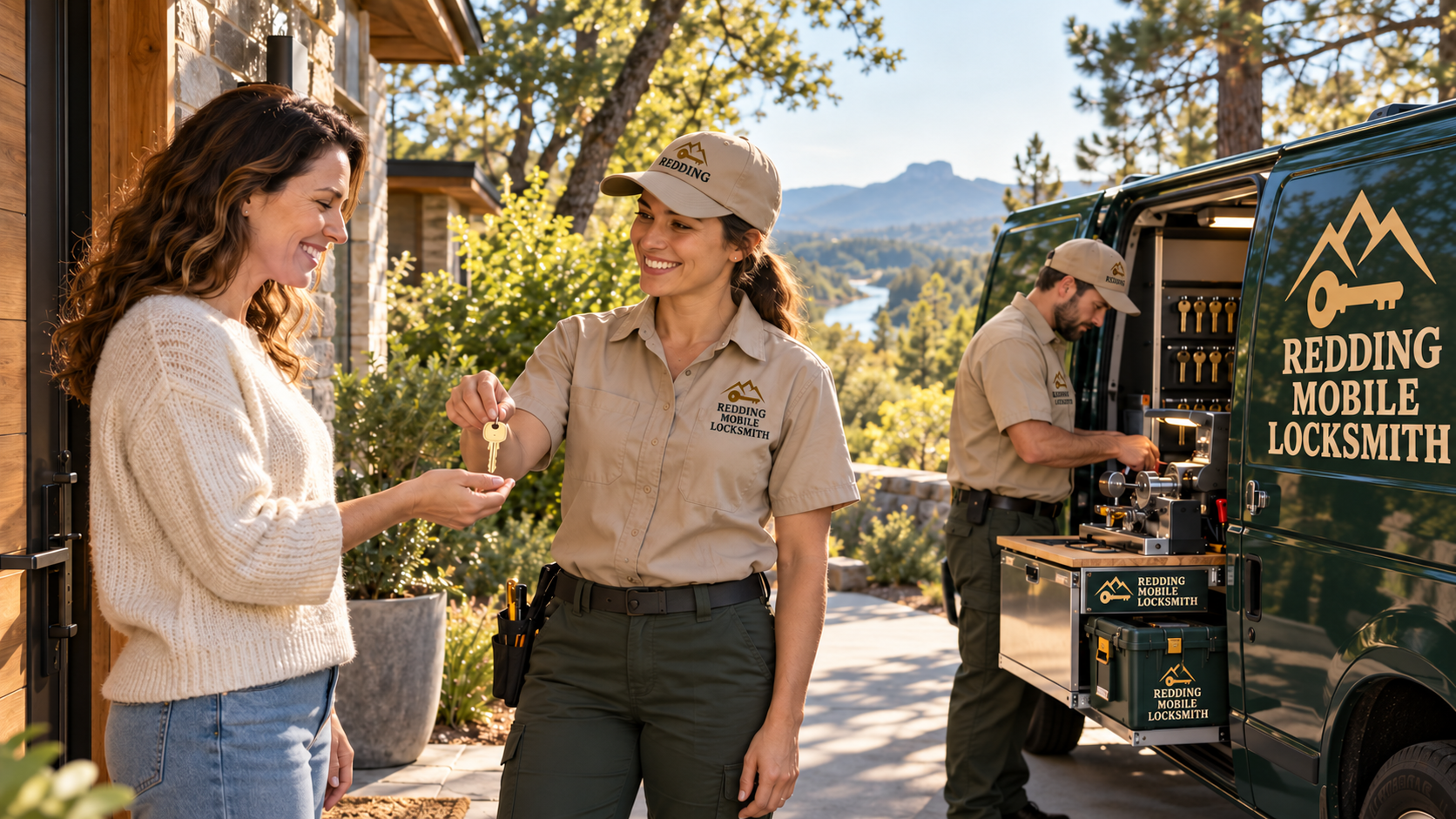
Redding Mobile Locksmith works from a branded service van with professional tools, key cutting and programming equipment, and common hardware, which means many door adjustments and repairs can be done on site. See our business lock service page for more on how that works, and our page about service in Weed for local details. If a business near the interstate in Mount Shasta or Yreka needs help, those communities are covered too.
Good to know
Common questions
How often should a business door be checked?
A short monthly check of latching, key feel, and gaps catches most problems early. Once or twice a year, tighten hinge screws, clean closer arms, and lubricate moving points lightly. Doors with panic bars should also be tested for full release and smooth return.
Why does my door slam shut or fail to latch?
The closer is probably out of adjustment. One valve sets the main swing speed and another controls the final latching stretch. Wind and temperature also change how it behaves. A locksmith can adjust the valves in small steps and replace the closer if it leaks.
Can a sagging commercial door be fixed without replacing it?
Often yes. Tightening or replacing hinge screws, repairing stripped holes, or replacing worn hinges can bring a door back into line. If the door itself is damaged, you will be told so. The goal is to fix the cause so the latch and lock work again.
Who is responsible for door hardware in a shared building?
It depends on the lease or agreement, and the answer varies by property. Read your documents or ask the owner or manager. A locksmith can describe what the hardware needs, and you can pass that information along when you discuss responsibility.
Does dust really hurt door hardware in Weed?
Yes. Fine grit works into latches, key cylinders, hinges, and closers and wears moving parts. Regular cleaning and the right light lubricant help. Avoid heavy oils that collect dust and turn into paste, which can make things worse.
What should I include when I ask for door hardware help?
Describe the door, whether it is exterior or interior, what symptom you see, and when it began. Add photos if you can. Mention the type of hardware, such as a closer, panic bar, or deadbolt. This helps the right parts arrive on the service van.