
Home / Services / Home Lock Service
Home lock service
Home lock service: keeping a household secure through moves, repairs and wear
A house is a long running project, and its locks are part of it. This page follows the life of a household's locks through moving in, daily use, wear and repair, and explains where a mobile locksmith helps.
Home lock service
A house changes, and its locks should keep up
Think about the locks on your home as a record of its history. The deadbolt went on when someone bought the place. The back door handle was replaced after the old one broke. The side gate has a padlock from a store that has since closed. Each lock was a decision made at a moment, and few of them were reviewed afterward.
Home lock service is the habit of reviewing them. Not in a nervous way, and not with a shopping list. Simply walking around your home, asking what each lock does, who has a key, and whether it still behaves the way it should. A mobile locksmith can do that walk with you, and often a short visit sets things right.
This page is organized around the moments that matter: moving in, living in, wearing down, and repairing. If you recognize your situation in one of them, that section is the place to start. If you are standing at a locked door right now, the locked out of your home page is more useful.
Locks have a way of becoming invisible. We use them dozens of times a day without a thought, and so we rarely notice that one is getting stiff or that a spare key has not been seen in a year. A scheduled look, even once a year, changes that. Pick a date that is easy to remember, such as the change of the clocks or the first cold snap.
Moving in: the first week matters
Whoever lived in a house before you may have given keys to relatives, neighbors, cleaners, contractors and friends. Some of those keys have been copied. Some have been lost. None of that is anyone's fault, but you cannot know who holds a key to your door. That is why the first week in a new home is the right time to deal with locks.
The usual answer is rekeying. A technician changes the internal pins of each lock, cuts new keys, and the old keys stop working. Your hardware stays in place, and the circle of people who can get in becomes exactly the one you choose. Rekeying your home has the details, and the guide on rekeying after buying a house gives the reasoning.
A good side benefit is that you can have all your exterior doors work from a single key. Instead of a ring of mismatched keys, you carry one. It is a small convenience that many people love, and it is easy to ask for.
If you rent a home and cannot change the locks yourself, the equivalent of this step is a conversation with the landlord. The guide on what renters should ask a landlord about lock changes lists the questions, and rules differ, so ask first.
Living in: the ordinary routines of keys
Most of what happens to home locks is routine. Keys get copied for family members, passed to a house sitter, or handed to a repair person who needs access. Over time the number of working keys quietly grows. A simple rule keeps it in check: know how many exist and who has each.
A household can ask a few plain questions once a year. Does everyone who needs a key have one? Does anyone have a key who no longer should? Is there a spare stored somewhere sensible, with a person you trust? If the answers are uncertain, a rekey draws a clean line under the past.
The guide on how many keys a household should keep offers a practical way to think about it. And if keys have gone missing, the guide on a lost wallet with house keys inside describes sensible first steps.
Houseguests and long stays add a layer. A relative staying for a month may need a key. Do not hand over your only copy. Cut a spare and keep track of it, or consider whether a keypad with a temporary code would make sense. Collect the key at the end of the stay and put it away somewhere you will remember.
Property managers and landlords will recognize the same cycle at a larger scale. Between occupants, the sensible routine is to collect keys, count them, and rekey before the next person moves in. The guide on describes how that tidy routine works for people who manage many doors.
Even in a single family home, a shorter version of that routine is worth borrowing whenever a long term guest, a worker or a former partner moves on.
Wear: how locks age
A lock has moving parts, and moving parts wear. Springs weaken, pins round off, latches lose their crisp action. The usual signs are a key that sticks or needs jiggling, a deadbolt that moves with effort, a handle that has become loose, or a latch that no longer clicks cleanly. Each is a message from the hardware.
Wear often accelerates because of the key. A worn key damages the pins, and damaged pins wear the next key. If you have been using a copy of a copy, there may be small differences that have added up. A fresh key cut from the original, or a rekey that resets the lock to new specifications, can restore the fit.
Weather plays a part. Hot dry valley summers dry out lubricants, and cold mountain winters bring moisture that freezes inside a lock. The guides on telling whether locks are worn out and weather and locks help you read the signs.
Cabin and vacation homes, common around the lake and in the mountains, have a rhythm of their own. Locks get left alone for months, and then face a sudden season of heavy use. A short spring check, before the first guests arrive, spots stiff cylinders and loose strike plates while there is still time to fix them.
Repairs: when the lock can be saved
Many locks that seem to be failing can be repaired. A cylinder can be cleaned and lubricated, a latch can be adjusted, a strike plate can be moved a fraction of an inch, a loose handle can be tightened and its internal parts replaced. These are modest jobs that restore a lock to good working order.
A technician looks at the door as well as the lock. A door that has sagged on its hinges will drag the latch out of line. A swollen frame will make a good lock feel stiff. Fixing the lock alone would not help. Sorting out the cause is what separates a repair that lasts from a repair that returns before long.
The lock repair and adjustment page describes the work in more depth, and the guides on why a lock turns hard and why doors sag cover two of the most common causes.
It is worth saying plainly that repair is often the more sensible choice. A skilled hand can bring a tired lock back to working order, keep your existing hardware, and leave your door looking the same. Replacement is there when repair would be a poor investment, and an honest technician will tell you which situation you are in.
Replacement and upgrades
Some locks are beyond saving, and some are simply not good enough. A lock with a worn cylinder, a damaged body, or poor build quality can be replaced with something better. A door without a deadbolt can gain one. A door that gets used constantly can be given a more robust handle set. A household can also choose a keypad or app controlled lock.
The decision depends on the door, the frame and the household. A lock that fits one door perfectly may not fit another. Door material matters too, since metal, wood and fiberglass hold hardware differently. The guide on metal, wood or fiberglass doors explains the differences.
The new lock installation page walks through the process. A good technician will explain options without pushing the most expensive one, because the right lock is the one that suits your door and your life.
Smart locks, keypads and app controlled hardware get plenty of attention. They can be genuinely useful for shared access, for guests and for people who dislike carrying keys. They need batteries, they need settings, and they deserve a keyed backup. The guides on smart locks and who needs one and whether smart locks can be rekeyed cover the main questions.
The special cases: kids, older relatives and shared homes
Households are not all alike. A home with small children may need a way to keep little ones from wandering out, while letting adults leave in a hurry. A home with an older relative living alone may need locks that are easy to operate and keys that are easy to hold. A house shared by roommates or students needs a plan for what happens when somebody moves.
Each of these situations has a guide. See childproofing exterior doors, lock choices for an older relative and keys in shared student housing.
The common thread is that security is about people. A lock that nobody can use is not a good lock. A lock that everybody can use is not a good lock either. The craft is finding the balance for your household.
Homeowners associations sometimes have opinions about what the outside of a door should look like. Rules vary, and we do not state them. Before changing visible hardware, ask your association what it requires. The guide on HOA questions about exterior door hardware lists what to raise.
Doors other than the front door
The front door gets most of the attention, but burglars and accidents alike find the others. The back door, the door to the garage, a side entry, sliding glass doors and old windows all matter. Many homes have a perfectly good front deadbolt and a back door with a flimsy lock.
A walk around the outside of the house, with fresh eyes, is a useful exercise. Look at the locks, the strike plates and the frames. A weak strike plate with short screws can be the most vulnerable part of a door. The guide on what makes a good strike plate explains why.
Check also the garage entry door, sliding doors and windows. See garage entry door failures, sliding door security and window locks for older houses.
If you have had a break in, give yourself time before you decide what to change. Make sure everyone is safe and that the authorities have been told. Then walk through the doors with a technician and decide together what repairs and upgrades make sense. The guide on locks after a break in is written for that moment.
Finally, do not forget the small stuff: a mailbox, a shed, a gate. They may not guard your valuables, but they guard your peace of mind. The guides on mailbox locks and shed and garage padlocks are short and practical.
When you are locked out
Even the most careful household gets locked out sometimes. The key is inside, or the door swung shut with the key on the kitchen table. A mobile locksmith can open most home doors without damage, though the method depends on the lock and the door.
Expect to be asked for proof that you live there. A driver's license with the address, a utility bill or a lease are typical. If you cannot show any, explain, and the technician will talk it through. The aim is to protect you, not to inconvenience you.
The locked out of your home page goes through the process step by step, and the guide on what to try first lists simple checks to make before you call. If the situation is urgent, see emergency help at any hour.
If you are ever unsure whether to wait or to call, ask yourself whether the door is secured. A home that can be locked and is not in danger can wait for a calm appointment. A home that cannot be locked, or has been damaged, deserves attention sooner. Say which in your request, and we will respond to the situation you describe.
Keep a note of what was done at each visit: which doors, which locks, how many keys and who holds them. A single page in a drawer is plenty. It answers the questions that come up later, such as whether a door was rekeyed last year or how many spares exist, and it saves a technician from guessing.
Where home lock service is available
Home lock service is part of the work in all seventeen communities we serve. Each has a local page: for example Redding, Anderson, Lakehead, Dunsmuir and Etna. The service areas page lists them all.
Our phone line is coming soon, so for now the way to ask is the request form. Tell us the community, the doors involved, and what you are hoping to achieve, whether that is a rekey after a move, a repair, a new lock or help getting in.
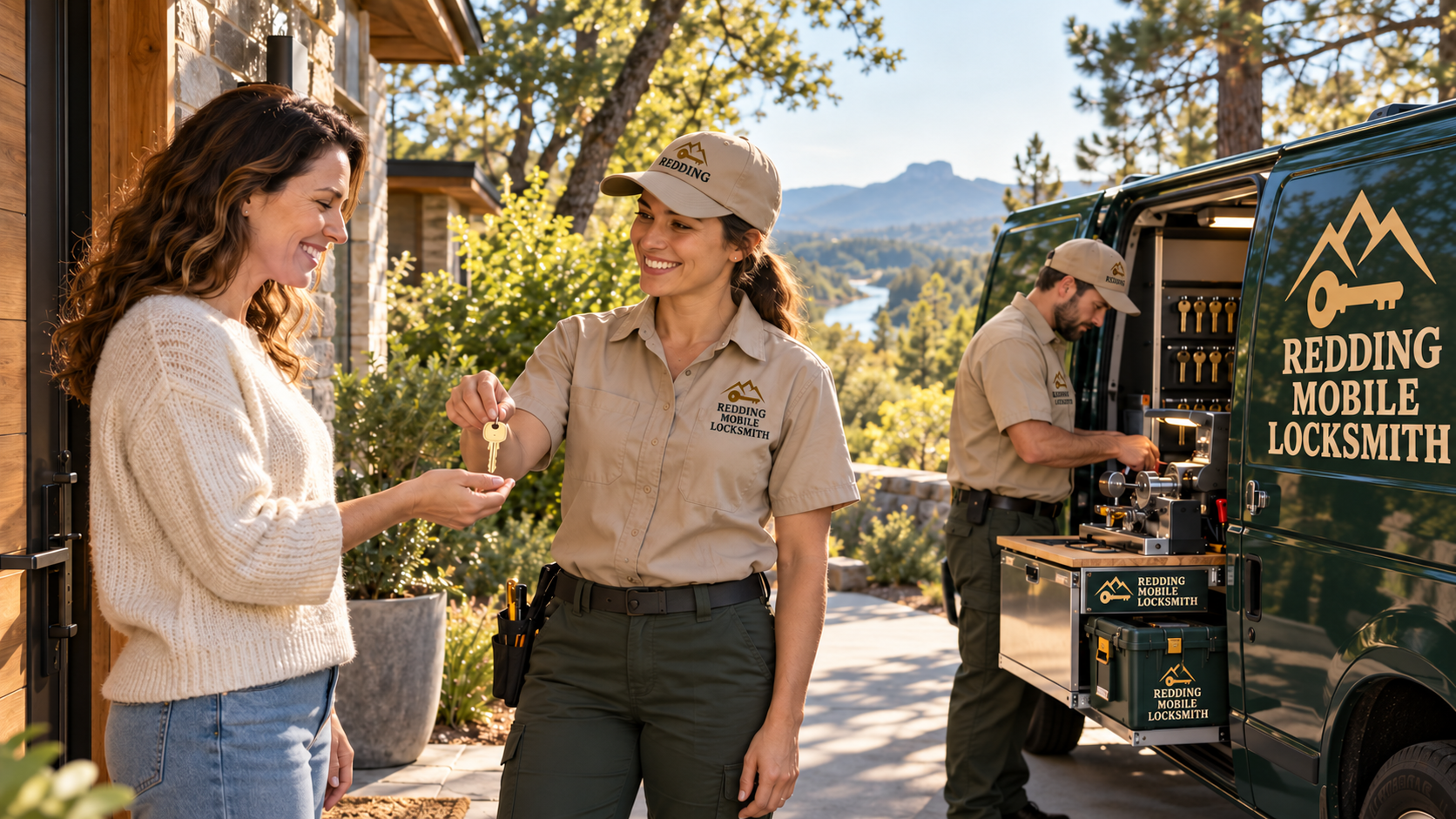
Out in the country, where homes are far apart and driveways are long, a lock repair that can be done on site matters even more. Nobody wants to drive an hour to a hardware store with a broken latch in the passenger seat. The van carries common hardware precisely so that many jobs finish in the driveway.
Good to know
Common questions
Should I rekey when I move into a new home?
It is a very good idea. You cannot know how many keys exist for the previous owner's locks or who holds them. A rekey changes the internal pins so the old keys stop working, and you receive new ones. It also lets you put all your doors on one key.
What is the difference between rekeying and replacing a lock?
Rekeying changes the inside of the existing lock so it works with a new key. Replacing removes the lock and installs a different one. Rekeying keeps your hardware, replacing changes it. Rekey when the lock is sound, and replace when it is worn, damaged or inadequate.
How do I know if my lock is wearing out?
Common signs are a key that sticks or needs jiggling, a deadbolt that takes effort, a loose handle, or a latch that no longer clicks cleanly. These are often fixable. A technician can tell you whether a lock needs adjustment, a part, or full replacement.
Can a locksmith open my home without damaging the door?
In most cases, yes. Professionals use methods that leave the lock and door intact. They will ask for proof that you live there before starting. If the lock is already damaged or unusual, the technician will explain what they find and what the options are.
Do all exterior doors need a deadbolt?
It is a widely recommended practice, though your doors and household differ. A deadbolt adds resistance beyond a simple latch. The library has a guide on the question, and a technician can look at your doors and suggest where a deadbolt would help most.
Can I install a new lock myself?
Some people do, and a basic handle swap can be a weekend job. Deadbolts, doors that are out of square and electronic locks are trickier. A poorly fitted lock can be less secure than the old one. The guide on changing a door handle helps you decide.