
Home / Neighbors ask / How many keys should a household keep?
Neighbors Ask
How many keys should a household keep?
Most households do well with one working key per adult, a couple of spares stored in different places, and a clear record of who holds what. The right number depends on who lives there and how you live.
Neighbors Ask
A number that starts with people, not doors
There is no magic count, but there is a sensible starting point. Give each adult who lives in the home their own key, add one for any older child who comes and goes alone, and then keep two spares. One spare stays inside the household, in a place everyone knows. The other lives outside the household, with someone you trust.
That formula works for most families because it answers the three situations that cause trouble. Someone loses a key, someone is locked out, and someone needs to get in while you are away. Each of those has a ready answer when you have the right number of keys in the right places.
Notice that the answer is built around people and not around doors. A house with three exterior doors does not need three times the keys, as long as the locks are keyed alike. We will come to that in a moment, because it is one of the simplest conveniences available to a homeowner.
A household in a rural stretch has an extra reason to think this through. When the nearest neighbor is a driveway away, or a gate and a long gravel road away, a lockout costs more than a few minutes of embarrassment. Plan your spares the way you plan for a winter storm: a little forethought, and then you do not have to think about it again.
Why more keys is not always safer
It is tempting to cut a dozen copies and hand them out so nobody is ever stuck. That feels generous, and it creates a quiet risk. Every key is a way in. Every key can be lost, copied or left on a counter at a gathering, and the more keys exist, the harder it is to know where they all are.
Think of keys as having a count you can account for. If you can name every person and every place that holds a key, you have control. If you cannot, you have a guess. A household that has lost track of its keys, for instance after a move, a divorce or a long string of house guests, may have more open doors than it realizes.
So the aim is not the biggest number or the smallest. The aim is a number you can name from memory. If the list is longer than you can recite, it is probably time to retire some keys.
The spare inside the household
Keep one spare in the house itself, in a spot all adults know. A drawer near the kitchen, a hook inside a closet, or a small lockable box all work. The idea is that anyone who finds themselves back at the house with a missing key can reach for the spare, provided they can get in at all, which is where the second spare comes in.
Do not hide a key under the doormat, in a fake rock or in the flower pot beside the door. These places are the first ones anyone checks, and they are the most common places for a key to be found. If a hiding place occurs to you in a moment of panic, it has occurred to everyone else too.
If you want an outdoor option, consider a small lockbox mounted somewhere discreet, with a combination known only to the household. It adds a step and a layer of protection that a doormat does not. Ask your locksmith about suitable placement, because the right spot depends on your home.
Whatever you choose, test it. Walk through the scenario once. If your partner is at work and you are locked out, can you actually reach the spare, and does it actually turn the lock? A spare that has never been tried has a surprising habit of being the wrong key.
The spare outside the household
The second spare belongs with someone who is reliable and reachable: a neighbor, a relative who lives nearby or a close friend. This person is your insurance when everyone in the household is locked out at the same time. It is the single most useful spare you can keep, and it costs nothing but a favor.
Agree on a few rules. The key stays in their possession and is not handed to anyone else. It carries no label with your address, only a name you both recognize. And you tell them if you ever change the lock, so they do not hold a useless key for years.
In small communities across Shasta and Siskiyou counties, neighbors often do this naturally. In larger neighborhoods you may need to ask. Either way, one conversation can save a long evening on the porch.
Reliability matters here as much as trust. A neighbor who travels for work or spends the winter elsewhere is not a good holder, however kind. Pick someone who is usually around, and if their situation changes, move the key to someone else.
Keyed alike versus separate keys
If your house has a front door, a back door and a garage entry, you might carry three different keys. Many locks can be keyed alike, meaning one key opens all of them. This is done by setting each lock's pins to the same pattern, and it is a standard job. Our page on rekeying your home explains how it works.
The upside is obvious. One key per person is easier to carry, easier to track and harder to mix up. The tradeoff is that losing that key exposes every door that it opens. For most homes, the convenience is worth it. For homes with a detached workshop or a rental unit, you may prefer separate keys for those spaces.
Some doors should stay separate on purpose, such as a door to a rental unit, a locked storage room or a storage building where you keep valuable tools. Those are places where you want a different list of key holders. A short chat with a locksmith can map this out in a single visit.
- One key per adult, keyed alike across the exterior doors, is a good baseline.
- Keep a separate key system for any rental unit or detached building.
- Give each household member a plain colored tag, never an address label.
- Replace labelled keys if you cannot account for who has seen the tag.
Special cases: teens, guests and caregivers
Teenagers are a case of their own. A teen who comes home alone needs a key, and a teen also loses keys more often than most adults. A good habit is to give them a key that is part of the family system, and to make sure a spare is already cut, so a lost key is an annoying afternoon rather than an emergency. Teen driving is a separate matter, covered in teen drivers and spare keys.
Guests, house sitters and caregivers are another group. Give them a copy for the time they need it and write down when it was handed over and when it came back. If the arrangement is long or open ended, think about a keypad lock that lets you set a separate code for each person and remove it later. Our page on lock choices for an older relative living alone goes into this.
Contractors, cleaners and dog walkers deserve the same care. If someone will have a key regularly, consider whether you would rather rekey after a long project ends. It is a small job, and it returns the household to a known count of keys.
Seasonal visitors are a good example. If a relative stays for the summer and then leaves, ask for the key back at the end. If that is awkward or the key has already been copied, a rekey solves it without any hard conversation.
When to rekey instead of cutting more
Cutting copies is the easy answer, but it does not always solve the problem. If a key has been lost in a way that suggests someone could find it and connect it to your address, the sensible answer is to change the lock. A rekey replaces the inside of the lock so the old keys stop working. You keep the same hardware and receive new keys.
The same applies after a move, a breakup, a change of tenants or a long stretch with many unknown key holders. If you are not sure who has a key, treat that uncertainty as information. A rekey gives you a clean slate and a count you can trust. Our page on rekeying after buying a house goes through why this matters.
Rekeying is not a sign of paranoia. It is routine maintenance, like changing a smoke alarm battery. Most households never regret it.
A fair question is how much a rekey involves. The locksmith removes the cylinders, changes the internal pins to a new pattern, and cuts new keys. The door hardware stays where it is. It is a more modest job than most people imagine, and it is often finished while you make a cup of coffee.
Where keys should not live
Some places are poor homes for spare keys. Under mats, in planters, inside electrical meter boxes, on top of door frames and in glovebox compartments all invite trouble. A key left in a vehicle can be taken along with the vehicle, and a house key with a car key on the same ring gives a thief the address of the home when the car is parked at a shop or a trailhead.
If you carry a house key on the same ring as your car key, consider using a valet key or a separate ring for the car when it will be handled by someone else. Mechanics, valets and parking attendants have no reason to hold your house key. Take it off before you hand the keys over.
Also avoid leaving keys at a workplace desk or in a coat that hangs in a public place. Many lost keys are not lost at all. They are simply left somewhere that was not safe.
Think about the thing that does not show up on any list: the copy that was cut years ago and handed to someone who is no longer in your life. If you suspect such a key exists, it is almost certainly worth the rekey.
Making a key inventory you can actually keep
Here is a small, practical habit. On an index card, list each key your household owns, what it opens and who holds it. Update it when something changes. Store it with your important papers, not on the fridge. If you ever need to decide whether to rekey, the card tells you at a glance.
Do not store the key codes on the same card as the keys themselves. Codes are information about your locks, and they deserve more care than the card itself. Read more about them at what is key code cutting.
Update the card when you hand out a key, retrieve one or replace a lock. If it sounds like a chore, remember that it takes about as long as writing a grocery list, and it answers questions that are very hard to answer later.
If your household includes people who share a space but not a lease, such as roommates, adult children returning home or extended family, write the key list in a way everyone can see. Surprise is the enemy of good key control. For the shared housing version of this question, see college students and shared housing keys.
What to do when a key goes missing
First, stay calm and retrace your steps. Many missing keys turn up in a coat, a car seat or a bag within the hour. If you are sure it is gone, decide whether it might be in the wrong hands. A key that fell out of a pocket on a hiking trail is a different case from one that left with a wallet.
If the risk is low, cut a spare from your remaining key and move on. If the risk is high, call for a rekey. And if you have no key left at all, read our page on making a key with no key present to see what a locksmith can do.
Never use the situation as a reason to leave a door unlocked overnight. A lock you cannot lock is not a lock. If you are stuck, the request form is the easiest way to get a visit planned.
Households across our service area
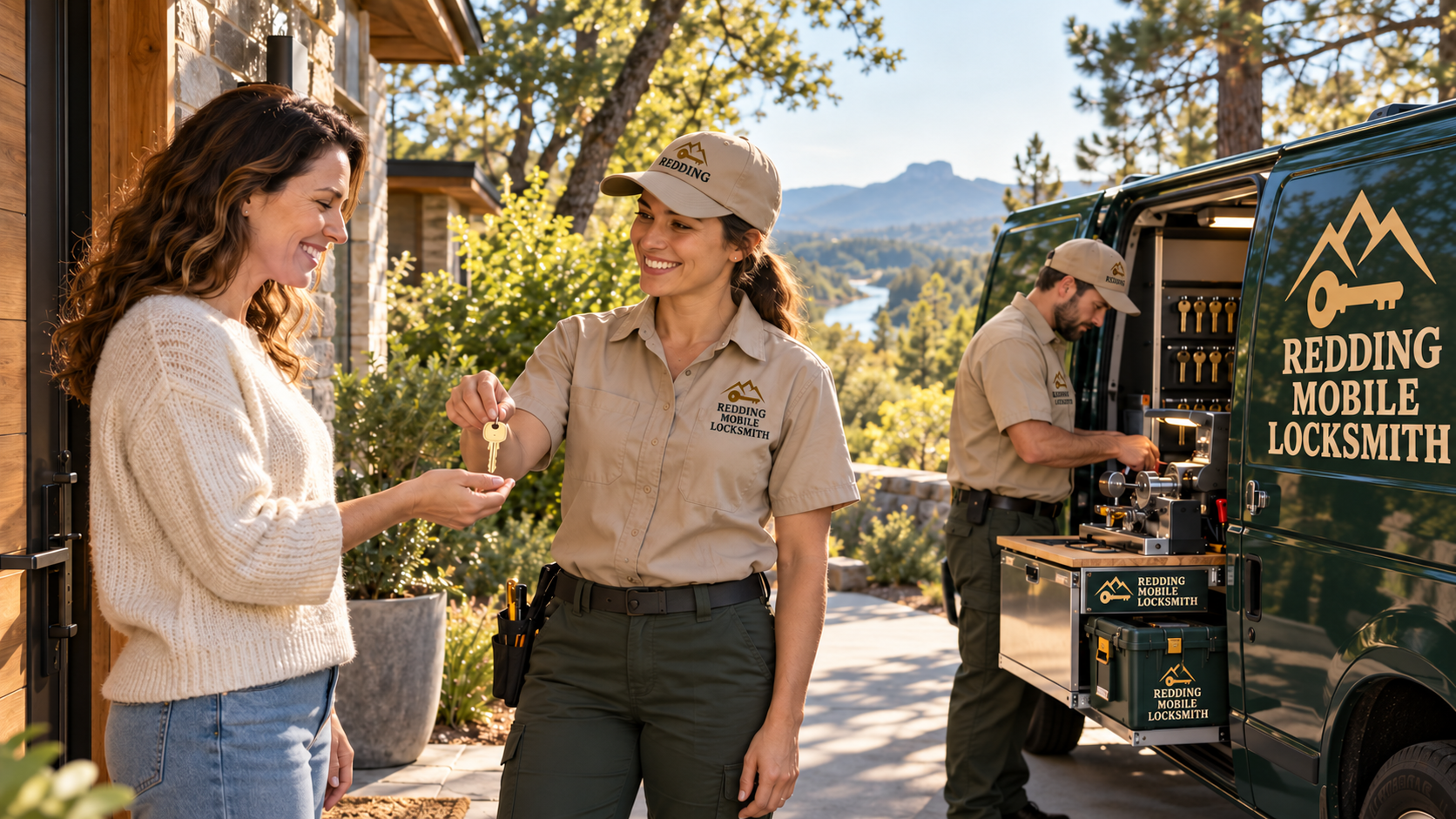
Redding Mobile Locksmith serves homes from Redding and Anderson in the valley to Weed, Yreka and the other mountain and valley communities of Shasta and Siskiyou counties. Our team works in uniforms and arrives in a branded van with key cutting equipment, so extra keys and rekeys can often be done on site.
The phone line is coming soon. In the meantime, use the request form on the contact page to tell us how many doors you have, how many people live in the home and what you would like to change. That is enough for a plan.
The right number of keys is the number you can name. Everything else is just conversation over the fence.
Good to know
Common questions
Is it a good idea to hide a spare key outside?
Usually not. Doormats, planters and ledges are the first places anyone looks. A better choice is to leave a spare with a trusted neighbor or relative, or to use a small lockbox with a combination known only to your household.
Should every family member have a key?
Every adult who lives in the home should have one, and so should an older child who comes home alone. Younger children may be better served by a trusted adult nearby or a keypad lock. The goal is to know who holds each key.
How many spares are enough?
Two is a good rule. Keep one inside the home in a spot everyone knows, and one with a trusted person outside the household. More than that makes the count harder to track, and every extra key is one more thing to lose.
Can all my locks use the same key?
Yes, locks can be keyed alike so one key opens several doors. It makes life simpler, though losing the key affects every door it opens. A locksmith can set this up during a rekey, and can keep a detached building on a separate key.
When should I change the lock instead of cutting a copy?
Change or rekey the lock when a key may be in the wrong hands, after a move, after a change in who lives there, or when you cannot account for every key. Cutting a copy does nothing about a key that is already out there.
Should I put my address on a spare key?
No. A labelled key tells a finder exactly where to use it. Use a plain colored tag that means something only to you and the people you trust, and keep a written inventory of which key is which in a private place.