
Home / Neighbors ask / Lock choices for an older relative living alone
Neighbors Ask
Lock choices for an older relative living alone
The right locks for an older relative are the ones they can operate every day without strain, that keep the house secure, and that let a trusted helper or emergency responder get in when needed. Comfort and safety have to come together.
Neighbors Ask
What we are really trying to solve
When a parent or grandparent lives alone, the question about locks is rarely just about burglars. It is about whether they can get in and out of their own house easily, whether a neighbor or aide can help without a fuss, and whether anyone who should not have a key is still holding one. A lock that is secure but frustrating will end up propped open, and that helps nobody.
So we start from the person rather than the product. Ask yourself what they find hard. Is it turning a small key, gripping a round knob, remembering a code, or carrying a heavy ring of keys? The answer points you to different hardware. A lock that suits a sharp eighty year old with strong hands may not suit a seventy year old with arthritis, and the reverse can also be true.
This column walks through the common situations. It is written for family members who are thinking ahead and for older homeowners who want to stay independent in their own homes for as long as possible. Nothing here replaces a conversation with the person who lives there, whose preferences should lead every decision.
Start with a conversation, not a shopping list
Before you buy anything, sit down with your relative and walk to each door together. Watch how they open it, hold the keys, and lock up at night. You will learn more from watching for two minutes than from a long checklist. Notice whether they hesitate, use both hands, or give up and leave a door unlocked because it is awkward.
Ask permission, and ask honestly. Some older people feel that a change to their locks is a criticism, or a step toward losing independence. Explain that you are trying to make life easier, and offer choices. People accept a new lock far more readily when it is their own decision and when it solves a problem they already feel.
Make a note of who currently has keys. Over the years a neighbor, a former caregiver, a cleaner and a few relatives may each have been handed one. The number of keys in circulation is often a surprise. Our piece on how many keys a household should keep offers a sensible way to count. Keep a simple written list of every key and code, who holds it, and when it was issued, and store that list somewhere both you and your relative can find. When someone moves away, changes jobs or stops visiting, you will know exactly what needs to be collected or changed. A list like this takes ten minutes to make and saves a lot of guessing later.
Ease of use comes first
Lever handles are generally easier than round knobs for hands that are stiff or weak, because you can push them down with a wrist or an elbow. If your relative has a round knob on the front door, swapping it for a lever is one of the most helpful small changes you can make. It does not change the security of the deadbolt, which is a separate lock.
For the key itself, consider a larger bow or a key with a rubber or plastic grip that is easier to hold. A key that is cut well and turns smoothly matters more than any gadget. A stiff cylinder tires a hand out, so if the lock sticks, have it adjusted or replaced. See our note on why a lock turns so hard for the usual causes.
A keypad or smart lock can remove keys from the daily routine altogether. A code is easy for some people and a source of anxiety for others, so try it before committing. Think about what happens if the battery fades, and whether your relative would remember to replace it. A good setup always has a physical key as a backup.
Deadbolts and the strike
A good deadbolt is the single most useful piece of hardware on an exterior door. It throws a solid metal bolt deep into the door frame, and the strength of that connection depends on the strike plate and the screws holding it. Many older houses have a short strike with short screws, which weakens the whole door. Longer screws that reach the framing make a real difference.
If your relative has trouble turning a deadbolt, a thumb turn on the inside with a larger, easier grip may help. On the outside, a keyed cylinder is still needed, but it can be cut with care so that it turns smoothly. A technician can also check that the door closes cleanly, because a door that must be lifted or shoved to lock is frustrating for anyone.
Rekeying is another useful step. If you do not know who holds old keys, changing the pins inside the lock makes all older keys useless without replacing the hardware. Our page about rekeying your home explains how it works, and the question of rekeying versus replacing helps decide which fits.
Who needs access and how to give it safely
Independence and safety pull in different directions here. You want a helper to be able to get in if your relative falls, but you do not want a ring of copies floating around. The cleanest approach is to decide who truly needs routine access and give each of them a clear purpose.
A lockbox mounted on the home, with a code that can be changed, is a common tool for this. It lets a caregiver or family member enter without a key and lets you change the code when circumstances change. Choose a spot that is not easy to see from the street and do not share the code more widely than necessary.
Keypad locks make it easy to issue separate codes to different people and to remove one when an arrangement ends. If your relative is comfortable with a keypad, this can be the most flexible option. If they are not, a traditional key plus a lockbox gives you the same practical effect with less to learn.
- A trusted neighbor who lives close by and can check in if there is a worry.
- A family member who lives in the area and can help during an emergency.
- A home care aide or cleaner, who may need a key on set days only.
- A lockbox or keypad code that can be given and later changed, so a stranger never keeps a permanent key.
- Local emergency responders, who in many cases can enter without a key if help is needed.
Smart locks, honest pros and cons
Smart locks can be a good fit, especially for someone whose family lives far away. A lock that reports whether the door is locked and who has used a code can give everyone peace of mind. It can also remove the daily struggle with a key. The better models still include a key cylinder so the door is never stuck if the electronics fail.
The cons are real. Some older people find the technology stressful, and a lock that needs a phone app to manage is not helpful if your relative does not use a phone. Batteries must be replaced, wireless internet can drop, and a system that your relative cannot understand will be a source of worry rather than comfort. Keep it simple, and let them keep control.
Our overview, what is a smart lock and who needs one, goes into more depth. If you are weighing it for a parent, ask yourself the question that matters most: will this make their day easier, or will it make mine easier? The right choice usually serves both, but your relative comes first.
Lockouts and what happens when something goes wrong
An older person locked out of their own home is in a vulnerable position, especially at night or in cold weather. Plan for it before it happens. A trusted neighbor with a key, a lockbox, or a keypad with a backup code means a lockout becomes an annoyance rather than a crisis. Hiding a key under a mat or a pot is not a plan, since it is the first place anyone would look.
If a lockout does happen, stay calm and stay somewhere safe. If your relative feels unwell or unsafe, the first call is to emergency services. For an ordinary lockout, a local locksmith can open a door without damaging it in most cases. Read our guide on what to try first when locked out and keep that list near the phone.
It also helps to write down simple instructions. Put the neighbor's name, the family contact and a trusted locksmith's details on a card near the phone. If you are arranging help for someone who cannot manage details, explain the situation when you call. Our team works around the clock for lockouts, and the locked out of your home page explains what to expect.
Windows, side doors and the rest of the house
It is easy to focus on the front door and forget the others. A back door, a patio slider and a side window can be easier ways in than the front. Check each one for a working lock and for ease of use. A sliding door lock that is hard to reach can be a hazard, while a window latch that is painted shut may be a hazard in a different way.
Think about how your relative would leave the house in an emergency. Every exterior door should be easy to open from the inside without a key, unless local rules and the household situation say otherwise. Do not add locks that need a key to leave. If you are uncertain, ask a professional what suits the building, and check what your landlord or local office expects.
In this part of northern California, older homes in the valley and in the mountain towns can have a mix of old and new hardware. A cabin or a farmhouse might have decades old locks that still work but are stiff. Spend a little time understanding what each door has before you replace anything, and keep what works. Many people forget the small details, such as a porch light that works, a door that closes without a slam, and a path to the door that is clear of clutter. Good lighting at the entrance helps your relative see the keyhole at night and also discourages unwanted visitors. A motion light is inexpensive in effort and often more useful than another lock.
A calm approach to scams and unwanted visitors
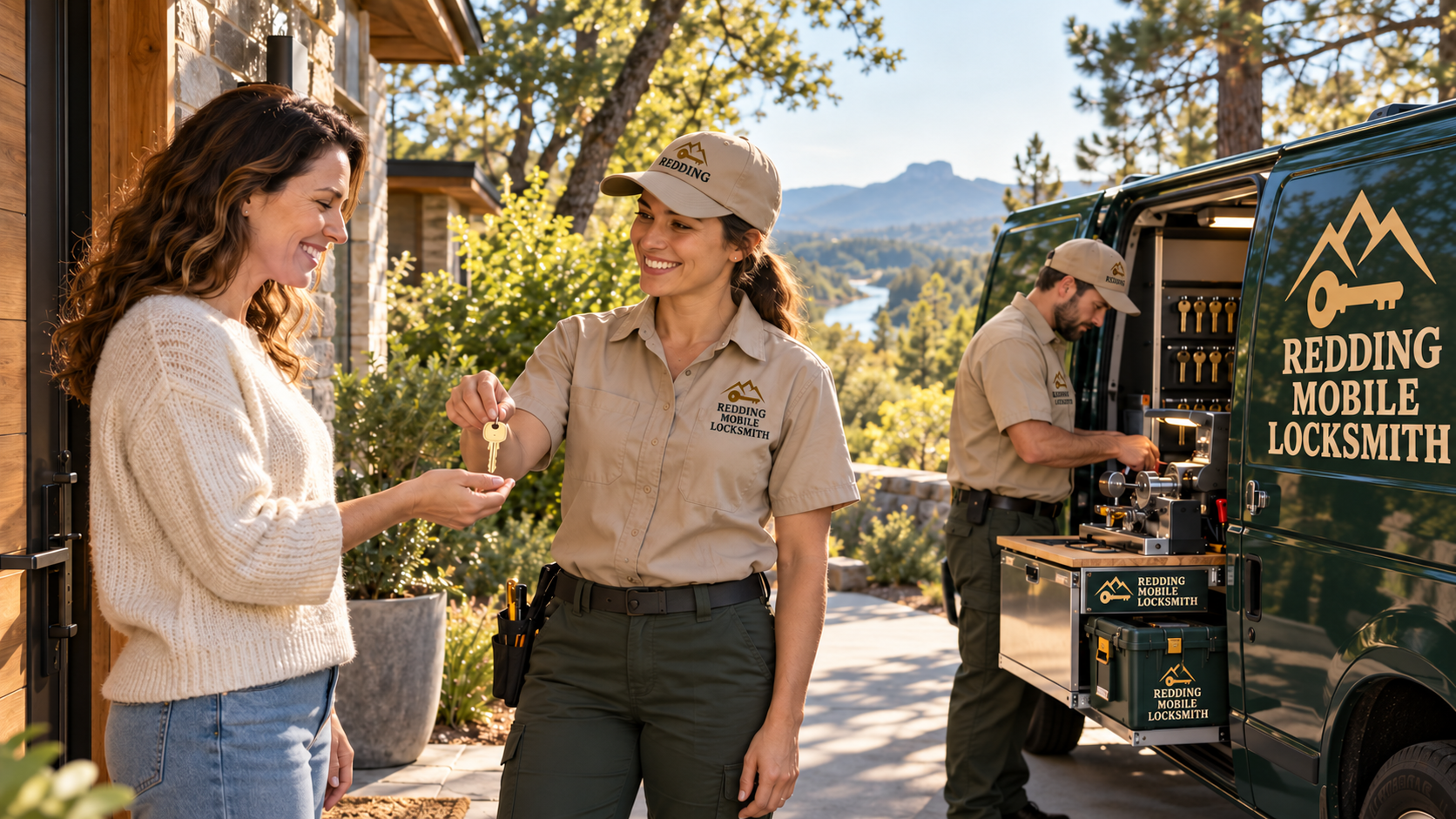
Older people are sometimes targeted by people who call or knock claiming to be a locksmith or a repair person. Teach your relative a simple rule: if they did not call, they do not open the door. A genuine technician arrives by arrangement, with a clearly marked vehicle, and can explain the job before starting work.
If someone does call a locksmith, they should ask what the company is called, how the job will be priced, and what the technician will do before the work begins. Our guide on how to tell a locksmith is the real thing gives a checklist you can read together. A good company will be happy to answer every question.
A chain or door viewer helps your relative see who is at the door without opening it. A door viewer at the right height, or a doorbell camera if they like the idea, can reduce the pressure to answer. Keep these simple, and make sure a visitor who needs to be there, like a nurse or a neighbor, can still be recognized.
Putting it together and getting help
A good setup for most older relatives has a handful of parts. A solid deadbolt with a strike that reaches the framing, a lever handle that is easy to use, a key your relative can hold, a way for one or two trusted people to get in, and a plan for lockouts. Everything else is optional. Add features only where they solve a problem your relative actually has. It is also worth checking that the locks on a garage entry door, a laundry room door or a basement door are as sound as the front. Those doors are often forgotten and are sometimes the weakest, because they were never meant to face the street. A short walk around the outside of the house, ideally at dusk, will show you what a stranger would see, and you can fix the gaps one at a time.
Once you have decided, book the work together. A technician can check each door, change locks, rekey, and set up a keypad or lockbox in a single visit. Tell them about any hand or mobility limits so they can suggest suitable options, and explain who needs access. You can use the request form to describe the doors and what you hope to achieve.
If your relative lives in a smaller community, our neighborhood pages cover the local picture. You might start with Redding or Anderson, or look at the full list of communities we serve. Whatever you choose, revisit it every year, because needs change and a good setup should grow with the person it protects.
Good to know
Common questions
What is the easiest type of handle for someone with arthritis?
A lever handle is usually easier than a round knob, since it can be pushed down with a wrist or forearm. Pair it with a smooth turning deadbolt and a key with a larger grip. Have your relative try the setup before you buy, because hand strength and comfort vary widely.
Should an older person use a keypad lock?
It can help by removing the daily struggle with a key, and by letting you give separate codes to helpers. It only works if your relative is comfortable with it, and the lock should keep a key backup in case the battery fades. Try it for a few days before you decide.
How can a neighbor get in during an emergency without a spare key?
A lockbox with a code that you can change, or a keypad lock with a code for that person, works well. Avoid hiding a key outside, since it is the first place anyone would look. Share the code only with people who truly need it, and change it when arrangements end.
Do we need to change the locks if a former helper had a key?
It is wise, especially if you do not know how many copies exist. Rekeying changes the inside of the lock so old keys no longer work, and usually costs less in effort than replacing hardware. Ask a technician which approach suits the doors in your relative's house.
What if my relative gets locked out at night?
Plan ahead with a trusted neighbor, a lockbox, or a keypad code. If your relative feels unwell or unsafe, call emergency services first. For an ordinary lockout, a local locksmith can usually open the door without damage, so keep a number written on a card near the phone.
How do I protect my relative from fake locksmiths?
Teach a simple rule that nobody is let in unless they were called. A genuine technician arrives by arrangement, in a marked vehicle, and explains the work before starting. Ask how the job will be priced and what will be done, and never feel pressured to decide on the spot.