
Home / Neighbors ask / How do I know a locksmith is the real thing?
Spotting the Real Thing
How Do I Know a Locksmith Is the Real Thing?
A real locksmith arrives in a marked vehicle, explains the job before starting, asks you to show you belong at the door, and never leans on you to decide. The warning signs are mostly about pressure and vagueness.
Spotting the Real Thing
What a genuine locksmith looks like when they pull up
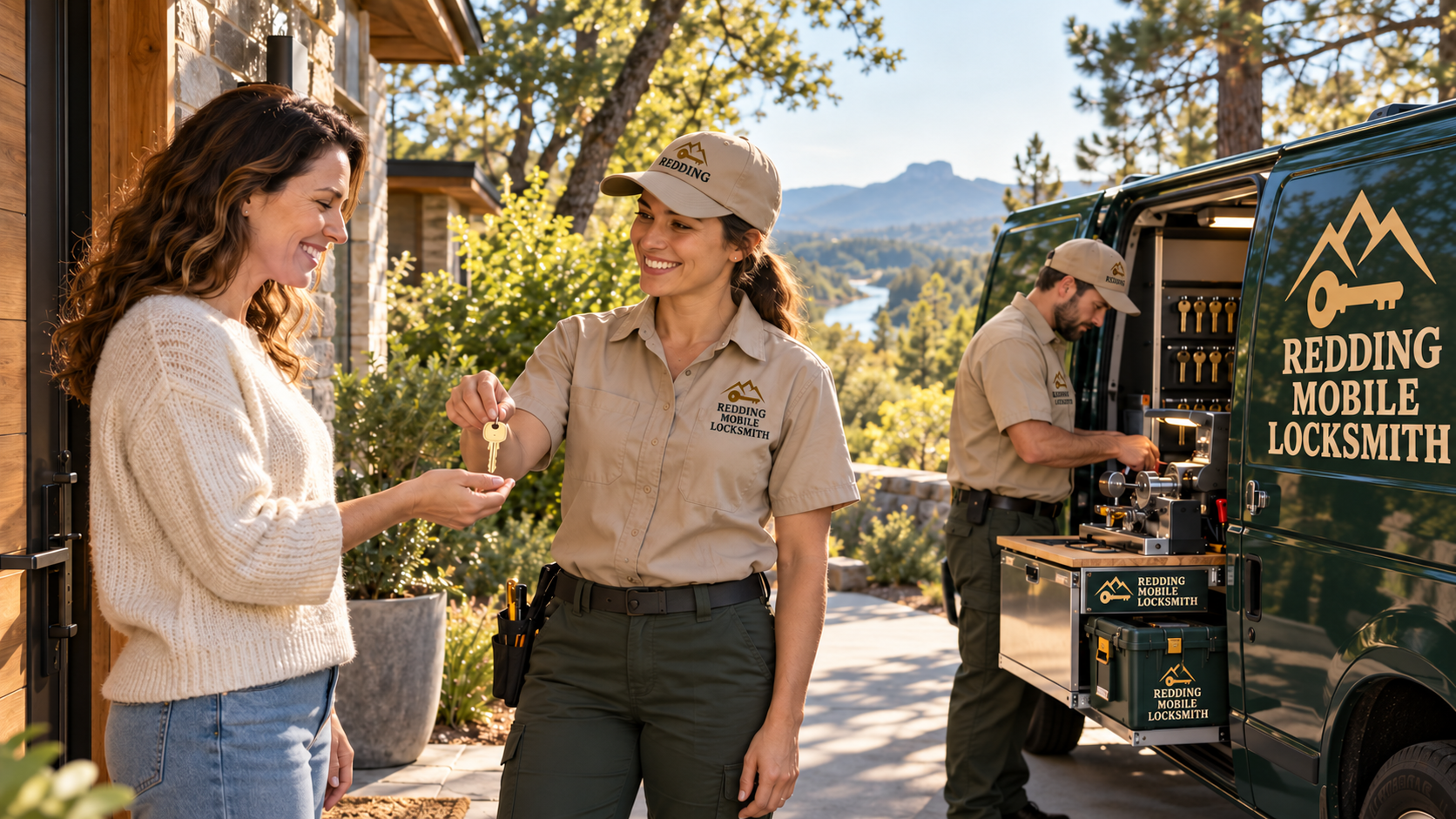
Start with what you can see from the window. A genuine local business shows up in a vehicle that carries its name, and the person who steps out wears something that matches. A branded team in uniforms driving a branded service van is exactly the picture Redding Mobile Locksmith aims to present, and it is a good picture to hold in your mind for any company you invite to your door.
Look at the equipment too. A real working van carries a lot of gear: cutting machines, programming tools, pin kits, hardware for common doors and a tidy supply of blanks. You do not have to inspect it like a customs officer, but if someone arrives with a single small bag and an odd story about needing to fetch parts, notice that.
None of this is proof, and a clean uniform cannot prove an honest heart. What it does is give you the first few pieces of a pattern. Add the points below, and you'll form a reliable picture soon after meeting someone at your door.
It also helps to remember that appearances work in both directions. A company that cares about its name wants you to be able to recognize it. Uniforms and a marked vehicle are a sort of promise that someone will remember who turned up, which is a modest kind of accountability and a useful one on a dark street.
Ask who is coming and what the business is called
Before anyone is on the way, ask for the name of the business and the name of the person who will arrive. A business that answers by saying a clear company name is behaving differently from one that answers with a generic phrase such as just the locksmith. If you reached them through a request form, as you would at the contact page, the response should name the business in the same way.
Take a moment to check that the name on the vehicle matches the name you were given. Mismatches can happen innocently, but a mismatch combined with other oddities is worth a second look. If you feel uneasy, it is entirely reasonable to say you'd like to confirm details before letting anyone start.
Our about page explains who Redding Mobile Locksmith is and how the team works, which is the kind of plain description any trustworthy company should be willing to put in front of you. If you cannot find anything like that for a company, ask yourself why.
Look for the check on your right to open the lock
Strange as it sounds, one of the clearest signs of a careful professional is that they ask you to prove you belong. A locksmith who will open any car or any door for anyone who asks is a danger to everybody, including you. A real one wants to see identification and something that ties you to the vehicle or the address.
What counts as enough varies by situation and by the rules where you live, so we won't pretend to list them all. The principle is simple. If you are a tenant, a landlord may need to agree. If you are managing a building, your role may matter. If a stranger asks you to open a house that is not theirs, the polite answer is no.
If you ever find yourself being asked to open something that is not yours, be honest with the technician. They are used to awkward situations and would rather hear the truth than discover it later. Our guide on what to have ready describes the items worth gathering beforehand.
Expect an explanation before any tool touches the door
A genuine professional looks first, then speaks. They'll examine the lock, tell you what they see, and explain how they plan to proceed. They will tell you whether the job is an opening, a repair, a rekey or a replacement, and why. If your answer to what is going to happen is a shrug, hold off.
A good explanation also covers what might change. A lock that looks simple may turn out to be damaged, a car may have a more complicated key system than expected, and a door may have a frame problem. A real technician mentions those possibilities early rather than presenting them as a surprise at the end.
You do not need to understand every detail. What you want is a feeling that you could repeat the plan to a friend and make sense. If the plan is too muddled for that, ask again, more simply. The way someone answers a polite second question tells you a great deal about them.
One more habit worth noticing is whether the technician narrates as they go. Not a lecture, just the occasional plain remark, such as that the bolt is binding on the strike or that the cylinder turns freely now. Someone who knows the trade usually finds it natural to say what they are seeing.
Look for honest estimates, not mystery numbers
Money is where trouble often starts, so we say this carefully. A trustworthy business tells you what the work is expected to involve and what it is expected to cost before work begins, and explains what could make that change. It does not lure you with a tiny figure and then inflate it at the door.
Be wary of a business that refuses to discuss cost in any form until the work is done, or one that changes the figure each time you ask. A fair explanation can be as simple as ranges that depend on the lock, the vehicle and the situation, with a clear number once the technician has seen the problem. We do not publish prices on this page, because the honest answer depends on the job.
If the number surprises you, say so. A reasonable professional can walk you through why. If they get defensive, hurry you or imply that you owe them something for even asking, that's information too.
Notice pressure, urgency and drama
Lockouts are stressful, and a few bad operators know it. They may say your lock is badly damaged when it isn't, push for drilling or replacement when a gentler method would do, or hint that the job must be done immediately or everything will get worse. A real professional tells you when something is urgent and tells you when it is not.
A useful test is to ask a simple question: is there another way to do this? A technician with real skill can usually name the alternatives, even if they prefer one. Someone who insists there's only one way, and that it is the most expensive, deserves a second thought.
You are always allowed to pause. If you're not sure, say you'd like a moment, step back from the door, and think. A person who respects you gives you that space. For a longer look at how lockouts are handled, our guide on what a lockout is explains common approaches.
Think of the drama problem as a mismatch between the size of the claim and the size of the evidence. A broken door frame can justify a bigger job. A key that simply needs lubricant or a gentle adjustment does not. Ask to be shown the evidence, such as the worn part or the damaged edge, and a real professional will gladly point to it.
Check how they handle the lock itself
Skill shows in small habits. A careful technician avoids needless damage, keeps the door and finish in mind, and chooses the least destructive method that works. They test after they finish, in both directions, and they don't leave a door half done. If they want to drill a lock out the moment they see it, ask why a gentler option is not on the table.
With cars, a real technician knows the difference between key types, from simple metal keys to transponder keys and fobs, and can explain why a new key must be programmed. Our page on key programming and fobs describes what the work involves. If someone confidently claims to program any key to any car without equipment or explanation, be careful.
Pay attention to how they treat your property. Do they put down a mat for tools, close the door gently, tidy afterward? Respect for small things often reflects respect for bigger things.
Know what a fair outcome looks like
When the work is done, you should have a working lock or key, a clear explanation of what was done, working keys you've tested yourself, and an understanding of what to do next. For a rekey or new lock, you should be given every key made. For a car key, you should see it start the car and operate the doors and any buttons.
You should also know what happened to any old parts. A broken cylinder or a replaced lock belongs to you if you want it. There's no mystery in that, and a straightforward answer is a good sign.
If something doesn't work, say so before the technician leaves. That's the moment to fix it. Our page on emergency help any hour explains how urgent visits are approached, which includes checking the result before the work is considered done.
Trust your own senses, and your neighbors
Your instincts matter. If something feels off, say so. If you're alone and uneasy, ask a friend or neighbor to stand nearby while the work is done. Local communities are small, and in towns like Anderson, Cottonwood or Yreka, somebody you know probably knows somebody who has used a given business. Asking around is no insult.
Also trust patterns over single moments. One awkward sentence does not make a fraud. A consistent pattern of vagueness, pressure and surprises does. Weigh the whole picture and decide on that.
If you want to see how we think about the region we serve, the pages for Anderson and Yreka describe the kinds of locksmith needs we see in each place, in the same plain voice you are reading now.
In Shasta and Siskiyou counties, many calls come from people far from any other option, whether on a rural road, in a snowy mountain town or at a lake cabin. Isolation makes it harder to say no, and that is exactly when people are most vulnerable to pressure. Knowing the signs ahead of time is a way of protecting your future self.
The smaller the community, the more reputation counts. A business that treats people well gets mentioned at the feed store, the school pickup line and the church lot. A business that does not gets mentioned too. It is worth asking a neighbor or relative whether they have had experience with a company, and worth telling others about yours.
Our pages for Redding and the other communities we serve describe local conditions in plain terms. Reading them before you need help can make the whole process feel more familiar, which is its own kind of protection.
What to do if you think something is wrong
If you realize mid job that something is wrong, stop the work calmly. Say you'd like to pause. Do not sign anything you do not understand, and do not hand over payment you are uncomfortable with. If you feel threatened, move to a safe place and contact emergency services.
After the fact, keep whatever record you can: names, vehicle descriptions, any paperwork, and a note of what was promised and what happened. If you believe you were mistreated, consumer protection offices and licensing bodies exist in many places, and rules differ, so ask the one that covers your area rather than relying on guesses from us.
The most useful thing you can do for the neighborhood is share what you learned with people close to you. Good businesses benefit when bad ones are spotted, and neighbors benefit from knowing who to call. For related reading, see our guide to whether to rekey or replace, which also talks about asking the right questions.
A short checklist you can keep in your head
When the van arrives, run through it quietly. Is the vehicle marked with the business name? Does the person match it? Did they ask who you are and why you need the lock opened? Did they look before they spoke, and explain before they worked? Did they give you a sense of cost before beginning, and did they let you pause?
If most of those answers are yes, you are very likely in good hands. If most are no, you owe nothing to politeness, and you can decline the work. The decision is yours, and it is much easier to make before a drill has touched the lock than after.
Keep the checklist simple enough to remember when stress has narrowed your thinking. It is meant to be a gentle structure, not an interrogation, and a real professional will feel it is fair. Many of the same ideas appear in our guide on key control policies, which looks at how businesses think about who may hold keys.
Finally, remember that you can always begin again. If a visit goes sideways, you can stop, secure what you can, and ask another business to take over. A lock problem is almost never so urgent that you must accept a bad bargain.
Good to know
Common questions
Should a locksmith ask me for identification?
Yes, in most situations a careful professional will. They want to be sure you have the right to open the car, house or building. What counts can differ, so ask when you make the request. A technician who skips this step entirely is not looking out for you or your neighbors.
Is it a bad sign if the price is not given up front?
Not always, because the real cost may depend on what the technician finds. It is a bad sign if no one will describe what the work involves, what could change the figure, or how the total is worked out. You should understand the plan before work starts.
What if the van has a different name than the one I was given?
Pause and ask. Business names can legitimately differ in small ways, but a clear mismatch deserves a polite question and a clear answer. If the answer is vague or the person gets irritated, you are entitled to decline the work before anything has been touched.
Can a locksmith drill every lock?
Drilling is sometimes the right method, especially for certain damaged locks, but it is rarely the first thing a skilled technician reaches for on a working lock. Ask why drilling is needed and whether a gentler option exists. A clear answer is a good sign.
How can I tell if someone is rushing me?
Rushing sounds like repeated urgency without explanation, refusal to let you pause, and shifting stories. A genuine professional can say what is urgent and why, and also respects a request for a moment. You are always allowed to step back and think.
What should I do after the work is finished?
Test every key and the lock in both directions, check the door closes properly, and ask for a clear explanation of what was done. Keep any paperwork. If anything seems wrong, raise it before the technician leaves, when fixing it is simplest.