
Home / Service areas / Cottonwood
Cottonwood, Shasta County
Locks for acreage, outbuildings and gates in Cottonwood
Cottonwood is the kind of rural Shasta County community where a property can have a farmhouse, a shop, a barn and a gate, and every one of them has its own lock that someone has to keep working.
Cottonwood, Shasta County
Country living means many locks
Ask a Cottonwood resident to count the locks on their property and the number usually surprises them. There is the house, of course, and perhaps a second door off the kitchen. Then the garage, the workshop, the equipment shed, the barn, the tack room, a gate at the end of the drive and maybe a second gate further in. Each has a lock, and each lock has a key somewhere.
This is the situation that shapes everything about locksmith work in the community, ZIP 96022, just south of Anderson and close to Interstate 5. A town house might have three doors to worry about. A working property can have fifteen. Keeping track of them is a small management task in its own right, and it rewards a little planning.
Below we walk through what that looks like, from the farmhouse to the farthest gate. We also link to the six pages written for Cottonwood in particular. If something needs attention now, the request form is the way in while our telephone line is coming soon.
Gates and long driveways
The gate is where a rural property first meets the world. It might be a simple pipe gate with a chain and padlock, a swing gate on a motor, or a rolling gate that slides on a track. Whichever it is, it lives outdoors, takes weather and dust, and is operated by everyone who comes and goes, so its lock wears out sooner than almost anything else on the land on the land.
Padlocks on gates fail in a few predictable ways. The shackle corrodes, the keyway fills with grit, or the lock is hit so often by the chain that the body deforms. A gate that will not open with a family waiting on one side and a delivery on the other is more than an annoyance. Our guide on gate lock questions for country driveways gives practical advice.
A good gate setup protects the lock from the chain, shields the shackle, and uses a key that is not copied casually. Where several people need access, such as family, a farrier or a delivery driver, keypad or coded options can avoid handing out more keys. Whatever you pick, test it in wet and dry weather before you rely on it.
Think too about the ordinary visitor. A friend dropping off hay, a neighbor borrowing a trailer, a contractor with a truck full of lumber: each needs a way in that does not involve phoning you every time. A coded option or a hidden but sensible arrangement for a trusted person is better than a key left in an obvious place, which tends to be found by the wrong people sooner or later.
The farmhouse and the main residence
The main house on a rural property often has the oldest locks on the land. It may have been added to, with a newer wing carrying newer hardware, and the doors do not all match. Keys multiply, and some of them no longer open anything anyone can remember.
Rekeying is the tidy answer. A technician takes the cylinders from your existing locks, changes the internal pins to match a new key, and returns them to the doors. When it is done, every old key is useless and you hold a clean set. It is especially sensible after buying a property, because you cannot know how many keys the previous owner, tenants or tradespeople kept. See rekey your home for the full picture.
Rural homes also benefit from a close look at how doors are fitted. Deadbolts that are long enough to reach the framing, strike plates fixed with proper screws, and frames in sound condition matter more than the name on the lock. Our page on home lock service covers what a technician checks.
- Rekey after buying a property so old keys stop working.
- Check that deadbolts extend fully into a solid frame.
- Replace short strike plate screws with long ones.
- Keep a written list of every lock on the property.
- Label spare keys by door so nothing is guesswork.
Barns, shops and the buildings nobody watches
Outbuildings are the quiet weak point of country properties. They are far from the house, rarely visited at night, and often hold things that are expensive to replace: tools, tractors, tack, fuel, feed and equipment. Yet they are often secured with the least costly hasp and padlock that came to hand.
The good news is that improvement here is straightforward. A heavier hasp fixed with through bolts, a protected shackle padlock, a deadbolt on the personnel door, and sensible lighting make a visible difference. For larger sliding or rolling doors, a lock that engages the track or a bar that spans the door can help. Our guide on shed and garage padlock questions goes into detail.
A single key for everything is tempting but risky, because a lost key opens every building at once. Many owners prefer a few keyed alike groups, so the house, the workshop and the barns each share a key within their group but not across. A technician can set that up when new hardware goes in. See new lock installation for how it works.
Whatever you choose, keep a short written list of which key opens which building and where the spares live. It sounds fussy until the day a helper asks for the key to the feed room and nobody can remember which one it is. A small tag on each key, coded in a way only you understand, is enough.
Shop buildings and working businesses
Cottonwood has its share of ranch operations, small farm businesses and shop buildings where work happens. These are commercial in every sense even when they look like part of the property, and their lock needs are commercial too. Doors must be strong, keys controlled, and in some cases doors must open freely from inside for safety.
If you have employees, seasonal helpers or family who come and go, a basic key control habit is worth building. Know who has which key. Collect keys at the end of a job. Rekey when someone leaves with one. The guide on what a key control policy is makes the idea simple, even for a small operation.
Hardware for working buildings tends to be heavy duty. Commercial grade cylinders, closers on doors that need to shut by themselves, and panic hardware on exits where it is needed are all common. Our pages on business lock service and door hardware for business describe the options.
Trucks, trailers and vehicles on the land
Rural life runs on vehicles. Pickups, work trucks, ranch vehicles, utility trailers and the family car are all part of a day. They also get locked out, lose keys in fields, and have toolbox locks that seize with dust. A key lost in tall grass or a pasture is a different kind of problem than a key lost in a parking lot.
If a vehicle key has gone missing, a mobile technician can cut and program a new one without hauling the truck anywhere. That matters when the vehicle is the only way to get to work. A working key needs both the right cut and the right coded chip, and a van that carries the equipment can do both where the truck sits. See replacement car keys and cars and trucks.
For work vehicles used by more than one person, think about the keys too. Know who holds one, keep a spare in a sensible place, and decide who to tell if a truck is locked or keys are lost. The guide on a work vehicle lockout and who to tell is a helpful read.
Remember too that a lockout on a ranch road is not like a lockout in a parking lot. There may be no passerby, no signal for a long stretch and no shade. Keep a spare key somewhere that does not depend on the vehicle, give someone at home a rough idea of your route, and carry water. Those habits are worth more than any gadget.
Wells, pump houses and utility doors
Rural properties often include small structures that are easy to overlook: a pump house, a well cover, an electrical shed, a propane enclosure. These hold equipment that matters enormously when it fails and that is a risk if someone tampers with it. A simple lock on each is a sensible habit.
These doors usually need a straightforward, weather tolerant lock. A padlock on a hasp is typical, and the choice of padlock matters more than people realize. A closed shackle design resists casual attack, a stainless or brass body resists corrosion, and a decent keyway resists gumming up. Check them every season.
Because these structures get opened rarely, locks on them tend to seize unnoticed. A good habit is to operate each lock a few times in spring and autumn, wipe it down, and apply a little suitable lubricant. If one turns stiffly, replace it before it is the middle of a cold morning and the pump has stopped. Our page on lock repair and adjustment can help with stubborn cases.
Heat, dust and mud
The valley floor around Cottonwood gets hot, dry summers, and the dust that comes with them is a lock's quiet enemy. Grit settles in keyways, mixes with old oil and forms a paste that grinds on the pins every time a key is inserted. Over a season this can turn a smooth lock into a rough one.
In the wetter months, mud and moisture take over. Tracks of dirt come in on boots and gloves, padlocks get splashed, and corrosion starts where water sits. The cure is mostly habit: wipe the outside of a lock, use a dry lubricant rather than a heavy oil, and keep a spare key somewhere clean and dry.
If a key sticks, resist the urge to force it. A bent or broken key is a bigger job than a stiff one. Our guide on dealing with a stuck key and the one on what lubricant belongs in a lock explain what helps and what harms.
Equipment that sits in a shop is often the worst affected, because it is surrounded by fine dust from sawing, grinding or feed handling. If a shop lock has become rough, the cure may be a proper cleaning and fresh lubricant rather than replacement. If cleaning does not restore the action, the lock is worn, and a technician can advise whether repair or a new cylinder makes sense.
Six pages for Cottonwood in particular
Each page below takes one service and looks at it from a Cottonwood point of view. Home lock service in Cottonwood deals with farmhouses and country homes, while cars and trucks in Cottonwood covers working vehicles.
Key programming and fobs in Cottonwood explains the chip side of modern keys. New lock installation in Cottonwood is for upgrades, and door hardware for business in Cottonwood is for shops and working buildings.
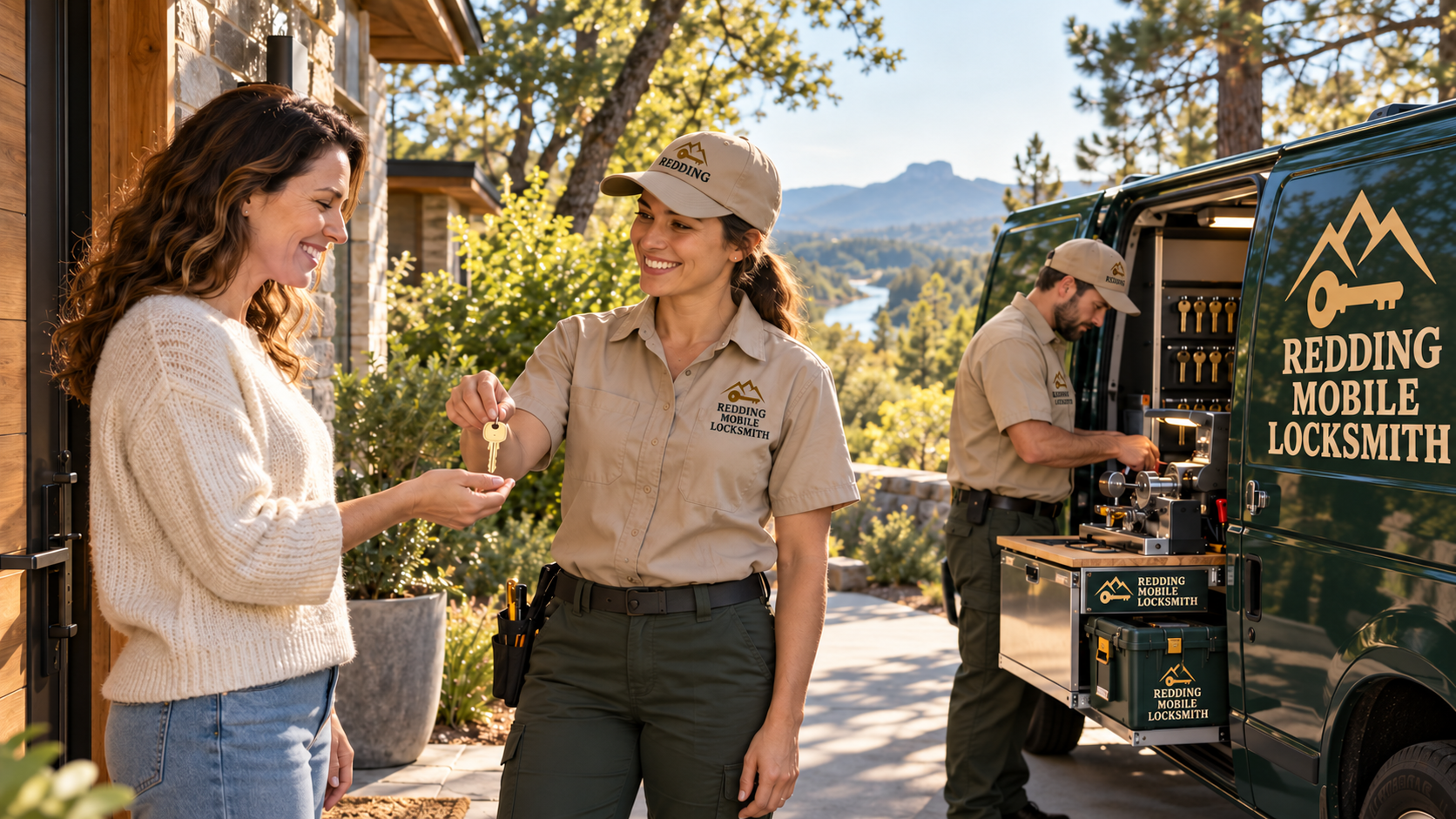
Emergency help any hour in Cottonwood covers what to do when something cannot wait. We are a 24 hour service with a branded van that carries tools, key cutting equipment and common hardware, which is helpful on rural properties where a second trip is a real inconvenience.
Describing a rural address so help can find you
When you ask for help in the country, the address often tells us less than a plain description. A long private road, a second gate beyond the first, a fork in the drive, a house number hidden by oak branches: these are the details that save time. Write them out in the request form.
Say what you can see from the entrance. Is there a mailbox cluster, a distinctive barn, a sign? Tell us whether a gate is locked or open, and whether anyone will be there to meet the van. If the road gets muddy in wet weather, mention that, since it affects how a visit is planned.
We do not promise a particular arrival time, because distance and conditions vary, and it would be dishonest to pretend otherwise. What we will do is tell you what is happening. If you want to see how an urgent request works, read our page on emergency help at any hour, then fill in the request form.
Neighbors close by
Cottonwood sits just south of Anderson and a good way from Redding along Interstate 5. Other rural communities in the county, such as Millville and Palo Cedro, share many of the same concerns about gates, outbuildings and long drives.
For a broad view of everything we do, browse our full list of help. If you have a question you are not sure how to phrase, the guides in Neighbors Ask answer the sort of things people wonder about over a fence.
Good to know
Common questions
Can you help with a locked gate on my Cottonwood property?
Yes. Describe the gate in the request form, including whether it is a chain and padlock, a latch with a keyed lock or a motorized gate. A technician can open, repair or replace gate locks. We will ask for reasonable proof that the property is yours before starting, and explain the plan first.
Is it worth rekeying a farmhouse I just bought?
Usually yes. You cannot know how many keys earlier owners, tenants or workers kept. Rekeying makes all of those keys useless without replacing the hardware, and you can have outbuildings keyed to groups that suit how you work. It is one of the more sensible first steps after buying a property.
What is keyed alike and would it help on acreage?
Keyed alike means several locks open with the same key. On a working property that can reduce the ring of keys you carry. The trade off is that a lost key opens everything in the group, so many owners make separate groups, for example one for the house and another for the shop buildings.
I lost a truck key out in a field. What are my options?
If the truck has a chip in the key, a technician with the right equipment can cut and program a new one where the truck sits. Give us the general make, approximate year and describe the key you had. It is also wise to make a spare once the new key works.
How should I protect a barn or workshop door?
Start with a sturdy hasp fixed with through bolts, a protected shackle padlock, and a solid door and frame. For a personnel door, a deadbolt with a long throw is a sensible upgrade. Lighting and visibility help, and keeping the keys accounted for matters as much as the lock itself.
Do I need to call to get help in Cottonwood?
Not currently. The call line is coming soon, so the request form on our contact page is how to ask. It handles urgent and planned jobs alike. Tell us where you are, what happened, and any details about gates or roads that could affect how we reach you.