
Home / Cottonwood / Key Programming and Fobs in Cottonwood
Programming, Cottonwood
Key Programming and Fobs in Cottonwood: Test Every Function, Before and After
A new key that turns the ignition is only half a job. The fob has buttons, the chip has a handshake and the doors have habits. Here is how to test it all, whether you are local or just passing through.
Programming, Cottonwood
A key that works is not always a key that is finished
Imagine a traveler heading north on Interstate 5 who pulls off near Cottonwood after the key fob stops answering. The doors do not unlock with the button, and the dashboard shows a light the traveler has never noticed before. A replacement fob is cut and programmed in a parking area. It starts the engine, the traveler is relieved, and a few hours later discovers that the trunk release does nothing, or that the panic button was never tested. Small gaps like that are common when the finish line is simply, it starts.
The better habit is to treat a replacement as a short list of things to verify. Every button, every door, every mode of the key. This page lays out that list, in the order you might use it, and explains why each item deserves a moment of attention. It applies to a traveler who has no time to spare and to a local who has all afternoon, because a missed function discovered a week later is always more annoying than one found in the driveway.
Cottonwood is a rural community south of Anderson in Shasta County near Interstate 5, with acreage, ranch properties, farm and shop buildings, long driveways and gates. People here may drive long distances on rough roads, so a key problem on the road is a real disruption. Knowing what a finished job looks like helps you ask good questions and recognize good work when you see it.
Before the replacement: what to write down
The test starts before the new key exists. Take a minute to note how the old key and fob behaved when everything worked. Which buttons did it have? Lock, unlock, trunk or tailgate, panic, remote start, a sliding door button? Did the doors unlock all at once, or driver first and then the rest on a second press? Did the vehicle chirp, flash or fold the mirrors? Write these down or take a short video. It becomes your reference.
Also gather the facts the locksmith will ask for: make, model and year, whether the vehicle has a key blade or a push button start, and how many working keys remain. A photo of the existing key and any marks on it can help. If you still have a working key, bring it along, since it can be copied or used as a guide. Have your registration and an ID ready, because a responsible locksmith will want to confirm you are entitled to a key.
Finally, decide how many keys you want. If you are already paying for a visit, it is much easier to program two than to return later for the second. A spare stored at home or with a trusted person has saved plenty of travelers and ranchers from repeated trouble. Our page on whether all car keys need programming describes which vehicles require it.
How a key actually gets programmed
There are several different things that can be called programming. The first is cutting the metal blade so that it turns the door lock and the ignition. The second is pairing the transponder chip with the vehicle so the engine will start. The third is programming the remote part of the fob, the buttons that lock and unlock from a distance. Some keys need all three. Others, like older metal keys, need only the first.
The pairing step typically uses a diagnostic tool connected to the vehicle, often through a port under the dashboard. The tool lets the vehicle learn the new chip and, in many cases, forget a lost one. The remote part may be learned through the same tool, or through a sequence of key turns and button presses. The details vary by vehicle, which is why a van carrying programming equipment, key cutting machines and a range of blanks matters. Our page on the key blank describes the raw material.
Some keys are cut by code, using a number tied to the vehicle's lock instead of a copy of an existing key. This helps when there is no key to copy. If you want to know how that works, see key code cutting. Whichever method is used, the cut needs to be accurate to a fraction of a millimeter, and the final test is how smoothly the key slides in and turns. A key that needs a jiggle is not finished.
The test list: doors, trunk and ignition
Once the new key is ready, run through the physical functions first. Insert the key in the driver door lock if the vehicle has one, and turn it both ways. It should move smoothly with no grinding. Try the passenger door as well if there is a lock. Then try the ignition. Turn it to each position: accessory, on, start. The key should turn without force and return without sticking. If it feels rough, mention it before the locksmith leaves.
Next, test the remote functions one by one. Press lock and listen for the doors, then watch for the lights or horn chirp that your vehicle normally gives. Press unlock once, then again, to see whether the vehicle unlocks the driver door first and the rest on a second press, if that is how it behaved before. Test the trunk or tailgate release, and the sliding door buttons on a van. Press the panic button briefly to confirm it works, then press it again to cancel.
If the vehicle has a remote start, test that too, with the vehicle in a safe, open place. Walk some distance away and press the button to see whether the engine starts. Check mirrors that fold, windows that roll down on a long press, and any other features your fob used to control. These are small things, but they are exactly the ones that surprise people later, and fixing them while the locksmith is still there is far simpler than coming back.
- Turn the key in each door lock and in the ignition, through every position.
- Press lock and unlock several times and note the lights and sounds.
- Test the trunk, tailgate and sliding door buttons.
- Try the panic button once and cancel it.
- Test remote start and any window or mirror features the old fob had.
Proximity keys and push button starts
Many newer vehicles have no ignition slot. The fob stays in a pocket or purse, and the vehicle senses it through short range radio. You press a button on the dash to start. These systems have more to test, because there are several antennas around the vehicle, each responsible for a different job. One in the doors detects the fob when you touch the handle, one inside the cabin lets the engine start, and another near the rear checks for the tailgate.
To test a proximity key, try each door handle with the fob in your pocket. Walk up to the vehicle from different sides. Start the engine with the fob in different places inside the cabin: a front pocket, a bag on the back seat, a cup holder. Step out and close the door to see whether the vehicle locks when you walk away. Remove the fob and ensure a warning appears. Behavior varies by vehicle, so compare with your notes from before.
Also ask about the emergency method. Most proximity fobs hide a small mechanical key inside, which can open a door if the battery dies. They also have a backup way to start the engine, such as holding the fob against a certain spot. Make sure you know where it is and that it works. Our page on what to do when a fob stops working gives the common steps.
Checking that old keys no longer work
A part of the test that people forget is what the new key should not do. If an old key was lost, stolen or simply unaccounted for, the locksmith can often remove it from the vehicle's memory during programming. Afterwards, any key that was deleted should no longer start the engine. If you still hold the old key, try it. If it still starts the vehicle, then the job is not complete, and you should ask about it.
The same applies to the remote part. A lost fob might still be able to lock and unlock the doors even if it cannot start the engine, depending on the system. Ask whether the old fob's remote function has been disabled, and if not, what the options are. This matters especially for a vehicle that was bought used, where the previous owner may still hold a key. Our page on buying a used car and the extra key question covers this.
Of course, if all your keys work and you want to keep them, you simply add the new one. Ask the locksmith to confirm how many keys the vehicle now recognizes and, if the tool allows, to show you the count. That number should match the number of keys in your hand. If it is higher, ask who the extra key belongs to. If it is lower, a key you thought was working may not be. Knowing is better than guessing.
When something does not work after the visit
Even with a careful test, a surprise may show up later. A button that worked in the driveway might stop. A door may not unlock on the first press. Before assuming the worst, check the simple things: the fob battery, any debris in the buttons, and whether the problem happens only in certain places. Radio interference can affect remote range, especially near large metal structures, electrical equipment or radio towers.
If the problem repeats, note exactly what happens and when. Does the fob fail only at a distance? Only when the vehicle is cold? Only after the engine has run for a while? Those clues help a locksmith or technician work out whether the fault is in the fob, the vehicle or the setup. Don't keep pressing buttons in frustration, since repeated attempts rarely help and can sometimes confuse the system.
Contact the locksmith who did the work and explain clearly. Reputable shops want to know when something is not right. A good installer will explain what to try and arrange a return if needed. Keep your notes from before and after, because they make the conversation simple. For a deeper look at how fobs fail, see our guide to transponder chips, which explains the part that most often causes surprise.
Spare keys and safe storage
Once the new key works, think about where it lives. A spare kept inside the vehicle defeats the point, since a locked out driver cannot reach it. A spare hidden under a bumper in a magnetic box is a known trick and not a safe one. A better plan is to give a spare to someone you trust, or keep it at home in a place only the household knows. Label nothing with your address or license plate.
Also protect the fob itself. A fob dropped in a puddle, left on a hot dashboard in a Cottonwood summer, or crushed in a work pocket has a shorter life. A small silicone cover helps, and so does a habit of keeping the fob away from heavy metal tools. Change the battery on a schedule instead of waiting for a failure. Most fobs use a coin cell, easy to replace, but check the manual to be sure.
If you have several vehicles on the property, such as a truck, a car and a utility vehicle, keep their keys clearly separated and labeled in a way only you understand. A single ring holding five fobs wears each one out sooner and makes it hard to find the right one in a hurry. The few minutes spent organizing pay back the first time you need a key and your hands are full. It also helps to tell everyone in the household which key belongs to which vehicle, so nobody carries off the wrong fob on a busy morning and leaves the rest of the family stranded at the gate.
What the visit looks like, and where to read more
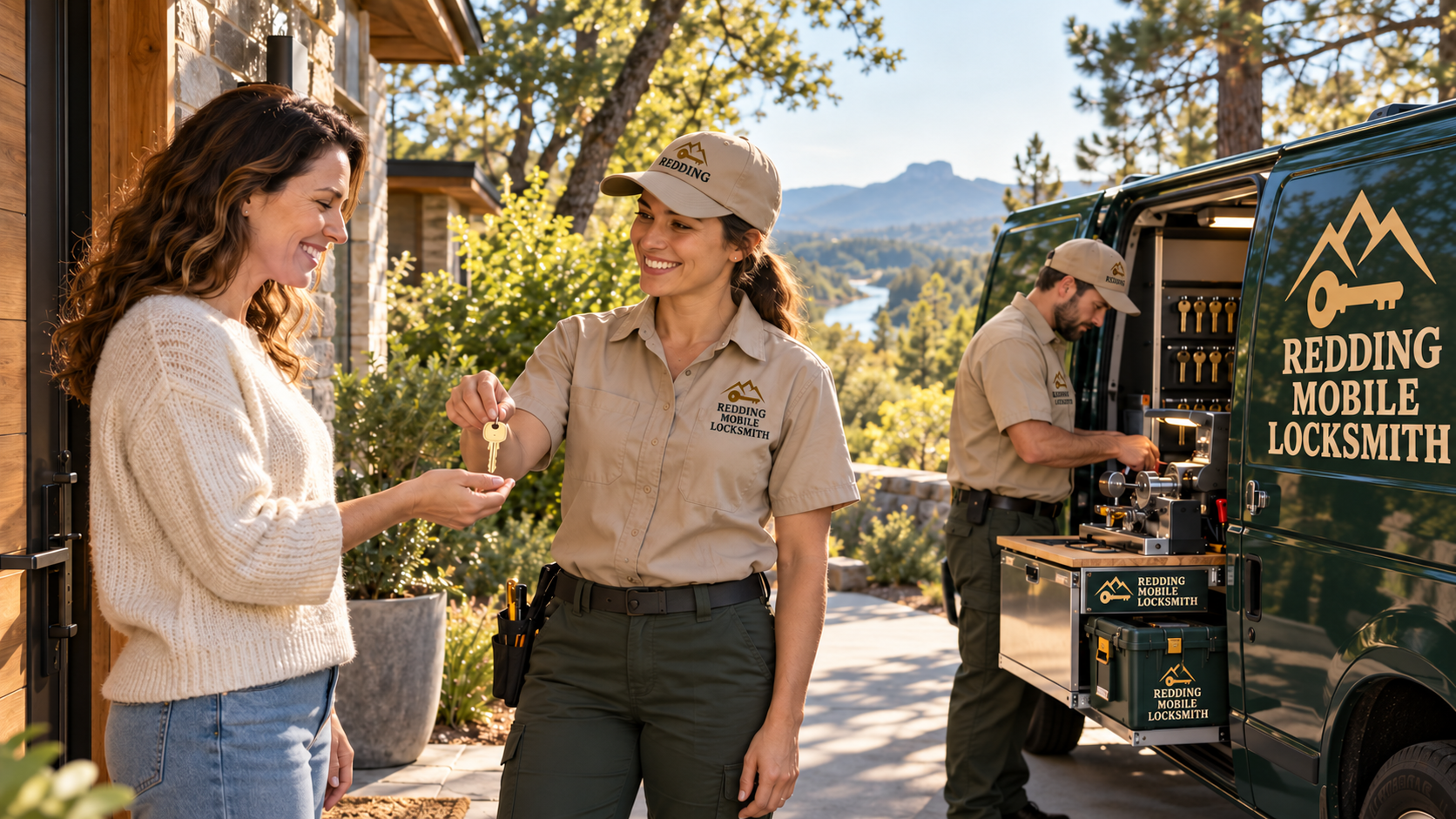
Redding Mobile Locksmith arrives as a branded team in uniforms with a branded service van that carries professional tools, key cutting and programming equipment, and common hardware. For a key or fob job, that usually means cutting, programming and testing in one visit, on a driveway, at a shop or at the roadside. The team should walk through the test list with you, and answer questions plainly.
For more on the work itself, see key programming and fobs and replacement car keys. If your vehicle will not start, cars and trucks in Cottonwood helps work out whether the key is to blame. For a lockout, see emergency help in Cottonwood. The Cottonwood page and Anderson page show what else we cover nearby.
When you are ready, use the request form. The phone line is coming soon. Tell us the make, model and year, what the key or fob is doing, how many working keys you have, and where the vehicle is. If you are passing through, say so, and mention which direction you are heading. A clear request helps the team arrive with the right blank and the right tool.
Good to know
Common questions
What is the difference between cutting and programming a key?
Cutting shapes the metal blade so it turns locks. Programming teaches the vehicle to accept the key's transponder chip, and sometimes the remote buttons too. A key can be cut perfectly and still not start the engine until it has been programmed to the vehicle.
What should I test after a new fob is programmed?
Test the door locks and ignition, then every remote button: lock, unlock, trunk or tailgate, panic and remote start if fitted. Compare the lights and sounds with how the old fob behaved. Also confirm the number of keys the vehicle now recognizes.
Can a lost key be removed from the vehicle?
In many vehicles, yes. During programming the locksmith can often clear the old keys from memory, so a lost one no longer starts the engine. Ask whether this was done, and try any old key you still have to confirm.
Why does my new fob work from close but not from far away?
Range can be affected by a weak battery, a poor connection in the fob, or interference near large metal objects or electrical equipment. Try a fresh battery first, then test in a few locations. If it persists, contact the locksmith with details.
Do I need two keys programmed at once?
It is not required, but it is easier to program two during one visit than to return later. A spare stored at home or with someone you trust protects you from a second lockout or breakdown, and it avoids the harder task of starting from no keys.
How do I request key programming in Cottonwood?
Use the request form on our contact page, since the phone line is coming soon. Include the make, model and year, the symptoms, how many keys you have and where the vehicle is parked, so the team can bring the right equipment.