
Home / Palo Cedro / Key Programming and Fobs in Palo Cedro
Keys and fobs
Key Programming and Fobs for Palo Cedro Drivers
A key that fits the ignition but will not start the car is one of the most confusing problems a driver can face. Here is what programming means, why copies fail, and how it gets solved at your driveway.
Keys and fobs
The key that fits but does not work
Picture a caregiver who has come to visit a relative in Palo Cedro for the week. The relative's car sits in the driveway, rarely driven, and the spare key from the kitchen drawer slides into the ignition like it was made for it. It turns, the dashboard lights flicker, and then nothing. No crank, no start, just a small light on the dash that blinks as if offering a hint.
That blinking light is the vehicle telling you it does not recognize the key. The metal part is correct, which is why the key fits and turns. What is missing is an electronic handshake, and that handshake is the whole subject of key programming. Once you understand it, a lot of car key mysteries stop being mysterious.
This page explains the idea in plain terms, the way a patient neighbor might over a fence. We will cover the chip inside the key, the different kinds of fobs, what a technician does with a programming tool, and what you should ask before and after the work. Along the way you will see why a duplicate cut at a hardware counter is rarely the whole answer.
If you are reading this with a car that will not start and a key in your hand, take a breath. This is among the most solvable problems in the trade. It almost never means the engine is damaged, and it rarely means the vehicle needs to be towed anywhere. It usually means the car and the key have not been introduced.
The chip that carries the secret
Inside the plastic head of most keys made in recent decades sits a transponder, a tiny part about the size of a grain of rice. It has no battery. When you turn the key, a coil around the ignition sends out a small burst of energy, which wakes the chip long enough for it to send back a code. The vehicle's computer compares that code with the list of codes it has been taught to accept.
If the code matches, the engine is allowed to start. If it does not, the engine may crank without firing or may not crank at all. That is a clever design, because it means a thief cannot start the car just by cutting a copy of the metal blade. It also means an honest owner cannot either, unless that chip has been introduced to the car.
Programming is the act of introducing it. A technician connects a specialized tool to the vehicle, puts it into a learning mode and teaches it the new key. In some vehicles this can be done with a sequence of steps the owner could perform if they already had a working key, and in many others it requires dedicated equipment. Which one applies depends on the make, model and year.
The many shapes of a modern key
Not every key looks alike, and the names matter when you describe your problem. A basic transponder key looks like an ordinary key with a plastic head. A remote head key adds buttons to lock, unlock and sometimes open the trunk. A flip key folds the blade into the fob. A smart key or proximity fob has no blade you insert, at least not in daily use, and lets you start the vehicle with a push button.
Each of these has a different internal design. A flip key is a mechanical key and a remote built into one housing. A smart key is mostly a small radio with a battery and an emergency blade tucked inside. Because the parts differ, so do the steps required to make a replacement work. Our page on key programming and fobs collects the types in one place.
The practical lesson is to look at what you have. If you hold a key with buttons, you probably need both the remote functions and the chip programmed. If you hold a fob with a push button start, the process is different again. Taking a photo of your key and your dashboard, and noting the make and year of the vehicle, gives us most of what we need to prepare.
- Transponder key: a metal blade with a chip in the head and no buttons.
- Remote head key: a blade, a chip and buttons in one piece.
- Flip key: the blade folds into the housing like a pocket knife.
- Smart key: a proximity fob that starts the engine with a push button.
What programming actually involves
Programming comes in a few flavors. In the simplest case, the vehicle learns a new key when you perform a sequence with a key it already knows. In another case, a technician uses a diagnostic tool plugged into the vehicle's data port, selects the vehicle, and tells the computer to accept the new key. In a third case, the computer must be cleared of old keys before new ones are added.
A technician also has to match the key's hardware to the vehicle. Cutting the blade is only a first step. The chip must be compatible with the car, the remote buttons must be paired, and the whole thing must be tested. We test every function before we pack up: door locks, trunk release, panic button, ignition and start. If something does not work, we find out while we are still in your driveway.
Some vehicles allow only a limited number of keys. Others may need a security code from the manufacturer's system, which can take a little time to retrieve. We explain what applies to yours as soon as we know the make and model. Our guide to whether all car keys need programming covers the exceptions.
It helps to know what the technician is looking at on the screen. The tool reads the vehicle's immobilizer system, reports how many keys are stored and lets us add or remove entries. Think of it as a guest list at a door. The tool does not break in. It is invited to edit the list by the vehicle itself, and that invitation requires the right access for the right model.
Why a hardware counter copy often fails
Many people try the nearest and most familiar option first. They take their key to a counter, receive a cut duplicate and walk out satisfied. If the vehicle is an older model without a chip, that works perfectly well. If the vehicle has a transponder, the copy opens the door and does nothing else. The blade is a duplicate, but the code in the chip was never copied.
Some counters sell a blank with a chip already included and can clone certain chips, which works for some vehicles and not for others. Cloning copies the original code onto a new chip, which means the vehicle sees two identical keys. That is acceptable in certain cases and less useful in others, especially if the original is lost and you want to remove it from the vehicle's memory.
A mobile visit avoids the guessing. The technician identifies the key system before cutting anything, brings a compatible blank, and finishes the job at the vehicle. If you are trying to avoid a second trip, that is the biggest practical advantage of having the work come to you instead of going to a shop, and it is particularly useful in a spread out community.
Fobs, remotes and the small battery problem
A fob that stops working does not always need replacing. Sometimes the battery is simply tired, and a fresh one brings it back. If the buttons respond weakly, the lock light on the fob flickers dimly or you need to stand next to the car for it to work, battery wear is the first suspect. Many fobs can be opened with a thin coin, and the battery type is printed on the old cell.
If a new battery does not help, the fob may have lost its pairing with the vehicle or suffered internal damage from being dropped or soaked. Re pairing is often possible with a programming tool. A cracked shell can sometimes be swapped without replacing the electronics. We look at the fob, tell you what we find and recommend the simplest fix that will last.
Our guide on what to do when a key fob stops working walks through the checks you can try at home before calling anyone. Try them. A surprising number of fob problems end with a coin and a small battery, and we are happy to hear that.
Keep in mind that a fob does not like a hard life. Keys dropped on concrete, run through a washing machine or left on a hot dashboard all summer will eventually fail. In a place with hot dry summers, a dashboard can get hot enough to stress plastic and batteries alike. Keeping the fob in a pocket or a bag rather than on the dash is a no cost habit with real benefits.
The caregiver and the borrowed vehicle
Return to our caregiver. The relative may have only one key, or a spare that has not been used in years, and the person asking for help is not the owner. That changes the conversation. We need to know who owns the vehicle, whether the owner can confirm the request, and what registration or identification can be shown.
This is not red tape for its own sake. A key is access to a valuable thing, and a responsible technician asks the same questions of everyone. If the owner is unable to be present, a clear explanation and documents that link the vehicle to the owner or caregiver help us proceed with confidence. If we cannot be sure, we will say so honestly.
The caregiver might also want to think about the long run. If the vehicle is seldom driven, a battery maintainer helps keep it healthy. If the only key is worn, a second properly programmed key is a good safeguard. And if someone is helping with errands and appointments, deciding who should hold a spare is worth a conversation with the owner.
Adding a spare before you lose the only one
The calmest key programming job is the one done before an emergency. With a working key in hand, adding another is usually straightforward. The vehicle can learn the new key while the old one is present, and the technician avoids the harder steps that come with having no key at all.
A spare has to be kept somewhere sensible. A drawer at home is better than a magnet box under the bumper, which is a place any thief checks. Some families share a spare among trusted relatives. Others keep one with a neighbor. Whatever you choose, write it down so the person who needs it knows where to look.
If you are planning for the future, ask us about the number of keys the vehicle can hold and whether a lost key can be removed from its memory. Our page about replacement car keys covers the options when no working key remains, and our guide on making a key when you have none at all explains what the process looks like.
Preparing for a programming visit
A short list of facts makes the visit smoother. Have the vehicle's make, model and year ready, and know whether it uses a blade you insert or a push button. If you have a working key, keep it handy. Note the number of keys you want, since each is cut and programmed separately.
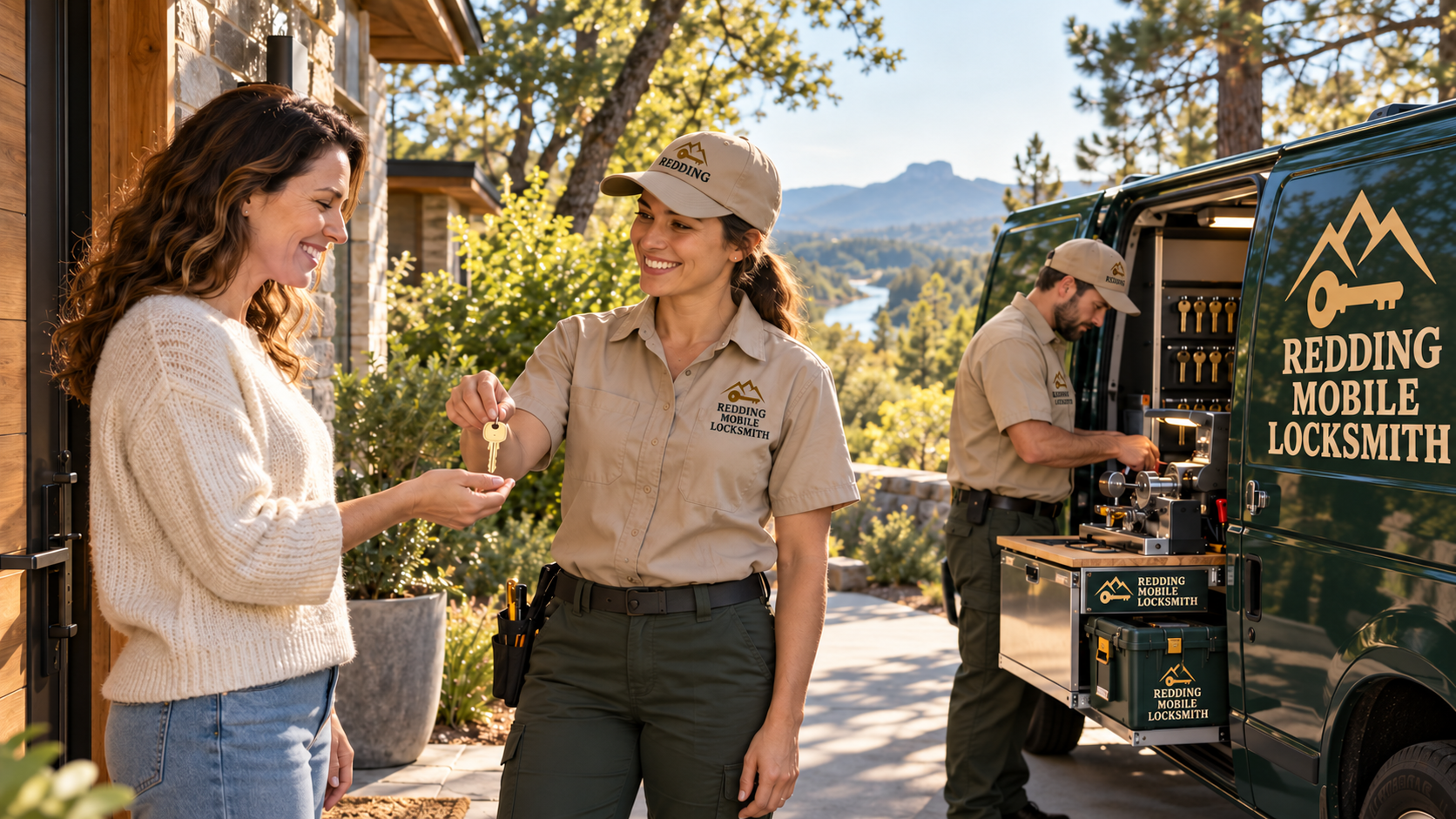
Have proof that you may authorize the work: identification, and something that connects you to the vehicle. If the car is parked on a larger lot with a long drive, make sure the technician can reach it and has room to work. Mention gates, steep drives or dogs. Our team arrives in a branded van and uniform, so you can recognize who is at the door.
To start a request, use the form on our contact page. The phone line is coming soon. Describe what the key does when you try it, and mention any warning lights. The more clearly you describe the symptom, the better we can prepare for the visit.
Where to go from here
If you learned one thing today, let it be this: the metal is only half of a modern key. The other half is a conversation between a chip and a computer, and programming is how that conversation gets started. A technician who understands both halves can solve most key problems in a single visit.
Neighbors in Palo Cedro, Cottonwood and Redding call us for the same reasons: lost keys, dead fobs, copies that will not start the car. Our page on cars and trucks in Palo Cedro covers entry and ignition problems, and the guide on what a transponder chip is goes into the chip itself.
Whatever your situation, ask questions. A good technician enjoys explaining, and an informed customer makes better choices. The goal is a set of keys that open, start and lock the way they should, and a driver who knows why.
Good to know
Common questions
Why will my copied key turn in the ignition but not start the car?
Most vehicles from recent decades check a chip inside the key before they allow the engine to run. A copy of the metal blade lacks that coded chip, or has one that was never introduced to the car. Programming teaches the vehicle to accept the new key.
Do I need to bring my vehicle anywhere to have a key programmed?
No. A mobile locksmith brings cutting and programming equipment to your driveway or wherever the vehicle is parked. That is particularly helpful when the car will not start, or when you do not want to drive a vehicle with only one working key.
Can a dead fob battery cause my car not to unlock?
Yes. A tired battery can make buttons weak or unresponsive. Many fobs open with a thin coin and use a small, common cell. If a new battery does not fix it, the fob may need to be paired again or replaced.
Can a lost key be removed from the car's memory?
On many vehicles, yes. When new keys are programmed, the old list can be cleared so a lost key no longer starts the car. Whether that is possible depends on the make, model and year, so mention the lost key when you ask for service.
What information should I give when I request key programming?
Give the make, model and approximate year, whether you have a working key, and what kind of key you use, such as a blade key, a key with buttons or a push button fob. Mention any dashboard lights. Photos of the key can also help.
Will you ask me to prove the vehicle is mine?
Yes. Expect to show identification and something that connects you to the vehicle, such as registration. If the car belongs to a relative, explain who the owner is and who approved the work. Responsible technicians ask everyone the same questions.