
Home / Sims / Key Programming and Fobs in Sims
Sims, Shasta County
Key Programming and Fobs for Sims Drivers, Explained
A car key that looks perfect and turns the ignition cylinder can still leave the engine silent. This page explains key programming in plain language and shows how a mobile visit solves it in Sims.
Sims, Shasta County
The key that looked right and did not work
Picture a retiree who lives alone in a home among the trees in Sims, in the Sacramento River canyon north of Lakehead. This is a hypothetical, but it is a story that plays out in many driveways. Their only key to the car is worn, so they have a duplicate made at a hardware counter. The new key slides into the ignition, turns smoothly, and the dashboard lights flicker. Then nothing. The engine does not start.
The retiree concludes the key was cut wrong and heads back to the counter. The counter cuts another. Same result. Neither key is wrong in the way they suspect. Each one matches the lock in every cut. What is missing is something invisible: the vehicle does not recognize it.
This page is for that moment. It explains what is really going on inside a modern key, why the shape of the metal is no longer the whole story, and what a technician does to fix it. By the end, you should be able to tell the difference between a bad cut and a missing program, and you will know what to ask for.
What a transponder key really is
Since the late 1990s, most vehicles have used a small electronic chip hidden in the plastic head of the key. The chip is called a transponder. It has no battery. When you turn the key, a coil around the ignition cylinder sends out a tiny burst of energy, and the chip uses it to wake up and send back a short coded message.
The vehicle's computer listens for that message. If the code matches one stored in its memory, the computer allows the engine to run. If the code is missing, wrong or from a chip that was never introduced to the car, the computer holds back the fuel or the starter, and the engine either cranks without firing or does not turn over at all.
That is why the blade of the key is only half of the story. The metal turns the lock, but the chip holds the permission. A duplicate made on a plain blank without a chip is just a key that opens doors. Even one made on a chip blank will not start the car until someone introduces it to the system. Our guide on what a transponder chip is goes through the same idea from another angle.
So what does programming mean
Programming is the act of teaching the vehicle to accept a new key. A technician connects specialized equipment to the vehicle, usually through a diagnostic port under the dashboard, and talks to the computer. With the right access, the technician adds the new chip's code to the list of keys the car will accept.
Depending on the vehicle, that can be simple or complicated. Some older models allow a sequence of turns and button presses that anyone with a working key can perform. Many others need dealer level equipment and security codes. Some require waiting through a timed cycle. A few can only be done with a working key already present, which makes a total loss of keys a bigger task.
The important idea is that programming adds or removes permissions, much like adding or deleting a user on an account. It does not change the lock, and it does not require taking the vehicle apart. In most cases the work happens right where the car is parked, and the result is a key that starts the engine like the original.
Fobs, remotes and the pieces that travel together
A modern key may do more than start the engine. It might also have buttons that lock and unlock the doors, open the trunk, sound a panic alarm or start the engine remotely. These remote functions are a separate system from the transponder, and they need their own programming. It is possible to have a key that starts the car but does not lock the doors from a distance, or a fob that locks the doors but cannot start the engine.
Smart keys go a step further. The fob stays in a pocket, and the vehicle detects it as you approach. A push button starts the engine. These keys talk by radio instead of by touch, and they have a battery that eventually runs down. When one stops working, the first thing to try is a fresh battery. If that does not help, the fob may need to be reprogrammed, or the unit itself may have failed.
For a retiree, a fob that stops responding in the driveway on a cold morning is more than an annoyance. Having a spare, tested and stored, matters. Our page on key programming and fobs describes the whole range of work, and the guide on what to do when a fob stops working offers a short list of checks to try first.
- A transponder key starts the engine only when the vehicle recognizes the chip.
- A remote or fob handles door locks and similar functions and is programmed separately.
- A smart key uses radio and a battery, and it can be replaced and paired by a technician.
- A plain duplicate may open doors but not start the engine, which is the situation most people meet first.
Why a copy can fail even when the blade is perfect
Back to our retiree. There are a few reasons the second and third keys did not work. The most common one is that the duplicate was cut on a blank without a chip. It is the right shape, but no electronics. The vehicle sees no chip and refuses to start.
A second reason is that the chip is present but was never programmed. Even if the blank has a chip in it, the vehicle has no record of it. It is a stranger, and strangers do not get to start the car.
A third reason is that the chip was cloned from the original but the vehicle uses a more advanced system that does not accept clones. This happens with some newer models that use rolling codes or encrypted exchanges. A technician with the correct tools can usually create a proper new key even then.
A fourth possibility is that the original key itself is worn or damaged, and the new key copied that wear. Duplicating a duplicate can carry small errors forward. A fresh key cut from the lock's code or by decoding the lock avoids this trouble.
What to ask for if you have no spare
If you have one working key, you are in a good position. Ask for a duplicate that includes a programmed chip, not just a cut blade. A technician can also make a spare while there, and testing both keys before the visit ends is part of a good job.
If you have no working key, the work is larger but not impossible. The technician cuts a new key using the vehicle's information, then programs it with equipment connected to the vehicle. Ownership proof is required, because the same skills would let someone else drive away with your car. Our page on replacement car keys goes into the process and what to have ready.
Either way, ask whether lost keys can be removed from the vehicle's memory. If a key has gone missing and you are concerned about who might have it, taking it off the list means it will no longer start the car, even though it may still open a door. That is a useful peace of mind on a vehicle that stays at home among the trees, where you are the only person looking after it.
Living alone and planning ahead
For someone who lives alone, a missing car key is a harder problem than for a household with several drivers. There is no one to bring over a spare, no second vehicle to make the trip into town. That is why a little planning pays off. Make a spare while you still have a working key. It is far easier and, in most cases, a smoother job than recovering from a total loss.
Store the spare somewhere that is not the car and not the obvious flowerpot. A trusted friend or relative who can bring it, or a lockbox at the house, are both reasonable choices. If you use a lockbox, choose a spot that cannot be seen from the road, and change the combination if it was ever shared.
It also helps to know where your owner's manual is and what the emergency procedure is for a dead fob. Many smart keys have a hidden blade and a spot on the vehicle where the fob can still be sensed when its battery is low. Spending ten minutes with the manual on a calm afternoon can save a long evening later. The article on lock choices for an older relative living alone covers the broader picture for homes as well.
Keys bought online, keys from a dealer, and keys that are cloned
Shoppers run into three other routes to a new key, and each has quirks. An online key is often a blank shell with a generic chip, sold at a low price and delivered in a plain envelope. It may be perfectly good, but it still has to be cut and programmed, and some of them are made for a slightly different model than the listing suggests. A technician can tell you at a glance whether the part is the right one, and it helps to bring it to the visit instead of ordering a second.
A dealer is another route. Dealers can order a key by the vehicle's identification number and program it, but the vehicle usually has to be brought to them, which is a trip nobody wants when the key is lost and the car will not move. The trade off is a matter of where you want the work done.
Cloning copies the chip's data from one key to another. It can be a neat shortcut when the original is still working, and it works with many vehicles. It is not a universal answer, because newer systems use security that resists copying, and it does not add a key to the vehicle's list in the way programming does. When a technician says a key can be cloned or must be programmed, they are describing two different tools, and it is fair to ask which one they plan to use and why.
Cold mornings, damp pockets and the life of a fob
Canyon winters are cold, and canyon summers are hot, and electronics notice both. A fob left on a dashboard in summer heat can soften its adhesive, warp its case and shorten its battery life. A fob carried in a damp coat in winter can corrode its contacts. None of this means the fob is bad, only that it works harder than you think.
A few small habits help. Keep the fob out of direct sun in a parked vehicle. Dry it if it gets wet before putting it away. Replace the battery when it starts to respond slowly, not after it dies, and use a battery of the type printed on the old one. If the key has a rubber cover, replace it when it cracks, because a split cover lets moisture in.
Do not carry a fob and a second fob in the same pocket if the vehicle uses a proximity system, as the two can confuse each other. And try not to store a spare fob next to the vehicle, such as on a hook in the garage, since some vehicles will detect it and leave the doors unsecured. Where the spare lives is a small decision with real consequences.
How a mobile visit works in the canyon
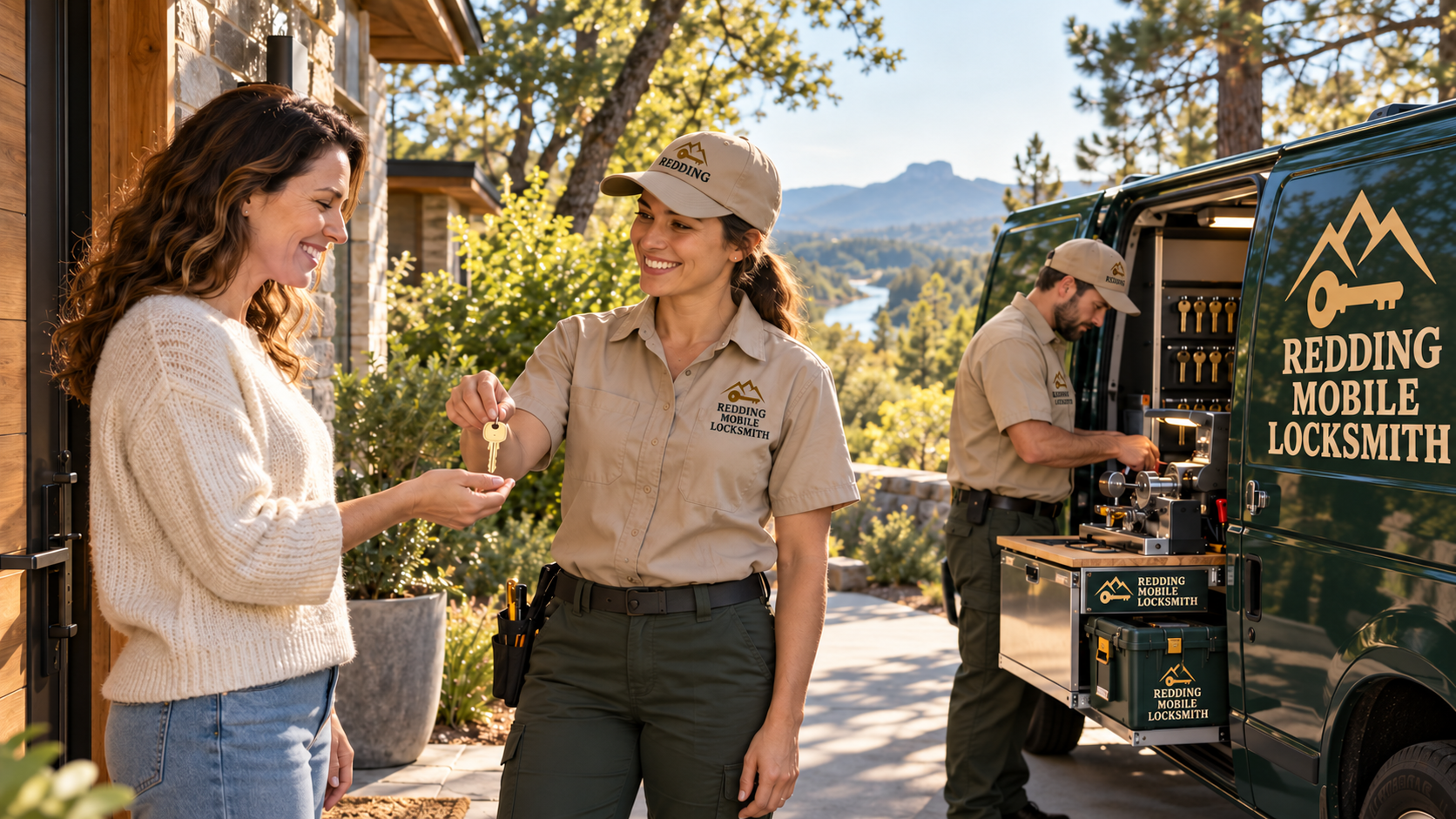
Redding Mobile Locksmith brings key cutting and programming equipment in a branded service van, with common hardware and professional tools. For a driver in Sims, that means the visit happens at your home or wherever the vehicle sits. A uniformed technician explains what is needed, confirms ownership, and describes the work before starting.
The vehicle's make, model and year help us plan, as does the number of working keys you have. Tell us whether the vehicle has a push button start, a remote, or a traditional key. If the vehicle is stuck at the roadside, say where and in what condition.
Request help through the request form on the contact page. Our phone line is coming soon. We do not publish arrival times, since distance and conditions vary from one call to the next. We will tell you plainly what to expect once we read your request.
If you are in a nearby community, look at our pages for Sims, Lakehead and Mount Shasta. For a wider view of vehicle service, the pages on cars and trucks in Sims and whether all car keys need programming are good companions to this one.
A short checklist before the technician arrives
Gather what you have: every key, including broken ones, the vehicle registration, a photo ID and the vehicle's year, make and model. If you can find the vehicle identification number, usually visible through the windshield on the dashboard, note it down. Check the fob battery if you have a working fob, because a dead battery can look like a dead key.
Decide how many keys you want. Two is a common choice, one for use and one for safekeeping. Decide whether you want remote functions or just a key that starts the car. Then think about what happens afterward. Where will each key live, and who knows?
When the job is done, test every function in front of the technician. Start the engine, turn it off and start it again. Lock and unlock the doors with the key and with the remote. Open the trunk. If anything does not behave, say so before the technician leaves.
Good to know
Common questions
Why does my duplicate key turn the ignition but not start the car?
The blade matches the lock, but the vehicle does not recognize the chip inside the key head. Either the blank has no chip, or the chip was never programmed to the car. A technician can program a proper key so the engine will start.
Can I program a key myself?
Some older vehicles allow a self programming sequence if you already have a working key, and the owner's manual may describe it. Many vehicles require special equipment and security access. If a self programming attempt fails, stop and ask a technician, since repeated tries can lock the system.
What if I have lost the only key I had?
A technician can still make and program a new one with proof of ownership. It is a bigger job than copying a working key, so tell us at the start that you have no keys. We will explain what is needed and what the vehicle allows.
Will a new key make my old keys stop working?
Not by default. Some vehicles let the technician remove old or lost keys from memory during programming. Ask for that if you are worried about a key you cannot recover. Keys you keep will need to be programmed again if the list is cleared.
How long does a fob battery last?
It varies with the fob and how often it is used, and we will not give a number. A fob that responds slowly or only at close range is often asking for a fresh battery. Replacing it is a simple step to try before assuming the fob needs programming.
Should I keep a spare key if I live alone?
Yes, and test it before you need it. Store it away from the vehicle, with a trusted person or in a lockbox that is not visible from the road. A spare made while you still have a working key is usually a simpler job than starting over.