
Home / Sims / Cars and Trucks in Sims
Sims, Shasta County
How Mobile Car and Truck Service Works in Sims
When the work comes to your driveway or the edge of the road, you skip the tow and the waiting room. This page explains how Redding Mobile Locksmith handles cars and trucks in Sims, step by step.
Sims, Shasta County
The shop comes to the vehicle
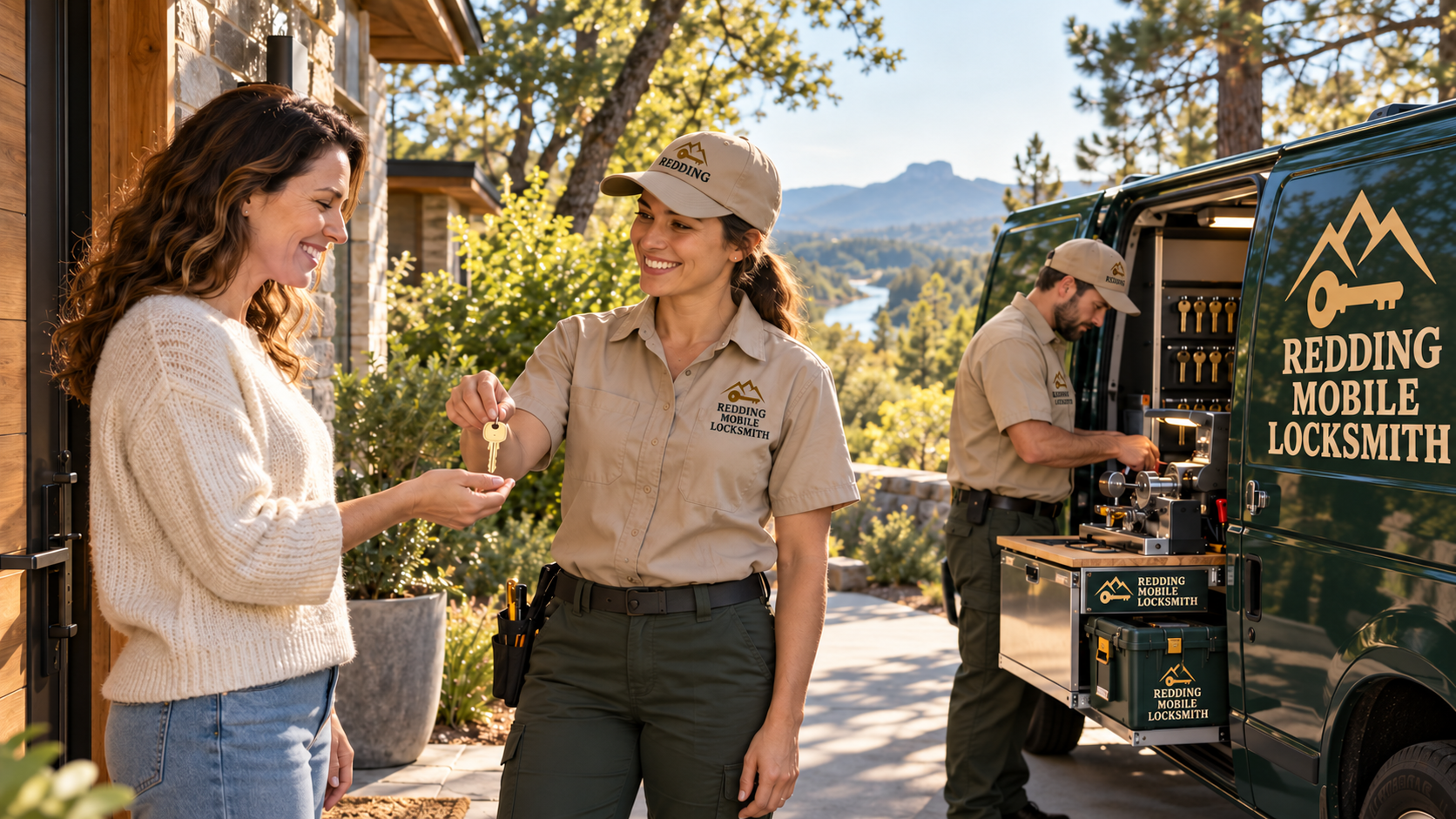
Most people picture a locksmith as a storefront with a key machine in the window. Mobile service turns that around. The equipment travels in a branded van, and the technician drives to wherever your vehicle is parked. In a small mountain community like Sims, where homes and cabins sit scattered through the forest in the Sacramento River canyon north of Lakehead, that matters more than it might in a town with a main street and a lot of parking lots.
A vehicle that will not start, or that you cannot get into, is not always a vehicle you can move. If the key is gone, driving to a shop is out of the question, and towing it adds a bill and a delay. A mobile technician avoids both by doing the work where the vehicle sits: in your driveway, along the shoulder of a quiet road, at a cabin turnout or behind a work site.
The van carries professional tools, key cutting and programming equipment and a stock of common hardware. That combination lets the technician open a door, cut a key from the vehicle's code, program a transponder or fob, and often finish everything on the spot. It is the closest thing to bringing the shop with the problem.
Picture a landlord turning over a unit
Imagine a landlord who owns a small rental cabin in Sims and a work truck used for upkeep on the property. A tenant has just moved out. This is a hypothetical, but the situation is a common one in forest communities where rental units and work vehicles share a driveway. The landlord needs to clean, repair and show the unit, and the work truck is the thing that carries ladders, paint and parts.
During the turnover, the tenant returns the cabin keys but cannot find the truck key they had borrowed for a trip into town. Or the truck is locked with the only key inside. Or the landlord has three keys of unknown origin and no certainty about who holds the fourth. All of these are small mysteries with real consequences: an unusable truck, a stalled turnover, and a vague worry that someone still has access.
The answer is a mobile visit that addresses the truck, and, if wanted, the cabin locks too. The technician can open the truck, cut a new key, program it, and remove old keys from the system where the vehicle allows it. We cover the cabin side of that story on our page about home lock service in Sims.
The first conversation
Every mobile job begins with a short exchange. You describe what happened: locked out, lost key, broken key, a fob that stopped working, an ignition that will not turn. You say where the vehicle is, and who owns it. The technician asks a few questions and explains what will be needed.
We ask about the vehicle because the answer changes the work. Make, model and year tell us what kind of key and what kind of lock the vehicle uses. Whether the key is lost or merely locked inside tells us whether a new key must be made. Whether you have any working key at all matters, because copying an existing key is a simpler job than creating one from scratch.
You can send that information through the request form on the contact page. Our phone line is coming soon, so for now the form is how requests reach us. Include the location, what the vehicle is doing, and anything you have already tried. A request that reads like a short story will get you further than one that says only help.
Proving the vehicle is yours
Before opening a vehicle or making a key, a responsible locksmith confirms that you are entitled to it. That is not a hurdle. It protects owners from anyone who might want access to their vehicle for the wrong reasons, and it is routine in the trade.
Useful proof includes the vehicle registration, a title, an insurance card in the owner's name, or a rental or lease agreement. A photo ID that matches the paperwork rounds it out. If you are the landlord in our picture and the truck is registered to a business or to a family member, bring that paperwork or have the registered owner confirm their authority.
If the vehicle is borrowed or belongs to a tenant, the situation is different, and we explain it plainly. Our guide on what to do when locked out of a borrowed car walks through who needs to be involved. The rule underneath is that the locksmith opens vehicles for people who can show they have the right to ask.
Lockouts at the curb or in the driveway
A lockout is the most common automotive call, and the one with the least drama if handled calmly. The technician uses tools designed to open the door or work the lock without harming the paint, the weatherstripping or the electronics inside the door. The method varies with the vehicle, and we do not describe it in detail because the skill is in the judgment, not in a trick.
What you will notice is how little happens. The technician looks at the vehicle, chooses the approach, and opens the door. The door closes as it did before, the keys come out of the interior, and you are back in. If a window is cracked or a lock rod is exposed, that can make things simpler, but it is not required.
For a longer look at what to expect, see our page on locked out of your car. And if a child or a pet is inside a locked vehicle, call emergency services first. That is not a situation for waiting on any locksmith.
Lost keys and new keys
When the key is gone entirely, the work is different. Modern vehicles rarely use a plain metal key. Most carry a transponder chip in the key head that talks to the ignition system. Without the right chip, the engine will not start even if the blade turns the lock. Others use a smart key or proximity fob that must be paired with the vehicle's computer.
So the work usually has three parts. First, a key blade is cut to match the vehicle's locks, often using a code or the lock itself as a guide. Second, the transponder or fob is programmed so that the vehicle recognizes it. Third, the technician tests everything: door lock, trunk, ignition, remote functions. A good job ends with you holding a key that does everything the original did.
We go deeper on the first and second parts in our pages on replacement car keys and key programming and fobs. For the landlord with a work truck, there is often a bonus: with the vehicle at hand, the old key can be removed from the vehicle's memory, so a lost key no longer starts the truck.
- Ask whether the old key can be erased from the vehicle so a lost key cannot be used later.
- Ask how many keys you will receive and whether a spare is worth making while the technician is there.
- Ask what the fob does and whether a remote start or trunk release is included.
- Ask for the key to be tested in each lock and the ignition before the job is closed.
What happens on the work site or in a rural driveway
Mobile service is shaped by the places it goes. In Sims, that often means a gravel driveway beneath tall trees, a pull out beside a county road, or a worksite where the truck is parked among stacked lumber. The technician needs room to open the van, a little light, and a place to stand. If you can pull the vehicle into the clearest spot without driving it, say so.
Weather matters. A cold, wet morning makes metal slick, and a hot afternoon makes the inside of a closed vehicle uncomfortable, so a person or animal waiting in one is a safety question. Dim light in the forest can also slow detailed work. If you can tell us about the conditions, we can plan for them.
We do not publish arrival times, because the distance between canyon communities and the conditions on the way make any number unreliable. We will tell you plainly what to expect once we have read your request. If you are close to Lakehead or Dunsmuir, the information on our pages for Lakehead and Dunsmuir shows how we think about the corridor.
Fobs, push buttons and keys you never put in a lock
Many newer vehicles never ask you to insert a key at all. A smart key stays in a pocket or bag, the vehicle senses it nearby, and a push button starts the engine. People love this until the battery in the fob dies, or the fob falls in a creek, or the only fob goes out with a departing tenant. At that point the vehicle may refuse to start, and the usual advice about hiding a spare blade only helps if there is a physical backup.
Most smart keys hide a small emergency blade inside the fob, and the vehicle has a quiet spot, often hidden in the door handle or the steering column area, where a dead fob can still be held against the car to start it. Checking your owner's manual for that spot is worthwhile before you need it. When the fob itself has failed, a technician can program a replacement to the vehicle, a task that needs the right equipment and the right security access, both of which the van carries.
Our guide on what to do when your key fob stops working covers the simple checks to try first, such as a fresh battery, before assuming something bigger is wrong.
Keeping the turnover tidy afterward
Once the vehicle is working again, the landlord in our picture has one more task, which is to close the loop. Write down how many keys exist for the truck and where each is. Decide whether any key should live in a lockbox for the crew. If a tenant or a former helper held a key, decide whether it is worth having the vehicle erase old keys.
That discipline pays off in small ways. The next time someone says they cannot find the truck key, you will know in a moment whether they are the only person who could have it. The next time a unit changes hands, you will not have to wonder about a loose key in a drawer.
The same thinking applies to the buildings. If you are turning over a rental, a rekey of the cabin locks makes sense at the same time. The page on the rekey at turnover workflow describes the steps, and a single visit can handle the truck and the cabin together if both are on the same property.
Trucks, work vehicles and fleets
Trucks are not always the same as cars when it comes to keys. Many are older, with simpler keys, and many are newer, with chips and fobs like any passenger vehicle. Heavy duty trucks sometimes have more than one lock: a door, a toolbox, a camper shell, a tailgate. A contractor's truck can have a chain of padlocks as well. Each of these is a small project that can be handled in one visit if we know about it.
If you manage several vehicles, keeping a simple list of which key belongs to which truck, and who has it, pays off. A work truck that is shared among crew members will suffer more lost keys than one driven by a single person. Putting a second key in a labeled box in a secure place is a sensible habit, and making a spare before the first is lost spares you far more trouble than making one afterward.
Our page on cars and trucks gives the full range of vehicle services, and the question and answer on a work vehicle lockout and who to tell is worth reading for anyone who drives for an employer.
Getting ready for the visit
Preparation is simple. Clear a space around the vehicle. Gather the paperwork. Bring any keys you do have, including broken ones, because a damaged key can still help the technician match the cut. Note whether the vehicle has an alarm, a remote start or a push button ignition. If your keys are in a hidden spot, leave them alone until the technician has seen the vehicle.
Decide in advance whether you want a spare. It is far easier to make two keys in one visit than to come back later. And if the vehicle is used by several people, decide who gets which key before the work starts, so that you know where each one ends up.
Finally, ask about the price before work begins. A reputable technician explains what will be done and gives you a clear sense of cost first. If something unexpected comes up, the technician should stop and tell you, not simply continue. That conversation is part of the service.
Good to know
Common questions
Can a locksmith make a car key if I have lost every key?
Yes, in most cases. The technician can cut a blade using the vehicle's lock or code and program a new transponder or fob so the vehicle accepts it. The process takes longer than copying an existing key, so tell us at the start that you have no working key.
Will mobile service work at a rural driveway or roadside?
Yes. The van carries what is needed to open vehicles, cut keys and program them where the vehicle sits. We need reasonable access to the vehicle and a safe place to work. Tell us about gates, dogs and uneven ground when you make the request.
Does the old key still work after a new one is programmed?
It depends on the vehicle. Many vehicles allow a lost key to be removed from memory so that it can no longer start the engine. Ask the technician whether that is possible on your vehicle, especially if the key was lost somewhere you cannot recover it.
What proof do I need that the truck is mine?
Registration, title, an insurance card or a lease agreement in your name usually works, along with a photo ID. If the vehicle belongs to a business, bring something that shows you are authorized to act for it. We will explain what we can accept when you make your request.
Should I try to open the door myself first?
Checking every door and window is fine. Prying, wedging or breaking glass is not, since it often costs more than the locksmith visit. If anyone is inside the vehicle, especially a child or a pet, call emergency services first and do not wait for a locksmith.
Can you cut keys for work tools and padlocks on the truck as well?
Often yes. Toolbox locks, camper shell locks and padlocks can be handled during the same visit if we know about them in advance. List each lock in your request so the van carries what is needed, and bring any existing keys.