
Home / Mount Shasta / Cars and Trucks in Mount Shasta
Vehicles in town
Car and Truck Locksmith Help in Mount Shasta
Vehicle trouble in a mountain town rarely arrives at a convenient moment. This page sorts the common car and truck problems a mobile locksmith handles in Mount Shasta, from locked doors to dead fobs and stubborn ignitions.
Vehicles in town
A newcomer and a very full driveway
Imagine someone who has just bought a house in Mount Shasta. The boxes are still stacked in the hall, the garage holds a pickup and a small car, and the previous owner left a drawer of unlabeled keys. Somewhere in that pile is a spare fob nobody can identify, and the new owner is not sure it works.
That small scene, which is a made up illustration and not a real customer, is a useful way into vehicle locksmith work. Cars and trucks bring their own cluster of problems, and they tend to arrive in bunches: one key lost, one spare untested, one door lock that has quietly stopped responding to the remote.
Our cars and trucks service page gives the full picture across the whole of Siskiyou and Shasta Counties. Here we focus on how those problems look from a mountain town, where weather, distance and seasonal visitors shape what people need.
Four kinds of vehicle problem
Almost every call fits one of four shapes. The first is entry: you are outside and the keys are inside. The second is keys: you have lost one, broken one, or need a spare. The third is the fob or remote, which has stopped responding or was never paired. The fourth is the ignition, where the key will not turn, will not come out, or the engine will not accept it.
These shapes overlap. A lost key leads to a lockout, which leads to a replacement, which needs programming. A locksmith who understands the chain can often solve all of it in one visit, rather than treating each step as a separate job.
Knowing which shape your problem takes helps when you describe it. Saying the key is inside and the doors are locked points one way. Saying the key turns but the engine does not start points another. Clear descriptions save time on both sides of the conversation, and they tell us what equipment to bring.
- Entry problems: keys locked inside, a stuck door lock, a damaged handle.
- Key problems: lost, broken, worn or never copied.
- Fob problems: dead battery, lost pairing, cracked case.
- Ignition problems: key will not turn, will not release or will not start the engine.
Getting back into a locked vehicle
Lockouts are the call most people expect, and they are usually the simplest. A professional uses purpose made tools to open the door without harming the paint, weather seal or electronics. We will not describe the techniques in detail, because that kind of how to belongs in a trade, not on a public page, but the principle is gentle access rather than force.
Before you call, take a breath and check the obvious. Try every door, including the rear and any hatch. Look for a window cracked open. If you have a second key or a phone app that unlocks the vehicle, use that. Our page on being locked out of your car covers the checklist.
If a child or pet is inside the vehicle, call emergency services first. Cars heat up and cool down much more sharply than people expect, and the time it takes a locksmith to arrive is time you should not spend waiting. Once the emergency crew has acted or told you it is safe, the door can be dealt with calmly.
Lost, broken and worn keys
Older vehicles used plain metal keys that could be cut at a bench in a few steps. Newer ones hide a transponder chip in the key head, which talks to the engine computer when you start. A key that looks right but has no matching chip will turn in the ignition and still refuse to start the engine.
If you have lost every key, a locksmith can often cut and program a new one at your vehicle using the vehicle's details and your proof of ownership. Our replacement car keys page explains the process, and the neighbors page on making a key with no key at all goes further.
Worn keys are quieter trouble. A key whose cuts have rounded off with years of use may turn stiffly or fail in cold weather. Replacing it before it breaks inside the ignition is less costly and kinder than dealing with a snapped blade at the roadside.
Fobs, remotes and how they pair
A key fob is a small radio. It sends a coded signal, and the car listens for that code. When the battery fades, the signal weakens; when the pairing is lost, the car stops listening altogether. Replacing the battery is the first thing to try, and it is a simple job on most fobs, and a small flat screwdriver or coin is often all you need to open the case. Note the battery number printed on the old cell before you buy a new one, and fit the new one the same way up.
If a fresh battery does not help, the fob may need to be paired again, or replaced if its electronics have failed. A mobile locksmith carries programming equipment that introduces a new fob to the car, so that the old codes are accepted and, where appropriate, the lost ones are removed. See key programming and fobs for the details.
The newcomer in our picture would do well to test every fob they inherited. A spare that has been sitting in a drawer for a year may have a flat battery or may never have been paired to the vehicle at all. Finding that out on a quiet afternoon is far better than on a snowy morning.
Ignitions that stick, spin or refuse
Ignition cylinders wear. A key that has been jiggled a few thousand times may stop engaging the little wafers or pins inside, and the cylinder will turn loosely or not at all. Sometimes the steering lock binds, which feels like a stuck key until you wiggle the wheel gently while turning.
If the key will not come out, do not force it. Check that the vehicle is in park, or in neutral for a manual, and that the steering lock is released. Forcing a key can snap it, and a snapped key is a bigger and more expensive problem than a stuck one.
When the ignition itself is worn, a locksmith can repair or replace the cylinder and cut and program a key to match. Our neighbors page on a key stuck in the ignition offers calm steps to try before you call anyone.
Snow, cold and seasonal habits
Mount Shasta winters are snowy, and a vehicle that sits outside collects ice in its door seals and moisture in its locks. A frozen lock is not broken; it is stiff. Warming the key gently or using a lock de icer can help, though it is wiser not to pour hot water over the door, which can refreeze and make matters worse.
Cold also drains batteries, including the tiny ones in fobs. Many a no response remote is just a coin cell that has given up in the frost. Carrying a spare battery in the glove box, or keeping a second key in the house, takes the edge off an icy morning.
Visitors add their own pattern. People come up for the outdoors, park at a trailhead and lose or lock away a key. Drivers with an unfamiliar vehicle, a rental or a friend's truck may not know where the spare is. Our neighbors page about being locked out of a borrowed car covers that case.
What a mobile locksmith brings to the roadside
Because the work happens where your vehicle is, the van carries what it needs: professional entry tools, key cutting equipment, programming gear and common hardware. A mobile visit avoids the tow, the dealership wait and the awkward question of how to get a vehicle with no working key to a shop.
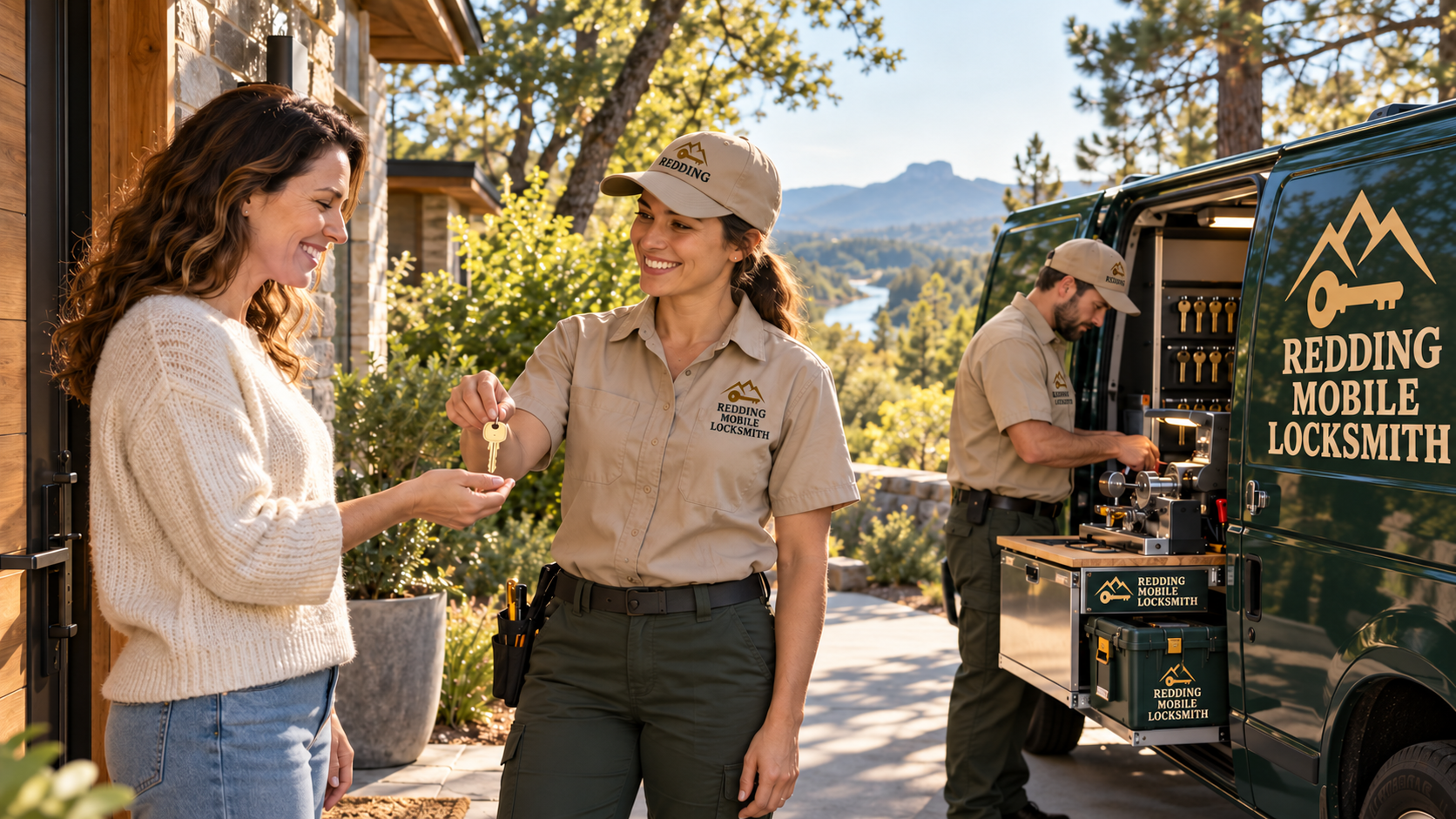
The uniforms and the branded van are there so you can recognise who is arriving. Before any work begins, expect the locksmith to confirm the vehicle details and ask for proof that the vehicle is yours. This protects you as much as anyone, and it is a sign of a professional rather than a nuisance.
If you are curious how that fits into the wider service, our Mount Shasta neighborhood page explains who we serve here and how requests reach us, and our emergency help any hour page covers the urgent side.
Trucks, work vehicles and used purchases
Pickups and work trucks are a fact of life in Siskiyou County, and they often carry more than one key. There may be a door key, an ignition key, a toolbox key and a tailgate or canopy key, each cut differently. When one goes missing, the first job is working out which lock it belonged to, because a toolbox key and an ignition key can look alike.
Work vehicles also tend to be used by more than one person. A key passed between family members or employees can wear sooner, and a fob that is dropped from a tailgate or a ladder takes more punishment than one that lives in a coat pocket. If a vehicle is shared, keep a record of who holds each key and where the spare lives.
Larger vehicles can have different hardware, such as heavier door handles, separate cab and cargo locks and older cylinders that have been rekeyed by owners over the years. A mobile locksmith can work through that mix on site. Tell us what you drive and which lock is failing, and we will arrive prepared rather than guessing.
It also helps to mention whether the vehicle has a push button start, a traditional key slot or both. That one detail tells us which kind of programming equipment is likely to be needed, and whether a simple key cut will do or a full pairing is part of the job. Photos of the door handle or the ignition area can make the conversation even clearer, since they show what the hardware really looks like.
Many people in a mountain community buy used vehicles, from neighbors, dealers and online listings. The seller often hands over one key with a cheerful promise that the other is somewhere. Before you finish the purchase, ask how many keys exist and whether each has been tested, because a lone key is a lost key waiting to happen.
If you already own the vehicle and only have one key, cutting and programming a spare is far easier while the first still works. Programming a second key from an existing one is usually a simpler job than starting from nothing, and it removes the pressure from every future trip. Our neighbors page on the extra key question when buying a used car explains what to check.
Our newcomer might also find that a previous owner of a used truck still holds a working key. If that worries you, a locksmith can program the vehicle so older keys are no longer accepted, where the system allows it. It is worth asking whenever you take on a vehicle with an unknown history.
Preparing before you call
Gather what you can before you contact us. The year, general type and color of the vehicle help, along with where it is parked. If it is a lockout, say whether keys are inside, whether the engine is running and whether anyone or anything is in the vehicle. These details shape the tools and keys we bring.
Have proof of ownership ready, such as registration or an identification that matches. If the vehicle belongs to a company or a friend, tell us so. We cannot provide access without confidence that you are entitled to it, and clear answers make the visit go smoothly.
Our phone line is coming soon, so use the request form on the contact page to describe the situation. Put the most urgent fact first, and tell us if the vehicle is on a roadside, a driveway or a parking area, so that we can plan for safe access.
Nearby towns and related reading
Drivers rarely stay in one town. If you are heading through Weed, Dunsmuir or McCloud, the same services apply, and our pages for those places reflect their own conditions.
For the house side of the story, see home lock service in Mount Shasta, and for the programming side see key programming and fobs in Mount Shasta.
The aim is the same on every page: help you understand the problem well enough to ask the right question, and give you a clear path to getting moving again. Redding Mobile Locksmith works at that pace, with patience and plain talk.
If you are weighing whether a problem is worth a call, the answer is usually yes when it involves a key you cannot replace, a door you cannot open or a vehicle you cannot start. A short description sent through the request form is enough to begin, and you can add details as you remember them.
Good to know
Common questions
What should I do first if I am locked out of my vehicle in Mount Shasta?
Make sure you and anyone with you are safe and out of traffic. Try every door and hatch, and see if a spare key or phone app can help. If a child or pet is trapped inside, call emergency services first. Otherwise, send a request through our contact form with the vehicle details and your location.
Can a locksmith make a new car key if I have lost all of them?
Often, yes. A mobile locksmith can cut a key and program the transponder chip so the vehicle accepts it, using the vehicle details and proof that you own it. Some vehicles and systems are more demanding than others, so tell us the year, type and any security features when you contact us.
Why does my key turn but the engine will not start?
On many vehicles a chip in the key head must be recognised by the engine computer. If the chip is damaged, missing or not paired, the key can turn the ignition and still not start the engine. A locksmith with programming equipment can test and, where possible, pair a working key.
Will cold weather affect my key fob?
It can. Cold drains small batteries, sometimes overnight, and a fob that works in the afternoon may not respond on a frosty morning. Try a fresh battery first. If that does not help, the fob may need to be paired again or replaced, which a mobile locksmith can usually handle.
Do I need proof of ownership for a vehicle lockout?
Yes, expect to be asked. A registration, an identification that matches, or a document showing you are entitled to use the vehicle all help. If the vehicle is borrowed or belongs to an employer, tell us up front so we know what is reasonable to ask for.
Can you work on a vehicle at a roadside or trailhead?
A mobile locksmith comes to where the vehicle is, including driveways, parking areas and roadsides, as long as it is safe to work. Describe the location as clearly as you can, note any hazards, and tell us if the spot is hard to reach so we can plan accordingly.