
Home / Yreka / Cars and Trucks in Yreka
Vehicle trouble
Cars and Trucks in Yreka: When the Problem Is Really the Key
Some vehicle trouble is not the engine at all. This page helps Yreka drivers tell when a car or truck that will not start or unlock is really a key, fob or lock problem, and what to do about it.
Vehicle trouble
Arriving after weeks away
Imagine a seasonal cabin owner driving into the Yreka area after several weeks away. The truck has been parked all that time, and now the key fob does nothing when the button is pressed. The owner uses the metal blade to open the door, turns the key in the ignition, and the engine refuses to start.
The natural thought is a dead battery, and sometimes that is right. But this made up scene, which is not a real customer, shows how easily a key problem hides behind engine symptoms. A fob with a flat battery, a chip that is not being read or a worn ignition can all mimic a mechanical fault.
Telling the difference saves time, effort and a good deal of frustration. A tow to a shop for a problem that a mobile locksmith could solve at the roadside is a poor trade. This page gives you simple checks to run, so you can describe the symptoms accurately and know when to call for help. None of them needs a tool, and none can harm the vehicle. For the full range of vehicle services, see cars and trucks.
Symptoms that point to the key
A few signs strongly suggest that the key, not the engine, is at fault. If the engine cranks normally but will not start, and a security light on the dashboard flashes or stays lit, the vehicle may not recognise your key. If the doors will not respond to the fob but the dome light and dashboard behave normally, the fob is the suspect.
Other clues include a key that turns stiffly or only at a certain angle, a key that has to be pressed or wiggled, or a push button start that shows a message about not detecting the key. If the problem comes and goes with how you hold or place the key, treat the key as the first suspect, and try the spare before anything else. Write down what you see and hear, because those notes become the most valuable part of your request.
Symptoms that suggest the battery or engine are different. Dim lights, a clicking sound and a slow or silent crank point toward power. A key problem usually leaves the vehicle otherwise lively, with bright lights, a working radio and a starter that turns the engine over as normal. Our neighbors page on when a car will not start because of the key goes through these in more depth.
- Engine cranks but will not start, with a security light flashing or lit.
- Fob does nothing but the vehicle otherwise works.
- Key turns only at an angle or needs wiggling.
- Push button start reports that it cannot find the key.
- Lights and dash behave normally while the car refuses to start.
Simple checks before you call
Start with the fob. Try the spare, if you have one. If the spare works, the first fob has a problem, most likely its battery or its pairing. If neither works, the cause may lie with the vehicle. Hold the fob close to the start button or the steering column, where some vehicles read a weak signal. Your owner handbook usually shows the exact spot, and finding it before you need it is worthwhile.
Next, check the vehicle battery, because a vehicle that has sat for weeks in the cold is a prime candidate for a weak one. Dome lights, dashboard lights and headlights should be bright. If they are dim, the main battery may be weak after weeks of sitting. A jump start may revive the vehicle, though that is a mechanical job outside what a locksmith does. Do not assume a locksmith can fix a flat battery.
Try the key gently in the ignition. If it feels rough, gritty or jammed, do not force it. Look for signs of damage to the blade. A bent or cracked key can often be replaced on site. Our guide to a key stuck in the ignition offers calm steps.
The fob after a long sit
A key fob left in a pocket or on a hook for weeks may still have a working battery, or it may not. Small coin cells lose charge over time, and cold or damp hurries the loss. A fob stored on a cold windowsill or in an unheated cabin can lose most of its charge without anyone noticing. A fob that was borderline when you left may be dead now.
Replacing the battery is a simple job on most fobs. Open the case with a small flat tool, note the battery number, fit a new one the same way up and close the case. After that, some fobs work at once, and others need to be paired again to the vehicle.
If a fresh battery does not bring the fob back, the fob may have lost its pairing or its electronics may have failed. A mobile locksmith with programming equipment can pair a new fob to the vehicle on site. See key programming and fobs for what this involves.
The transponder chip and the immobilizer
Many vehicles use an immobilizer, a security system that prevents the engine from running unless the right key is present. The key carries a transponder chip. When you turn the key or press the button, the vehicle reads the chip and compares its code with a list in its computer. A match lets the engine start.
If the chip is damaged, missing or not on the list, the immobilizer blocks the start. Often a light on the dashboard warns you, typically in the shape of a key or a lock. The engine may crank and then die, or may not crank at all.
This is why a key cut at a counter may open the door and turn the ignition but still fail to start. The metal fits and the chip does not match. Our neighbors page on what a transponder chip is explains the basics, and a locksmith can test your key and tell you whether the chip is the problem.
Worn keys and worn ignitions
Keys and ignition cylinders wear together. After years of use, the cuts on a key round off and the pins or wafers inside the ignition slip. The result is a key that needs wiggling, turns only partly, or works one day and not the next. A key in this state is also at risk of breaking.
If the key is worn but the ignition is sound, a fresh key cut from the code or from a good original will often solve it. If the ignition is worn, a locksmith can repair or replace the cylinder and cut and program a key to match. Doing it before failure is easier than after, because a key that still works can be copied and a key that has snapped inside the ignition cannot be used for anything.
Be wary of heavy key rings. A bunch of keys and charms hanging from an ignition key puts a steady load on the cylinder and speeds up wear. Removing the weight costs nothing and may add years to the ignition. Our neighbors page on how to judge how long a lock will last has more thoughts.
Locked out is a key problem too
Sometimes the first sign of a key problem is that the vehicle will not open. If the fob does not unlock the doors, the blade inside the fob usually works on the driver door. Look for a small release on the fob, and for a hidden keyhole under a cover on the door handle.
If that fails, or you are locked out with the keys inside, a locksmith can open the vehicle using professional tools while taking care of the paint, seals and electronics. See our page on being locked out of your car for the full steps.
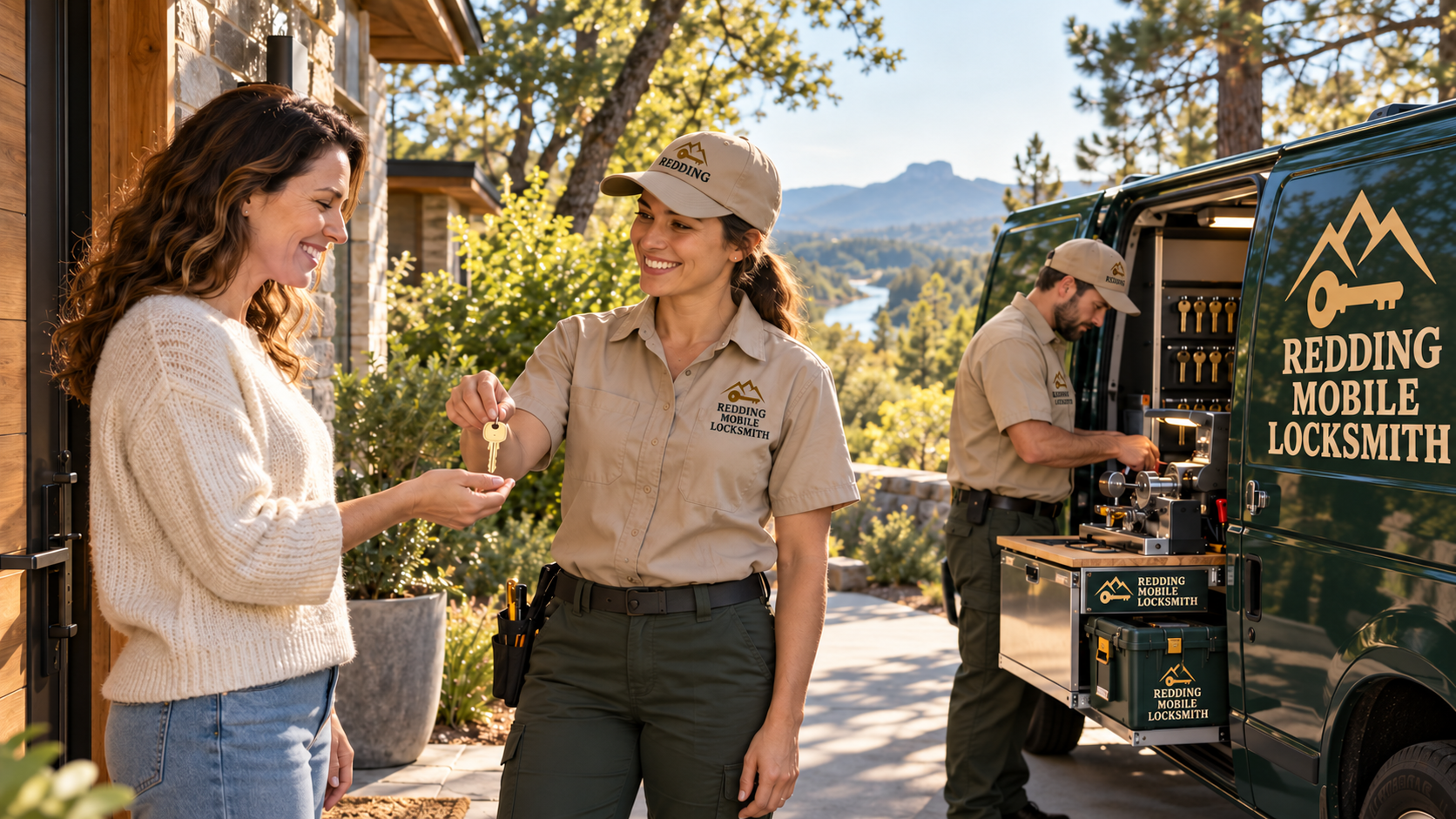
If a child or pet is inside, call emergency services first. Do not wait for a locksmith. Once everyone is safe, the door can be opened and the lock dealt with. The seasonal cabin owner in our picture could avoid this entirely with a habit of checking pockets before shutting any door, but a short walk around the truck before shutting a door is a good habit.
Cold, distance and the long drive
Yreka sits along Interstate 5 in the Shasta Valley area, and many drivers pass through on long trips. A key problem at a rest stop, a parking area or a driveway far from home is more stressful than one near home. Carrying a spare key, and knowing where it is, is the soundest preparation.
Cold and heat both affect electronics. A fob can behave differently in a freezing morning than in a warm afternoon, and a vehicle left in summer sun can have a stressed battery. If a problem appears only at certain times of day, mention it. It helps a locksmith narrow down the cause.
Rural edges of the county add distance. If you are on a country road or a ranch driveway, say so, and describe how to reach you. Redding Mobile Locksmith comes to the vehicle, so the location matters. A clear description of landmarks, gates and turns helps us plan. If a gate is locked or a driveway is steep, tell us that too, so the van arrives ready for the real conditions and not for a tidy parking space.
Office parking, work vehicles and shared keys
Yreka has county and professional offices, and with them come work vehicles, pool cars and employees who share keys. A key that passes through many hands wears sooner and gets lost more often. When a work truck will not start on a Monday morning, the question of who last had the key matters as much as the mechanical cause.
If you manage vehicles for an office or business, keep a simple log of keys: which vehicle, how many keys exist, who holds each and where the spares live. When someone leaves, collect their key or ask a locksmith to program the vehicle so older keys no longer work, where the system allows it.
Shared vehicles also benefit from a spare that never leaves a secure place. A lockbox in an office, a labeled hook in a locked cabinet or a trusted manager can all work. Our neighbors page on a work vehicle lockout and who to tell sets out a sensible order of calls, and our door hardware for business in Yreka page covers the buildings.
What a mobile locksmith can and cannot do
A mobile locksmith can open vehicles, cut keys, program transponder keys and fobs, repair ignition cylinders and door locks, and replace worn keys. The van carries professional tools, key cutting and programming equipment and common hardware, so many of these jobs finish where the vehicle sits.
We do not repair engines, batteries or alternators. If the diagnosis points to a mechanical fault, a locksmith will tell you honestly and suggest you speak to a mechanic. We would rather give you a clear answer than sell work that does not fix your problem. If the vehicle turns out to need both, for example a new key and a battery, we can say so and leave the mechanical part to the right person.
Expect questions about ownership. A locksmith needs to be sure you are entitled to access or a new key. Have registration or identification ready, and tell us if the vehicle belongs to someone else or a business. If you are a family member helping a relative, say so, and be ready to explain how you are connected to the owner. See what to have ready when you call a locksmith.
Getting help and exploring further
To ask for help, use the request form on our contact page. Our phone line is coming soon. Describe the symptoms in your own words, mention any warning lights, say how long the vehicle has been parked and say where it is. We will reply with the next steps, which may include a few more questions so the visit is planned properly.
Yreka drivers also use the roads to Montague and Fort Jones, and the same service reaches those towns. Our Yreka neighborhood page gathers our local pages, including home lock service in Yreka.
Whether the trouble is a fob, a chip, a stiff ignition or a locked door, the aim is the same: find out what is wrong, say so plainly and put it right with as little fuss as possible.
Before you leave a vehicle for a long stretch, make a small checklist of your own. Test every key and fob, replace tired batteries, keep a spare somewhere safe and remove heavy key rings. Start the engine once or twice if you can, and lock and unlock the doors with the fob. Ten minutes of care before you go can spare you an awkward discovery when you return, and it is the most useful habit any seasonal owner can build.
Good to know
Common questions
How can I tell if my vehicle problem is the key and not the battery?
Check the lights. If dome and dashboard lights are bright but the engine cranks and will not start, or a security light flashes, suspect the key. If lights are dim and the engine clicks or cranks slowly, suspect the battery. Trying a spare key helps separate the two.
Why won't my truck start after sitting for weeks?
It could be a weak main battery, a dead fob battery, or a key that is not being read by the immobilizer. Try the spare fob, check whether the lights are bright, and watch for a security light on the dash. These clues help decide whether a locksmith or a mechanic is the right call.
Can a mobile locksmith program a key at my vehicle?
Often, yes. The van carries programming equipment, and many keys and fobs can be programmed on site if you can show proof of ownership. Some systems need special procedures, so give us the vehicle details when you request service and we will say what is possible.
What should I do if my key will not come out of the ignition?
Do not force it. Check that the vehicle is in park, or neutral for a manual, and gently turn the steering wheel while turning the key, since the steering lock may be binding. If it remains stuck, ask a locksmith to help before the key breaks.
Is it safe to leave a spare key hidden on the vehicle?
It is not wise. Thieves know the usual hiding places. Keep the spare with a trusted person or in a secure place at home. If you lose your only key, a locksmith can cut and program a new one, though having a spare beforehand is much easier.
How do I request vehicle help in Yreka without a phone number?
The phone line is coming soon. Use the request form on our contact page and give the vehicle type, the symptoms and your location. If a child or pet is trapped inside, call emergency services first rather than waiting for us.