
Home / Yreka / Home Lock Service in Yreka
Home in Yreka
Home Lock Service in Yreka: Every Lock and Latch, in Order
A house has more locks than most owners count. This page walks through every lock and latch on a typical Yreka home, from the front door to the garage, and explains what to check and what a locksmith can do.
Home in Yreka
After a long shift, at your own front door
Imagine someone coming home after a long work shift in Yreka. It is late, the street is quiet, and the only thing they want is to get inside, eat something and sleep. They pull out the keys and the front door lock does not turn. They jiggle it, lift the handle, try again, and eventually it gives.
Nothing dramatic happened that night, and the person goes to bed, a little more tired and a little less trusting of the front door. But a lock that needs coaxing at midnight is telling you something. It is worn, misaligned or dirty, and sooner or later it will refuse. This is a made up picture and not a real customer, yet it is how most lock failures begin: a small annoyance that is easy to ignore.
This page takes the opposite approach. Instead of waiting for the failure, which always seems to choose the worst hour, we walk through the whole house the way a locksmith would, door by door and latch by latch, so you can spot trouble early and decide what to do. Our home lock service overview sets out the full service for both counties.
Your house in Yreka, at a glance
Yreka is the seat of Siskiyou County, set along Interstate 5 in the Shasta Valley area, and its mix of old and new shows in the doors. Its houses range from older homes near the downtown to newer neighborhoods and properties on the rural edges. Each kind of house brings different locks, and older ones often carry hardware from several decades, patched and added to by whoever lived there. That patchwork is not a problem in itself, but it does mean the keys, the finishes and the quality can vary from door to door.
An older house may have original knobs, a mortise lock on the front door and a mix of replacement deadbolts added over the years. A newer home usually has a standard set of keyed entry knobs and deadbolts, sometimes with a single key for all of them. A rural property may add gates, barns and workshops.
Whichever you have, the same rule applies, and it is worth saying again because it is so often skipped. Know what you own, know how many keys exist, and know what each lock protects. A homeowner who can answer those three questions is already ahead of most. We will go through the typical list in the sections that follow, beginning with the door everyone uses and ending with the ones nobody remembers.
The front door
Start at the front door, which takes the most wear and gets the most attention. Look at the deadbolt and the handle set, which are separate pieces of hardware and may have been fitted years apart. Turn the key from outside and listen: it should move smoothly with a clear throw of the bolt. A gritty or stiff feel means dirt, wear or misalignment.
Close the door and check how the bolt meets the strike plate. The bolt should slide into the hole without rubbing. If you have to lift or push the door to lock it, the door may have sagged on its hinges or the frame may have shifted. That is often cured by adjusting hinges or moving the strike, not by replacing the lock.
Check the screws on the strike plate. Short screws that only reach the thin jamb are common, and they give little protection against a hard push. Longer screws that reach the framing behind the trim make a real difference with little effort. Our neighbors page on what makes a good strike plate explains why.
Finally, look at the hinges. Three or four sturdy hinges with screws that bite into the framing keep a door in true alignment, and a hinge with a loose or missing screw is a common reason a bolt starts to rub. Tighten what you can, and if a screw hole is stripped, a longer screw or a wooden dowel in the hole usually restores the grip.
- The key should turn smoothly and the bolt should throw fully.
- The door should close without lifting or pushing.
- The strike plate should be held with long screws.
- The handle and deadbolt should not wobble.
Back and side doors
The back door is often the weak point of a house, because it is out of sight and gets less care. Check it as carefully as the front. Many back doors, especially in older homes, have a simple knob lock and no deadbolt, or a deadbolt that is rarely used. If the household never locks it, it might as well not be there.
Side doors, mudroom doors and basement doors deserve the same attention. They may be older, they may have lost their keys long ago, and they may be hidden by shrubs. A single turn of the key will reveal whether each lock still works, and whether anyone has a key at all.
Doors with glass panels need special thought. A deadbolt that can be reached by breaking a pane is less secure than it looks, so consider a keyed lock on the inside or a laminated pane. We do not give advice that would help someone break in, but sensible protection of glazed doors is a normal part of home security.
The garage and its entry door
A garage often has three routes: the big overhead door, a side door and the door from the garage into the house. Each can be a weak spot. The overhead door has its own latches and opener. The side door has a lock like any other. The interior door is sometimes left unlocked because it feels safe.
Weather matters even in a garage. Cold and damp make metal parts sluggish, and a side door that is seldom used can seize. Spray a suitable lock lubricant into the keyway once a year, work the key a few times and wipe off any excess so it does not collect dust. It is a two minute job, easily done on a weekend morning, that avoids a seized lock when you need to use it.
Treat the door from the garage into the house like an exterior door. A deadbolt on that door adds a second line of protection if the garage is entered. Our neighbors page on what to do if the garage entry door lock fails explains how to cope when it breaks.
Check that the garage door opener remote is not stored in a vehicle that stays outdoors, since that is an invitation. If you lose a remote, ask the opener maker how to reset the codes. A locksmith can advise on door locks, though the opener itself may be outside the work we do.
Windows and sliding doors
Windows have latches rather than locks, and the older the window, the weaker the latch. Check that each one engages properly and that the sash does not rattle. A latch held by loose screws is a latch that will give way under a push.
Sliding patio doors are a special case. Their latches are often light, and the door can sometimes be lifted off its track from outside. A simple metal bar in the track, a pin through the frame or an auxiliary lock helps. Make sure that whatever you add still lets people leave in an emergency.
Older houses may have wooden sash windows with a single brass catch. These can be improved with modern fittings made for the purpose. Our neighbors pages on sliding door security questions and window lock questions for older houses go into the details.
Interior locks, closets and cabinets
The inside of a house is where small, forgotten locks live. Privacy locks on bathrooms and bedrooms are meant to be simple. They usually have a small hole on the outside for an emergency release with a thin tool, which matters if a child locks themselves in. Know where yours is and what tool opens it.
A home office, a gun cabinet, a medicine cabinet or a storage room may have a keyed lock. Keep track of those keys, and keep them separate from the main ring. If a cabinet key goes missing, a locksmith can usually open or rekey the lock.
Do not lock children or vulnerable people in rooms in ways that stop them leaving in an emergency, and do not rely on a flimsy interior lock to protect something truly valuable. For safety, think about what happens if there is a fire or a fall. Our page on childproofing exterior doors offers a calm approach.
Mailboxes, sheds and other small locks
Around the property there are often small locks that are easy to forget: a mailbox lock, a shed padlock, a gate latch and a toolbox. They may all use different keys, and the keys may be scattered among drawers and coat pockets.
Try each one now. A mailbox lock that sticks can be lubricated or replaced. A shed padlock rusted by the weather may need to be cut off and replaced. A gate latch bent by a bumper may need straightening. These small tasks are easy to do on a calm afternoon and annoying to do in a hurry.
If you have a number of similar padlocks, consider having them keyed alike, so one key opens them all. That cuts the clutter. For more on small locks, see our neighbors pages on mailbox lock questions and shed and garage padlock questions.
Keys: counting, labeling and spares
With the doors checked, turn to the keys. Lay out every key you own on a table and match each to a lock. You may find keys that fit nothing, keys that fit locks you no longer use, and two doors that share a key you did not expect. That inventory is more revealing than any lecture about security.
Next, count how many copies exist of each key. Think about contractors, relatives, neighbors, former tenants and the previous owners if you bought the house. A good number of homes have a key floating around in a drawer in someone else's house. If that makes you uneasy, rekeying the locks puts the control back in your hands.
Label your keys in a way that only you can decode. Do not write the address on a key ring, since a lost ring then leads straight to your door. Keep one spare with someone dependable and one in a safe spot indoors. Our neighbors page on how many keys a household should keep offers a sensible rule of thumb.
What to fix, rekey or replace
After the walk, you will have a list. Sort it into three piles, on paper or in your head. Things that need adjusting, like a sagging door or a loose handle. Things that need rekeying, like locks whose keys may be in the wrong hands. And things that need replacing, like locks that are broken, corroded or too weak for the door.
A locksmith can help you sort the list and carry out the work in one visit if the right parts are on the van. Our pages on lock repair and adjustment and rekeying your home explain the details of each.
Do not feel that you must do everything at once, because security is built in layers over time rather than bought in a single afternoon. Fix the front and back doors first, since they matter most. Add the rest over time. A locksmith can tell you which items are urgent, such as a broken latch on an exterior door, and which can wait, such as a tired but working interior knob, without pushing you to buy more than you need.
It also helps to keep a simple home record: a sheet listing each door, the type of lock, the date it was last serviced and where the spare key lives. When you sell the house or hand it to a tenant, that sheet is a gift. When you are standing at a door at midnight, it is a calm reminder of what you already know.
If you are locked out, or want help now
If the walkthrough reveals a problem you cannot solve, or you are shut out, ask for help. For a lockout, see our page on being locked out of your home. For urgent situations, our page on emergency help any hour in Yreka explains what to do and what to tell us.
Our phone line is coming soon, so use the request form on our contact page in the meantime. Tell us what you found on your walk, and we will plan the visit. If someone is in danger or trapped, call emergency services first.
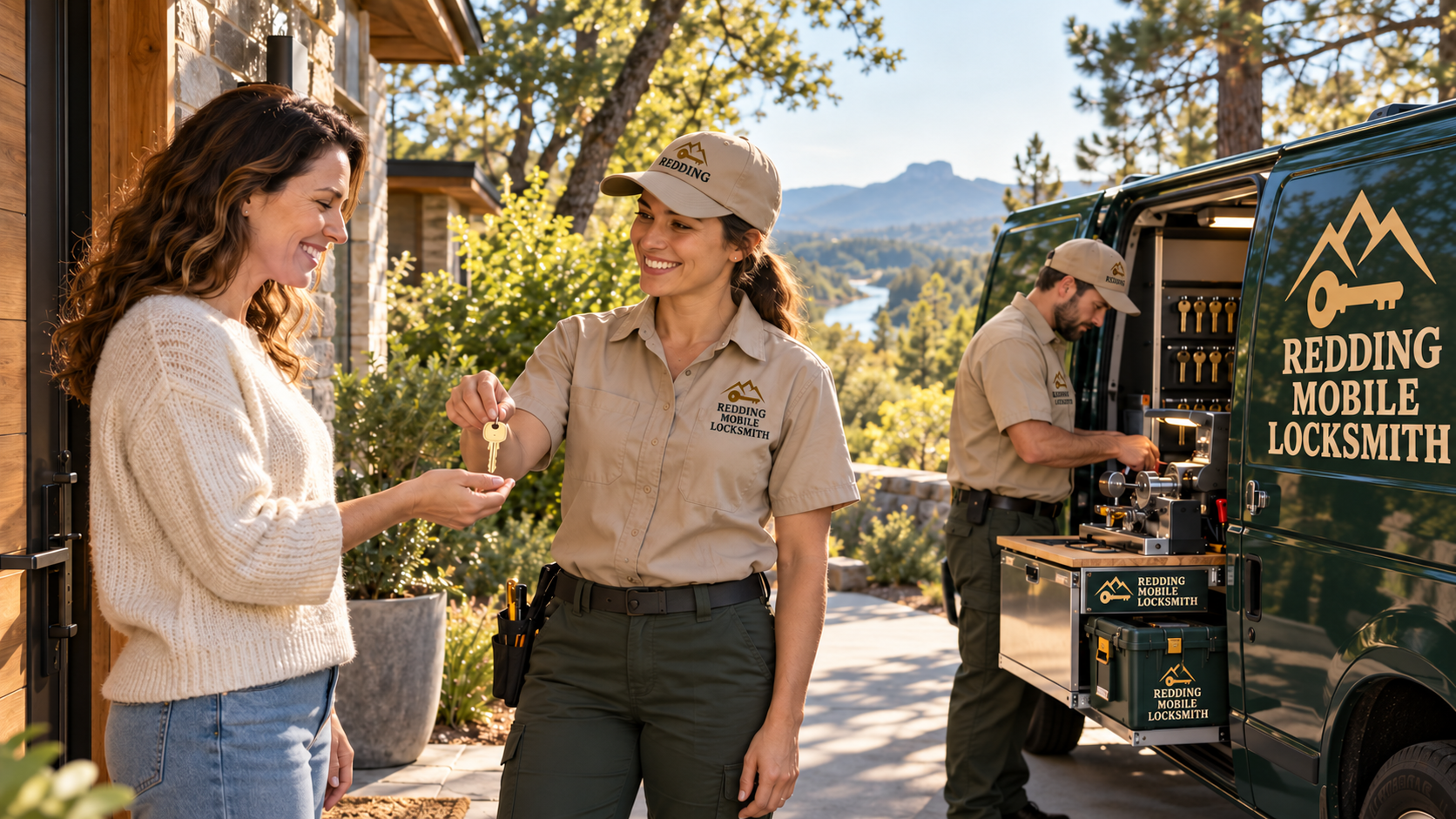
Redding Mobile Locksmith, a 24 hour mobile service with a branded van carrying tools, key cutting and programming equipment and common hardware, serves Yreka and the surrounding communities, including Montague, Fort Jones and Etna. Our Yreka neighborhood page brings together everything we offer for this city.
Good to know
Common questions
How often should I check the locks on my house?
A walk around once or twice a year is plenty for most households. Choose a calm day, such as the change of season, and test every key, latch and deadbolt. Note anything that sticks, wobbles or fails to close fully. Catching problems early keeps a small annoyance from becoming a lockout.
My front door lock needs jiggling. Do I need a new lock?
Not necessarily. A lock that needs coaxing may be dirty, worn or out of line with the strike plate. Often the fix is cleaning, lubrication or adjusting the door or strike. If the cylinder is badly worn or the key is old, rekeying or replacement may be the better answer.
Do older Yreka houses need special locks?
Older houses often have mortise locks, original knobs and wooden windows that predate modern hardware. Many of these can be repaired or rekeyed instead of replaced. A locksmith can look at the door and tell you whether the hardware can be saved or whether a modern replacement suits it better.
Should I put a deadbolt on the door from the garage to the house?
Many homeowners do, treating that door like any exterior door. Rules about hardware vary, so check what applies to your home. A deadbolt adds a second line of protection if the garage is entered. A locksmith can advise on the right type for your door.
Can all my locks use the same key?
Yes. A locksmith can rekey several locks so one key opens them all, or fit new locks keyed alike. This reduces the number of keys you carry. Keep separate keys for anything you want to control more tightly, such as a cabinet or a workshop.
How do I request service when the phone line is not yet open?
The phone line is coming soon. Use the request form on our contact page, list the locks you want looked at and describe any problems. If you are locked out, say so at the start. If someone is in danger, call emergency services before anything else.