
Home / Yreka / Key Programming and Fobs in Yreka
Yreka key programming
Key Programming and Fobs for Yreka Households
If you live in or near Yreka, a fob that quits or a key that will not start the car is rarely a small problem. Here is how programming works, what gets tested, and how to prepare.
Yreka key programming
Why programming matters more on a place with gates
Picture an owner of a few acres outside Yreka. There is a truck, maybe a second vehicle, a gate at the road, another gate at the barn, and a shop out back with its own lock. Every one of those things answers to some small piece of metal or plastic on a key ring, and most of them have to be taught to recognize that piece before they will do anything.
That teaching is what people mean by programming. A modern car key often carries a tiny chip that holds a code, and the car holds a matching code in its computer. When the two agree, the engine is allowed to run. When they do not, you get a car that cranks, or lights that blink, or nothing at all.
Fobs add a second layer. The buttons that lock the doors, open the back and sometimes start the engine speak to the vehicle by radio, and the vehicle has to be told which radios it should listen to. A fob that looks perfect in your hand can still be a stranger to your truck.
What a locksmith actually does with the car
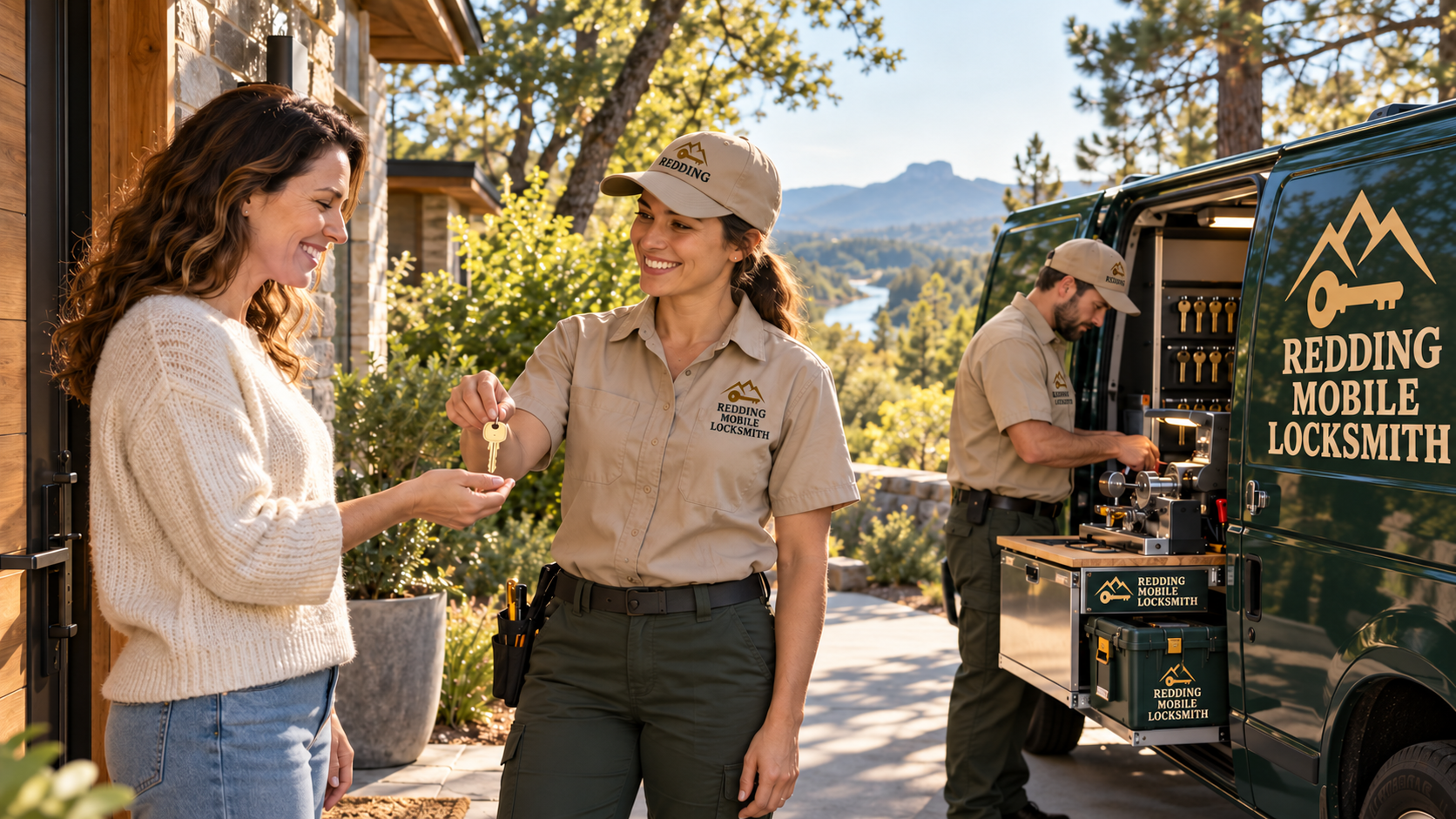
Our team arrives in a branded service van with key cutting and programming equipment on board, so the work happens where the vehicle is sitting. In a driveway on a Yreka side street or beside a barn on rural acreage, the steps are the same. We connect a programming tool to the vehicle, tell it we are adding a key, and present the new key so the car can learn it.
Some vehicles accept this as a short sequence done from the driver's seat. Others need the vehicle's computer to be addressed directly, which takes longer and more patience. Either way the process is something a person with the right equipment does deliberately, and it is not guesswork with a handful of buttons.
What you may notice is how little drama there is. A good programming visit looks like a technician quietly working at a laptop and a handheld tool while you stand nearby with a coffee. The interesting part is what happens after the new key is accepted, which is where most of this page is going.
- The vehicle is identified so the right procedure and the right key type are used.
- The new key or fob is cut if it has a blade, and the blade is checked in the door and ignition.
- The key is programmed so the vehicle accepts the chip and, where it applies, the remote.
- Existing keys are checked to see whether they still work after the new one is added.
- Every function is tested before the vehicle is handed back to you.
The testing step most people never see
Here is the part that sets a careful visit apart from a hurried one. Once a key starts the engine, many people assume the job is done. A properly finished job treats the engine starting as the first test of several, not the last.
Think of a fob as a small switch panel. Lock, unlock, trunk or tailgate release, panic, remote start where the vehicle has it, and the sliding door buttons on vans that offer them all need to be pressed and watched. If the lock button works but the tailgate button does not, you want to find that out in your own driveway with the technician still present, not three weeks later at the hardware store.
Testing also means trying the key the old way. The blade should enter the door lock cleanly, turn without catching, and work in the ignition if the vehicle has a keyed ignition. A mechanical key that fails quietly is the one you will need on the day the fob battery gives up.
Before and after a replacement: two sets of checks
When a key has been lost or broken, the service usually has a before and an after. Before work begins, it helps to note what you still have. Do you have one working key, no keys, a damaged fob, or a fob that works on the doors but not the ignition? Each answer changes the approach, and each is worth stating plainly when you request help through the request form on the contact page.
After work, you repeat the same list with the new key in your hand. Does it start the vehicle, does it lock and unlock, does the trunk release respond, does the spare still behave. If you keep a second vehicle that shares a key style, bring up the idea of testing that one too, because some programming sessions can disturb nothing and some cannot be assumed to.
There is a quiet benefit to this habit. You leave with a clear memory of what worked on the day, which makes it far easier to tell later whether a problem is the key, the battery, or something else in the vehicle. Our replacement car keys page walks through the situations where a key has to be made from scratch.
Spare keys and the gate problem
Back to the acreage owner. Out there, a missing key rarely means one missing key. A work truck gets lent to a neighbor, a gate remote lives in the glove box, and a ring of keys that once hung on a nail is now in someone else's jacket. When programming is on the table, it is a good moment to ask what else is out in the world.
Many vehicles let a locksmith erase old keys during programming so that only the keys in your hand will start the car. Whether that suits you depends on the vehicle and on how many people you want to keep driving it. Spend a minute deciding before the technician starts, since it is easier to add a key afterward than to go back for one that was erased.
Gate remotes and similar devices are a separate matter from vehicle fobs, but the same habit applies. Know what you have, label it, and test each one at the gate itself. For a broader view of how homes and outbuildings fit together, see home lock service and the page for new lock installation in Yreka.
What can go wrong, and what it looks like
Most failed programming jobs fail for ordinary reasons. The key blank was the wrong type for the vehicle, the chip inside was a style the car does not accept, or the fob was a used one already tied to another vehicle. Bargain or secondhand fobs are especially prone to this, because many of them can be locked to the first vehicle they met and cannot be reused.
A weak vehicle battery can also interrupt programming. The computer needs steady power while it is learning, and a battery that has been sitting through a Siskiyou winter may not provide it. If your car has been struggling to turn over, mention that when you request help, since it may need attention before keys are touched.
Then there are the problems that look like key trouble and are not. A dead fob battery makes a good fob seem broken. A worn blade makes a good chip seem faulty. A locksmith who checks these first saves you from paying for programming you did not need.
- A fob that works on the doors but will not start the car usually points to the chip, not the buttons.
- A key that starts the car only sometimes may have a worn blade or a failing chip.
- A fob that stops working after a battery change may need to be reintroduced to the vehicle.
- Blinking dash lights with a cranking engine often mean the vehicle does not recognize the key.
Yreka's weather, and how it touches your keys
Yreka sits in the Shasta Valley along Interstate 5, with hot dry summers and cold winters, and a vehicle spends its days in both. Heat can warp plastic fob cases and loosen the little contacts around the battery. Cold can make a weak battery fail on the very morning you need it.
If your fob has become unreliable, try a fresh battery first, and make sure the contacts are clean and seated. That small step solves a surprising share of complaints, and it costs almost nothing. When it does not, you have at least ruled out the simplest cause and can describe the symptoms clearly.
Keep a mechanical blade key somewhere sensible, too. Many fobs hide a small emergency blade, and it is worth confirming that it exists and still turns the door. On a winter morning with a frozen car and a dead fob, that blade is the difference between a short delay and a long one.
Working vehicles, farm trucks and shared keys
Households around Yreka often run vehicles that more than one person drives. A ranch truck, a pickup used for the job site, and an older sedan for errands might all wear different styles of key. Older vehicles may use a plain metal key with no chip, while newer ones need full programming, and a single ring can hold both.
That mix is exactly why it helps to tell us the make, model and approximate model year when you ask for service. We can then confirm the key type before anyone arrives, which cuts down on surprises. The key programming and fobs service page explains the general process for every vehicle type we handle.
If a vehicle is owned by a business or a partnership, decide in advance who is allowed to authorize key work. A locksmith will reasonably want to confirm that the person asking has the right to have keys made for that vehicle, and clearing that up beforehand keeps things moving.
How to get ready before you ask for help
A short bit of preparation makes the visit smoother. Gather whatever keys and fobs you still have, even the broken ones, since a damaged key can still tell a technician a great deal. Know where the vehicle is parked, and make sure it can be reached.
Have the vehicle's details ready, and any proof of ownership you would normally carry, such as registration. A locksmith may ask for this to confirm that the vehicle is yours, which protects you as much as anyone. If you cannot find it, explain the situation and ask what else would be acceptable.
Our phone line is coming soon, so for now the simplest route is the request form. Describe the symptoms, the number of keys you want, and whether any are lost. For a lockout rather than a programming need, locked out of your car is the better place to start.
- Collect every key and fob you have, including cracked or worn ones.
- Write down the make, model and approximate year of the vehicle.
- Find registration or other proof that the vehicle is yours.
- Decide how many working keys you want when the job is finished.
- Note anything odd, such as dash lights, a slow starter or a dead fob battery.
Neighbors, nearby towns and the rest of the county
The Local Standard covers Yreka and the communities around it, including Montague, Fort Jones and Weed, all of which lean on Interstate 5 or the highways that branch from it. A vehicle owner in one of those towns faces the same questions about chips and fobs as someone in Yreka, and the same advice applies.
For the whole picture of what we do in town, the Yreka page collects the set, including help with cars, homes and businesses. If a different need is bothering you, the emergency help page for Yreka covers the first things to try during a lockout.
We are Redding Mobile Locksmith, a 24 hour mobile service with a branded team and van, and we would rather help you decide what you need than sell you something you do not. A short conversation about the symptoms is often enough to point toward the right job.
A last word on testing, and on keeping it simple
The idea behind this page is easy to say. Do not accept a key as finished until you have watched every function do its job. That small discipline turns a replacement from a hopeful guess into something you can rely on.
If you carry only one lesson away, let it be to test with the technician still there, test the spare along with the main key, and test the physical blade as well as the buttons. The extra few minutes at the curb are worth far more than a return trip.
And if you are still unsure what your vehicle needs, ask. Describe the symptoms in your own words, send the form, and let us help you work out whether you need a battery, a blade, a programming session or a new fob entirely.
Good to know
Common questions
Can any locksmith program a fob for any vehicle?
Not necessarily. Programming depends on the vehicle, the key type and the equipment on hand. Some vehicles accept a simple onboard procedure, while others need a dedicated programming tool. When you describe the make, model and year, we can tell you what the job calls for before anyone arrives, so there are fewer surprises at the curb.
My new fob unlocks the doors but will not start the car. Why?
Door buttons and engine starting use different parts of the key. The remote part talks to the door locks by radio, while the chip inside the key talks to the engine immobilizer. One can work while the other has not been learned, or the blade or chip may be the wrong type. A technician can test each part separately.
Should I test the spare key as well?
Yes. After any programming session, try every key you own on the doors, the ignition and each remote function. Some procedures change which keys the vehicle accepts, and you want to find out while the technician is still with you. A spare that is never tested is a spare you cannot trust.
What if I lost every key to my vehicle?
That is still workable in many cases. A locksmith can often create a new key and program it to the vehicle, though the steps depend on the make and model. Tell us it is an all keys lost situation when you send the request form, and have proof of ownership ready, since we will want to confirm the vehicle is yours.
Does a weak battery in the fob really cause problems?
It does, and often. A tired fob battery can make a good fob seem broken, with buttons that work only up close or not at all. Try a fresh battery first and make sure the contacts are clean. If the fob still misbehaves with a new battery, it is time to look at programming or the fob itself.
Do you only serve Yreka for key programming?
No. We serve Shasta County and Siskiyou County, which includes Yreka and nearby communities such as Montague, Fort Jones, Etna and Weed, along with Redding and others. Our branded team works from a service van carrying cutting and programming equipment, so the work can usually be done where your vehicle is parked.