
Home / Service areas / Shasta Lake
Shasta Lake, Shasta County
Lock and key help in Shasta Lake, near the dam and the water
Shasta Lake is a Shasta County city beside the dam and the big reservoir, full of family homes, rentals, weekend visitors and people who drive to Redding each morning. Each group runs into its own lock troubles.
Shasta Lake, Shasta County
Where the highway meets the water
Few places in Shasta County have a setting as recognizable as this one. The city sits near Shasta Dam and Lake Shasta, with Interstate 5 running along its edge, and it covers three ZIP codes: 96019, 96079 and 96089. People come here to live, to rent, to launch boats, to camp, and to pass through on a longer journey. A locksmith serving the area has to think about all of them.
What strikes you about a community like this is how many different relationships people have with their keys. A long time homeowner has a ring of keys they could find in the dark. A renter may have only one copy and no idea who else holds another. A visitor from out of the area has a rental house key, a car key, and a boat or trailer lock, all in one pocket.
This page goes through those relationships in turn, with a neighborly eye and without jargon. It also links to our six pages written for Shasta Lake in particular, and to the wider set of guides. If you simply need help, skip ahead and use the request form, since our telephone line is coming soon.
Family homes and the everyday lock
The backbone of the city is family housing, and the lock concerns there are the familiar ones. Deadbolts that stick in the cold morning, back doors that are used a hundred times a week until the latch wears, and garage entry doors that nobody checks. Children lose keys, teenagers borrow them, and a spare gets handed out to a friend and never seen again.
One of the most useful habits a household can build is knowing exactly how many keys exist. If the count is uncertain, rekeying is a calm and sensible fix. A technician changes the pins inside each cylinder so that the old keys no longer work and a new set does, all without replacing the doorknobs or deadbolts. Our page on home lock service describes the range of work, and the guide on how many keys a household should keep offers a practical answer.
Families with small children have an extra reason to think about doors. A child who can reach and turn a deadbolt can also lock themselves in a room or out of the house. There are sensible, simple measures, such as raising a latch or fitting a different style of handle. Our guide on childproofing exterior doors goes through the options calmly.
Rental housing and the turnover problem
A good share of the housing here is rented, and rentals produce a particular kind of key trouble. Each time a tenant moves out, a number of keys go with them: the ones they were given, the ones they had copied, and the ones they forgot to hand back. The next tenant is then moving into a home whose security depends on the honesty of the last one.
Property owners and managers deal with this by rekeying between tenants. It is a modest job compared to replacing locks, it keeps the existing hardware, and it leaves a clean break. Tenants have their own questions to ask, and the answers vary by lease and by property. Our guides on handling keys when a tenant moves out and what renters should ask a landlord about lock changes help each side.
We do not advise on what a lease allows or what local rules require, because those depend on your property and agreement. What we can do is explain the options and carry out the work once the right person has agreed. If you manage several units, the guide on the rekey at turnover workflow is a useful read.
- Count the keys handed over at move in and at move out.
- Ask the landlord or manager before changing any lock.
- Keep a simple log of which unit has which key.
- Rekey between tenants instead of replacing hardware.
- Test every door and window latch after the work is done.
Lake visitors, cabins and short stays
Visitors are part of the rhythm of Shasta Lake. People arrive for a weekend on the water, rent a house or stay with family, and bring with them a trailer, a boat, a car full of gear and a ring of unfamiliar keys. The classic mishap is the key left on the boat or in the truck bed while everything else is locked up.
Homes that host guests face their own lock puzzle. A key under a mat or a code shared in a text message is a short term convenience that becomes a long term risk. Keypad locks suit this use because the code can be changed between guests, but they only help if someone actually changes it. Our guide on managing keys at a rental with many guests covers the practical steps.
If you own a vacation property or a lake cabin, the end of a season is the time to think about the locks. Check that every door and window fastens, replace any hardware showing rust from damp air, and decide who holds keys over the quiet months. The guide on managing locks for vacation homes is a useful companion.
Commuter cars and the morning scramble
Plenty of Shasta Lake residents drive to Redding for work, which means cars are central to the day. Keys get dropped, fobs get wet, and a locked car in a hurry is a miserable start to a long shift. The vehicle problems we hear about most are lost keys, keys that no longer start the car, and fobs whose buttons have stopped responding.
The reason these jobs feel complicated is the chip inside the key. A transponder sends a coded signal to the car, and the engine will not run unless it matches. A copy of the metal blade alone will open the door but not start the engine. A technician with programming equipment can create a new key and teach the car to accept it, on the spot. See replacement car keys and key programming and fobs for the details.
If you only have one working key, treat that as a warning. Making a spare while you still hold a good key is usually simpler than starting from nothing after the last one is lost. The guide on whether a key can be made with no key at all explains why that second case takes more work.
Boats, trailers, gates and other locks you forget
Not every lock in a lake community is on a door. Trailer hitches, toolboxes on truck beds, storage lockers, gates and padlocks all quietly matter. They sit outside, they face weather, and they are used infrequently enough that nobody notices when they begin to fail.
Water and a lock are not friends. Moisture works its way into keyways, mineral deposits build up, and the first sign of trouble is a key that turns with effort. Light, appropriate lubricant and the occasional use help, but corroded padlocks are often better replaced than coaxed. Our guide on dealing with a stuck key explains what to do, and what not to do, when a lock grips.
Gates deserve a note. A gate at the end of a drive or a storage lot is the first thing anyone meets, and a weak or worn lock on it is a quiet invitation. A solid lock, a protected shackle and a key that is not copied freely go a long way. See also shed and garage padlock questions for more on outdoor hardware.
Shops and services that serve the lake
The business side of Shasta Lake leans toward the needs of residents and travelers. Small offices, service providers, repair shops and places that cater to visitors all need dependable doors. Many of them also share a pattern: a handful of keys, a few employees and no formal record of who holds what.
A tidy approach starts with the front door and the back door, then works inward. Make sure each one latches positively, closes by itself if it is meant to, and cannot be opened from outside when locked. Where doors must open easily from inside for safety, panic hardware does that job. Our page on door hardware for business describes closers, push bars and electric strikes in plain terms.
For owners just opening a place, the guide on a new business owner's lock checklist is a sensible first read. It suggests rekeying a space you have just taken over, since nobody can say how many keys the previous occupant handed out. See business lock service for the full range.
Dry summers, wet winters and the dust between
Heat is a constant in Shasta County summers, and the lake area is no exception. A car baked in the sun can make a key fob behave strangely, and a lock exposed to full sunlight dries out more readily. Dust gets into keyways and builds a gritty paste with any oil already in there.
Wetter months bring moisture, and moisture brings corrosion. A lock facing the weather deserves attention each autumn. A simple wipe, a dry style lubricant, and a firm turn of the key to check the action will tell you more than any amount of staring. If the key feels rough, that is the cylinder asking for help before it asks for replacement.
Wood doors respond to weather too, swelling and shrinking until a latch that lined up in spring no longer meets its strike in summer. The solution may be adjusting the strike or planing the edge of the door instead of replacing the lock. Our guide on why doors sag and what it does to locks explains the cause.
Six pages made for Shasta Lake
Each of these pages looks at one kind of help through a Shasta Lake lens. Home lock service in Shasta Lake covers family homes and rentals. Cars and trucks in Shasta Lake looks at commuter vehicles and visitors.
For key chip questions, read key programming and fobs in Shasta Lake. If you are adding or upgrading hardware, see new lock installation in Shasta Lake. Business owners will want door hardware for business in Shasta Lake.
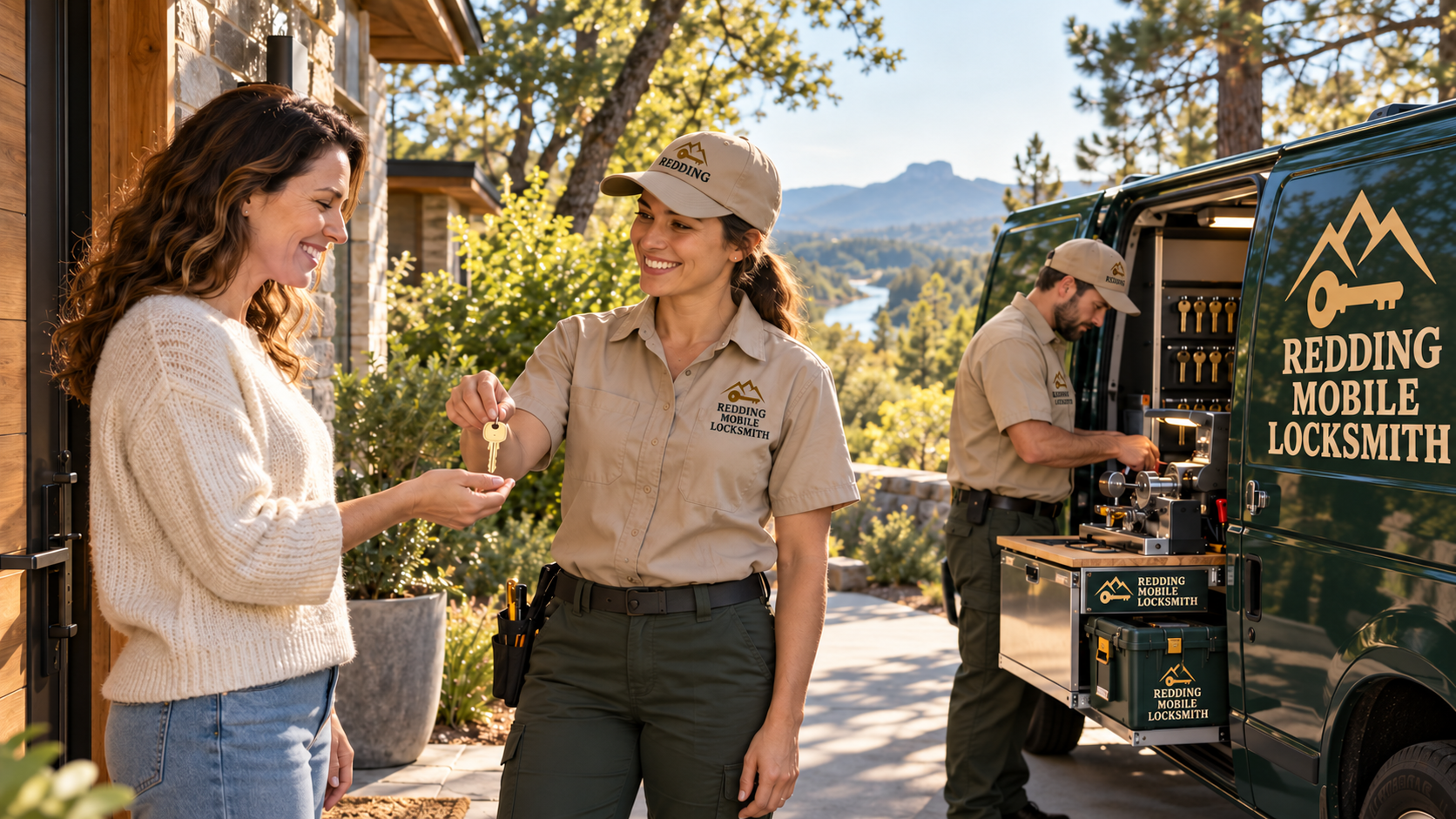
When it is urgent, there is emergency help any hour in Shasta Lake. We are a 24 hour service, with branded vans and uniformed technicians, and the request form is currently the way to reach us because the phone line is coming soon.
When you are locked out near the water
The first rule is safety. If a child or pet is inside a locked vehicle, call emergency services right away, then deal with the lock. If you are at the shore or on a boat ramp and your phone is in the car, find a person who can help you reach the right people, and do not attempt anything risky to get back in.
For a car, think about what else might open it: another door, a trunk release, a spare key with someone nearby. For a home, think about whether a window is unlatched, and resist any approach that damages the frame. A professional can usually open a door without harm and will check that you are entitled to be inside before starting.
Once you are back in, take a minute to fix the cause. A spare key kept somewhere sensible, a second fob made while the first still works, and a habit of patting your pocket before closing a door are all low cost protections. Our guides on locked out of a borrowed car and what to try first in a lockout are good to read ahead of time.
Neighbors up and down Interstate 5
The city sits between Redding to the south and Lakehead to the north, with Anderson farther down the same corridor. People move between these places constantly, and the same technicians cover them all.
If you are comparing what is available, take a look at our full list of help. It sets out each service in plain language, from emergency lockouts to commercial door hardware. For short answers to the sorts of things neighbors ask, Neighbors Ask collects the guides in one place.
Whatever your situation, the approach is the same: tell us what happened, show that the lock or vehicle is yours, hear the plan, and decide. You can begin any time with the request form.
One more thought for a place with so many people coming and going: keys travel. A guest takes one home by accident, a contractor keeps one for the next visit, a relative copies one for convenience. None of this is sinister, it is simply what happens when a lot of people share a lot of doors. A fresh rekey every so often, or after any change in who lives or stays at a property, gives you a clean starting point and a calmer mind. It is among the smallest jobs a locksmith does, and among the most worthwhile.
Good to know
Common questions
Which ZIP codes in Shasta Lake do you serve?
We serve Shasta Lake across its three ZIP codes, 96019, 96079 and 96089, as part of our coverage of seventeen communities in Shasta and Siskiyou counties. If you are near the city but not certain you are inside it, mention that in the request form and we will tell you whether we can come.
I rent my home. Can I ask for the locks to be rekeyed?
You can ask, but the answer usually belongs to your landlord or manager, and rules vary by lease and property. Many owners agree to rekey between tenants. Ask in writing, find out who pays and who may authorize the work, and then contact us once the right person has said yes.
My boat key and my car key are on one ring and I locked it all in the truck. What now?
First make sure nobody is in danger. Then use the request form and describe the vehicle, where it is parked and what is inside. A technician will check that the truck is yours and open it without damage where possible. Afterward, consider a spare key kept somewhere separate.
Do you make car keys on site for commuter vehicles?
Yes, in many cases. Our service van carries key cutting and programming equipment, so a key can often be cut and coded to your vehicle where it is parked. Tell us the general make, approximate year and what kind of key you have so the right equipment is brought.
How often should a vacation home have its locks changed?
There is no fixed schedule. Consider rekeying whenever you buy a property, after a rental period, when a key goes missing, or when several people have held copies. Seasonal closing is also a good time to check every door and window latch and to decide who holds keys while the place is empty.
Is there a phone number for Shasta Lake service?
Not yet. The call line is coming soon, and we do not publish a number until it is live. For now the request form on our contact page is the way to ask for help, and it can be marked urgent when a lockout or a damaged door cannot wait.