
Home / Services / Replacement Car Keys
Car key replacement
Replacement Car Keys: Every Type, from Plain Blade to Smart Key
A car key used to be a piece of shaped metal. Today it can be a tiny computer. Knowing which kind you hold explains why replacing one can be simple, or a more involved job.
Car key replacement
Why replacing a car key is not one job anymore
Ask a few neighbors about the last time they lost a car key and you will get very different stories. One person walked into a hardware counter and left with a copy in a few steps. Another needed a long conversation, a vehicle identification number and a technician with a laptop. Both were right, because the word key now covers objects that have almost nothing in common.
The difference comes down to what is inside the key. A plain metal blade only has to match the cuts of a lock. A modern key also has to prove to the car, electronically, that it belongs. Replacing the second kind means making a key that does both jobs, and that is why a mobile locksmith arrives with cutting equipment and programming equipment in the same van.
This page takes you through the families of car keys, from the simplest to the smartest, and explains how replacement differs for each one. Read it before you need it, or read it right now if you are standing in a parking lot with an empty pocket.
The plain metal key
The oldest and simplest car key is a single piece of metal with cuts along its edge. Those cuts lift tiny pins or wafers inside the ignition and door locks to the correct heights, and the cylinder turns. There is no electronics, no battery and no conversation with the car's computer.
Replacing a plain key is mostly a cutting job. If you still have one working key, a copy can be made from it. If you have none, a locksmith can often work out the cuts from the lock itself or from a key code tied to the vehicle, and cut a new key from a blank. The skill is in getting the cuts accurate, since small errors mean a key that sticks, wears the lock or simply will not turn.
These keys are common on older cars and trucks, and some work vehicles still use them. If your vehicle is old enough that nothing electronic is involved in starting it, replacement can be one of the more direct jobs in car key work.
One thing to watch is wear. A copy made from a worn key inherits the wear, so a third generation copy can feel sloppy in the lock. If your only key is badly worn, it is worth cutting a fresh one from the code or from a clean original and retiring the tired one, so the lock and the key both last longer.
The transponder key
From the later part of the last century, many manufacturers added a small chip to the plastic head of the key. This chip is called a transponder. It holds a code, and when you turn the key, the car sends out a weak signal that powers the chip and asks it to answer. If the answer is right, the engine is allowed to start. If it is wrong, the engine may turn over briefly and then stop.
This means a transponder key has two requirements. The metal blade must be cut to open and turn the ignition, and the chip must be introduced to the car so it recognizes the code. A key with the correct cuts but no matching chip will turn the lock and still not start the car. You can learn more in our guide on what a transponder chip is.
Replacing one therefore involves cutting and programming. The locksmith cuts the blade, prepares the chip, and then teaches the car to accept it. The details differ by vehicle, and some vehicles need an additional step when all keys are lost, which is why it helps to tell the locksmith in advance whether you still have a working key.
- A transponder key looks like a normal key with a thick plastic head.
- The chip inside needs no battery, because the car powers it through the ignition.
- The blade must match the cuts, and the chip must match the car.
- Having one working key often makes adding another simpler.
The remote head key and the separate fob
Many drivers carry a key with buttons built into the head, or a separate fob on the same ring. The buttons lock and unlock doors, open a trunk or hatch, and sometimes start the engine from a distance. Inside is a small radio transmitter, a battery, and often a transponder chip as well.
These pieces are separate systems. The transponder lets the car start. The remote transmitter lets you work the doors. Either can fail on its own, which is why a car can start with a key whose buttons have stopped working, or why the buttons can work while the car refuses to start. A dead battery is a common cause of dead buttons and costs far less to fix than a replacement key.
When a remote head key is replaced, the locksmith treats both functions. The blade is cut, the chip is programmed, and the remote is introduced to the car so it responds to the new buttons. If you only lost the fob and still have the blade key, the job is smaller. Our page on key programming and fobs explains the learning process in detail.
Some of these keys fold the metal blade into the fob like a pocket knife, with a button that swings it out. They are handy in a pocket, but the hinge, the spring and the blade are all wear points. When one of those breaks and the electronics are still healthy, the circuit board and chip can often be moved into a new shell instead of replacing the whole key, which keeps the job simpler. A locksmith can inspect it and tell you whether that route makes sense.
The laser cut key
Some keys have a thick body with a wavy channel milled into the flat side rather than cuts along the edge. These are called laser cut or high security keys, though the name has more to do with the cutting pattern than with an actual laser. The channel makes them harder to copy with ordinary tools, and they typically fit locks with more precise internal parts.
Cutting one requires a machine built for the job. A shop counter machine that handles ordinary keys cannot follow the channel, so these keys come from specialized equipment. The van of a mobile locksmith carries that equipment, which means the key can be cut at your location instead of you waiting for a part from somewhere else.
These keys can be plain, transponder, or remote head, so the replacement steps still depend on the electronics inside. The cut is only half the story.
Ask the locksmith to explain which blade style your key uses before work begins. A high security blade sometimes has a different key blank for each model year, and the right blank matters as much as the cut. Describing the key, or sending a photo through the request form, helps make sure the correct blank is brought to the job.
The smart key and push button start
The smartest keys never touch a lock at all. You carry a fob in a pocket or bag, and the car detects it as you approach, unlocks the doors when you touch the handle, and starts when you press a button with your foot on the brake. Underneath, the car and fob exchange encrypted messages at close range, and the system verifies the fob each time.
Most of these fobs hide a small emergency blade inside, which opens the door if the fob battery has died. They are the most complex to replace because the car must be taught to trust a new fob, and some vehicles restrict how many fobs can be added or how the process is performed.
If you have a smart key and it stops working, try a fresh battery before anything else. If that does not help, or the fob is gone altogether, a locksmith with the right programming equipment can usually address it, depending on the vehicle. Be ready to tell them the year, make and model, and whether you have another working fob.
When you have no key at all
Losing the only key is the situation people dread, and it is often easier than they expect. A locksmith can usually produce a new key without the original, using information tied to the vehicle and the lock. For ordinary mechanical keys this involves key code cutting, which uses a code instead of an existing key as the pattern. Our guide on key code cutting explains how that works.
For electronic keys, the process adds a step. The car must be told to accept a new key, and in many vehicles that process requires access to the car's security system. This takes more preparation than adding a spare, but it is routine work for a locksmith with the proper equipment.
You can read more in our answer about making a key when you have none at all. Whatever the situation, expect to be asked for proof that the vehicle is yours, such as a registration or title and your identification.
Proof of ownership and why it comes first
Any responsible locksmith will ask you to show you own the vehicle before making a key. That might sound like a hurdle, but think about the alternative. A key is a license to drive away with someone's property, and a service that made keys for anyone who asked would be dangerous for every car owner in the county.
Typical proof includes a registration or title matched with photo identification. If you are borrowing a car or handling it for a relative, explain the situation and ask what documents would work. Rules vary, and the locksmith will tell you what they need.
Having the paperwork ready saves the most time. Keep a photo of your registration on your phone and know where the vehicle identification number appears on the dashboard and on your documents. It can make the difference between a smooth visit and a wait.
Why a mobile visit usually beats a tow
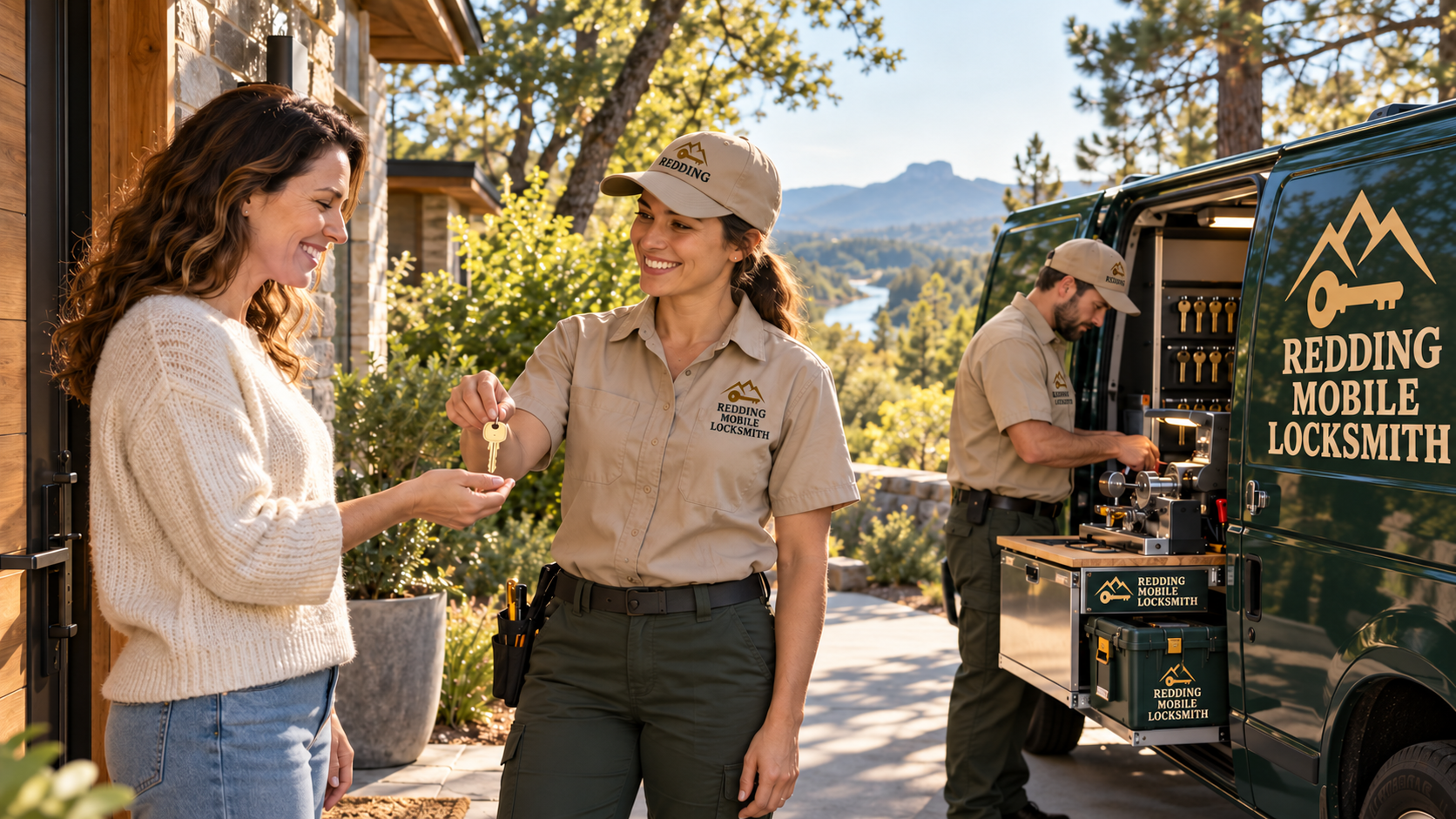
Many people assume a lost car key means a tow to a dealership and a long wait. For many vehicles that is not necessary. A mobile locksmith comes to the car, whether it is in a driveway, a workplace lot, or at the edge of a rural road, and does the cutting and programming there. The van carries professional tools, key cutting and programming equipment, and common hardware.
That matters across our service area. In Redding and Anderson the car may be at a home or workplace. Up in Mount Shasta, Dunsmuir or Yreka it might be parked near snow banks, and in Lakehead near the lake the car might be at a trailhead or a campsite. Reaching the vehicle where it sits avoids moving a car that cannot be driven.
Not every vehicle can be handled on site, and a locksmith will tell you honestly if a particular model needs something different. Ask early, describe the car, and you will get a clear answer.
Spare keys: a habit worth building before you need it
The ideal time to make a spare is while you still have a working key. Copying a key you hold is a smaller job than building one from nothing, and it avoids the stress of having no way to move the car. Many households keep a spare in a safe place at home, not in the car, where a thief might find it.
Think about how many keys the car should have in total. A family with several drivers may want one per driver. A work truck shared among employees may need a tracked set. A used car that came with only one key is a good candidate for a spare right away. Our companion page on cars and trucks covers the wider picture.
If you are not sure which type of key you have, a short description is enough to start. Tell us the year, make, model and what the key looks like, then send a note through the request form. The phone line is coming soon, and the form is the way to reach us for now.
Replacement across our service area
We serve 17 communities across Shasta and Siskiyou counties. The needs vary a little by place. Valley towns see a mix of commuter cars, family vehicles and work trucks, while the mountain towns see visitors, seasonal residents and vehicles that have waited out a hard winter.
Look at our pages for Redding and Yreka to see what typical key situations look like in each area, or visit the Redding key programming page for a closer look at the electronic side of the work.
If a fob has simply stopped responding, start with our note on what to do when a key fob stops working. And if you are wondering whether programming is even needed, see whether all car keys need programming. Business details such as staff names and credentials will be added here as they are confirmed.
Good to know
Common questions
Can a locksmith make a car key if I have lost every key?
Often yes. For mechanical keys a locksmith can cut from a code or from the lock. For electronic keys, the car must also be taught to accept the new key, which takes extra equipment. Tell the locksmith the year, make and model, and be ready to prove you own the vehicle.
What is the difference between a transponder key and a remote key?
A transponder key has a chip inside that lets the engine start. A remote key has a radio transmitter that works the doors. Many keys have both, but they are separate systems, so one can fail while the other still works. A replacement has to address whichever functions your key has.
My key turns the lock but the car will not start. Why?
That usually means the metal blade is cut correctly but the chip inside is missing, damaged or not matched to the car. The ignition turns because the cuts are right, but the car's security system does not recognize the key's code. Programming the key to the car normally fixes this.
Do I need to bring the car anywhere?
Not usually. A mobile locksmith comes to the vehicle with cutting and programming equipment and works where the car sits. Some models may need special handling, and the locksmith will tell you honestly if yours does. Describe the vehicle in your request so the right equipment is brought.
What documents should I have ready?
Have your photo identification and proof that the vehicle is yours, such as a registration or title. A photo of those papers on your phone helps. The vehicle identification number, visible through the windshield, can speed things up. If the car is not in your name, explain why and ask what would work.
Is it worth fixing a worn fob instead of replacing it?
Sometimes. If the electronics inside still work, a fresh battery or a new shell can restore the key without a full replacement. A locksmith can inspect the fob and tell you whether the board and chip are healthy. If not, replacement and programming is the cleaner route.