Emergency lockouts
Home, vehicle and business access when the key is missing or the lock will not cooperate.
Tell us what happened Redding MobileLocksmithRequest service
Local help, right at your door
Clear communication and a properly equipped mobile team for lock and key needs across the North State.
Call line coming soon.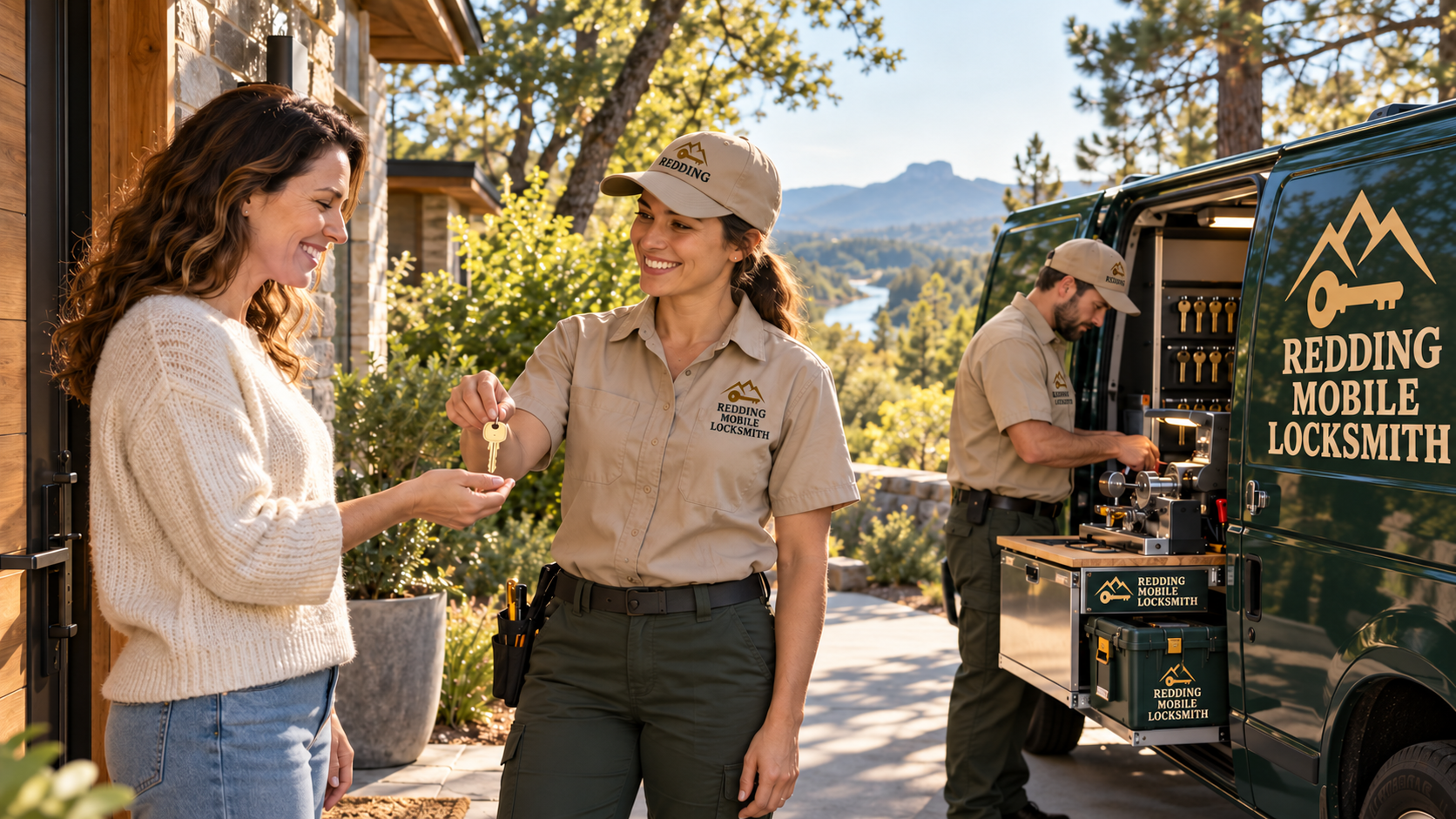 Redding, California
24 hourEmergency availability
MobileTools and key equipment
Two countiesFull requested coverage
HumanClear, respectful service
A more thoughtful service call
Our website is designed around what customers actually need in the moment: an easy way to explain the problem, clear service categories, and immediate confirmation of whether their community is covered.
Services
Home, vehicle and business access when the key is missing or the lock will not cooperate.
Tell us what happenedVehicle entry, replacement keys, key programming and other mobile automotive services.
Automotive helpRekeys, lock changes, repairs and straightforward security improvements for the home.
Home locksmithRekeying, door hardware and access solutions for offices, shops and local properties.
Business serviceThe people and the tools
The van is part workshop, part inventory room. It keeps the team ready for common residential, automotive and commercial needs without making the experience feel impersonal.
Service area
Every community we serve and its ZIP codes are listed below.
Welcome neighbor
Most trades ask you to bring the problem to them. A locksmith is different, because the problem is usually the thing that is stuck: a door you cannot get through, a car you cannot get into, a key that will not turn. So the sensible shape for this work is a van that travels, with the workshop inside it. That is what we run, and it is the idea behind everything on this site.
The people who show up are a branded team in uniforms, driving a branded service van. That matters more than it sounds. When someone arrives at your home after dark or at your car on a quiet road, you should be able to tell at a glance that this is the business you asked for, not a stranger who happened to pull up. A uniform and a marked van are small things that make a stressful moment a little easier.
We are a 24 hour service, which means a lockout at three in the morning is treated as a real job and not an inconvenience. If you are reading this because you are standing outside right now, skip ahead to the section about asking for help. If you are reading this at the kitchen table with a cup of coffee, welcome, and take your time.
There is also a quieter benefit to a mobile service that people notice only afterward. You stay with your property. Your car is not towed away, your door is not left unlatched while you run to a shop, and you can watch the work and ask questions as it happens. For anyone who has ever handed keys to a stranger and wondered, that is a real comfort.
Our home base is Redding, and from there the work reaches across Shasta County and up into Siskiyou County. In Shasta County that means Redding, Anderson, Shasta Lake, Cottonwood, Palo Cedro, Millville, Lakehead and Sims. In Siskiyou County it means Mount Shasta, Yreka, Dunsmuir, McCloud, Weed, Granada, Montague, Fort Jones and Etna.
The country in between is not uniform, and a good locksmith knows it. The valley floor around Redding and Anderson has hot, dry summers and older neighborhoods next to newer subdivisions. Further north, the road along Interstate 5 climbs toward Mount Shasta, Dunsmuir and Weed, where winter brings snow and hard cold that change how locks and car doors behave. Out toward Yreka and Montague the land opens up, and in places like Fort Jones and Etna the properties are bigger and the neighbors farther apart.
Every one of those places has its own page on this site, with a short list of the services people there ask about most. If you want the full picture by corridor and county, the service areas page lays it out with ZIP codes. Think of it as a map you can read.
A mobile locksmith lives or dies by what is on the shelves inside the vehicle. Ours carries professional tools, key cutting and programming equipment, and a stock of common hardware. The point of each is simple. Tools let us work on a lock without wrecking it. Cutting and programming equipment lets us make a working key on the spot, including the electronic kind that modern cars expect. Common hardware means that when a lock is beyond saving, we can often put a sound one in its place during the same visit. That is the difference between a job that ends and a job that drags on.
That last part is worth dwelling on. A lot of lock trouble ends in a part that has to be replaced: a worn cylinder, a bent latch, a strike plate that no longer lines up. If the replacement is in the van, you go back inside and the door works. If it is not, you are left with a temporary fix and a second appointment. Stocking the common items is how a mobile service avoids that.
None of this is magic and none of it is meant to impress. It is just a workshop that happens to have wheels, organized so that the usual jobs can be finished where they start.
The work falls into twelve services, and the services page explains each one. Four are the big headings: emergency help at any hour, cars and trucks, home lock service and business lock service. Eight are the specific jobs that sit underneath them.
Those eight are being locked out of a car or a home, replacement car keys, key programming and fobs, rekeying a home, lock repair and adjustment, new lock installation and door hardware for business. Some people arrive knowing exactly which one they need. Many do not, and that is fine. Describe what is happening and the right label usually becomes obvious.
A small example makes the point. Imagine a key that has started to stick in a front door lock. Is that repair, a rekey, or a replacement? It depends on whether the key is worn, the cylinder is worn, or the door has shifted. A technician figures that out by looking, and you should never feel you had to guess the category before calling.
Here is the honest state of things. Our phone line is coming soon, and we are not going to publish a number that is not ready. Until it is, the way to reach us is the request form on the contact page, which you can jump to directly at the request form. Tell us where you are, what is locked and what has happened so far.
If you are in danger, if a child or an animal is shut inside a vehicle, or if you smell smoke or gas, do not wait on any locksmith. Call emergency services first. A locksmith can help with the lock afterward, but nothing about a lock is more urgent than a person or a pet in trouble.
When you write to us, a few plain details save a great deal of back and forth. Name the community, say whether it is a car, a home or a business, and describe the problem in your own words. You do not need the technical vocabulary. Phrases like it turns but nothing happens, or the key went in and now it will not come out, are exactly the kind of clues a technician uses.
There is a short list of things that make any call go smoothly, and you can think about them before you ever need us. For a car, know the make, model and year, and whether the missing key is a plain metal key, a key with a plastic head, or a push button fob. For a home, know which door and whether it has a deadbolt, a handle lock or both. For a business, know whether the door is a storefront, an office or a back entrance.
The second thing is proof that the place or vehicle is yours. A responsible locksmith will ask for it, and you should be glad when they do, because the same care protects your own property. The neighbors ask library has a guide on exactly this, what to have ready when you call a locksmith, and another on how to tell a real locksmith from a pretender.
Finally, think about where you will wait. If you are locked out at night, a lit, public spot is better than a dark driveway. The guide on being locked out at night walks through that in a calm, practical way.
A car lock, a house lock and a shop lock all turn a bolt, but the thinking behind each is different. Cars are about electronics as much as metal. Many keys contain a small chip that the car must recognize before the engine will run, and many fobs talk to the vehicle by radio. Getting a new one working is a programming job, not just a cutting job.
Homes are about people. A house lock has to work for a family, a houseguest, a babysitter, sometimes a tenant. The questions are about who has a key, who used to, and whether it is time to change that. Rekeying, which changes the inside of a lock so old keys stop working, is often the neatest answer and often keeps the existing hardware in service instead of starting over with new locks.
Businesses are about routines. Who opens, who closes, who left last month and still has a key? A shop owner thinks about access the way a homeowner thinks about family. The business lock service page and the door hardware page cover that side in detail, and the guide on a new business owner lock checklist is a good first read.
One habit applies to all three. Before any lock work begins, ask what the technician is going to do and why. A clear answer in ordinary words is a sign you are in good hands. Vague answers, pressure to decide at once, or a sudden need to drill a lock that nobody has tried to open any other way are signs to slow down and ask again.
Up here, the weather is a coworker. In the valley, long hot summers bake car interiors, warp plastic and dry out lubricant, so a stiff key in August is not unusual. In the mountain towns, winter brings moisture that freezes inside a lock, and cold makes metal contract and plastics turn brittle. A fob battery that worked fine in October can quit on the first hard frost.
Seasonal habits help. A little of the right lubricant at the right time, a spare key kept somewhere sensible, and a look at door fit when the seasons change all prevent the small failures that turn into lockouts. The guides on weather and locks and what lubricant belongs in a lock go into the details.
Wood doors swell and shrink with the humidity, and a door that closed easily in dry weather may rub in wet weather, which pushes the latch out of line with its strike plate. That kind of problem looks like a bad lock but is really a door fit issue, which is why a technician always looks at the whole door and not just the cylinder.
There are four main places to go. The services section explains what we do. The service areas section explains where. The neighbors ask library is a collection of answers to the questions people actually raise about locks, keys and doors. And the about page explains how we work.
Inside the service areas, each community page leads to six short local pages on the topics that matter most there, which saves you from hunting. Inside the library, guides are grouped by theme: rekeying and replacing, cars, renters and landlords, businesses, repairs, and the odd corners like mailboxes, gates and cabins.
We wrote the library as if each question had come over the fence from a neighbor. The answers are meant to be useful even if you never call us. If a guide helps you solve a problem with a screwdriver and a little patience, that is a good outcome. And if a guide convinces you that you need a professional after all, the path from there to a request is short.
Every page links onward to related ones, so you can follow your own question. Someone reading about rekeying, for instance, will find a route to lock repair and to the guide on whether rekeying beats replacing. Someone reading about a community will find its local pages. Nothing here is a dead end.
Honesty is part of the service, so here is what is not on this site yet. We have not published a phone number, an email address or a street address, and we are not going to hint at them. We have not listed prices, because the right answer depends on the job. We have not made claims about arrival times, since those depend on where you are and what else is happening.
Business details such as ownership, history and credentials will be added as they are confirmed, and the about page says so in plain language. We would rather leave a gap than fill it with something that sounds good.
What you can count on is the approach. We explain what we are doing, we ask for proof of ownership, we keep the work to what is needed, and we tell you what we find. If you have a question that this site does not answer, put it in the request form and we will answer it directly.
Good to know
Yes. Redding Mobile Locksmith is a 24 hour mobile service, so a lockout late at night or very early in the morning is treated like any other job. Because the phone line is still coming soon, use the request form on the contact page and give your location and the problem in plain words.
Seventeen. In Shasta County: Redding, Anderson, Shasta Lake, Cottonwood, Palo Cedro, Millville, Lakehead and Sims. In Siskiyou County: Mount Shasta, Yreka, Dunsmuir, McCloud, Weed, Granada, Montague, Fort Jones and Etna. Each has its own page with ZIP codes and local topics.
We come to you. The service van carries professional tools, key cutting and programming equipment, and common hardware, so most work is done where the lock is. That is why a mobile locksmith suits a stuck door or a locked car far better than a shop visit does.
Car locks and ignitions, house doors, deadbolts, handle sets, and commercial doors and hardware. The twelve services cover lockouts, key replacement, key programming, rekeying, repair, new lock installation and business door hardware. If you are unsure which applies, describe the problem and we will sort it out together.
Look for the uniform and the branded service van, and expect to be asked to show that the property is yours. A real locksmith wants that proof. The neighbors ask library has a guide on spotting the real thing that is worth reading before you ever need to call.
Of course. Use the request form on the contact page and say that you only have a question. Many people want to know whether a rekey or a replacement makes more sense, or what a worn lock looks like, and a plain answer is usually just a few minutes of conversation away.
Request service
Tell us where you are and what happened. The call line is coming soon.