
Home / Neighbors ask / Locked out at night, what is the safe thing to do?
Neighbors ask
Locked out at night, what is the safe thing to do?
Get yourself somewhere lit, visible and out of the cold or heat first, then tell someone you trust where you are. The lock can wait a few minutes. Your safety cannot.
Neighbors ask
Safety before the lock
A lockout at night feels different from the same lockout at noon. The street is quieter, the porch light may be on the wrong side of the door, and every small sound seems louder. The first job is not to open anything. It is to make sure you are in a place where nothing worse can happen while you sort the rest out.
Look around and decide whether where you are standing is a good place to wait. A spot with light, a view of the street and, ideally, other people nearby is better than a dark driveway or a deserted lot. If your spot is not good, move to one that is, even if it means leaving the car or the front step for a little while.
Then take a breath. Almost every lockout is solvable, and most are solved without any harm at all. A calm, ordered approach is what turns an upsetting evening into an ordinary story you will tell later.
It helps to keep a short mental list. Am I in a safe spot? Does someone know where I am? Is my phone charged? Is anyone inside who needs help? If every answer is yes, you can move on to the lock with a clear head. If one answer is no, fix that first, because it is the thing most likely to matter by the end of the night.
When to call emergency services instead
There are a few moments when a locksmith is not the right first call. If a child or a pet is locked inside a vehicle, call emergency services at once. If someone inside your home may be hurt, ill or in danger, call emergency services. If you think someone is following you or is threatening you, go toward people and light and call for help right away.
Also call emergency services if you notice signs that someone has forced a door or window while you were out. In that case, do not go in. Stand back, keep clear of the entrance, and let trained responders check the place first. Your belongings can be sorted out later.
Calling for help in those situations is the right call and nobody will think you overreacted. A lock can always be fixed afterward, and our guide on locks after a break in picks up the story once everyone is safe.
Tell someone where you are
Send a message to a friend or family member with your location and a short description of what has happened. It might feel like a small step, but it means that someone else knows where you are and can check on you if they do not hear from you again.
If your phone is running low, do that first, before searching for a number or looking up options. A short message costs very little battery, and a dead phone is a much bigger problem than a locked door. If you can, turn the screen brightness down and close any apps you do not need.
Where you have a neighbor you know well, consider knocking. Many of us have a spare key tucked away with someone down the street, and a friendly face at the door is a good thing at night. Just use judgment, and only approach homes where you feel comfortable and where lights are on.
If you are traveling on a long stretch of highway, such as Interstate 5 or Highway 299, and the lockout happens at a rest stop or small town, the same advice holds. Share your location, describe the vehicle, and stay where there are lights and other people. Rural areas can be quiet after dark, which makes a plain message to a friend even more valuable.
Locked out of your car after dark
If you are locked out of a car, think about where it is parked. A well lit lot beside a business that is open is a decent place to wait. A pull off beside a dark stretch of road is not. If the car is in a risky spot, it may be wiser to walk to a safe place nearby and leave the vehicle until help arrives.
Keep your hazard lights on if the car still has power, and stay clear of traffic. Do not stand in the road, and do not lean on the car in a way that puts you between the vehicle and passing traffic. If you have a reflective item or a flashlight, use it.
When you are ready to call, our page on locked out of your car explains how a technician opens a vehicle without damage. If a child or pet is inside, remember the rule above and call emergency services first.
Keys left in a running car, or a fob left inside a car that locked itself, are the two most common night time stories. In both, the engine may still be on, so stay clear of the exhaust pipe if you are in an enclosed space like a garage, and do not climb into the car through a gap you have forced. A professional can open the door without harm to the seals or the electronics.
Locked out of your home after dark
At home the picture changes. You are standing at your own front door, and it is easy to start looking for creative ways in. Resist that urge. Climbing through a window, scaling a fence or leaning a ladder against a wall in the dark is a good way to get hurt, and it can damage frames and screens as well.
A few calm checks are worth making. Is there another door you left unlocked, like a patio door or garage entry? Does a family member or housemate have a key and a way to reach you? Is there a spare hidden or left with a neighbor? If any of these work, you may be inside without any further help.
If not, our page on locked out of your home describes how a professional gets you back in without harming the lock or the door, and the home lock service page covers what we can do afterward to make the door more dependable.
If you rent, think about who else may have access. A landlord or property manager sometimes keeps a spare, and building rules differ on who may call for help and who must be informed, so ask rather than assume. If you live in a complex with a shared entry, a neighbor may be able to let you through the outer door while you arrange help for your own.
A short checklist for the walk to safety
If you do decide to leave the car or the doorstep to find a safer place, take what matters first. Your phone, wallet and anything you cannot replace should go with you, and valuables should not be left in view if you have to leave a vehicle for a while. Lock what can be locked and note where you left it.
Choose your destination thoughtfully. An open gas station, a hospital entrance, a 24 hour restaurant or a friend's porch with the lights on are all better than a stretch of empty sidewalk. If you are unsure, go toward people. Their presence is often the strongest protection you have.
Once you are settled, make your call. Describe your location in words that someone else can follow, such as the nearest cross road, a landmark or the name of the business you are beside. It sounds obvious, but a clear description saves a lot of back and forth when you are cold and tired and the person helping you is unfamiliar with the spot.
Finally, keep a record of what you did, if only in a note on your phone. The time you called, who you spoke to and what was said can be handy later, and it keeps you from having to rely on memory after a long night. Small habits like these are what make the next surprise feel less like a crisis.
Weather and the hours after dark
Weather is the quiet partner in every lockout. In the mountain towns, a cold night with frost or snow turns a short wait into a risk, and anyone without a warm coat should treat shelter as the first priority. In the valley during summer, the evening can stay hot long after sunset, and a car left closed can hold heat for hours.
If you are cold, move somewhere warm: a friend's place, an open business, or a vehicle with a working heater. If you are hot, find shade and water. Neither of these is a luxury. Waiting well is part of the plan.
Let the technician know about the conditions when you call. A person standing in sleet needs a different level of urgency than a person on a mild porch, and we would rather plan around the real situation than guess.
How to tell a legitimate locksmith from a stranger
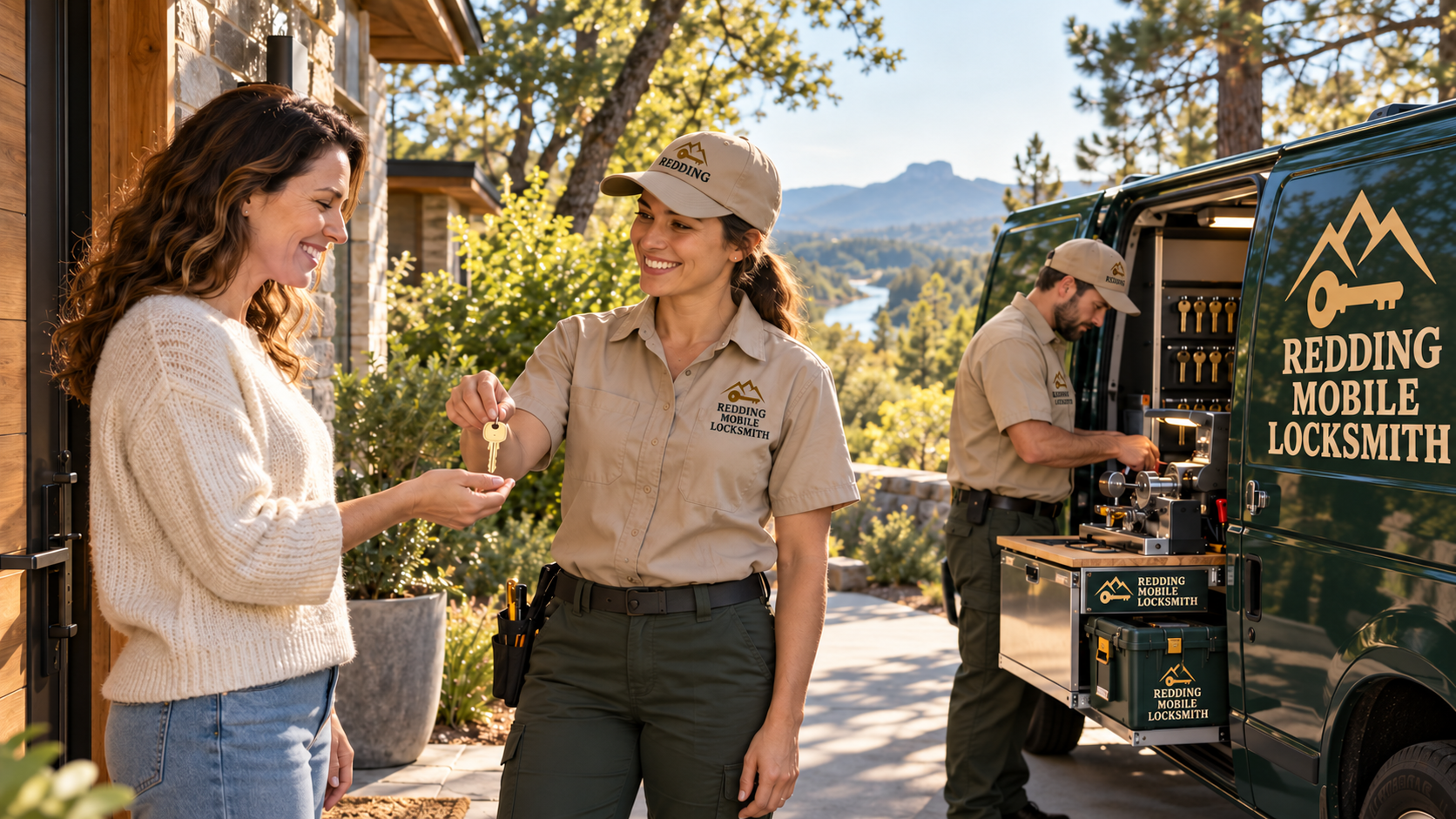
Night is when people are most hurried, and that is why it is worth slowing down for a moment to confirm who is coming. A genuine locksmith will give you a business name on the phone, explain what will happen, and arrive in a vehicle and with a uniform that match what you were told. Ours comes in a branded service van with a branded team in uniforms.
Ask for identification when the technician arrives and compare it with what you were told. Be wary of anyone who refuses to give a name, who demands payment before explaining the work, or who pressures you into drilling a lock without first trying a gentler method.
Our guide on how do I know a locksmith is the real thing offers a longer checklist. You are allowed to ask questions, and a professional expects them. If you do not like the answers, you may say no and look elsewhere.
What a night call with us looks like
We take calls around the clock, and you can describe your situation on the request form on the contact page. Tell us where you are, what you are locked out of, whether it is a car or a home, and whether anyone is inside. If it is a car, include the make, model and year.
Picture someone stuck outside a house after returning from a late shift. They tell us the door type, we explain what is likely to happen, and a technician arrives in a clearly marked van. The identification is shown, the ownership of the home is confirmed, and the door is opened with tools made for the job. Afterward, the lock is tested to be sure it works.
The same pattern holds for vehicles, and for businesses that need entry after hours. Our page on emergency help at any hour sets out the service in more detail, so you can read it ahead of time and avoid the stress of searching for answers while standing in the dark.
We will not promise a particular arrival time, because roads, weather and distance vary, but we will tell you honestly what to expect once we know your location. Keep your phone on and nearby so the technician can reach you, and stay in your safe spot until they arrive. A short call to confirm that you see the van is a sensible habit.
What not to do
Do not break a window to get in, even if it seems like the simplest solution. Glass is dangerous, repairs can cost much more than the call you were avoiding, and a broken pane in a car or home leaves the space open to weather and theft. Do not try to force a lock with tools that are not made for it, because you can wreck the mechanism and make the eventual fix harder.
Do not accept help from a stranger who offers to open the door for a fee on the spot, and do not hand over keys, cards or personal documents to anyone you have not verified. If someone offers a ride or a place to wait and you are not comfortable, say no and go back to your safe spot.
Finally, do not stand in a dark place for the sake of saving money or avoiding a call. Delay can mean cold, fatigue and worse choices. If you need help, ask for it, and if you are unsure what to do, call someone you trust and talk it through.
Making the next night easier
Once you are back in, spend a minute thinking about how to avoid a repeat. A spare key with a trusted neighbor, a lockbox with a code, or a keypad lock can all make a late night lockout less stressful. Our guide on how many keys a household should keep offers some practical suggestions.
Put your key somewhere consistent. A hook by the door, a zipped pocket on a bag, a clip on a belt loop all work better than the bottom of a purse. Make a habit of checking your pockets before you close the door behind you, especially when you are tired, carrying groceries or leaving a car that locks itself.
And if the lockout showed you that a lock is worn or unreliable, deal with that in daylight. Our page on lock repair and adjustment explains what can often be fixed without replacing the whole door.
Good to know
Common questions
What is the first thing to do when I am locked out at night?
Move to a lit, visible spot where you feel safe, preferably near other people, and tell someone you trust where you are. Only after that should you work on the lock. If a child or pet is locked inside, or you feel threatened, call emergency services first.
Is it safe to wait next to my car on a dark road?
Often it is not. If the car is on a poorly lit road, move to a safer place such as a lit business that is open, and leave the car until help arrives. Stay clear of traffic, use hazard lights if the car has power, and keep your phone charged.
Should I try to climb in a window of my own house?
We would advise against it. In the dark you can fall, cut yourself on glass or damage the frame and screens. First check whether another door is unlocked or whether someone has a spare. If not, a locksmith can open the door without damage.
How do I know the person who shows up is a real locksmith?
Ask for a business name on the phone, look for a marked vehicle and uniform on arrival, and ask for identification before any work begins. A professional explains the job, confirms you own or may access the property, and does not pressure you. You may decline and look elsewhere.
Do locksmiths work at night?
Ours does. We are a 24 hour mobile locksmith serving Shasta County and Siskiyou County, with a branded team and service van. Use the request form on the contact page to describe where you are and what is locked, and include the vehicle details if it is a car.
What if the weather is very cold or hot while I wait?
Treat shelter as a priority. Go to a warm place or a vehicle with a working heater in the cold, and to shade and water in the heat. Tell the technician about the conditions when you call so they understand the situation and can plan accordingly.