
Home / Services / Locked Out of Your Home
Home lockouts
Locked Out of Your Home: What Happens and What to Have Ready
Standing on your own porch without a way in is a strange kind of helpless. Here is how a house lockout is handled, what proof of residence means, and how families, renters and owners each get through it.
Home lockouts
The moment you realize the door has closed behind you
It usually happens in the most ordinary way. You carry out the trash, the wind catches the door, and the latch clicks home with your keys still sitting on the kitchen counter. Or you come back from a long shift and the key simply will not turn. Either way, you are suddenly a visitor at your own address, and the feeling is part embarrassment and part alarm.
Take a breath before you do anything dramatic. Most house lockouts are solved without a single scratch on the door, the frame or the lock, because a trained locksmith works with the lock rather than against it. The damage people fear, a broken window or a kicked in jamb, is almost always the more expensive and more stressful route.
This page walks through what a house lockout call actually looks like from your side of the door. It covers the questions you will be asked, the proof you will be asked for, and the small decisions that make the visit go smoothly. It also covers what to do afterward so the same thing does not happen next month.
What a mobile locksmith does when you call
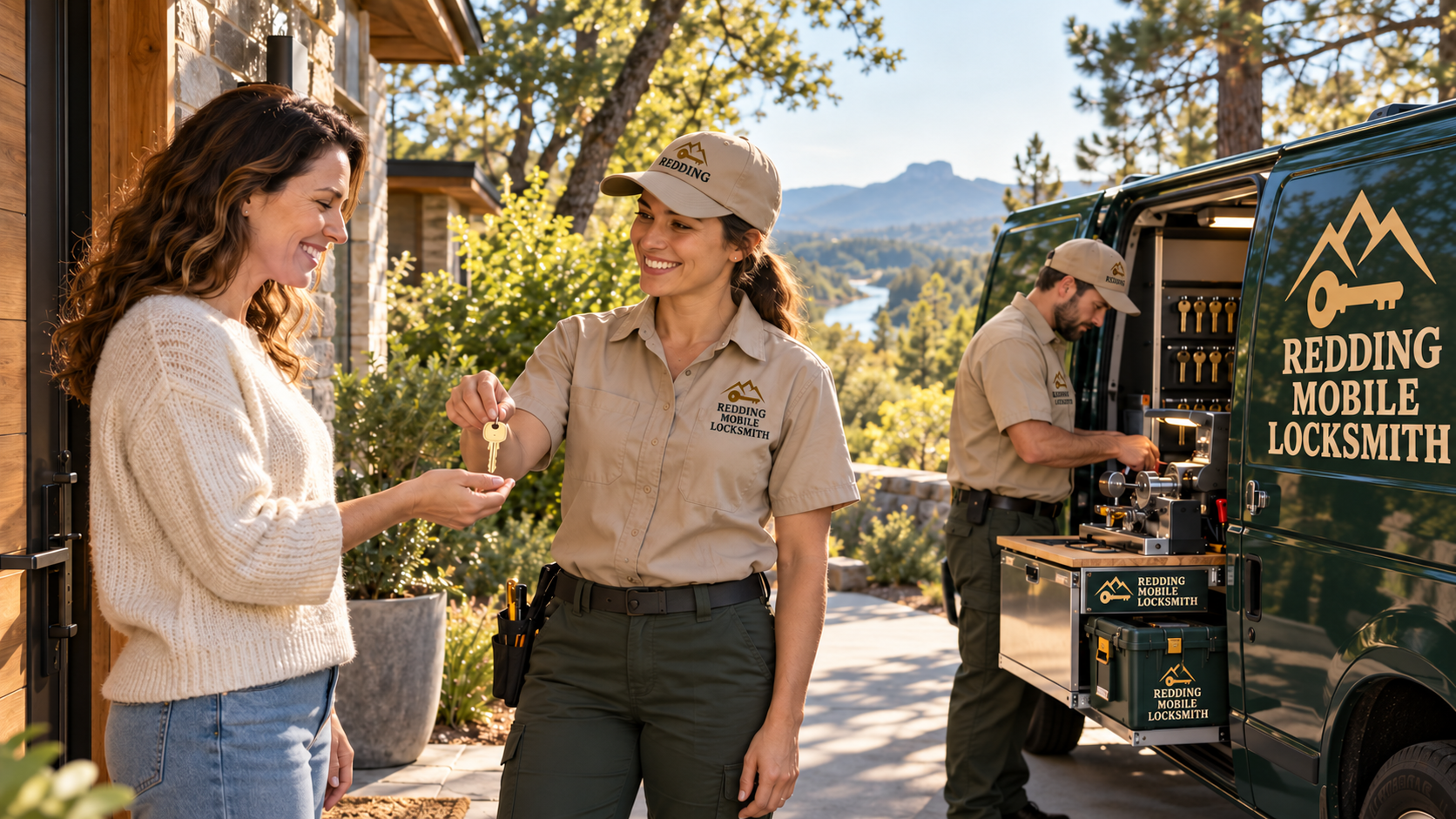
Redding Mobile Locksmith is a 24 hour mobile service, which means the work comes to you instead of asking you to come to a shop. The team arrives in uniforms and a branded service van, carrying professional tools, key cutting equipment and common hardware. That van matters, because it means most problems can be solved on your porch in one visit rather than in two.
Before anyone touches your door, you can expect a short conversation. You will be asked where you are, what kind of door and lock you have, and whether anything seems damaged. You will also be asked who you are and how you connect to the home. That last question is not an accusation. It is the thing that separates a legitimate locksmith from someone who would open any door for anyone.
Once the details line up, the locksmith assesses the lock. Many residential locks can be opened without damage using specialist tools and an understanding of how the mechanism works, and when a lock cannot be opened cleanly, a professional will explain the options before choosing one. You stay informed and you stay in charge of the decision.
Proof of residence and why it matters
A responsible locksmith asks you to show that you belong at the address. This is the part that surprises people, so it deserves a plain explanation. Opening a door for someone who does not live there is exactly how a burglary or a domestic dispute turns worse. Asking for proof protects you, your neighbors and the locksmith.
Proof of residence is usually something ordinary that links your name to the home. A government issued photo identification with the address is the cleanest example. A piece of mail, a utility bill, a lease, or a vehicle registration can also help, and so can the simple fact that your belongings are visible inside and a neighbor knows you. Rules and practices vary, so the locksmith will tell you what they need in your situation.
If your identification is inside the house, do not panic. Say so honestly. There are usually other ways to establish who you are, such as documents on your phone, a conversation with a landlord, or a family member who can confirm the situation. The point is a reasonable check, not a trap. A locksmith who skips the check altogether is the one to be wary of.
- Photo identification that shows the address is the easiest proof.
- A lease, rental agreement or recent bill with your name on it can help.
- A landlord or property manager can confirm a renter's tenancy.
- A family member who lives there can vouch for you if you cannot show papers.
- If you have nothing at all, explain calmly and ask what else would work.
Families, children and the clock in your head
A lockout feels very different when a child is involved. Imagine a parent who steps outside to carry a bag to the car while a toddler plays in the living room, and the door swings shut behind them. That is not an inconvenience anymore. It is an emergency, and it deserves to be treated as one.
If a child or anyone who cannot help themselves is alone inside, call emergency services first. A locksmith is a good partner for a locked door, but emergency responders are the right call when someone's safety is at risk right now. After that, call for locksmith help and say clearly that a child is inside, so the visit is handled with the right urgency.
For ordinary family lockouts, the most useful preparation is quiet. Teach older children where a trusted neighbor lives. Agree on a plan for what to do if they arrive home and cannot get in. A short conversation at the kitchen table now saves a cold, anxious wait on the step later, and it works in every season, from the hot dry afternoons in the valley to the snowy evenings in the mountain towns.
If you rent, the landlord is part of the story
Renters get locked out just as often as owners, but they have an extra party to think about. Your lease may say who is responsible for lock changes, who holds spare keys, and what you are allowed to do to the hardware. Those arrangements differ from one building to the next, and this page cannot tell you what yours says.
What we can say is that a locksmith will usually want to open the door without damaging it, because a damaged door becomes a conversation with the landlord about repair. Opening cleanly keeps the situation simple. If a lock does need to be repaired or replaced, ask your landlord or property manager first about what they expect.
If you lost your keys instead of locking them inside, ask yourself whether anyone else could now find them. A lost key with your address on a tag is a different problem from a key left on the counter. In that case, rekeying your home is worth discussing with the landlord, since it makes the lost key useless without changing the whole lock.
Owners have more choices, and more to protect
If you own the home, you get to decide how much to do while the locksmith is already standing there. Some owners simply want in and nothing more. Others use the lockout as a reason to look at the hardware they have been ignoring for years, such as a sticky deadbolt, a loose handle, or a back door lock that never worked well.
Because the van carries common hardware, many fixes happen during the same visit. A worn cylinder can be replaced, a lock can be rekeyed so an old key no longer works, and a failing deadbolt can be swapped for a new one. Ask what is realistic before the work begins, and ask the locksmith to explain what each option changes in plain language.
It also helps to think about who else has keys. A home that has had contractors, house sitters, former partners and old tenants may have more working keys in circulation than you realize. A lockout is a natural moment to ask whether those keys should still open your door. You can read more about how that works on our home lock service page.
What to try before you call
Before you pick up the phone, it is worth a calm, five minute check of the easy things. Walk around the house and test the other doors, including the garage entry and any side or patio doors, in case one was left unlocked. Check whether a family member, roommate or neighbor holds a spare. Look at the obvious hiding places only if you already keep a key hidden, and think twice about leaving one anywhere a stranger might find it.
What you should not do is force the door, take a tool to the lock, or climb through a window you cannot safely reach. Forcing a lock tends to turn a small problem into a broken latch, a cracked frame or an injured hand. Window climbing is where people get hurt. Our guide on what a lockout is and what to try first goes through the sensible order of steps.
If it is dark, cold or you simply do not feel safe where you are standing, skip the experiments and make the call. Our note on being locked out at night covers how to stay safe while you wait.
What to have ready when you request help
The easier you make the first conversation, the smoother the visit. Know your exact address and any gate or entry details. Be ready to describe the door, for example whether it is a front door with a deadbolt, a sliding patio door, or a side door with only a knob. Mention whether you can see the keys inside, whether the lock has been acting strangely, and whether anyone is waiting inside.
Have your identification close, even if it is just a photo on your phone, and any document that links you to the home. If you rent, think about whether your landlord will be reachable. If you are not the person who lives there, such as a relative helping an elderly parent, say so right away and explain the relationship.
Our short list of what to have ready when you call a locksmith goes into more detail. When you are ready, you can send a request through the request form on the contact page. The phone line is coming soon, so the form is the way to reach us for now.
After you are back inside
Once the door is open, take a moment before you close it again. If the lock was hard to turn, sticky or loose, say so while the locksmith is still there, because it may be a sign of a lock that is wearing out. A lock that fails gently today often fails completely a few weeks later, usually at an inconvenient time.
Think about a spare. A spare key stored with a trusted neighbor or family member, or a keypad lock that does not rely on a physical key, can turn the next lockout into a small bump instead of a call. Every approach has tradeoffs, so ask about the ones that suit your door and your household.
Finally, build a small habit. Many lockouts happen during a routine moment, like taking out the trash or checking the mail. Keeping a key on your person, not on a hook by the door, is a boring answer that works. It is also worth reading about lock repair and adjustment if the lock that locked you out was already misbehaving.
Weather, seasons and the lockout that gets worse
Where you live changes how a lockout feels. In the hot dry summers of the valley, standing on a sun baked porch with a phone running low on battery is miserable in its own way, and shade, water and patience matter. In the mountain towns, a winter lockout can mean snow, ice and a drop in temperature that turns waiting into a real concern.
Cold also affects locks themselves. A deadbolt that moves easily in August can stiffen when moisture freezes inside it, and a door that swells with damp weather can bind against its strike so the bolt will not line up. Sometimes what looks like a lockout is really a lock and door that need adjustment, which is why the locksmith may look at the fit as well as the keyway.
If you are outside in bad weather, tell the person you speak with. It helps them understand how urgent the situation is and what to ask you to do while you wait, such as moving to a sheltered spot or sitting in your car. Safety comes first, and a lock can always be dealt with a little later.
Serving homes across Shasta and Siskiyou counties
Lockouts do not respect city limits, and neither does this service. We cover 17 communities across both counties, from the valley towns around Redding and Anderson up through the mountain communities near Mount Shasta, Dunsmuir and Yreka. Each place has its own housing mix, from older houses with original hardware to newer builds with keypad entries.
If you are in the valley, our pages for Redding and Anderson describe what homes there tend to need. For a closer look at a specific service in your town, try the Redding home lock service page, which shows how the work looks in that community.
Wherever you are, the approach stays the same: confirm who you are, open the door without damage whenever possible, explain the choices, and leave the home more secure than we found it. Business details like staff and credentials will be added to this site as they are confirmed, and nothing here is invented to fill a gap.
Good to know
Common questions
Will a locksmith damage my door when opening it?
Most residential lockouts can be solved without damage, because a trained locksmith works the lock itself using specialist tools. Occasionally a lock is jammed, broken or unusually built, and the locksmith will explain the situation and the options before choosing any approach that could affect the hardware. You decide how to proceed.
What counts as proof that I live at the address?
Photo identification showing the address is the clearest proof. A lease, a recent bill, or mail addressed to you can also help, as can confirmation from a landlord or a family member who lives there. If you have nothing with you, explain honestly and the locksmith will tell you what else might work.
I rent my home. Should I call my landlord first?
It is usually wise to let your landlord or property manager know, since your lease may cover lock changes and spare keys. If you are stuck outside and need help right away, a locksmith can still verify who you are and open the door cleanly. Ask your landlord about any hardware repairs afterward.
What if a child or pet is alone inside?
Call emergency services first. They are the right responders for anyone in immediate danger, and a locksmith is not a substitute. After you have contacted them, request locksmith help as well and make sure to say clearly that someone is inside, so the visit is treated with the right urgency.
Can I keep using the same key after a lockout?
If you only locked the key inside, nothing about the key changes and it will work as before. If the key was lost, it makes sense to ask about rekeying so the old key no longer opens the lock. Rekeying changes the inside of the cylinder while the hardware stays in place.
How do I request help if the phone line is not available yet?
The phone line is coming soon. For now, use the request form on the contact page and describe your address, your door and what happened. Include anything about children or safety concerns first so the right level of attention is given to your request.