
Home / Services / Emergency Help Any Hour
Emergency help
Emergency help at any hour: staying safe and calm when you cannot get in
A lockout never arrives at a convenient time. This page is about the first few minutes: how to keep yourself safe, how to steady your thinking, and which details to give so that a mobile locksmith can help without guesswork.
Emergency help
First, check the thing that matters more than the lock
Before anything else, look at the people and animals involved. If a child or a pet is shut inside a vehicle, call emergency services first, right now, before you search for any locksmith. If someone inside a building needs help, or you smell smoke or gas, the same rule applies. A lock is a problem that can be solved calmly later tonight. A person in trouble is not.
Once everyone is safe, the situation changes character. A lockout is annoying, sometimes expensive and occasionally frightening, but it is rarely an emergency in the true sense. Knowing that lets you slow your breathing, put the phone down for a moment, and think. People who pause for thirty seconds usually make better decisions than people who hurry.
We are a 24 hour service, so a lockout at midnight is as welcome a request as one at noon. Still, the safest thing you can do is keep your own situation steady while help is arranged, and the rest of this page explains how.
It also helps to say out loud, to yourself or to whoever is with you, what has actually gone wrong. The keys are inside. The lock is jammed. The key snapped. Naming the problem in one plain sentence tends to shrink it, and that same sentence is a good opening line for your request.
Choosing a safe place to wait
Where you stand matters more than most people realize. If you are locked out of a car, a lit, public spot with other people around is better than a dark roadside. If you are locked out of a home, a neighbor's porch you know, a well lit sidewalk, or a car you can sit in with the doors locked are all good choices. Avoid wandering to find a better signal or a different view.
In the mountain towns, weather becomes part of the safety picture. A winter night with snow on the ground and a jacket left inside is a different problem from a summer evening in the valley. In the hot months, shade and water matter. Think about what you need to stay comfortable for a while, and move toward it.
If you feel unsafe where you are, say so when you ask for help and move somewhere you feel better. The guide on being locked out at night goes through this in more detail, with practical suggestions.
Keep your phone charged if you can, and keep it in your hand rather than in the locked car or house. It sounds obvious, but a surprising number of lockouts also strand the phone, and then the first job becomes borrowing one. If you do borrow a phone, ask the owner to stay nearby so you are not alone while you wait.
The details that make a request useful
Good help starts with good information. The most useful single detail is your location, as precisely as you can give it: the community, the road, and any landmark you can describe without naming a business. Rural roads often have a mailing address that does not match where you stand, so describe what you can see.
Second, say what is locked. A car, a home, a shop and a gate each call for different tools. Add the specifics: the make, model and year for a vehicle, or whether a door has a deadbolt, a handle lock or both. Third, describe what has already happened. Did the key break? Did the lock stop turning? Did you simply leave the keys inside?
Fourth, tell us who you are in relation to the property. The owner, a tenant, an employee and a family member all have different standing, and a responsible locksmith asks. You will find a fuller list on the guide about what to have ready.
One more helpful detail is whether anyone else has a key. A spouse, a roommate, a landlord, a neighbor with a spare, or a manager at work might solve the problem with a single call and no locksmith at all. Check that before you ask for help. If it does not work, you will have lost very little, and the technician will want to know that you tried.
- Your location, as precisely as you can describe it.
- What is locked: a car, a home, a business or something smaller.
- The make, model and year if it is a vehicle.
- What you have already tried, and whether anything broke.
- Your relationship to the property, and what proof you can show.
How to ask while the phone line is coming soon
Our phone line is coming soon, and we will not guess at a number or post one that does not work. Until it is live, the way to reach us is the request form on the contact page, which you can jump to directly at the request form. Write it as if you were telling a friend what happened.
There is no special language required. Phrases such as the key turns but the door will not open, or my keys are on the car seat and the doors are locked, are the kind of detail a technician finds useful. Short messages are fine. Long ones are fine too. The point is to say where you are and what is going on.
If you are in a place with weak reception, write the message before you need it, and send it when the signal returns. And if you are able to reach emergency services but not us, that is the right priority whenever safety is involved.
Include anything that might affect access, too. Is there a locked gate on the drive? Is the driveway steep or icy? Is the building set far back from the road? These small facts help the technician plan the route and bring the right equipment, and they cost you only a sentence to write.
Photographs can help as well, if your phone allows. A picture of the door, the lock or the vehicle gives a technician a head start on what hardware is involved, and it can settle small doubts about brand, finish or fit before anyone arrives. You do not need a good photograph, only a clear one.
What arrives when help does
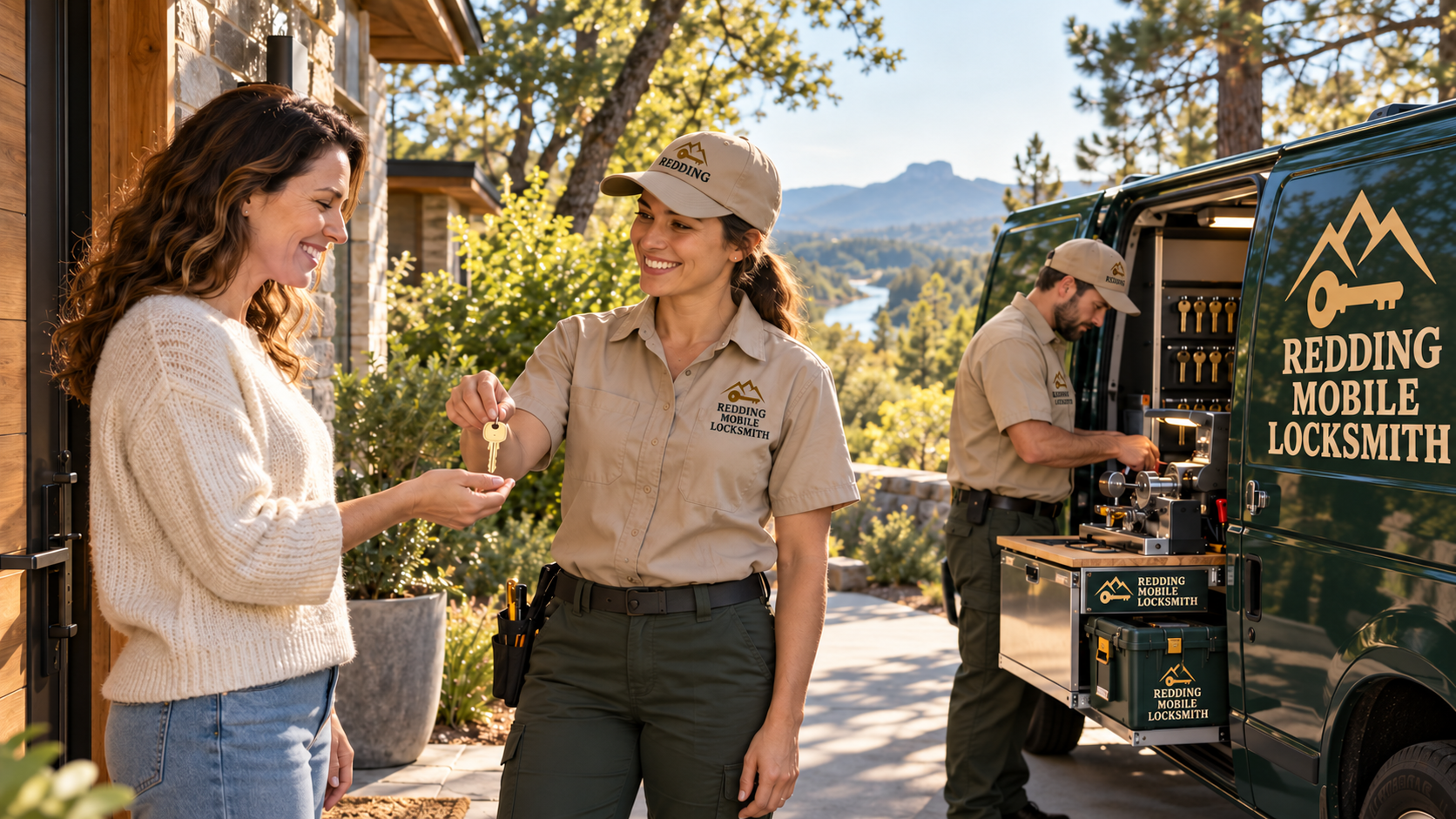
A branded team in uniforms arrives in a branded service van. That detail is a safety feature, not a marketing flourish. When you are tired, frustrated and alone at a curb, being able to recognize the people you expected matters. If a vehicle that does not look like what you asked for pulls up, you are entitled to be careful and to ask questions.
The van carries professional tools, key cutting and programming equipment, and common hardware. For an emergency visit, that means the technician can often open the door, fix or replace a damaged part, and cut a working key without sending you away to wait for something to be ordered. Not every job can be finished that way, but many can.
Expect to be asked to prove the property is yours. A driver's license showing a matching address, a vehicle registration, or a lease are common examples. If you have none to hand, say so, and talk it through. The aim is to protect you, not to make your night harder.
If you want to double check who is arriving, ask the technician to show their identification and explain who sent them. A genuine professional will not mind. The guide on telling a real locksmith from a pretender lists other signs worth knowing.
What the technician will and will not do
The technician's first goal is to get you in without damage. For a car, that usually means entry methods that do not scratch glass or tear weatherstripping. For a door, it means working with the lock itself in a way that leaves it usable afterward. Force is a last resort and is usually a sign that something unusual is going on.
A professional will tell you what they plan to do before they do it, and will not pressure you to approve extra work you do not need. If a lock is damaged, they will show you the problem and explain your options, which may include repair, rekeying or replacement. You decide.
We do not publish prices on this site, and we do not promise times, because honest numbers depend on the job and the place. What you can expect is an explanation in ordinary words, and a technician who treats your property with care.
Finally, remember that a lockout is not a character flaw. Locksmiths meet people with expensive cars, tidy homes and careful habits every day, all of whom have been caught out by a door that swung shut. There is nothing embarrassing about it, and the technician has almost certainly seen the same thing earlier the same week.
Common emergency situations, and how they differ
A car lockout with the keys in plain view is the simplest case. A house lockout in the evening, with no spare key and no one home, is the next most common. A broken key in a lock, a lock that suddenly will not turn, or a door that has been damaged by a break in attempt are more complicated, and the technician will need details.
Business emergencies have their own character. A shop owner who cannot open up in the morning, or one who has just let a staff member go and wants the locks changed right away, needs a different kind of help from a homeowner who cannot find a key. Say clearly which it is. The business lock service page covers that angle.
If you have just been through a break in, make sure you are safe first and that the authorities have been told. The guide on locks after a break in explains how to think about the doors afterward.
Weather and season color the picture too. In the hot valley summers a car lockout feels urgent for reasons that go beyond the lock, since a closed car heats up. In the snowy months a house lockout with no coat inside is its own kind of urgent. Tell us about those conditions, because they affect how we plan, and if anyone is at risk, safety services come first.
Related services you might need
Emergency help often leads to a second job. A car lockout may need lockout service for vehicles followed by a replacement key. A house lockout may need home entry help, then a rekey if the missing key could be in someone else's hands. A damaged lock may need repair and adjustment or a new lock.
It is worth deciding calmly, afterward, which of these is right. Resist the urge to approve everything in the middle of a stressful night. A technician can secure the door for now and let you choose the longer term fix the next day when you can think.
The services page explains all twelve services if you want the whole picture.
If you are weighing whether to upgrade after a bad night, give yourself a day. Rekey or replace is a question worth answering with a clear head, and so is whether every exterior door needs a deadbolt.
Preparing now so the emergency is smaller later
The ideal emergency is one that never quite happens. A spare key with someone you trust, a photograph of your vehicle details stored on your phone, and a short note of which doors have which locks all shrink a lockout into an inconvenience. It takes a few minutes on a calm day.
Check fob batteries before winter, oil sticky locks with the right product, and fix a door that has begun to drag. The library has short guides on how many keys a household should keep and what to do with a stuck key.
If you manage a business or a rental, write down who holds what. That one page can turn a crisis into a simple lookup.
A short habit to build is checking pockets and bags at the door, every time, before it closes behind you. Keys, phone, wallet. Many lockouts happen in the half second when a door is already swinging shut. It feels silly until the first time it saves you, and then it feels like common sense.
Where emergency help applies
Emergency help is available in every community we serve, from Redding and Anderson to Mount Shasta, Yreka and Etna. Each community page lists a local emergency page with details that suit that setting, and the service areas page lists them all.
Rural and mountain locations take a little extra thought, because roads are longer and conditions vary. Say where you are, and be honest about any difficulty reaching you: a locked gate, a steep drive, deep snow. A technician who knows in advance can bring what is needed.
Seasonal visitors deserve a mention. If you are staying in a rental, a cabin or a vacation home in Lakehead, Mount Shasta or Sims, check with the host about spare keys and lockboxes before you need them. A lockout in an unfamiliar place is much easier to solve when you already know who to ask.
Good to know
Common questions
Is emergency help really available at every hour?
Yes. Redding Mobile Locksmith is a 24 hour mobile service, so a request sent in the middle of the night is treated like any other. Because the phone line is coming soon, use the request form on the contact page and include your location and what has happened.
What should I do first if I am locked out?
Check that everyone is safe, and if a child or a pet is inside a vehicle, call emergency services before anything else. Then move to a safe, lit place, check for any unlocked door or window you know of, and gather your location details.
Will you ask for proof that the property is mine?
Yes, and you should expect it. A responsible locksmith confirms that the person asking has the right to enter. Examples include a driver's license with a matching address, a vehicle registration or a lease. If you have none with you, explain, and the technician will talk it through.
Can you open a door without damaging it?
In most cases, yes. A skilled technician tries methods that leave the lock and the door intact. Damage is usually a sign of something unusual, such as a lock already broken or a door bent by a previous attempt, and the technician will explain what they find.
What if I have no signal where I am?
Move to a safe spot with reception if you can do so without risk, or ask a nearby person for help sending the message. If safety is at stake, contact emergency services by any means you have. For a plain lockout, waiting in a safe place is fine.
Do you charge more for night calls?
We do not publish prices on this site, so we cannot quote one here. Ask in the request form, mention the hour and the place, and describe the job. A clear answer before work begins is part of how we operate, and you can say no before anything starts.