
Home / Weed / Emergency Help Any Hour in Weed
Weed emergencies
Emergency Help Any Hour in Weed: What to Do in the First Ten Minutes
A lockout feels enormous when it happens, but the first few minutes are mostly small, calm choices. Here is what to check, what to avoid, and what to prepare, whether it is you or a neighbor.
Weed emergencies
A knock on the door at an odd hour
Imagine you are at home in Weed on a windy evening and you hear a knock. It is the neighbor from down the street, jacket pulled tight, holding a phone in one hand and nothing in the other. The door is shut behind them, the keys are on the kitchen counter, and the light in the hallway is on, which is somehow the worst part. You can see where the keys are, but you cannot reach them.
What would you tell them? Most of us reach for a few instincts at that moment, and some of them are good. Stay calm. Check the obvious. Make a plan. But a few instincts are not good, like trying a screwdriver on the frame or a credit card on the latch, which tend to damage the door and rarely work. This page is the conversation you would want to have with that neighbor.
It is also the conversation you would want to have with yourself, because the person on the porch is going to be you at some point. Almost everyone gets locked out once. What separates a short, tidy evening from a long, expensive one is mostly what happens in the first ten minutes, before anyone has made the situation worse.
Minute one: stop, breathe, and look around
The first minute is for assessing, not acting. Take a breath and look at what you actually have. Are you safe where you are? Is it dark, cold, or windy? Is anyone with you who needs shelter? Is anyone, a child or a pet, inside the home or vehicle? If the answer to that last question is yes, call emergency services first, before anyone else. A locksmith is not a substitute for them.
If everyone is safe, the situation changes from a crisis into a puzzle. You are outside, the door is locked, and you want in. That is a solvable problem and rarely a dangerous one. Reminding yourself of that helps you make better choices. Most bad decisions in a lockout come from panic, not from the lock. The lock is doing exactly what it was built to do; the trouble is only that you are on the wrong side of it.
Check your own pockets and bag, including the coat you wore yesterday and the console of the vehicle you drove today. People are often surprised to find a spare key tucked in a jacket, or a garage opener clipped to a visor. Check your phone, too, since you may need it for calls and light. If your phone is inside, borrow one from a neighbor, which is a good reason to be on friendly terms with the people nearby. A small town runs on exactly this kind of favor.
Minutes two to four: the checks that cost nothing
Walk around the home and try every door and window you know to be yours. Do it gently. A back door that was left unlocked, a garage entry door, or a window latch that never quite caught are all common ways back in. Do not climb or force anything, and do not break glass, because broken glass is more costly and more dangerous than almost any lockout.
Think about who might have a spare. A family member, a roommate, a trusted neighbor, or a landlord might. Make that call now rather than later. If you have a smart lock with a keypad or a phone app, try that too. If you keep a spare in a lockbox, check the code. Our neighbor guide on what a lockout is and what to try first goes through these checks in a bit more detail.
While you check, notice the weather. Weed can be windy, and nights get cold in the cooler months. If you are not dressed for waiting outside, find a warmer place to wait, such as a neighbor's porch or a vehicle. Comfort matters, because a cold, tired person makes hurried choices.
- Try every door and window you own, gently and without force.
- Call anyone who might hold a spare key.
- Check a keypad, app, or lockbox if you have one.
- Find shelter from wind and cold if the wait could be long.
- Do not break glass or climb to a second story.
What to avoid, even with good intentions
Some well meant attempts do more harm than good. Prying a door with a screwdriver can bend the frame and crack the jamb. Slipping a credit card into the latch gap works only on the simplest spring latches and can snap the card or damage the weather strip. Kicking a door can split the frame and leave you with a bigger repair than the original problem.
Neighbors, especially friendly ones, sometimes want to help with tools from the garage. Gently decline. A door that is intact can be opened by a professional without damage, but a door that has been battered must be repaired, sometimes replaced. Ask your neighbor to help in other ways, like lending a phone, a warm spot, or a flashlight.
Do not post your situation on a public social media page asking for help. It tells strangers that your home is empty and your door is locked. Contact people you know, and contact a reputable locksmith. Our guide on how to know a locksmith is the real thing explains what to look for when someone arrives.
What to prepare before you call
Preparing a few details makes the call smoother. Be ready to say where you are, what kind of door or vehicle is locked, and whether anyone is inside. Know whether the door has a deadbolt or only a latch, and whether it is a standard house door, a sliding door, a garage entry, or something else. If it is a vehicle, know its general type, year, and whether it has a key blade or a push button start.
Have identification and proof that you live at the home or own the vehicle. A professional will ask for it before opening anything, and that step protects you. A utility bill, a registration, or a piece of mail with your name and address can help. If you are locked out of your house, the identification may be inside, which is a little ironic. In that case, a neighbor who can vouch for you or a landlord's confirmation can help.
Finally, find a safe place to wait that has light and shelter. Let the locksmith know where you are. Our guide on what to have ready when you call a locksmith covers the same ground in a handy list.
Cars, trucks, and highway stops
Weed sits where Interstate 5 meets Highway 97, and a lot of lockouts happen far from home. A traveler stops for gas, steps out, and hears the doors lock. A driver pulls over to stretch and leaves the keys on the seat. A hiker parks at a trailhead and returns to a vehicle that will not open. These feel more stressful than a home lockout, because you may be a long way from your own door.
If you are stuck beside a road, safety comes first. Move away from traffic, keep your phone charged, and stay somewhere visible, such as a lit parking area. If there is any chance someone is inside the vehicle, call emergency services. Otherwise, call a locksmith who can reach you. Our page on locked out of your car explains how a professional opens a vehicle without harm.
Notice what is around you, such as a nearby business or public place where you can wait. Be careful about accepting help from strangers who offer to open the vehicle themselves. A professional arrives in a marked vehicle and asks for identification. Our neighbor guide on what is the safe thing to do when locked out at night adds more on that.
Lockouts that are not the front door
Not every lockout involves the main door of a house or a car. Some of the most annoying ones happen at the edges of daily life: a sliding patio door that slid shut with the latch down, a shed with a padlock and a missing key, a side gate that locks on its own, or the door between the garage and the kitchen after the overhead door has closed behind you. Each of these has its own quirks, and each is usually solvable without drama.
A sliding door typically has a small hook latch that drops into a keeper on the frame, sometimes with a pin or a bar in the track for extra hold. If the latch has caught and the door will not budge, the answer is rarely force. A professional can work with the door in a way that does not bend the track or crack the glass. A padlock on a shed is a different story, since a padlock is a self contained device, and options include finding a spare key, cutting a key from the lock code, or in the worst case opening or replacing the lock itself.
The door from the garage to the house deserves a mention, because it often locks behind people by design. Keep a spare key somewhere outside the house that you can reach, such as with a trusted neighbor, and know where the emergency release cord of the overhead door hangs. Our neighbor guide on what to do if the garage entry door lock fails is useful here, and shed and garage padlock questions covers the padlock side. Describe the exact door when you call, and say whether anything is blocking it from the inside.
How mobile emergency help works
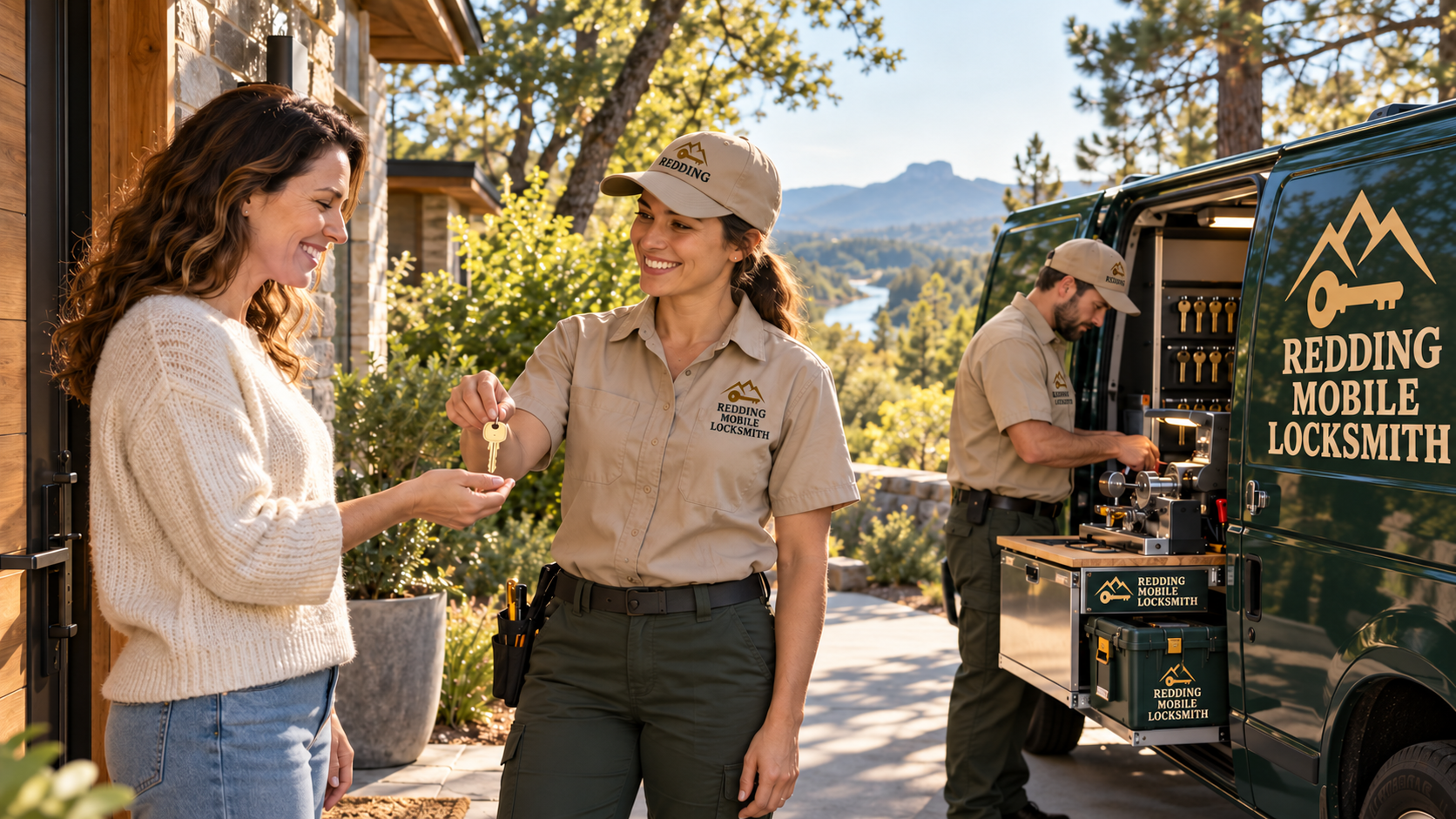
Redding Mobile Locksmith is a 24 hour mobile locksmith. The team works in uniforms and arrives in a branded service van carrying professional tools, key cutting and programming equipment, and common hardware. That means the help comes to you, in a driveway, at a curb, or in a parking area, and the work is done on site.
When help arrives, the locksmith will confirm who you are and that you are entitled to the home or vehicle. Then they assess the lock and choose a method that fits. The aim is to open the door without damaging it. If a lock is worn or broken, they can often repair or replace it right then, and if you lost the key, they can often make a new one. Our page on emergency help any hour describes the general process.
We do not publish arrival times or promise specific timing, because conditions vary. What we can say is that the team is built for the situation you are in. To reach us, use the request form on our contact page. Our phone line is coming soon, so the form is the way to start right now. Share the location, the kind of lock, and anything unusual, and the team can prepare the right tools before the van heads out.
After you are back inside
The moment the door opens, it is tempting to exhale and forget the whole thing. Take two more minutes before you do, because this is the calmest moment you will have to look things over. Check the lock that was involved. Does the key still turn smoothly? Did the lock or door sustain any damage? If anything feels different, say so before the locksmith leaves.
Then think about what caused the lockout and how to prevent a repeat. Is a spare key kept with a trusted person? Is there a lockbox, and who knows the code? Does the household need another key? Our neighbor guide on how many keys a household should keep offers a sensible answer.
If the lockout revealed a weakness, such as a worn latch, a sticky deadbolt, or a door that does not close square, now is the time to fix it. Our service pages on lock repair and adjustment and being locked out of your home may help you decide on next steps. A small repair after a lockout is far easier to live with than another lockout later.
Being the good neighbor
Back at the start, our neighbor stood on the porch with a phone and a problem. The kindest help is calm, practical, and kind. Offer a warm place to sit. Offer a phone. Offer to wait with them so they are not alone in the dark. Offer a charger, a drink, a flashlight. Do not offer to break in.
Small acts of preparation also make you a better neighbor. Know the names of the people nearby. Agree, if you like, to hold a spare key for each other, and keep it somewhere safe and labeled in a way a stranger could not understand. Make sure your own household knows where its spare is, and that everyone can describe it without pointing at the wrong drawer. The more of these ties exist, the less a lockout turns into a crisis.
For a wider view of our coverage, visit the page about service in Weed, or see our home lock walkthrough for Weed. Next time someone knocks on your door at an odd hour, you will know exactly what to say.
Good to know
Common questions
What should I do first if I am locked out?
Stop and check that everyone is safe. If a child or pet is inside the home or vehicle, call emergency services first. Otherwise, check pockets and bags for a spare, then gently try your other doors and windows. Avoid forcing anything, and call a locksmith if nothing works.
Why should I not pry the door or use a credit card?
Prying can bend the frame and crack the jamb, and a card works only on the simplest spring latches and can break or damage seals. A professional can usually open an intact door without damage, so force often turns a lockout into a repair.
What will the locksmith ask me for?
Expect to confirm where you are, what type of door or vehicle is locked, and whether anyone is inside. You will be asked for identification and proof that you live there or own the vehicle. This step protects you and the property.
Is it safe to ask for help on social media?
It is better not to. A public post can signal that your home is empty and your door is locked. Contact people you know, such as family or neighbors, and a locksmith you can verify when they arrive.
How does mobile help reach me at a trailhead or highway stop?
The service van comes to your location with tools, key cutting and programming equipment, and common hardware. Tell the team where you are, what is locked, and a safe place to wait. We do not publish arrival times, since distance and conditions vary.
What should I do after the door is open?
Test the lock that was involved, ask about any damage, and decide how to prevent another lockout. Consider a spare key held by someone you trust, a lockbox, or a repair if the lock or door was sticking. Note what happened for your records.