
Home / Weed / Cars and Trucks in Weed
Weed vehicles
Cars and Trucks in Weed: When the Problem Is Really the Key
Many vehicle troubles that look like a dead battery or a stubborn engine are actually key problems in disguise. Here is how to tell the difference, with Weed's roads and weather in mind.
Weed vehicles
The family that cannot get home from the lake
Imagine a family finishing a long day at a lake or in the woods near Weed. Wet towels in the back, tired kids, a cooler that is lighter than it was this morning. Someone turns the key, or presses the start button, and nothing happens in the way they expected. Maybe the dash flashes a little key symbol. Maybe the engine turns over and then quits. Maybe the doors will not unlock from the fob. Everyone assumes the vehicle is broken.
Often the vehicle is fine. What has failed is the conversation between the key and the car. Modern vehicles do not just turn a mechanical lock. They check a small coded chip in the key, they listen for a radio signal from the fob, and they decide whether to allow the engine to run. When any part of that exchange fails, the symptoms can look exactly like a mechanical problem.
This page is about telling those situations apart. We are not asking you to diagnose an engine. We are helping you notice the clues that point to the key, so you know whether to call a mechanic, a tow, or a mobile locksmith. It can save a lot of wasted effort on a dark road with a car full of people. A few minutes of calm observation at the start often matters more than anything you try afterward, because the clues are all there if you know where to look.
What a modern key actually does
A car key has two jobs. The first is mechanical: the cut blade lifts the pins inside the ignition or door lock so the cylinder can turn. The second is electronic. Hidden in the plastic head of most keys is a tiny transponder chip. When you turn the key or press the start button, the vehicle sends out a faint radio signal that wakes the chip, and the chip answers with a code. If the code matches what the vehicle has stored, the engine is allowed to start. If it does not, the engine may turn for a second and then shut off, or may refuse to crank at all.
Push button start systems skip the blade entirely. A key fob stays in your pocket and trades short messages with the vehicle's computer. Inside the fob is a small battery, and when that battery weakens, the signal gets patchy. That is why a fob can work perfectly in your driveway and then fail at the trailhead parking area, where the vehicle may be cold and the battery is already tired.
Understanding these two jobs is the key to everything else. A key can fail mechanically, with worn teeth or a bent blade. It can fail electronically, with a dead chip or a weak battery. Or it can fail because the vehicle has lost track of it. Each failure has a different fix, and guessing wrong costs time, tow money you did not need to spend, and patience you may not have to spare. Our guide on what a transponder chip is goes into more detail.
Clues that point to the key, not the engine
Start with the dashboard. Many vehicles show a small key light, a lock symbol, or a car with a padlock when the security system does not recognize the key. If that light stays on or flashes repeatedly after you try to start the vehicle, the engine is probably healthy and the key is the issue. Compare that with a vehicle that cranks slowly and groans, which usually points to a weak battery instead.
Listen to the starter. A healthy engine that turns over and almost catches, then dies after a second or two, is a classic sign that the immobilizer cut the fuel or spark. A completely silent click, or a slow grinding crank, points elsewhere. Also notice whether the interior lights, radio, and power windows behave normally. If everything electrical works and only the start fails, the key is a prime suspect.
Pay attention to patterns too. Does the trouble happen with every key you own, or only one? If the spare works and the main key does not, you have your answer, because the vehicle and the spare are fine. If neither key works, the problem is more likely in the vehicle's receiver or its battery, and a locksmith with programming equipment can often tell which by testing the key, the fob, and the vehicle response together. That kind of side by side test is hard to do on your own without the right tools, which is one good reason to call.
- A flashing security or key symbol on the dash after you try to start.
- An engine that cranks, almost starts, and then shuts off.
- Doors that will not unlock from the fob while the interior lights work.
- One key works while a second key does not.
- A push button start that says no key detected while the fob is in your pocket.
Simple checks you can safely try first
Before calling anyone, there are a few harmless things you can try. Swap to your spare key, if you have one. Hold the fob right against the start button or the steering column, because many vehicles have a backup antenna there that reads a weak fob at close range. Check the fob battery if the housing opens easily, and make sure the small battery is seated and not corroded.
Gently try the steering wheel. In many vehicles, a locked steering column can bind the ignition so the key will not turn. Wiggle the wheel slightly while turning the key. If it releases, you had a binding column, not a broken key. And look at the key itself. A blade bent from years in a pocket or a plastic head cracked from a fall at the lake can cause real trouble.
Do not force anything. A key that refuses to turn should not be hammered or twisted hard, because that can snap the blade inside the cylinder and turn a small problem into a bigger one. If you run out of gentle options, stop and call for help. Our guide on when a car will not start because of the key goes through the same checks in more detail.
Doors that will not open
Sometimes the symptom is a lockout, not a no start. The fob clicks but the doors stay locked. The key turns in the driver's door but nothing happens. The most common cause is a weak fob battery, followed by a worn key blade, followed by a dead lock actuator inside the door. A mobile locksmith can usually tell which by watching how the vehicle responds.
If you are locked out entirely, the first question is whether anyone, human or animal, is inside. A child or pet locked in a vehicle is an emergency, and you should call emergency services first, before anyone else. If the vehicle is empty and safe, take a breath and think about where your spare is. Our page on locked out of your car explains how a professional gets a door open without harming the paint, the weather seals, or the electronics.
Vehicles that sit in cold weather add a twist. Frozen door seals can make a lock feel stuck when it is only the rubber that has frozen to the frame. A gentle pull on the handle while pressing the door toward the vehicle sometimes releases the seal. Never pour hot water on a frozen door or lock, because it can refreeze and make things worse.
Lost, broken, or worn out keys
Not every key problem is a mystery. Sometimes the key is simply gone. A family leaves a lake in a hurry and the keys stay in a jacket pocket on a shore somewhere. Or a key snaps off in the ignition after years of flexing. These are the moments when a replacement key has to be made from scratch, and many people assume only a dealership can do it.
A mobile locksmith with key cutting and programming equipment can often cut a new key to fit your vehicle and program its chip so the vehicle accepts it. The work happens where the vehicle is parked. Our service page on replacement car keys describes the steps in plain language, including what you will be asked to show to prove you are the owner.
If your key is worn but still working, consider replacing it before it fails. A copy of a copy of a copy slowly loses accuracy, and the teeth round off. Having a fresh, clean key made while the original is still healthy is much easier than starting from nothing. Our guide on making a key with no key at all explains what is possible.
Programming and the quiet failures
Programming is the step that tells the vehicle to accept a key or fob. When a new key is cut, it needs to be introduced to the vehicle's computer, the way you introduce a new phone to a wireless speaker. Without that step, the blade may turn the lock but the engine will still refuse to start. Fobs follow the same rule. A new fob that was never paired will do nothing when you press the buttons.
Quiet failures happen too. A battery replacement in a fob can sometimes cause it to lose its pairing, though many fobs keep it. A vehicle whose own battery died and was recharged can occasionally forget a key or a remote. If a key that worked yesterday stops working today and nothing obvious has changed, programming is worth checking.
Our service page on key programming and fobs explains what the process looks like, and our neighbor guide on whether all car keys need programming clarifies which ones do and which do not. There is also a helpful look at what to do when a fob stops working.
Weather, mountains, and the practical side of Weed
Weed has open terrain, strong wind, and cold seasons. Each affects vehicles and keys. Cold drains small batteries in fobs more than warm air does. Dust gets into ignition cylinders and door locks. Wet gear tossed into a vehicle after a day on the water can find its way into a key fob in a pocket, and moisture is not kind to electronics.
Highway travel matters here as well. Interstate 5 and Highway 97 bring a steady stream of people passing through, and a key problem for a traveler is a different kind of stress from one at home. They may be far from a spare, far from a dealership, and short on patience. That is a big part of why mobile service makes sense in a place like this. The help comes to the vehicle.
If you spend time at trailheads and lake access points in Siskiyou County, it helps to keep a spare key at home or with someone you trust, and to avoid leaving a fob in a wet jacket. A small habit like that prevents most of the situations in this article before they begin.
How mobile help works at your vehicle
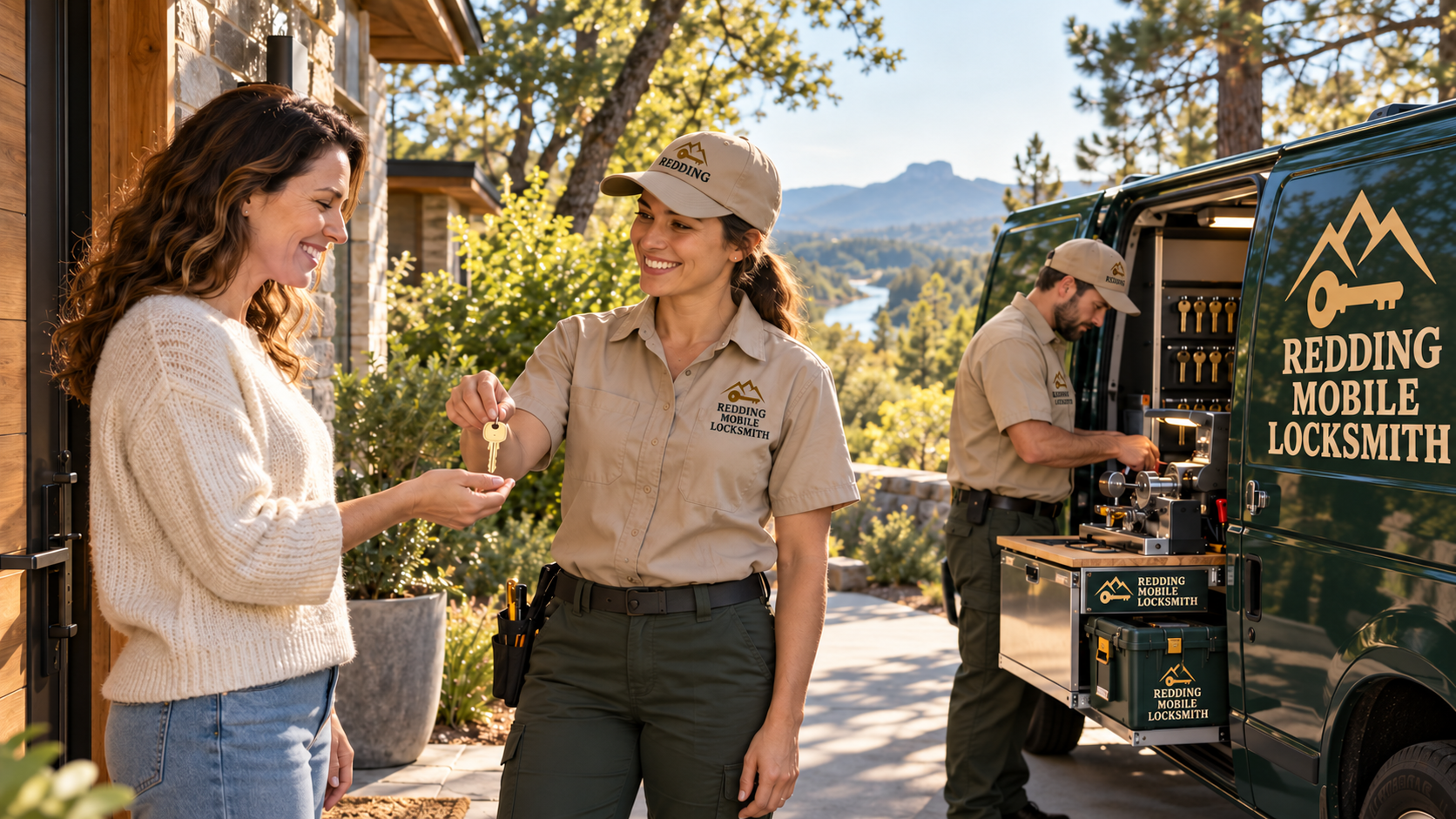
When you contact Redding Mobile Locksmith for a vehicle problem, the team works from a branded service van carrying professional tools, key cutting and programming equipment, and common hardware. The work is done at the curb, in a driveway, or in a parking area, wherever your vehicle is. You do not have to tow it unless something outside of the key system is wrong.
Explain what you see: the dash lights, the sound of the starter, whether the spare works, and what year and general type of vehicle you have. Have your ownership paperwork or identification ready, since a locksmith will want to confirm you are entitled to the vehicle before making keys for it. The request form on our contact page is the place to send those details, and our phone line is coming soon.
For a longer look at how this works across the region, see our cars and trucks service page, and read about service in Weed. If you are heading toward the next community north, our page on Yreka may be helpful too.
After the problem is solved
Once your vehicle is running again, take ten minutes to make the next time easier. Test every function of the new or repaired key: the lock and unlock buttons, the trunk or tailgate release, the remote start if you have it, and the engine start. Do this while the locksmith is still there, so anything that is off can be fixed on the spot. Our Weed page on key programming and fobs includes a full test routine.
Then decide about the spare. If you now have two working keys, store one somewhere separate from the vehicle and from your daily keys. A spare that lives in the same bag as the main key is only half a spare. Think about who else drives the vehicle, and whether they should have their own.
Finally, make a note of what happened and when. If the trouble was a fob battery, you now know to replace it on a schedule. If it was a worn blade, you know to be gentle. If it was a lost key, you have a new habit to build. Small lessons like these are what turn a stressful evening into something useful. Keep the note with your lock map or in your phone, wherever you will actually find it again.
Good to know
Common questions
How can I tell if my vehicle will not start because of the key?
Look for a flashing key or lock symbol on the dash, an engine that cranks briefly and then dies, or normal lights and radio with no start. If a spare key works and the main one does not, the key is the problem. A weak battery usually shows slow cranking or dim lights instead.
Can a mobile locksmith make a key for my car at the roadside?
In many cases, yes. The service van carries key cutting and programming equipment, so a new key can be cut and paired with the vehicle where it sits. You will be asked to show that you own or are entitled to use the vehicle before any key is made.
What should I do if a child or pet is locked in the vehicle?
Call emergency services first. Do not wait for a locksmith, and do not search for your spare key while someone is in danger. Emergency responders can reach the vehicle. A locksmith can help afterward with the lock or key problem once everyone is safe.
My fob works at home but not at the trailhead. Why?
A weak fob battery, cold air, or radio interference can shorten the signal range. Try holding the fob close to the start button or the steering column, and replace its battery if it opens easily. If it still fails, the fob or its pairing may need attention.
Will I need to tow my vehicle to get a new key?
Usually not. The work is done where the vehicle is parked. A tow is only needed when the trouble lies outside the key system, such as a mechanical engine failure. The locksmith can help you work out which situation you are in.
What information should I have ready before I ask for help?
Know the general type and year of your vehicle, what symptoms you see, whether you have a spare key, and where the vehicle is parked. Have ownership paperwork and identification ready. These details help the visit go smoothly and save time at the vehicle.