
Home / Granada / Cars and Trucks in Granada
Granada vehicles
Cars and Trucks in Granada: How Mobile Automotive Service Works
When your vehicle is parked and your key is the problem, the help comes to you. Here is what that looks like step by step, from a traveler's first message to the last test of the key.
Granada vehicles
A traveler, a turnout, and a problem
Picture a traveler driving along Interstate 5 through the Shasta Valley, deciding to turn off near Granada to stretch their legs. They park, step out, shut the door, and hear the unmistakable sound of the locks. The keys are on the seat, visible through the window and completely out of reach. Or perhaps the key is in the ignition and will not turn. Or the fob works, but the engine will not start. Whatever the story, they are a long way from home, and the nearest familiar face is hours behind them.
This is the situation mobile automotive service was designed for. Instead of towing a vehicle to a shop or waiting for a dealership appointment, a locksmith arrives where the vehicle is, with the tools to open it, cut a key, or program a replacement. The work happens at the curb, in a driveway, or in a gravel turnout beside a country road.
This page walks through how that process works, for travelers and for locals alike. Granada is a small community in the Shasta Valley area near Montague, with rural homes, open ranch country, outbuildings, and gates. People live here, work here, and pass through here, and all of them drive vehicles that sometimes have key problems.
What mobile service means in practice
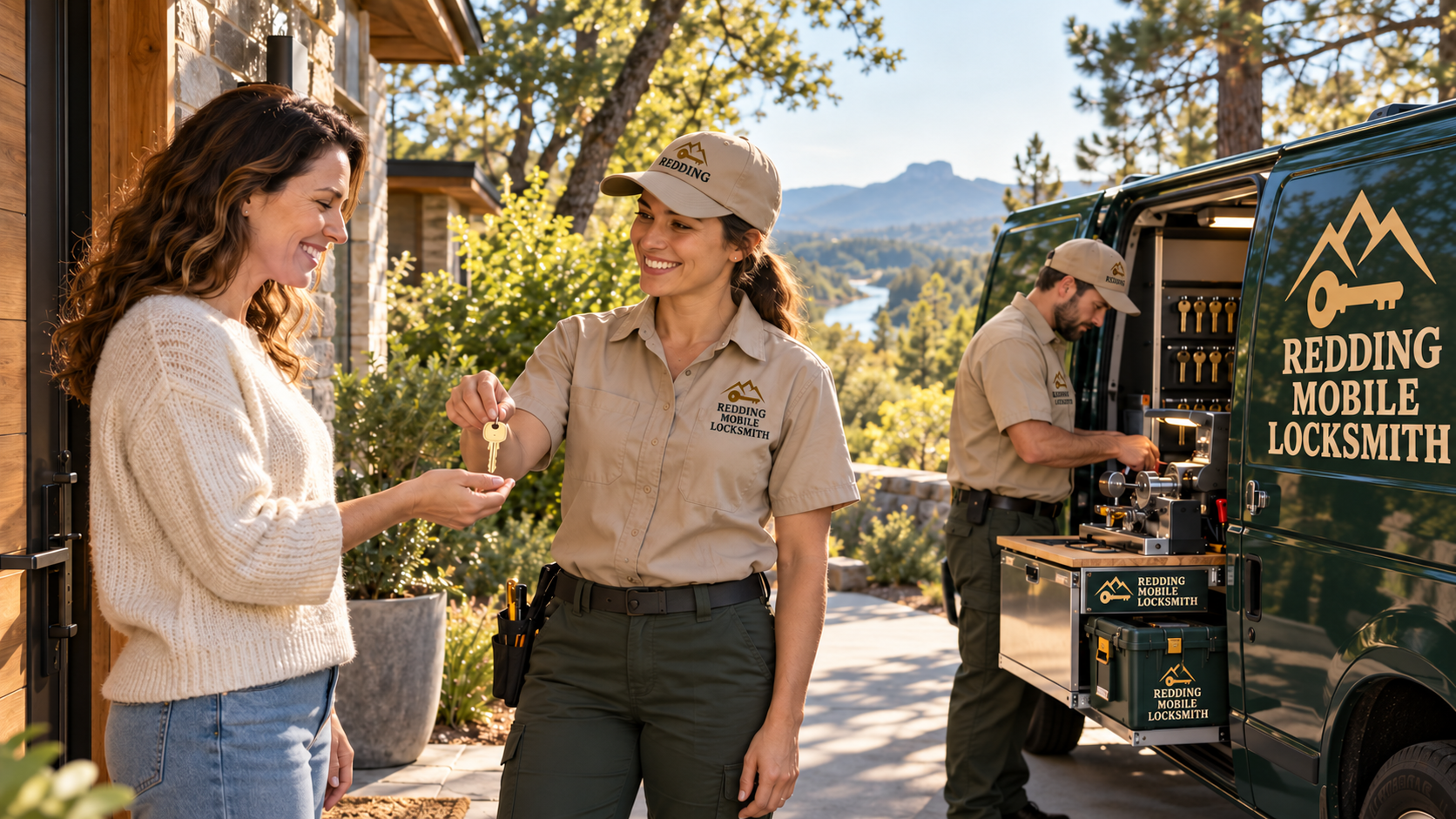
Mobile service means the locksmith's shop is a vehicle. Redding Mobile Locksmith operates a branded service van that carries professional tools, key cutting and programming equipment, and common hardware. The team wears uniforms, and the van is marked, so you can recognize who has arrived. Everything needed for most automotive key problems is on board. Think of it as a small workshop on wheels, organized so that the right tool is within reach whatever the vehicle turns out to need. Because every vehicle is different, the team asks questions first and chooses tools second.
That includes tools for opening locked vehicles without harming them, machines for cutting new keys to fit, and equipment for programming transponder chips and remote fobs to a vehicle's computer. It also includes common hardware such as blanks and replacement parts. When a job requires something unusual, the locksmith can explain what is needed.
The main advantage is simple: your vehicle stays where it is. There is no tow, no wait for a shop's open hours, and no transporting a vehicle that may not even run. For a traveler on a schedule, or a local with a vehicle in a rural driveway, that is a major convenience. Our service page on cars and trucks gives the broader view.
Step one: reaching out and describing the problem
The process begins with contact. Use the request form on our contact page to describe your situation. Our phone line is coming soon, so the form is how requests arrive for now. Say where you are, as precisely as you can, what the vehicle is, and what is wrong. Use plain words: locked out, key broken, will not start, fob not working.
Details help. Mention the general type and year of the vehicle, whether it has a traditional key or a push button start, and how many keys you have. If a child or pet is inside the vehicle, stop and call emergency services first, before anything else. That rule has no exceptions, and a locksmith will say the same.
If you are in an unfamiliar place, find a safe spot to wait, preferably somewhere visible and out of traffic. Note a landmark or a road name if you can. Do not leave the vehicle in a position that blocks a driveway, gate, or farm access. In rural country, those access points matter to the people who use them.
- Say where you are and what the vehicle is.
- Describe the problem in plain words.
- Note whether you have a spare key and whether it works.
- Mention if a child or pet is inside, and call emergency services first.
- Stay somewhere safe and visible while you wait.
Step two: confirming who you are
When the locksmith arrives, the first thing they do is confirm that you are entitled to access the vehicle. Expect to show identification and some proof of ownership, such as registration or title paperwork. This can feel formal, but it protects you. The same step prevents anyone else from cutting a key to your vehicle or opening it without permission.
Travelers sometimes worry because they are far from home and their documents are inside the locked vehicle. Explain the situation. A locksmith has seen it before and can often work out a reasonable way to verify you, such as matching the name on your identification with other information you can provide. Be patient and honest, and remember that the locksmith is just as interested in doing this properly as you are in getting moving. If something cannot be verified, they may not be able to proceed, and that is intended to keep owners safe.
Our neighbor guide on how to know a locksmith is the real thing explains what to look for on your side, such as a marked vehicle, a uniform, and a willingness to explain what they are doing before they do it.
Step three: opening the vehicle
For a simple lockout, the locksmith chooses a method that fits the vehicle. Modern doors have weather seals, wiring, airbags, and electronics inside, so the approach must be careful. Professionals use purpose made tools that work with the door instead of against it. The goal is to open it without scratching paint, bending the frame, or setting off anything that should not be disturbed.
You do not need to watch every move, but it is fine to ask what is happening. A good locksmith will explain in general terms. We do not describe step by step methods publicly, because the details could help the wrong people, but the principle is easy to share: skilled hands, the right tool, and patience.
Our neighbor guide on how a car is opened without the key offers a general explanation, and our service page on locked out of your car adds more. Once the door is open, check that the lock and handle work normally and that nothing looks different from before. Look at the weather seal along the door edge and the paint near the handle. If a mark appears that was not there earlier, mention it right away rather than after the van has gone.
Step four: cutting and programming keys
If the problem is a lost, broken, or worn key, the next step is making a new one. The locksmith identifies the correct key blank for your vehicle and cuts it to fit, either by following the lock itself or by using a key code, which is a number that describes the cuts. Our neighbor guide on what key code cutting is explains the idea.
Most modern vehicles also need the new key introduced to the computer. A transponder chip inside the key answers a radio query from the vehicle, and the vehicle must be taught to accept its code. The locksmith connects programming equipment to the vehicle, usually through a standard port, and pairs the new key. Push button fobs follow a similar process.
Our service pages on replacement car keys and key programming and fobs describe these steps in more detail. If you have no working key at all, the process can still be done, and our neighbor guide on making a key with no key at all explains how that works in general terms.
Step five: testing everything before the locksmith leaves
The final step is the one people skip when they are tired or in a hurry, and it is the one that matters most. Test the new key in every way. Turn it in the door lock. Turn it in the ignition, if your vehicle has one. Start the engine and let it run. Press each button on a fob: lock, unlock, trunk or tailgate, panic, and remote start if available.
If your vehicle has a push button start, carry the fob away and come back to see that the doors respond. Place the fob in different spots in the cabin and check that the start button recognizes it. If something is off, say so right then, while the locksmith and equipment are still there. Fixes are far easier before the van leaves.
Our page on key programming and fobs in Weed includes a fuller test routine, and it applies here as well. A few minutes spent testing can prevent a frustrating discovery far down the road, when a function you assumed worked turns out not to.
Travelers: planning for the unexpected
For people passing through, a key problem is more than an inconvenience, because it disrupts a plan. Appointments, ferry times, family waiting at the other end. Having a few habits can soften the blow. Carry a spare key in a different bag from your main key, or give one to a travel companion. Keep a photo of your registration on your phone, since proof of ownership is part of the process.
Know your vehicle. Is the key a simple blade, a transponder key, a flip key, or a push button fob? Knowing what you carry helps when you describe the problem. Keep your charger and a power bank handy too, because a dead phone makes every other problem harder. Replace worn fob batteries before a long trip. Cold nights can weaken them, and a dying fob often fails at the worst time.
Our neighbor guides on what to do when locked out of a borrowed car and a work vehicle lockout and who to tell cover situations that come up when the vehicle is not exactly yours.
Locals: farm trucks, work vehicles, and gates
For people who live in and around Granada, vehicles are tools. A truck might carry feed, a trailer, tools, or a family. When its key fails, work stops. Rural life also means long driveways, gates, and sometimes poor cell signals, so it helps to know how to describe your location clearly. A road name, a gate color, or a nearby landmark can guide the team.
Work vehicles sometimes have several drivers, and keys get passed around and lost. Spares are valuable for exactly this reason. Consider having an extra key made before one is lost, and keep it somewhere safe and separate. Our neighbor guide on teen drivers and spare keys has a sensible look at the topic.
If your truck refuses to start and you suspect the key, our neighbor guide on when a car will not start because of the key can help you decide whether to call a locksmith or a mechanic. Telling those two situations apart saves effort, because a mechanic cannot fix a key and a locksmith cannot fix a worn starter. Good questions at the start send the right person to the right problem.
Weather, distance, and the open valley
The Shasta Valley is open country, and open country has its own rhythm. Summer afternoons are hot and dry, which can bake a plastic fob left on a dashboard and soften its seals. Winter brings cold that thins out battery power and stiffens door seals until they stick to the frame. A lock that behaves in July may act differently in January, and a traveler used to one climate can be caught off guard by the other.
Distance also changes the plan. Between ranch gates and country roads there are long stretches with little shade and few buildings. If you are waiting for help, bring water, a layer for the wind, and a way to stay visible. Never leave a child or pet in a closed vehicle, even briefly, in warm weather.
These are simple points, but they shape how the service works. A mobile locksmith arrives knowing the setting, and the visit is planned around the vehicle, the location, and the conditions rather than around a shop counter. That is the real meaning of help that comes to you.
What to expect afterward and where to learn more
After the visit, you should have a vehicle that opens and starts, keys that work in every way you tested, and a clearer idea of how to avoid a repeat. Ask whether a spare is worth making while the equipment is already on site. Ask how to care for the fob. Ask anything that is on your mind, since the locksmith has the knowledge and you have the question. A traveler who leaves with a working spare and a clear sense of what happened has turned a bad afternoon into a useful lesson.
Keep notes for your own records: what happened, what was done, and how many keys now exist. If the vehicle is shared, tell everyone who drives it. If an old key was lost, ask whether it can be removed from the vehicle's memory so that it can no longer start the engine.
For more about our work in this part of Siskiyou County, visit our Granada service area page and the page for Montague. If you also care for a home or outbuildings, our Granada home lock page looks at the other side of the picture. Wherever the road takes you, help can reach you at the curb.
Good to know
Common questions
What does mobile automotive service include?
The service van carries professional tools, key cutting and programming equipment, and common hardware. That allows a locksmith to open a locked vehicle, cut a new key, and program a transponder chip or fob on site. Your vehicle stays where it is parked.
What do I need to show before a key is made?
Expect to show identification and proof that the vehicle is yours or that you are entitled to use it, such as registration or title paperwork. This protects owners. If your documents are inside the vehicle, explain the situation and the locksmith can discuss options.
What if a child or pet is locked inside?
Call emergency services first. Do not wait for a locksmith and do not search for a spare key. Responders can reach the vehicle. A locksmith can help afterward once everyone is safe, if the lock or key still needs attention.
Can you help if I am on a country road or in a turnout?
Yes. Mobile service is built for vehicles parked wherever they are. Tell us the road, a landmark, and the direction you were traveling, and find a safe place to wait. We do not publish arrival times because distance and conditions vary.
How should I test a new key or fob?
Try it in the door lock and ignition, start the engine, and press every fob button, including lock, unlock, trunk or tailgate, panic, and remote start. For push button systems, walk away and return to check the doors. Report any problem before the locksmith leaves.
How can travelers prepare for a key problem?
Carry a spare key separate from your main one, keep a photo of your registration on your phone, and replace a weak fob battery before a long drive. Know what kind of key your vehicle uses, so you can describe the problem clearly when you ask for help.