
Home / Neighbors ask / Teen drivers and spare keys
Neighbors Ask
Teen Drivers and Spare Keys: A Practical Plan for Parents
When a teenager starts driving, keys multiply and so do the ways to lose them. A little planning about spares, copies and what to do after a loss keeps small mistakes from becoming long evenings.
Neighbors Ask
Why a new driver changes the key math
Before a teenager drives, your household probably has a tidy key situation. Two car keys, maybe one spare in a drawer, and everyone knows who has what. Then a new driver arrives, and suddenly there is a third person who needs access to a vehicle, a house key for the evenings when no one is home, and a growing set of places a key can go missing: a locker, a gym bag, a friend's car, a pocket of a jacket left at a game.
This is nothing to be alarmed about. It is simply that a teenager is learning independence, and keys are one of the first pieces of independence they hold. Mistakes will happen. The aim is to make the mistakes small and recoverable, so a lost key ends in a short errand rather than a crisis.
So what do you need? A reasonable spare plan, a clear rule about who may copy keys, a habit for where keys live at home, and a calm procedure for the day one disappears. We will go through each. The page on replacement car keys covers the technical side if you want it.
It also helps to remember that the car is not the only thing a key opens. A teenager with a job might carry a locker key, a key to a family shed or a spare to a grandparent's door. Every extra key is a small responsibility, and the more they carry, the more worth it is to teach a simple system early. Start with one ring, one pocket and one place at home where the keys go when the day ends.
Do not hand over your only key
The most common mistake is giving a teenager the family's only working key. If it is lost, the whole household loses the car at once, and the replacement job starts from a worse position because no working key remains to copy from. Keep at least one extra working key in the house, in a place the teenager knows about but does not carry.
A second full key is better than a door only key, since a door only key will not start a car with a transponder chip. Check what you have before assigning it. Our column on which car keys matter explains the difference.
If your household has only one key, make a spare before the teenager drives alone. Cutting and coding a spare is a straightforward job when a working key exists. It becomes a larger job when none does. Early action is the easiest kind, and it is often done in the driveway. See when a car will not start because of the key for what a dead key looks like.
Think about the day the key is lost, too. If the household holds a second working key, the replacement job is a short errand. A technician can read the spare, cut a matching blade and code a new chip, and the lost key can be removed from the car's memory if the vehicle allows it. Without a spare, the same job takes more time and more equipment, and the family may have to arrange a tow or a visit to the car wherever it stopped.
Fobs, remotes and the cost of carelessness
Modern car keys are small electronic devices, and teenagers are hard on small electronic devices. Fobs get dropped, sat on, run through a washing machine and left in a pocket on a hot dashboard. A water soaked fob sometimes recovers after drying, and sometimes does not.
It helps to have a conversation about what the fob is. It is not a plastic trinket. It carries a coded chip that the car expects to see, and a remote with buttons that opens doors from a distance. Replacing one requires cutting, coding and sometimes programming. That is a reason to treat it with care.
A protective case or a lanyard can keep a fob from sliding out of a pocket. A key ring with a bright tag makes it easier to spot. Some families attach a small clip to a backpack, so the key hangs in the same place every day. Little habits like that prevent more lost keys than any lecture. Our page on key programming and fobs explains how they work.
Consider the battery in the fob as part of the routine. A coin cell inside the case powers the buttons and, on some cars, the proximity signal. When it weakens, the fob works only up close, or only some days. A new driver who has never seen this may assume the fob is broken. A fresh battery in a drawer, and a short lesson on swapping it, spares a good deal of confusion.
The house key side of the plan
Teenagers need a house key too, and it is easy to forget that they have been losing it since the first week of school. A house key left in a gym bag or lent to a friend is the usual story. It is worth deciding in advance what to do when that happens.
If the key is lost for a few hours and then found, there is little to fear. If it is truly gone, think about where it was lost and how likely it is that someone could connect the key to your house. A key with no tag or address is a mild risk. A key on a ring with a school ID is a bigger one. When in doubt, rekey the lock.
Rekeying changes the pins in the cylinder so the lost key no longer turns it. You receive new keys for the new arrangement and carry on. It is a small job compared with the worry of an unaccounted for key. Read about rekeying your home, and see the column on what to do if your wallet and house keys are gone.
- Never put your address on a key tag.
- Keep one spare house key with a trusted adult, not hidden outside.
- Decide in advance what a lost key triggers, such as rekeying after a set number of hours.
- Show your teenager where the spare lives and who else knows.
- Replace worn keys before they snap.
Copies and the question of who may make them
Teenagers have friends, and friends have rides. It is common for a young driver to hand a key to a friend or to ask to have a copy made so a friend can borrow the car. That is a decision to make as a household, not by accident.
Be clear about the rule. Many parents decide that no copies are made without their permission, and that the car keys are not lent. For a transponder key, a plain copy from a counter often will not start the car, but it may open the door, and it still tells you something about who has access.
If a copy is truly needed, a technician can make one that is properly coded, and you stay in control of the arrangement. This way the number of keys is known. Our column on how many keys a household should keep can help you pick a sensible number.
A middle path some parents like is a keypad or code on a shed, gate or garage door, so the teenager does not need yet another key for those. Codes can be changed when circumstances change, which is a virtue with a young person whose friend circle changes from term to term. Whatever you choose, keep the list of who knows what, and update it when plans change.
Locked out is a rite of passage
Sooner or later, a teenager will lock keys in the car, and it usually happens at an inconvenient time: after practice, after work, at a friend's house. The reaction matters more than the event. If your child knows you will help calmly and that they can ask for help without being scolded, they will call sooner and avoid riskier choices.
Teach a short list of safe responses. Stay in a well lit, public place. Do not try to force the door or use tools found nearby. Call a parent or a trusted adult. If a child or pet is inside the car, call emergency services first, because that is an emergency and not a key problem.
Then call for professional help. A technician can open most vehicles without damaging them, using tools made for the job, and can also make a spare if needed. Our page on locked out of your car explains what happens, and locked out at night addresses the after dark question.
Remind your teenager that a locksmith is a professional helper, not a last resort to be embarrassed about. A calm call, a clear description of the car and its location, and a safe place to wait is all it takes. Teenagers who learn this early become adults who handle small troubles without panic. Families in Anderson and nearby towns can read how we serve their area on the local pages.
Where keys live at home
A surprising share of lost keys go missing in the house. A hook by the door, a bowl on a shelf or a drawer in the hall solves this. Pick a place, tell everyone, and make it a rule that keys go there first when anyone walks in. It sounds almost silly, but it works.
For teenagers, the habit extends to the backpack. Choose a pocket and keep the keys in that pocket every time. A key that always lives in the same place is much easier to find than one that wanders. Some families add a clip, a cord or a small zipper pouch.
Consider also where the spare lives. A spare in a lockbox or with a neighbor is useful when no one is home. A spare hidden under a mat is a gift to any passerby. Spend a moment on this and the odds of a bad day drop. For more options see lockboxes and showings.
When the car does not respond to the key
Sometimes a teenager calls to say the car will not start, and the first suspicion is the battery. It might be, but a key problem is also possible. A worn key, a dead fob battery, a damaged chip or a swollen ignition can all produce a car that turns over but does not run, or does not turn over at all.
Ask a few questions over the phone. Does the dashboard light up? Does a key shaped light blink? Does the fob work on the door? Did the key get wet or take a hard drop? The answers help decide whether the issue is the key, the car or the battery. Our column on when a car will not start because of the key has more.
Do not instruct a teenager to try forcing the ignition or the steering column. That can cause real damage and make a small problem larger. If the key is stuck, see a key stuck in the ignition. If the problem persists, bring in a professional.
Teaching the habit of one tidy ring
A heavy ring of keys dangling from an ignition is bad for the cylinder. The weight pulls on the lock over time and wears it out sooner than you would expect. For a teen who carries a locker key, a house key, a bike lock and a charm, the weight adds up.
The simple fix is a detachable ring. Keep the car key on a clip you can remove from the larger ring, and let only the car key hang in the ignition. This keeps the cylinder healthy and makes it harder to lose the whole set at once.
It also prevents the nuisance of a key being bent by leverage. A key that gets bent is more likely to break, and a broken key in an ignition is a bigger problem. A little tidiness here saves a lot. For what a professional can do with worn hardware, see lock repair and adjustment.
If the ignition itself feels worn, mention it. A cylinder that sticks, a key that needs a wiggle, or a steering lock that releases only with effort are all signs the lock needs attention. Heavy key rings and years of use wear down the little pins inside, and a technician can often service or replace the cylinder before it fails on a school morning.
Getting local help when you need it
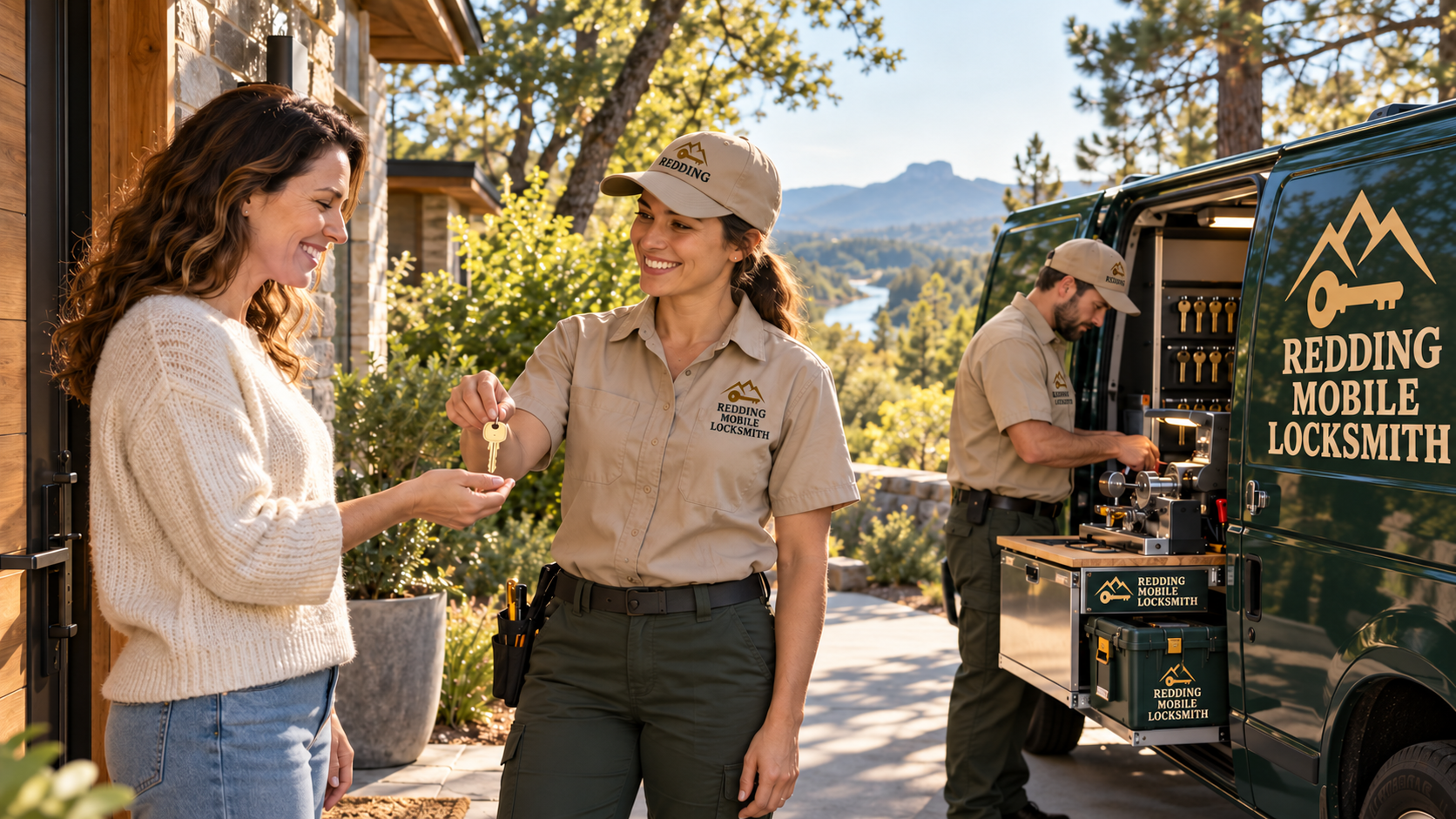
Redding Mobile Locksmith serves seventeen communities across Shasta County and Siskiyou County, from the valley around Redding to mountain towns near Mount Shasta. The team works around the clock with a branded service van that carries key cutting and programming equipment, which helps when a key problem lands on a weekend night.
When you make a request, have the basics ready: the make, model and year of the car, how many working keys exist, where the car is parked, and a safe place for the technician to meet you. Use the request form, since the phone line is coming soon.
For after hours trouble, emergency help any hour describes the service. If your teenager is the one calling, make sure they know to share their location, stay somewhere safe and keep their phone charged. Planning ahead turns a stressful evening into a manageable errand.
Good to know
Common questions
How many spare keys should a family with a teen driver have?
At least one fully working spare that stays at home, plus the key the teenager carries. If more than one driver shares the car, think about a second spare. Avoid scattering copies among friends. The right number is the lowest count that still covers a loss.
Should my teenager have a copy of the house key?
Most households say yes, with sensible rules. Use a key with no address on it, store it in the same pocket every day, and decide in advance what happens if it goes missing. A rekey is the clean answer if the loss worries you.
Can a lost car key be shut out of the car?
On many cars a technician can reset the list of keys the car accepts so the missing one stops working. It depends on the vehicle. Ask about it when you have a spare made, especially if the lost key left with a teenager.
What should a teen do if locked out at night?
Stay in a well lit public place, call a parent or trusted adult, and avoid forcing the door. If a child or pet is locked in the car, call emergency services first. Then arrange professional help to open the car or make a key.
Do fob batteries matter for new drivers?
Yes. A weak battery can make a fob seem broken when it only needs replacement. Teach a new driver to notice weak buttons or a warning on the dash, and keep a spare coin cell at home. Persistent trouble needs a technician.
How do I request key help for a car?
Fill out the request form on the contact page with the make, model, year, number of working keys and your town. If your teenager is stranded, include where the car is parked. The phone line is coming soon.