
Home / Weed / Home Lock Service in Weed
Weed homes
Home Lock Service in Weed: A Walk Through Your House
If you just bought a house in Weed, you inherited a handful of locks and a bag of keys nobody explained. Here is a room by room walkthrough of what you have and what to do about it.
Weed homes
Congratulations, you own a house full of locks
The paperwork is signed, the boxes are stacked in the hall, and somebody handed you a small bundle of keys with a cheerful goodbye. That bundle is the beginning of a quiet job that every new owner in Weed inherits: finding out what all those locks are, who else can open them, and which ones are about to give you trouble. Most people skip this job for months. It does not take long, and it is far easier to do on a calm afternoon than at a dark doorstep with the wind pushing at your jacket.
Picture a newcomer standing in a front hall with a coffee and a notepad, ready to walk the house. That is the spirit of this page. We will go door by door, latch by latch, and explain what each piece of hardware does, how it wears, and what a mobile locksmith can do about it. You do not need tools for the walkthrough. You need patience, a flashlight, and a willingness to jiggle things gently.
Weed sits north of Mount Shasta in Siskiyou County, right where Interstate 5 meets Highway 97, and the town has the mix you would expect: older homes with a lot of character, newer builds, rentals near the college, and plenty of houses that see wind from every direction. All of that shapes how locks behave. Keep it in mind as you read, and keep the notepad nearby.
The front door is the one everybody judges
Start where visitors start. A typical front door carries two pieces of hardware: a knob or lever with its own latch, and a deadbolt above it. The latch is the spring loaded tongue that holds the door shut against the frame. It is convenient, but it is not meant to stop a determined push. The deadbolt is the sturdier piece, a solid bolt that slides deep into the frame when you turn the key or thumb turn. When you close the door and turn the deadbolt, you should hear and feel a smooth, confident throw, with no scraping and no hesitation.
Try this: with the door open, extend the deadbolt and look at it. It should move freely with no door in the way. Now close the door and extend it again. If it drags, grinds, or you have to lift or press the door to make it go, the bolt and the hole in the frame no longer line up. That misalignment is common in houses that have settled, and it is usually a small correction rather than a big replacement. Our page on lock repair and adjustment explains how that kind of fix works.
Look at the strike plate too, which is the metal plate screwed into the frame where the latch and bolt land. On a lot of older houses it is held by two short screws that bite only into thin trim. Longer screws that reach the solid framing behind the trim make a real difference when a door gets shoved. It is a small detail that costs very little and that most owners never think about until they have a reason to.
- Turn the deadbolt with the door open and watch the bolt travel all the way out.
- Close the door and repeat, listening for scraping or dragging.
- Check that the strike plate is snug and that its screws are not loose.
- Note whether the key turns smoothly or needs wiggling.
Back doors, side doors, and the one nobody uses
Every house has a door that gets ignored. It might be a side entrance off the carport, a back door onto the yard, or a door from the kitchen to a porch that stays covered in boots. These are the doors most likely to have the oldest hardware, because nobody has fussed with them in years. They are also the doors where a loose latch or a missing deadbolt matters, since they are often out of sight of the street.
Walk to each one and run the same test. Does the lever or knob spring back crisply when you release it? Does the latch fully catch when you close the door? Is there a deadbolt, and does it match the others in finish and feel? If you find a door that has only a push button lock on the knob, that is worth writing down. Those are privacy locks, designed to keep the door closed against a draft, not to keep a person out.
The sliding glass door off a patio deserves its own moment of attention, and it has its own questions, covered nicely in our neighbor guide on sliding door security. For now, just notice what holds it shut and whether anything can be lifted out of its track. If the answer is nothing, add a line to the notepad.
The garage and the door between garage and house
Garages quietly become the busiest entrance of a house. People come home, pull in, and walk straight into the kitchen. Because of that, the door between the garage and the living space often carries a lock that was installed once and never thought about again. Check it. A solid door with a deadbolt is ideal, and a hollow one with a thin latch is a weak point that is worth upgrading when you get the chance.
Then look at the overhead door itself. Most are opened by remote or keypad and have an emergency release cord you can pull from inside. Remember where that cord is. If the opener fails, a stuck overhead door can turn into an unexpected lockout from your own garage, and the entry door becomes your only way in. Our guide on what to do if the garage entry door lock fails walks through that exact situation.
If the house came with a shed, a workshop, or a gate along the driveway, add them to your list. The lock on an outbuilding is often a padlock of unknown age, and the keys are rarely in the bundle you were handed. It is much better to learn that on a Saturday morning than when you need the ladder inside and nothing opens.
Windows, sliders, and the small catches
Windows are where the walkthrough gets quiet and detailed. Most windows carry a crescent latch or a simple sash lock that pulls the two frames tight together. Open and close each one. A latch that spins loosely, a frame that rattles, or a lock that no longer reaches its keeper tells you the window is held shut by habit more than by hardware.
Older houses often have wooden sash windows with a small brass or painted latch that has been painted over a few times. These may need a gentle clean and a good adjustment rather than a replacement. Our neighbor guide on window locks in older houses covers what is realistic and what is overkill.
Basement windows, bathroom windows, and anything at ground level near a fence line are the ones to inspect twice. You are not looking for ways to be afraid. You are looking for the places where a lock is missing or has stopped doing its job, so you can decide calmly what matters to you.
Keys: counting what you were handed
Now sit down with that bundle of keys and the notepad. Try each key in each lock, and write down which key opens what. You will probably find at least one key that opens nothing, and that is normal. Previous owners, contractors, real estate visits, and house sitters may all have held copies at one point, and nobody can tell you who still has one. This is the strongest argument for rekeying a home after a purchase, a question we answer in more depth in do I need to rekey after buying a house.
Rekeying does not mean replacing every lock. It means changing the inside of each cylinder so the old keys no longer work and a new key does. The hardware stays in place, and the finish on your doors stays untouched. Our service page on rekeying your home explains how a mobile locksmith does this at your door, and how all the exterior locks can end up on a single key.
While you are counting, think about how many working copies the household needs. A good rule of thumb is one for each adult who lives there, plus one spare kept somewhere sensible that is not under the doormat. We talk about the details in how many keys a household should keep.
Wind, dust, and a town that sits where it sits
Weed is known for wind, and that is a lock story as much as a weather story. Open terrain means more dust and grit finding its way into keyways and latch bodies. A lock that was perfectly smooth when you toured the house can become stiff and gritty by the end of a windy season. A little grit in a pin tumbler cylinder acts like sand in a hinge, wearing both the key and the pins.
Cold plays its own part. Mountain winters mean frost on exterior hardware, and metal contracts slightly as the temperature drops. A door that closes easily in summer may bind in winter, and a latch that caught perfectly may start to miss. If your lock gets harder to turn when it is cold and eases up when it is warm, it is telling you something about alignment or lubrication. Our neighbor guide on weather and seasons and locks goes deeper.
One practical note about lubricant: not every spray belongs in a lock. Heavy oils collect dust and turn into paste. That is a topic we cover in what lubricant belongs in a lock, and it is worth reading before you reach for whatever is on the garage shelf.
Decide what to keep, repair, or replace
With the notepad full, you can sort the findings into three piles. The first pile is hardware that is working well and only needs a new key relationship, meaning rekeying. The second pile is hardware that is worn, loose, or misaligned, which is a repair or adjustment. The third pile is hardware that is missing, outdated, or simply not the kind of lock you want, which is a new installation.
That third pile is where new lock installation comes in. It might mean adding a deadbolt to a door that never had one, or upgrading a worn knob set to a sturdier lever. It might mean choosing between a standard keyed lock and a smart lock, and our guide on smart locks helps you decide whether that is worth it for your situation.
If you are not sure which pile something belongs in, that is fine. Many owners find that a short conversation at the doorstep settles the question better than hours of guessing. A locksmith can look at a lock, try the key, check the alignment, and tell you whether you are looking at a small adjustment or a true replacement.
Draw your lock map
Here is a habit that pays off for years: turn your notepad into a one page lock map. Draw a rough outline of the house and mark each exterior door, each window with a lock, the garage, and any outbuildings. Next to each one write the type of lock, which key opens it, and any issue you noticed. Keep it in a drawer, not in a place a stranger could find.
This map becomes useful in three situations. When a key is lost, you know exactly which locks need attention. When a lock starts to fail, you can describe it clearly. And when you decide to rekey, you can tell the locksmith the whole story in one conversation. If you ever need help preparing, our guide on what to have ready when you call a locksmith lists the things worth knowing.
Add a few lines about the household too: who has a key, who has the garage code, and whether a neighbor holds a spare. The more your map reflects real life, the more useful it becomes during the one moment you need it, usually an evening when something unexpected happens.
When you want a pair of experienced hands
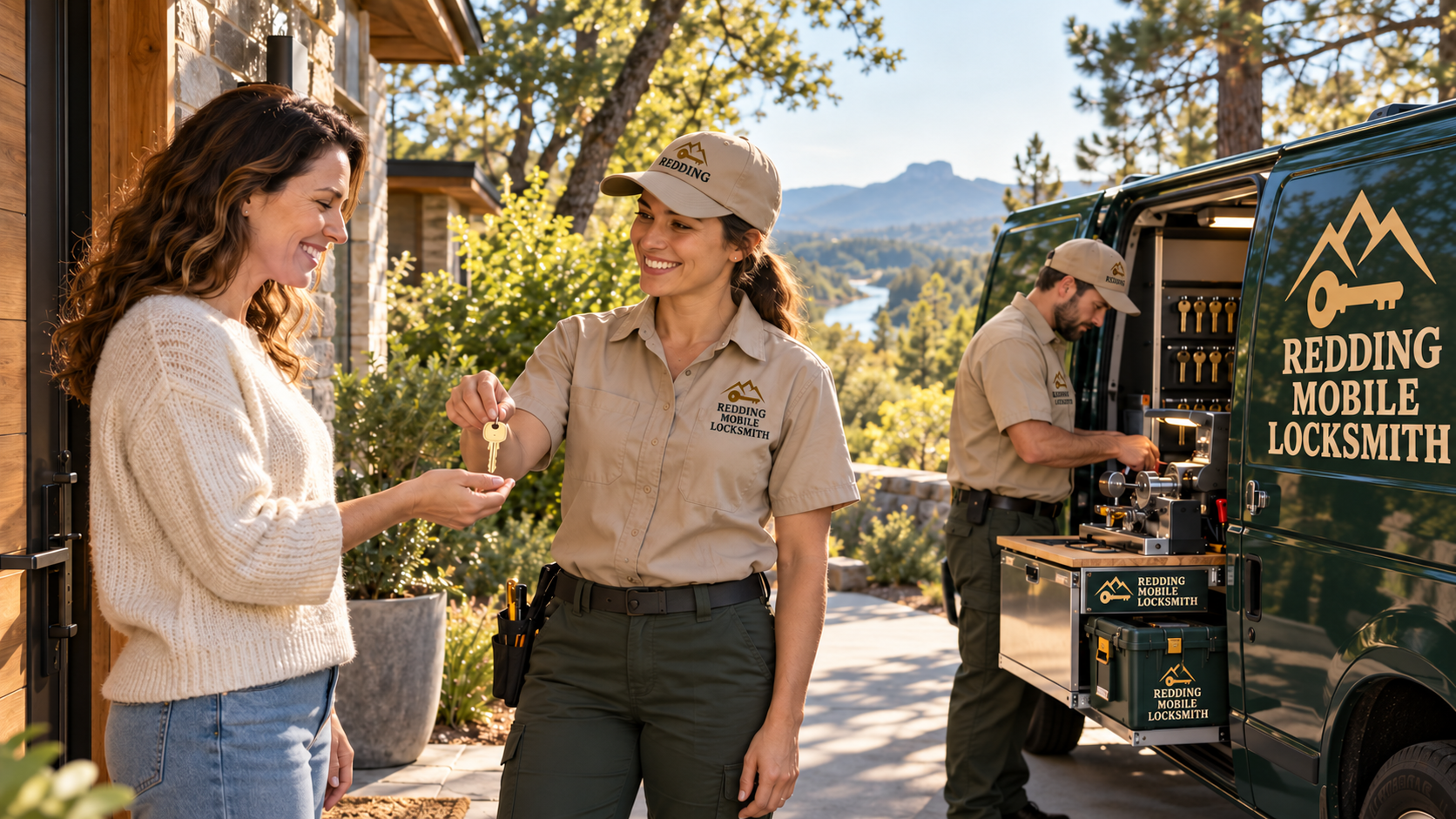
Plenty of owners enjoy doing a few small lock tasks themselves, and that is perfectly reasonable. Others would rather hand the job to someone who does it every day. Redding Mobile Locksmith works from a branded service van that carries professional tools, key cutting and programming equipment, and common hardware, so the work happens at your door instead of in a shop across town.
The team works around the clock for emergencies, and for planned house work you can use the request form on our contact page to describe what you have found on your walkthrough. Our phone line is coming soon, so the form is the way to reach us right now. The more detail you give about your doors and locks, the better prepared the visit will be.
If you ever find yourself outside with the door shut behind you, our page on being locked out of your home explains what happens when help arrives. And for a broader look at what we do in this part of Siskiyou County, visit our Weed service area page, or see how the neighboring community of Mount Shasta is covered.
Good to know
Common questions
What is the first lock I should look at after buying a house in Weed?
Start with the front door deadbolt. Open the door, extend the bolt, and check that it moves freely, then close the door and repeat. If it drags or needs lifting to engage, the bolt and the frame no longer line up. From there, move to the back door, the garage entry door, and the windows.
Do I really need to rekey if I already changed the door code or lock cover?
A code or cover change does not touch the key cylinders. Any old key that fit before may still fit after. Rekeying changes the pins inside each cylinder so past keys stop working. If you are unsure who held copies, rekeying is the calm way to start with a clean slate.
Can wind and dust really damage a house lock?
Yes, over time. Grit works into keyways and latch bodies and wears both the key and the internal pins. A lock that feels gritty or stiff after a windy season may need cleaning and the right lubricant, or in some cases new parts. Heavy oil often makes it worse by trapping dust.
Are rental or shared house locks handled differently?
The hardware is the same, but who may change it is not. Rules differ by lease and by landlord, so check your agreement and ask permission before any change. A locksmith can describe what is possible, and you can pass that along to whoever manages the property.
How should I describe my locks when I contact you?
Use your lock map. Say how many exterior doors you have, what kind of lock each one carries, and what problem you noticed, such as sticking, a loose latch, or a lost key. Photos help too. The request form on our contact page has space for those details.
Does a home lock visit happen at my house or in a shop?
It happens at your house. The service van carries tools, key cutting and programming equipment, and common hardware, so most work is done at the door. If a part is not on the van, the locksmith will tell you what is needed before anything is changed.