
Home / Montague / Emergency Help Any Hour in Montague
Montague emergency help
Locked Out in Montague: Staying Calm and Giving the Right Details
Imagine a small shop owner in Montague at closing time, bags in hand, door shut behind them and the keys somewhere inside. Here is what to do, what to say and what to leave alone.
Montague emergency help
The moment the door clicks shut
Imagine a small shop owner on a Montague evening. The lights are off, the till is counted, the bank bag is under one arm, and the door swings shut a half second before the thought arrives: the keys are on the counter. Nearly everyone has a version of this moment. The stomach drops, the pockets get patted twice, and a small voice suggests that surely it can be fixed with a credit card and a little luck.
Take a breath before anything else. A lockout is almost always a solvable problem, and the worst decisions are made in the first minute of panic. Nothing about the situation gets better if you throw your shoulder at the door or pry at the frame. What gets better is a clear head, a safe place to stand and a few useful facts to hand to the person who will help you.
Montague is a small town in the Shasta Valley of Siskiyou County, with older homes, agricultural surroundings and small main street businesses. That setting shapes what an emergency looks like here. Streets can be quiet after the shops close, a lot of properties are spread out, and help is not always one block away. That is exactly why it pays to know your next steps before you need them.
Safety comes before the lock
Before you think about the door, think about where you are standing and what you are holding. If it is dark, move to the brightest spot nearby and keep your back to a wall or a lit window rather than an open lot. If you are carrying cash or a bank deposit, keep it close and out of sight. If the weather is cold, remember that Siskiyou County winters are real, and standing around in thin clothes turns an inconvenience into a risk before long.
Ask yourself whether anything else is happening. Is someone inside who needs to come out? Is a stove on, a heater running, a child or an animal in a closed vehicle or a closed room? Those are different situations from an ordinary lockout. If a child or a pet is locked in a vehicle, or if anyone is in danger inside a building, call emergency services first. A locksmith is a good call for a locked door, and emergency responders are the right call for a person in trouble.
If you feel uneasy about your surroundings, trust that feeling. Step into an open business, wait in your vehicle if you have one and it is unlocked, or ask a neighbor to stay with you. You do not have to prove anything to the door. Waiting somewhere comfortable is a perfectly good plan, and it makes the later conversation with a locksmith calmer.
What to check before you call
There is a short checklist worth running, and it takes less time than you might think. Try every door and window you own, gently and in order. Back doors get locked from the inside by habit and forgotten, but a side door that was never latched is more common than people admit. Walk around the building and look for anything you left open, such as a loading door or a window you unlatched for air.
Think about whether someone else holds a key. A partner, a family member, a neighbor you trust, a landlord or a property manager might be reachable. If a spare is nearby, it may be the simplest route. At the same time, be honest about whether the spare is truly safe to retrieve. A key hidden under a mat or planter outside is a gift to anyone who happens to look, and a good moment to rethink that habit once you are back inside.
Finally, look at the lock itself. Is it a deadbolt that was thrown, or just a latch that clicked shut? Is the cylinder one you recognize? Can you see through a window whether the keys are visible on a counter? These small observations are exactly the details a locksmith will ask for. You can read about related choices on our page for what a lockout is and what to try first.
- Try every other door and window gently, in order.
- Think about who might hold a spare and whether retrieving it is safe.
- Note whether the door is latched only or deadbolted.
- Look through a window to see where the keys are.
What to avoid doing
The temptation to improvise is strong, and most improvised methods do more harm than good. Forcing a door bends the frame, splits the wood around the strike and sometimes snaps the latch inside, which turns a simple lockout into a repair. Prying at a glass storefront door can crack the glass or bend the narrow metal frame. Sliding a stiff card into the gap can damage weatherstripping and rarely works on a deadbolt at all.
Do not ask a passerby to climb through a window unless it is genuinely safe and the window is meant to open. A fall or a cut is a much bigger problem than a locked door. Do not pour anything into the lock, and do not spray random products into the keyway, because oil and grit left in a cylinder cause trouble later. If you have a key that is stuck rather than missing, our guide on dealing with a stuck key describes what to leave alone.
There is also an important point about trust. A professional will not ask you to do anything unsafe, and will not pressure you to decide before you understand what is happening. If someone who offers help turns up without being invited, or the story changes as the conversation goes on, pause. Our guide on how to know a locksmith is the real thing is worth a read before you ever need it.
The details that matter when you call or write
When you reach us, the most useful thing you can offer is a clear picture. Start with where you are. For Montague, say so, and add the type of building or the general setting in your own words. Say what is locked: a shop front, a back door, a house, a vehicle, a shed. Say what kind of door it is, whether wood, metal or glass, and whether you hear or see a deadbolt, a knob, a lever or a push bar.
Then describe what happened. Were the keys locked inside, lost, stolen or broken off in the lock? That distinction changes the work. A key left inside is a lockout. A lost key may call for rekeying afterward. A stolen key or wallet raises a security question, and the right answer is often to change the lock once you are inside. Be honest about it, because the right solution depends on the true story.
Last, tell us about urgency and safety. Is there anything inside that cannot wait? Is it dark or cold? Are you alone? Our phone line is coming soon, so for now the request form is the way to reach us. Fill it out with as much detail as you can, and say clearly that the situation is an emergency so it is read first.
What a professional does when they arrive
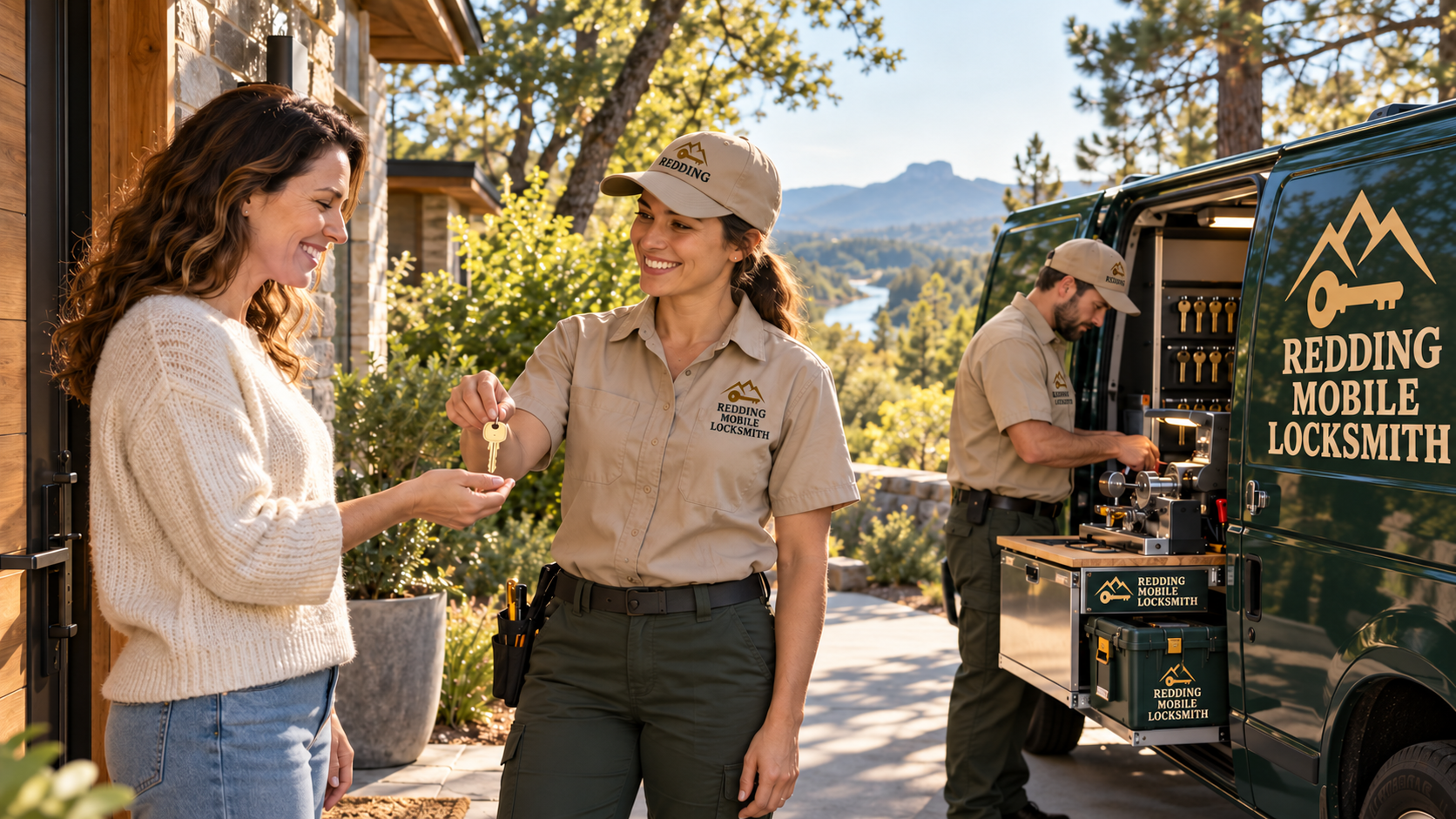
Our team arrives in a branded service van wearing uniforms, and the van carries professional tools, key cutting and programming equipment, and common hardware. Expect a person who introduces themselves, asks you to confirm that you have the right to be at the property, and looks at the door before doing anything. Anyone who works on a lock without confirming that it is yours to open is not someone you want near it.
The method depends on the door. In many cases a locksmith can open a lock without damaging it, using tools designed for the job, and leave the hardware working as before. In other cases the lock is damaged or the door is unusual, and the safest path is to open it in the way that does the least harm and then repair or replace the parts affected. We explain our approach in general terms and we tell you before we do anything that changes the hardware.
Once the door is open, the work is not finished. A good visit includes checking that the lock and key still work smoothly, looking at whether the door latches properly and talking about how to prevent a repeat. If the keys are missing, we can cut or program replacements. For related services, see locked out of your home and our emergency help overview.
A business lockout is different from a house lockout
A shop door carries more than a house door does. It may hold cash, stock, records and equipment, and there may be people depending on it opening in the morning. A closing time lockout is stressful in a particular way, because the building is closed but not secure, or secure but unreachable. The first question to settle is whether the door is locked in the way you intend. If you cannot get in and the door is locked, the building is protected. If something is ajar, that changes the priority.
Small main street businesses often have a mix of old and new hardware. A modern lever may sit on a door with an old deadbolt, a glass door may have a narrow frame, and a back door may have a hasp and padlock layered over a basic latch. Each of these opens differently. Knowing which hardware you have, even in rough terms, helps us bring the right tools. If you are curious about the hardware itself, read our page on door hardware for business in Montague.
After a lockout, a shop owner should think about the key situation. Who has keys, where do they live and how many exist? If the answer is unclear, rekeying is a sensible next step, and our page about business lock service explains what it involves. A little attention afterward turns a bad evening into a small lesson in better habits.
Vehicles, cold nights and country roads
Not every lockout happens at a door. Around Montague, plenty of people are in vehicles on rural roads, at farm gates or in the lot behind a shop. A locked vehicle with keys inside is a very common call, and it is handled differently from a building. Cars use different locks, windows and electronics, and the method depends on the make and model. If the engine is running or the key fob is inside, tell us, because it changes how we approach the job.
Weather matters more than most people expect. A person waiting beside a locked truck in a cold wind is losing comfort and safety by the minute. If you have a warm layer in your trunk, you cannot reach it. If you have a phone, keep it charged and keep the number or form link handy. And if you are alone on a quiet road, stay in a lit spot, tell someone where you are and let the help come to you.
For more on vehicle lockouts, read locked out of your car and locked out at night, what is the safe thing to do. For those who work from vehicles, a work vehicle lockout and who to tell is also worth a look.
Preparing now so the next time is easier
The right time to prepare for a lockout is on a day when nothing is wrong. Keep a spare key somewhere genuinely safe, such as with a trusted person, rather than hidden on the property. Make sure every key you rely on has a duplicate that works, and test the duplicate in the actual lock rather than assuming it does. A copy cut a little off will turn in the lock only some of the time.
Write down the basics of each door you care about. What type of lock, what kind of key, whether it has a transponder or a fob. Store that note where you can reach it from your phone. Take a photo of the door and the hardware while you are at it. The next time something goes wrong, you will describe it in one clear sentence instead of struggling to remember.
Finally, make a small habit of checking your pockets before you close any door behind you. Keys, phone, bag. It is a three second check and it prevents most lockouts. For those with a more elaborate setup, explore what to have ready when you call a locksmith, which goes into more detail.
Neighbors nearby and the wider area
Redding Mobile Locksmith serves Montague and sixteen other communities across Shasta County and Siskiyou County, from Redding in the south to Etna and Yreka farther north. If you are traveling or working near Montague, our Yreka page and our Montague page describe local needs in more detail.
If you live in Montague, you may want to explore our other pages for the town: home lock service, cars and trucks, key programming and fobs and new lock installation. Each covers a different part of owning keys and locks in a small valley town. Whichever page you start from, the idea is the same: a lockout is an ordinary problem with an ordinary solution, and the people who handle it well are the ones who stayed calm, stayed safe and knew what to say. Keep this page handy, share it with anyone who opens or closes your building, and let it be the thing you reach for when a door will not open and the evening is getting colder.
Good to know
Common questions
What should I do first if I am locked out at closing time?
Stay calm and make sure you are somewhere safe and lit. Check whether any other door or window is open, and whether anyone holds a spare. If someone or something inside is in danger, call emergency services first. Otherwise, gather the details about the door and reach us through the request form.
Is it safe to try opening a door myself?
Usually it is better not to. Forcing or prying damages frames, glass and latches, and turns a simple lockout into a repair. A few gentle checks of other doors and windows are fine, but improvised tools are a poor idea. A professional can often open a lock without harming it.
What information should I give when I contact you?
Tell us your location, what is locked, what the door is made of and whether you see a deadbolt, lever or push bar. Say whether keys are inside, lost, stolen or broken, and mention any safety concern such as cold weather or a person or pet inside. A photo helps if you can send one.
Do you help with a locked vehicle in Montague?
Yes, we help with car and truck lockouts as well as buildings. Tell us the make and model in general terms, and say whether the engine is running or the fob is inside. If a child or a pet is locked inside a vehicle, call emergency services first, before anything else.
Are you available at night?
Yes, we are a 24 hour mobile locksmith and handle urgent calls at any hour. Our phone line is coming soon, so use the request form on the contact page, and say clearly that it is an emergency so it is read first.
Should I change the lock after a lockout?
Not always. If you simply left the keys inside and the door opened without harm, nothing about the lock has changed. If keys were lost or stolen, rekeying is a sensible next step. We can talk through which applies to your situation once the door is open.