
Home / Montague / New Lock Installation in Montague
Montague new locks
New Lock Installation in Montague, California
Not every door wants the same lock. This page compares deadbolts, handle sets, keypads and smart locks, and shows Montague households how to match each type to the door it will guard.
Montague new locks
Sand in the shoes and a sticking back door
Imagine a family that comes home from a long day at the lake or in the woods, sunburned and happily tired, with wet towels, a cooler and a dog that wants water. The front door is a hundred steps away, and the person holding the keys is also holding the cooler. Nobody can find the right key in the dark, and the lock, which has always been fussy, finally refuses to turn.
Everyone who has lived with a stubborn lock knows the small daily friction. It is easy to put off, and it is exactly the sort of problem that a better lock solves. A smooth deadbolt, a handle that feels solid and a way of entering the house that does not require a flashlight turn a chore into a pleasant habit.
This page is for the household that has decided to do something about it. It describes the main kinds of lock, explains what each does well, and walks through what happens during an installation. The theme throughout is fit: the right lock on the right door, chosen for the people who actually use it.
Montague is a small town in the Shasta Valley of Siskiyou County, with older homes, agricultural surroundings and small main street businesses. That mix means a typical household might have a century old front door, a newer back door added in a remodel and an outbuilding or two. The lock choices for each are different, and treating them as one decision is the most common source of regret.
Four kinds of lock and what they are for
Think of locks as tools with different jobs. A deadbolt is the heavy lifter, a bolt that slides deep into the frame and cannot be pushed back without the key or the thumb turn. A handle set, either a knob or a lever, latches the door and lets you move through it. A keypad lock replaces the key with a code. A smart lock adds wireless features such as phone control and a record of use.
Most exterior doors work well with two things working together: a handle set that is comfortable to use and a deadbolt that provides the strength. Keypads and smart locks can take the place of either, or sit alongside a conventional deadbolt as the convenient layer.
The choice is rarely all or nothing. A household can combine types to suit different doors, using a rugged deadbolt on the back door, a keypad on the side entrance and a decorative lever on the front. Our page on new lock installation covers the general service, and what follows tells you how to decide.
Appearance counts for more than people admit. A front door lock that looks cared for signals a cared for house, and a loose, tarnished or mismatched handle does the opposite. Finishes come in many styles, from plain to ornate, and a technician can show you options that suit an older house without looking out of place.
The front door: a lock that welcomes as well as protects
The front door is the one visitors see, and it sees the most use. It benefits from a lock that is smooth, handsome and reliable. A well made deadbolt with a lever handle in a matching finish gives a clean look and a solid feel. If the door is old and decorative, the hardware can be chosen to fit its character without giving up strength.
Pay attention to the door's thickness and the existing bore holes. Most modern hardware fits standard sizes, though older doors in Montague's older homes may have unusual measurements. A technician can measure and adapt, sometimes using a plate to cover old holes.
A keypad or smart lock on the front door suits families who dislike fumbling for keys. Consider carrying a physical key as a backup. Our guide on what a smart lock is and who needs one is useful here, and so is the question of whether smart locks can be rekeyed.
Mudroom doors and farm kitchen doors take a lot of abuse in a place like this. Muddy boots, wet coats, deliveries and constant traffic all work on the hardware. Choose a handle that can be operated with a gloved hand or an elbow, and a deadbolt that is rugged enough to take a daily dozen cycles without complaint.
Back doors, side doors and the garage entry
Back doors lead to yards, kitchens and mudrooms, and are often used more than the front. They also tend to be less visible from the street, which makes them a more tempting target. They deserve the same quality of deadbolt as the front, with a strike plate anchored deep into solid framing.
A garage entry door, the one between the garage and the house, is easy to overlook. Because it is often hidden behind parked vehicles, it needs a deadbolt of its own, and the door and frame should be sound. If the garage door opener is ever broken or left open, this inner door is your second line.
Sliding glass doors need their own thinking. The latch on a typical slider is light, and a bar or pin in the track adds a great deal. Our guide on sliding door security describes the options, and the one on what to do if the garage entry lock fails addresses a common weak point.
Climate leaves its mark on every material. Wood swells and shrinks with the seasons, metal gets cold enough in winter to be unpleasant to touch and can condense moisture, and finishes fade in the summer sun. Hardware with a durable finish and a properly sealed mechanism will serve you far longer in the valley's range of conditions.
What the door is made of changes what fits
A wooden door takes standard hardware well, as long as it is thick enough and sound. A hollow core door is lighter and can crack around a heavy bore, so reinforcement may be needed. Metal doors are strong but have fixed sizes and may need special parts. Fiberglass doors look like wood and respond to hardware much like a composite.
Frames matter as much as doors. The frame is where the strike lives, and a flimsy frame defeats a strong lock. Trim may hide a rotted jamb, and old paint may disguise cracks. A technician can tell you whether the frame needs reinforcement before the lock is fitted.
You do not have to judge these things yourself. Describe the door and send photographs if you can. Our guide on how locks fit metal, wood and fiberglass doors offers more detail, and the one on strike plates shows why a small plate makes such a large difference.
Security habits matter more than gadgets. A strong code, a limit on who knows it and a plan for removing a person's access are what make a keypad trustworthy. A smart lock with a weak password on the connected account is no stronger than the password. Treat these locks as you would any account you care about.
Keypads and smart locks: honest pros and cons
A keypad lock takes a code. You do not carry a key, a code can be shared and withdrawn, and there is no cylinder for a lost key to open. A smart lock adds a radio link, so it can be controlled by a phone, can report its status and can open for a guest at a distance.
The pros are comfort and control. The cons are dependence on batteries, on firmware and, for smart locks, on a phone and a network. A lock that stops responding in a cold snap, or whose battery dies on a visitor's last night, is frustrating. Good practice is to choose a lock with a physical key override and to change batteries on a schedule, before the lock complains.
Think also about who lives in the house. Children, older relatives and guests may find a keypad easier than a key. Someone who dislikes technology may prefer the key. A rental or vacation property may suit codes that can be changed between guests. Our guide on managing locks for vacation homes covers that side.
Keyways come in different patterns too. A standard keyway can be copied at almost any key counter, while a restricted keyway needs authorization to duplicate. If you want control over who can make copies, ask a technician about restricted keys. It is a modest extra step that gives the household real command over its keys.
Deadbolt details that are worth knowing
A deadbolt has a few features that affect how it performs. The throw is the length the bolt extends, and a longer throw reaches deeper into the frame. The bolt material matters, since a hardened insert resists sawing. The cylinder can be single, with a key outside and a thumb turn inside, or double, with a key on both sides.
Lock grade is a rating system that describes how much testing a lock has passed, and higher grades suit heavier use. You do not need the highest grade on every door, though the main entrances benefit. Our guide on what lock grade means explains the idea without jargon, and the one on whether expensive locks make a difference offers a reasonable view.
Double cylinder locks deserve a word of caution. They can trap people inside if the key cannot be found, so think carefully about fire safety. Rules vary by location and use, and an insurer may have views as well. Ask before you decide.
Cleanup is part of the job. The old lock should be removed without leaving a mess of splinters and screws, the door edge should be left tidy, and any holes that are no longer needed should be filled or covered. If a technician offers to take the old hardware away, ask whether you wish to keep it, especially if it is a decorative piece from an older house.
How an installation unfolds
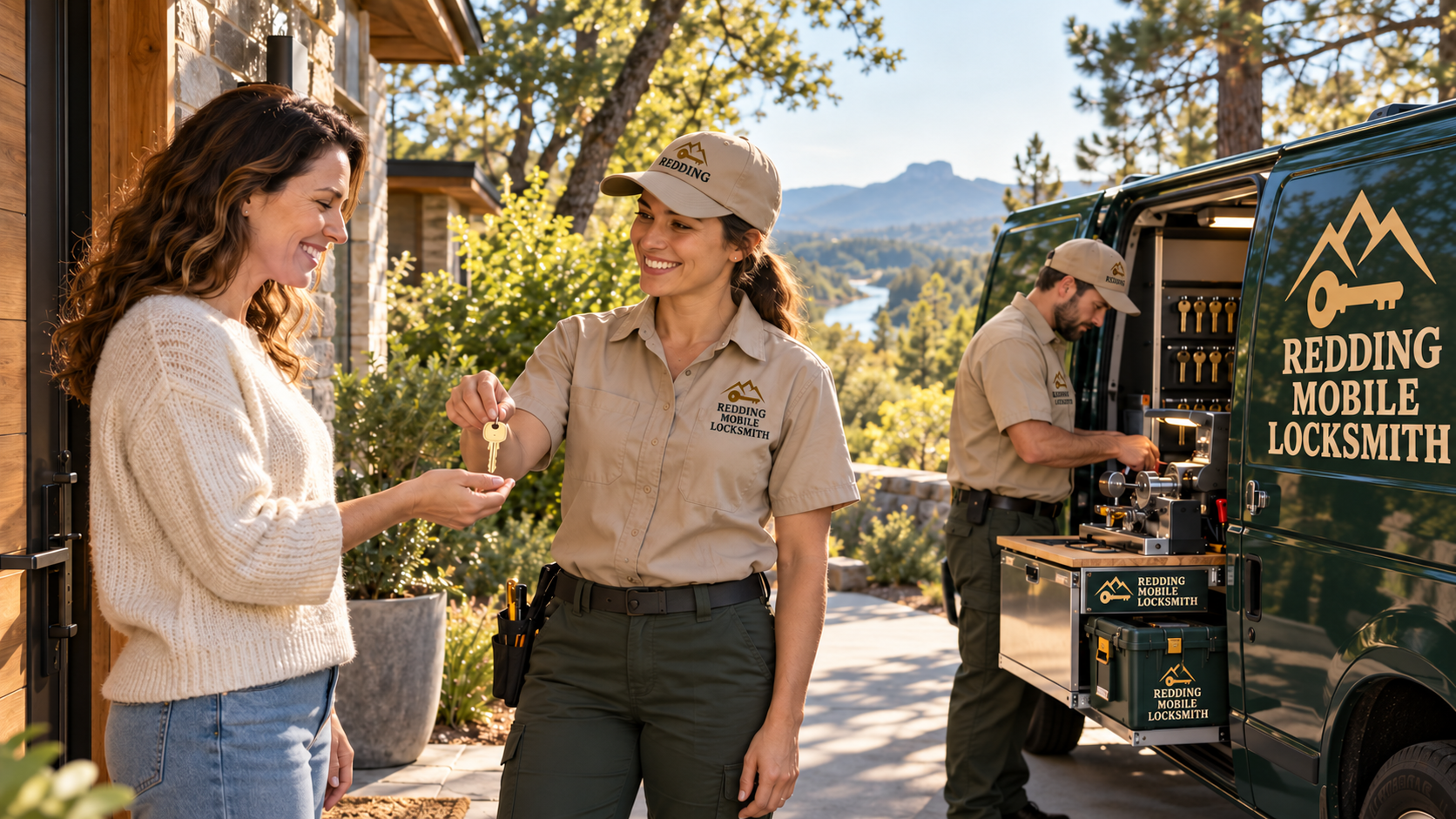
A visit begins with an assessment. The technician looks at each door, measures its thickness, checks the bore, inspects the frame and notes any damage. You talk through what you want, and the technician offers suggestions. If new parts are needed, the branded service van carries common hardware, so many choices can be installed that day.
Installation itself follows a pattern. The old lock is removed, the bore is checked or adjusted, the new bolt and lock body are fitted, the strike is aligned and secured with long screws, and the trim is attached. The technician then tests the action many times and checks that the door closes without pressure.
At the end, you should receive every key, a demonstration of how each lock works and any codes or instructions. Ask about keying alike if you want one key for several doors, and about the difference between a key you can copy at any key shop and one with a restricted blank.
Guests and helpers are part of that picture. A keypad lets you give a house sitter, a delivery driver or a relative a code for a set time. A conventional lock does the same job with a spare key, though copies are harder to track. Choose the method that makes you comfortable and that you can manage consistently.
Keeping the household in mind
Locks are used by people, and the right lock is one that all of them can operate. Children need to be able to leave the house in an emergency, so a thumb turn at a height they can reach is important. Older relatives may need a lever instead of a knob. A caregiver or neighbor may need a spare or a code.
Think about the daily routine. Who comes home first? Who carries what? Does anyone arrive late at night? A well chosen lock fits those patterns and reduces the fumbling that leads to propped doors and hidden keys under mats.
Our guide on childproofing exterior doors discusses balancing safety and security, and the page on home lock service in Montague shows how installation connects with repair and rekeying.
When you are ready to start
Gather a few details before you ask for help. Count the doors you want to cover and note what each is made of. Decide whether you prefer keys, codes or both. If you rent, talk to the owner first, since leases and landlord rules differ and some changes need approval.
Redding Mobile Locksmith works around the clock, and you can begin with the request form on the contact page. For the neighboring community, see new lock installation in Granada, and the Montague overview lists every local page for the town. A good lock should fade into the background, and that is the aim of every installation.
- Photograph each door and its frame.
- List who needs access and when.
- Decide how many keys or codes you will need.
- Ask whether new locks can be keyed alike.
- Ask what happens if a battery runs out in a keypad.
Good to know
Common questions
Do I need a locksmith to install a deadbolt?
Not always, as some handy homeowners fit one themselves. A professional installation checks the door, the bore and the frame, aligns the strike properly and tests the lock under real use. If your door is old, damaged or oddly drilled, expert fitting avoids cracked wood and a bolt that drags.
Can a keypad lock work on an old wooden door?
Often yes, as long as the door is thick enough and sound. Older doors may need a small modification or an adapter plate. A technician can measure the door and the existing holes and tell you plainly whether a particular lock will fit. Batteries and a physical key backup are worth discussing too.
What happens if the batteries in a smart lock die?
Most smart and keypad locks give a warning before the battery runs out and have a backup, such as a physical key or an external terminal for temporary power. Change the batteries on a schedule and keep a spare key somewhere safe. Ask the technician to show you the backup before they leave.
Should every exterior door have the same lock?
Not necessarily. Matching deadbolts on all exterior doors is sensible, but handles and keypads can vary with each door's use. Many households key everything alike so one key opens all. The tradeoff is that a single lost key affects every door, so decide with that in mind.
How do I know which lock grade I need?
Heavier grades suit busier, more exposed doors, such as the main entrance. Lighter grades may be fine for interior or low use doors. A technician can explain the grades and match them to each door. More expensive does not always mean more suitable, so ask what each option offers.
Is it a problem to install new locks in a rental?
It can be if the lease forbids changes, so ask the owner first. Many landlords agree to upgrades or arrange them. Keep the original hardware in case the owner wants it back. Our guide for renters lists questions to ask about lock changes and who should pay.