
Home / Neighbors ask / Can smart locks be rekeyed?
Neighbors Ask
Can smart locks be rekeyed?
Often yes, if the lock has a mechanical key cylinder. That cylinder can be rekeyed like any other, while codes, cards and phone access are changed through the lock's own settings instead.
Neighbors Ask
The honest answer: it depends on what you mean
The word rekey really refers to the mechanical part of a lock, the cylinder with pins inside that your metal key lifts into place. Rekeying means changing those pins so that old keys stop working and new keys take over. So the first question about any smart lock is whether it has a key cylinder at all.
Many do. A large share of smart deadbolts keep a keyhole on the outside as a backup for dead batteries or for people who prefer a key. If yours has one, that cylinder can usually be rekeyed in much the same way as an ordinary deadbolt, provided the cylinder is of a standard type.
Some smart locks have no keyhole whatsoever. They open only by code, card, phone or similar means. For those there is nothing to rekey, and the equivalent action is to change the codes and remove any access you no longer want. We will go through both cases.
Two kinds of access in one lock
A smart lock is really two locks under one cover. One is the mechanical lock, if any, that responds to a metal key. The other is the electronic lock that responds to codes, cards, fobs and phones. Each has its own list of who is allowed in.
That is why a smart lock needs two kinds of housekeeping. The mechanical side is rekeyed. The electronic side is reset. If you only look after one, the other quietly keeps a list of people who may still be able to enter. A tidy job handles both.
Think of a building with a front door and a side gate. Changing the gate lock does nothing for the front door. In the same way, rekeying the cylinder does nothing about a code that your former house sitter still remembers. Both ends need attention after a change in who should have access.
Rekeying the mechanical cylinder
When a smart lock has a key cylinder, a locksmith can usually remove that cylinder, change the internal pins to a new pattern, and cut new keys to match. The process is the same used on ordinary locks, which we describe in rekey your home. It does not disturb the electronics, and it does not change the way the lock communicates with your phone.
The most important question is whether the cylinder is a standard type that accepts rekeying. Many smart locks use cylinders from common families, and those are straightforward. Others use proprietary designs that only the maker can service, and some are built so that the cylinder cannot be changed without replacing the whole lock body.
A locksmith can usually identify the type at a glance. If the cylinder is rekeyable, the job is a modest one. If it is not, the options are to replace the cylinder with a compatible one, to replace the lock, or to accept that the keyhole is a convenience rather than a security feature.
- Look for a keyhole on the outside of the lock, often behind a small cover.
- Ask whether the cylinder is a standard type that can be rekeyed.
- Expect the electronics to stay untouched during a rekey.
- Plan to reset codes and app access as a separate step.
Resetting the electronic side
For codes, you generally use the lock's own settings, either on the keypad or in an app. Deleting a code removes that person's ability to enter. Changing a master code does the same for the master. Many locks let you see a list of users, which is a handy way to check who still has access.
For phones and cards, access is removed in the app or by erasing the card from the lock's memory. A few models require a full reset to clear everything, after which you add back only the people you want. That is a clean start, similar in spirit to a rekey.
After any reset, test the lock thoroughly. Try every code, card and phone that should work, and make sure removed ones do not. Locksmiths do this as a matter of habit, since it is easy to leave a stale entry behind. If the lock keeps a log, look it over to make sure nothing unexpected remains.
One caution is worth stating plainly. Rekeying a smart lock is a job for someone who knows how that product is built. Taking the cylinder out the wrong way can leave a connector loose, and a motor that no longer lines up with the bolt. A locksmith who works with these locks regularly will know where the cylinder sits, how it is retained and what must be left alone.
Why you might want to do this
The reasons are the same as for any lock. You may have bought a home with a smart lock already installed, and you do not know who holds keys or codes. You may have ended a relationship, a tenancy or a working arrangement. A key may have gone missing. A code may have been shared too widely. In each case, you want to return to a known list.
Our page on whether to rekey after buying a house explains the thinking in the ordinary case, and the principle holds here as well. A new owner cannot know who has the old keys or the old codes, and a clean slate is a sensible start.
A property manager might do this at every turnover. For that workflow, see property managers and the rekey at turnover. Smart locks can make turnover easier, since codes can be changed without a visit, but the mechanical cylinder still deserves a rekey when keys have been handed out.
Sometimes the motivation is less dramatic. A household may want to bring a newer smart lock in line with the keys on the rest of the doors, or a family member may have moved out and returned the spare. Rekeying is not only for emergencies. It is also a tidy way to keep your key list honest as life changes.
When the cylinder cannot be rekeyed
Sometimes the answer is no. A few smart locks use a sealed cylinder, or a design with a special keyway that is only available through the maker. A locksmith may be able to order a replacement cylinder from the manufacturer, and some makers support exactly that. Others will tell you to replace the entire lock.
Before spending money, consider how important the key really is. If you never use the key and the keyhole is a backup you do not intend to rely on, you might choose to cover it, or to leave it, and manage security through codes alone. That is a reasonable choice for some households, but it should be a conscious one. A keyhole that is never used can still be used by someone else.
If the lock is old or worn, replacing it may make more sense than patching it. Newer products often have better batteries, better mechanical grades and better software. Our page on lock grade can help you compare options.
There is also a middle road for sealed cylinders. A locksmith may be able to fit a compatible cylinder from the same family and key it to your system, or, if the maker supports it, send the original out for service. This takes patience, and it is wise to ask early so you know the timeline before the old keys are retired.
Pairing with other locks in the house
Many households have a mix: a smart deadbolt on the front door and ordinary deadbolts on the back. If they all use the same key, rekeying them together keeps your keys simple. A locksmith can set the smart lock's cylinder to the same pattern as the others, so a single key still fits every door.
This is called keying alike, and it works only if the cylinders are compatible. The locksmith checks the keyway of each one. If they are different, an adapter or replacement may be needed. Our page on how many keys a household should keep explains why this is useful.
If you are installing a smart lock for the first time, you can ask the installer to match it to your existing key system. That prevents a pocketful of different keys. See new lock installation for what to expect.
Keep one more point in mind: a smart lock is only as secure as its weakest entry method. If the keyhole is easy to rekey but a short code is easy to guess, the keyhole is not your problem. Choose codes of a sensible length, avoid obvious patterns, and let the lock lock itself if that feature suits your household.
A short illustration
Imagine a household that bought a house with a keypad deadbolt on the front door. The previous owner mentioned that a neighbor had a code and that a cleaner had a key. The new owners are not sure who else has either. They want to start fresh.
A locksmith examines the lock. It has a standard cylinder behind a cover. The cylinder is rekeyed to a new pattern and two new keys are cut. Then the codes are erased from the keypad, and the owners set a new master code and one guest code. The lock is tested with each key and each code, and a spare key goes to a trusted neighbor.
The whole thing is calm and orderly. Nobody takes the door apart in a dramatic way, and the lock remains installed and working. This is only a made up example, but it reflects how a typical visit tends to go.
Now picture a different situation, a small rental where a tenant has moved out. The owner wants the next occupant to start with a clean list. The locksmith rekeys the cylinder, the owner clears the old tenant's code and sets a new one, and the keyless door is ready. Seasonal owners with a mountain cabin might use the same steps before each season. See managing locks for vacation homes for more.
Another common surprise is the inside of the lock. On many models the thumb turn or the interior assembly is where the batteries and the electronics live, and it may be held on by screws that are only reachable with the door open. That is normal, and a locksmith will tell you which parts belong to the mechanical side and which belong to the electronic side before anything is opened.
Questions worth asking
Ask whether your lock has a rekeyable cylinder, and what type it is. Ask what happens to the electronic settings during the work. Ask whether the codes will be cleared, and whether you will be shown how to set new ones. And ask what the plan is if the cylinder cannot be rekeyed.
Ask also about the manufacturer's terms. Some makers have rules about modification, and a locksmith will tell you if a particular product has any. Do not assume any rule, and do not ask us to stand in for the maker. Terms vary by product, so check with the maker if you have concerns.
Finally, ask for spare keys at the same visit. A rekey with a single key is a rekey that will bring you back. Having a spare for a neighbor, a partner or a safe place is exactly the sort of thing that avoids a second visit.
Batteries, cold and the day you do the work
Because smart locks run on power, it is smart to schedule a rekey together with a battery change. A locksmith can put in fresh cells, check the motor and test the lock from inside and out. In the cold mountain towns, this is worth doing before winter, since low batteries and low temperatures together are the most common reason for a smart lock to balk.
It also helps to try the lock with the door open and then closed. A bolt that moves freely in the air but strains when the door is shut tells you the strike is out of line. A locksmith will adjust it, or tell you if the door itself needs attention. See lock repair and adjustment for how that goes.
Take a moment, too, to teach everyone in the household what changed. A new code does no good if a family member keeps typing the old one at the door at night, and a replaced key does no good if it stays in a drawer. A short conversation after the work saves a great deal of confusion.
Finally, keep notes. Write down which cylinder you have, which codes exist and who holds them, and store the list somewhere private. The next time you need a change, a good record saves everyone time.
Smart lock help across Shasta and Siskiyou counties
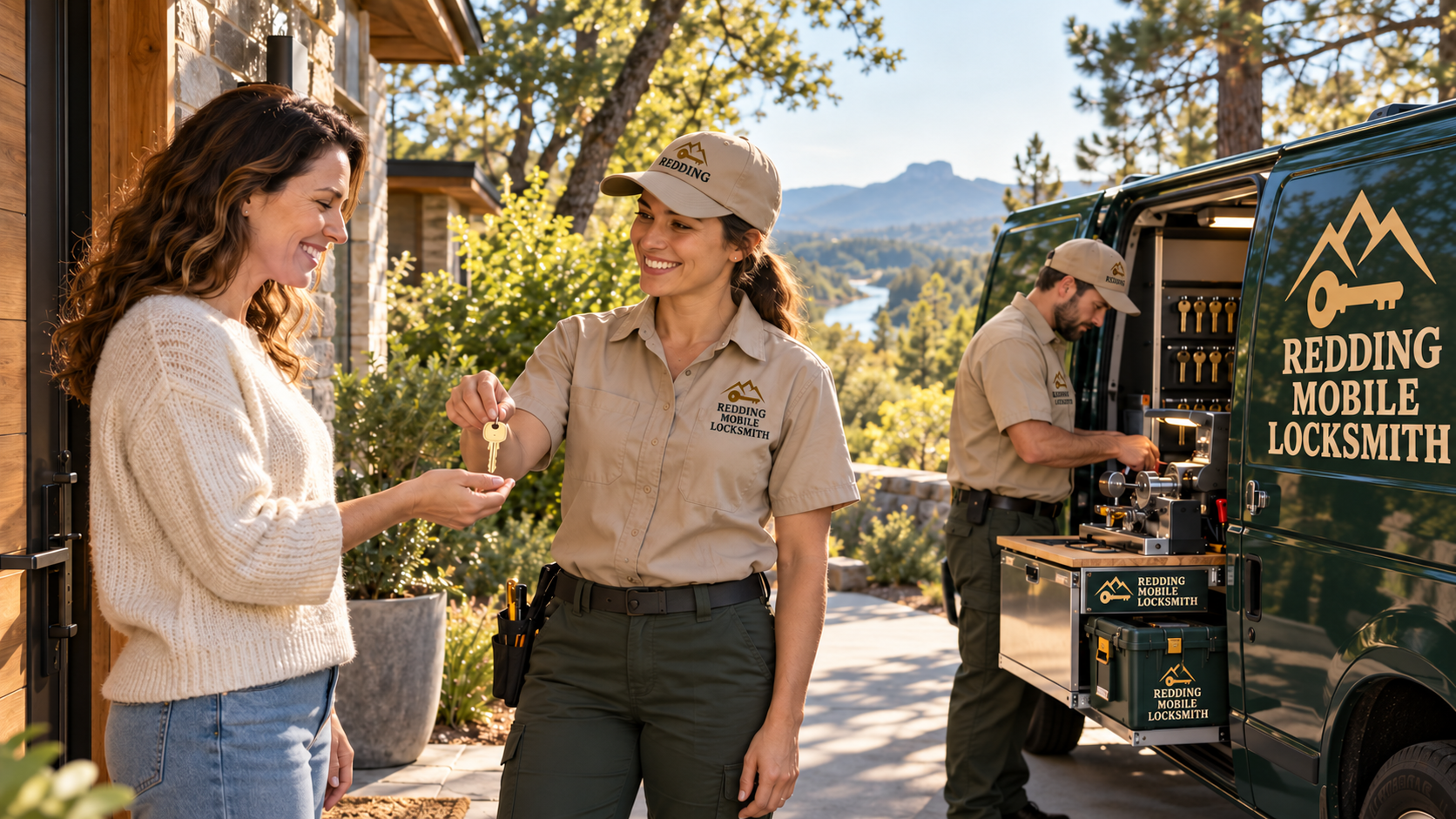
Redding Mobile Locksmith serves homes and businesses in Shasta and Siskiyou counties, including Redding, Shasta Lake and Weed. Our team works in uniforms and arrives in a branded van with rekeying tools, key cutting equipment and common hardware, so many rekeys can be finished at your door.
The phone line is coming soon. To start, please use the form on the contact page. Tell us the type of smart lock you have, whether it has a keyhole and what you want to change. If you can describe the lock or send the model name, that helps us bring the right parts. Our page on what a smart lock is can help you describe it.
Whatever lock you have, the principle is the same: know who can get in, and keep that list short and current.
Good to know
Common questions
Can every smart lock be rekeyed?
No. Only those with a mechanical key cylinder that is a standard, rekeyable type. Some smart locks have no keyhole, and a few use sealed or proprietary cylinders. A locksmith can usually tell by looking at the lock whether rekeying is possible.
If I rekey the cylinder, do my codes still work?
Yes. Rekeying changes only the mechanical pins. Codes, cards and phone access are stored in the electronics and are unaffected. That is why you should reset them separately if you want to remove someone's access.
What should I do about codes after a move or a breakup?
Delete every code you do not recognize, change the master code and add back only the people who should have access. Some locks need a full reset to clear everything. Then test each remaining code and make sure removed ones no longer work.
My smart lock has no keyhole. What now?
There is nothing to rekey in that case. Manage access by changing codes and removing cards or phones, and keep a backup way into the house, since a keyless lock depends on power. A locksmith can advise on what suits your door.
Will rekeying void the maker's terms?
It depends on the product. Some makers have rules about modification, and others do not. Check the paperwork for your lock or ask the maker. A locksmith can tell you what a rekey involves so you can decide with the facts in front of you.
Is it better to rekey or replace a smart lock?
If the cylinder is standard and the lock works well, a rekey is usually the simpler choice. If the lock is worn, unreliable or has a sealed cylinder, replacement may make more sense. A locksmith can help you weigh the two options.