
Home / Neighbors ask / What does lock grade mean?
Neighbors Ask
What does lock grade mean?
A lock grade is a rating of how much testing a lock can endure. Grade one is the toughest, grade three is the lightest, and the number tells you more about durability than about the lock's looks or price.
Neighbors Ask
The short version
Lock grade is a way of sorting locks by how well they stand up to hard use and hard treatment. Hardware is put through standardized tests: thousands of cycles of turning, repeated blows to the door, force applied to the bolt, and more. A lock that passes the toughest set of tests earns the highest grade. The grade is a number, and in the common system a lower number means a stronger lock.
Grade one is the strongest and is meant for heavy use, such as busy commercial doors. Grade two sits in the middle and is common on better quality residential hardware. Grade three is the lightest and is found on many basic residential locks sold in big stores.
So when someone asks what lock grade means, the answer is that it is a shorthand for how much punishment the lock was built to take. It is a useful clue, though it is not the entire story, and we will walk through what else matters.
Think of it like the load rating on a ladder or the cycle count on a kitchen appliance. Nobody claims the number tells you everything, yet it is much better than nothing. A grade is a tested promise about a narrow set of things, and its worth lies in being comparable from one product to the next.
Where grades come from
Lock grades are set by industry standards bodies, which publish test procedures that manufacturers can follow. The tests are designed to be repeatable, so that a grade one lock from one maker means roughly the same level of toughness as a grade one lock from another. This gives buyers a common language, which is a good thing in a market with hundreds of products.
The grade covers specific features. There are separate tests for the latch or bolt, for the strength of the lock body, for the cycle life of the mechanism, and for resistance to forced entry on the door edge. A product gets a grade for what it passed, and a manufacturer may list the grade on the package or on a data sheet.
Not every lock is graded. Some inexpensive or imported products carry no grade at all, or they carry vague words like heavy duty that mean nothing in particular. If a lock has no grade, you are relying on the maker's description and your own judgment, and that is a weaker position than relying on a tested standard.
Be wary of marketing language that sounds like a grade without being one. Words such as commercial style, security series or contractor grade are descriptions chosen by the seller. A true grade is a number from a tested standard. When in doubt, ask the seller to show you where the grade appears in the product literature.
What the three grades mean in everyday terms
Grade three is designed for light use. It is meant to survive a smaller number of cycles, which is fine for a bedroom door that is locked once a day, and acceptable for an exterior door in a home where nobody is rough on hardware. It will do the job, though it may wear sooner and may take less abuse.
Grade two is a step up. It is tested for a higher cycle count and a stronger load, and it is a reasonable standard for the exterior doors of most homes. If you want hardware that will last through years of daily use and the occasional shove, grade two is a sensible target.
Grade one is built for the hardest service. Think of a shop door that opens constantly through the day, a school or office entrance, or a door where a mistake would be serious. It is also available for homes, and some homeowners choose it simply for peace of mind and longevity. Heavier materials and thicker parts make it feel solid in the hand.
Another detail: grades often apply separately to different pieces. A product might carry a higher grade for its bolt than for its finish, and a finish that fails does not weaken the lock but can make it look worn. Outdoor exposure matters here, since sun and rain in our region can dull finishes and stiffen moving parts on hardware that was meant for a covered porch.
- Grade three: light duty, basic residential use, shorter expected life.
- Grade two: stronger and longer lasting, common on better residential doors.
- Grade one: heavy duty, designed for busy or demanding doors.
- No grade: no tested standard to rely on, so ask more questions.
The grade is not the whole story
It is tempting to treat the grade as a ranking of security, but it measures durability and strength more than resistance to every kind of attack. A grade one lock on a thin door with a weak frame is still easy to defeat at the door itself. A well fitted grade two lock on a solid door in a good frame can serve a home very well.
Consider the weakest link. A door has a lock, a strike, a frame, hinges and a door slab. Each of these has its own strengths. A lock with a high grade only helps if the other parts keep pace. That is why a locksmith looks at the whole door, not just the item you bought.
There are also differences between what the grade measures and what you may care about. A keypad deadbolt can be a fine grade two product and still have different security characteristics from a mechanical one. Smart locks add electronics and software to the mix. We talk about those in what is a smart lock and who needs one.
A related idea is cycle life, meaning how many times the lock can be locked and unlocked before the mechanism wears out. A lock on a back door that is used twice a day will take years to reach its limit. A lock on a busy shop door reaches the same point in a fraction of the time. That is the practical reason for the commercial grades.
Residential versus commercial
Homes and businesses use locks differently. A family might open the front door a dozen times a day, while a shop or restaurant may open its main door a great many times. The wear is simply different, and commercial hardware is built to handle it. That is why you will often see grade one locks on commercial doors and grade two or three on homes.
For a business, a higher grade is nearly always worth considering, because replacing worn hardware means downtime. Our page on door hardware for business explains the options, and business lock service covers the larger picture.
For a home, the choice depends on the door, the household and the budget of effort you are willing to put in. A front door that sees heavy use by a busy family might justify a grade one or two. A rarely used side door may be fine with grade three. Matching the grade to the use is the point, rather than buying the most robust item for every door.
Rental properties sit in the middle. A landlord with many units may reasonably choose a durable grade because tenants change and hardware gets heavy use. If you are a tenant who suspects your lock is flimsy, see what renters should ask a landlord before you change anything yourself.
How to find the grade of a lock you already own
Start with the packaging, if you kept it, or the manufacturer's website. The grade is often printed on the box or in the product description. If you no longer have either, look at the lock itself. Some carry a model number that a locksmith can look up. Others carry no grade at all.
If you cannot tell, a locksmith can usually tell you by feel and by looking at the parts. Heavier construction, thicker bolts and sturdier mounting plates suggest a higher grade. Lightweight stamped parts and thin faceplates suggest a lower grade. It is not a perfect test, though it works well for a trained eye.
You can ask a locksmith to take a look at your exterior doors and tell you what they see. That conversation is a good way to decide whether an upgrade makes sense. You can arrange it through the form on the contact page.
It can help to compare what a lock does over its lifetime. A hardware set that lasts many years without sticking, loosening or needing a rekey costs less per year than one that must be replaced twice in the same time. People tend to remember the price on the box and forget the cost of the second purchase.
Cost versus value
A higher grade usually costs more up front. The question is whether that extra cost buys you something you will use. If you plan to live in the house for many years, a stronger lock is likely to outlast a lighter one, and avoids the trouble of replacing it. If you expect to sell soon, a modest grade may be enough.
It also pays to think about the labor. Installing a lock costs about the same whether it is grade one or grade three, so a higher grade often adds only a small share of the total job. If you are paying for the visit anyway, you may as well choose hardware that will last.
We cover this from another angle in do expensive locks make a difference, and in how long a lock will last. Both are worth a look if you are deciding between two options on a shelf.
Keep in mind, too, that a grade is a snapshot of a product as tested. Installation matters. A grade one lock fitted crookedly, with a bolt that rubs and a strike that does not line up, will wear itself out in a way the test never imagined. A careful installer makes the grade real.
Grades for different kinds of hardware
Not only deadbolts are graded. Knob and lever sets carry grades. So do mortise locks, which are the heavier boxes set into the edge of a door, and exit devices such as push bars. Door closers have their own grades as well. This matters because a door is a system, and a mismatched set can leave a gap in your defense.
For example, a high grade deadbolt with a low grade latch on the same door means the latch becomes the weak point. If a door sees heavy use, each part should be graded for that use. Our page on door closers explains why a closer needs to match the door.
The same principle applies to the strike plate and the screws. A strong lock set in a weak frame invites trouble. Long screws and a solid strike make the grade of the lock count for something.
A short story to make it concrete
Picture two neighbors who each bought a new front door lock. One chose an inexpensive set with no grade listed. The other chose a grade two deadbolt and a grade two lever set. Five years later, the first neighbor's lock is stiff and the key sticks, while the second neighbor's lock turns as smoothly as on the day it was installed. This is only an illustration, but it reflects how wear tends to accumulate.
The difference was not magic. It was thicker metal, tighter tolerances and a tested standard. The grade told the second neighbor roughly what to expect, and it helped them avoid a lock that would need to be replaced.
Of course, any lock can fail in a given case, and a higher grade is not a promise of anything. It is a sign that the maker took the standard seriously, and that is a reasonable thing to value.
Do not feel you must memorize any of this. You need only remember that the grade tells you how tough a lock was built to be, that it is one useful clue among several, and that you can ask for help. Neighbors who know a little about locks make better choices, and neighbors who ask make better choices still.
Choosing with a locksmith's help
When we look at a door, we ask a few simple questions. How often is it used? Who uses it? What is the frame like? What happens if it fails? From those answers, a grade and a type fall into place. Some doors need grade one, some are well served by grade two, and a few can manage with grade three.
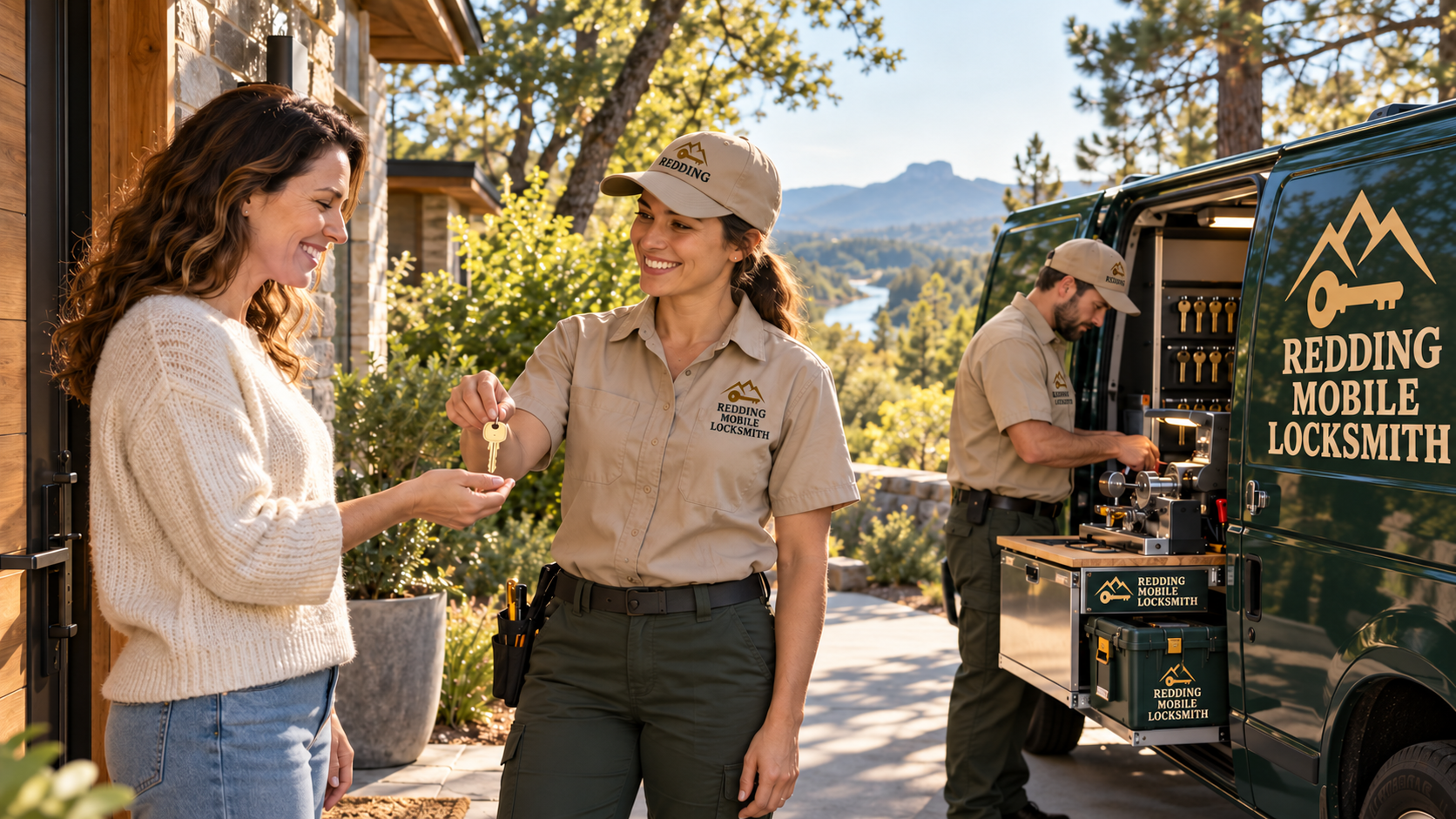
Redding Mobile Locksmith works in uniforms and brings a branded van with hardware and tools to homes and businesses in Shasta and Siskiyou counties, including Redding, Anderson and Mount Shasta. If you are installing new hardware, our new lock installation page describes what happens, and home lock service covers the wider range of work.
The phone line is coming soon, so please use the form on the contact page. Tell us how many doors you have, what they are used for and what you have now, and we will help you sort the grades.
Good to know
Common questions
Is grade one always better than grade two?
It is stronger and more durable, but better depends on the door. A grade one lock on a thin door in a weak frame is not much safer than a grade two lock on a solid door. Match the grade to how the door is used and how sturdy the rest of it is.
Do all locks have a grade?
No. Many inexpensive or imported locks carry no grade at all, or use vague words like heavy duty that mean little. A graded lock has been tested to a published standard, which gives you something to compare. If a lock has no grade, ask more questions before buying.
Is a higher grade lock harder to break into?
Not necessarily. Grade measures durability and strength under testing, not resistance to every kind of attack. A strong lock helps most when the door, frame, strike and hinges are strong too. A locksmith can look at the whole assembly and tell you where an upgrade matters.
What grade is right for a house?
Many homeowners are well served by grade two on exterior doors, with grade three acceptable on lightly used doors. Grade one is reasonable for busy front doors or for people who want maximum durability. The right answer depends on use, budget and the condition of the door.
How can I tell what grade my current lock is?
Check the packaging, the maker's website or a model number on the lock. If none of those are available, a locksmith can often judge by the weight, the thickness of the parts and the feel of the mechanism. Heavier and sturdier generally suggests a higher grade.
Do smart locks have grades too?
Many do, since the mechanical part of a smart lock can be tested like any other. The electronics are a separate matter and are not captured by the grade. Ask the maker for the mechanical grade, and ask a locksmith how the whole product suits your door.