
Home / Fort Jones / New Lock Installation in Fort Jones
Fort Jones installation
New Lock Installation in Fort Jones: Door Prep, Strikes and Alignment
Picture a traveler who left the interstate to look at a small Scott Valley property and noticed every door. Here is what makes a new lock work: preparing the door, setting the strike and lining everything up.
Fort Jones installation
A traveler who left the interstate
Picture a traveler on Interstate 5 who decides, on a whim, to turn off and see what Scott Valley looks like up close. They end up in Fort Jones, wandering past a small property for sale, with a farmhouse, a barn, a workshop and a gate. They are not a locksmith, but they are the kind of person who tries a door handle out of curiosity, and what they find is instructive. The front door lock feels loose. The workshop door needs a shoulder to close. The gate chain is held with a padlock that is clearly older than the buyer.
Every property like this has the same underlying story. Locks fail less often because the lock was poor than because the installation around it was. A well made lock in a badly prepared door is a poor lock. A modest lock in a well prepared door can serve for decades. That is what this page is about: the unglamorous steps that make a new lock work properly, so that when you hear the word installation, you know what a good one includes.
We will cover the door itself, the holes that are drilled, the strike plate, the alignment, the testing and the follow up. None of it requires special knowledge to understand, and knowing it will help you judge any installation, ours or anyone else's.
Start by reading the door
Before any new lock is fitted, the door has to be understood. How thick is it? Most residential entry doors are a standard thickness, but older doors in farmhouses and outbuildings vary. What is it made of? A solid wood door takes screws well and can be drilled cleanly. A hollow core interior door is thin and weak. A metal door has a skin that must be cut precisely. A fiberglass door has a core of foam or wood that must be protected from damage.
Look at the condition. A door that has warped, swelled or sagged will not carry a new lock well. A lock fitted to a door that rubs the frame is simply a lock that will not latch. Often the first job is to fix the door: tightening or replacing hinges, planing an edge, or resetting the frame. Those jobs are not glamorous, and they make the rest possible.
Finally, look at what is already there. Existing holes in a door tell a story. A standard bore for a lock is a certain size, and many new locks are made to fit that size. If the old hole is oversized or damaged, a trim plate or a repair may be needed. When you describe the door to us, a photo of the edge and the face helps enormously. You can send one with the request form.
Door prep: the holes that matter
A typical residential lock set needs two holes. The larger one goes through the face of the door and holds the knob or lever and the deadbolt body. The smaller one goes into the edge and holds the latch or bolt. These holes must meet each other precisely and sit at the right distance from the door edge. That distance is called backset, and the two common sizes are close enough that using the wrong one means the lock does not fit.
Drilling is done with special hole saws and a jig that keeps the cut straight. A hole that wanders leaves a lock that binds when turned. A hole that is too large weakens the door. A good installer drills slowly, supports the wood so it does not split at the exit and checks the fit before assembling anything. On metal and fiberglass doors, the process is more delicate still.
The edge hole must also be cut so the latch plate sits flush with the edge. A latch plate that sticks out catches on the frame, and one set too deep leaves the bolt unsupported. These are details a careful installer notices, and you can check them yourself: run a finger along the plate and feel for an edge. For information on how locks differ in strength, see what lock grade means.
- Measure thickness and note the door material first.
- Confirm backset so the latch lines up with the frame.
- Drill straight with a jig and support the exit side.
- Set the latch plate flush with the edge of the door.
The strike plate: small piece, large job
The strike plate is a small metal plate set into the door frame, with a hole for the bolt to enter. People rarely think about it, and it does more work than almost any other part. When someone pushes on a locked door, the force goes through the bolt into the strike and then into the frame. If the strike is held by short screws in thin trim, the frame can split and the door can open even though the lock never failed.
A good installation uses screws long enough to pass through the plate and the trim into the solid framing behind. On exterior doors, that often means screws of two to three inches. A reinforced strike with a longer plate spreads the force further. The hole behind the strike must be deep enough that the bolt can extend fully without hitting the bottom.
Alignment matters just as much as strength. The bolt should enter the strike hole without rubbing. If you have to lift or push the door to lock it, something is off by a fraction of an inch. A strike that is slightly high or low can be adjusted by filing the opening or moving the plate. Our article on what makes a good strike plate goes into more detail.
Alignment: why a good lock still sticks
Many calls begin with the words my new lock is sticking. In most cases the lock is fine and the alignment is not. A door hangs on hinges, and hinges loosen. A door that sags a sixteenth of an inch moves its latch out of line with the strike. The result is a lock that works when the door is held up and fails when it is not.
To check alignment, close the door slowly with the deadbolt retracted. The latch should slip into the strike without catching on an edge. Then extend the deadbolt and watch whether it moves freely into its hole. If either rubs, mark where it touches. The fix may be a tightened hinge, a shim behind a hinge, or a small adjustment of the strike.
The reason alignment drifts is often the building itself. Older houses settle, and Scott Valley has real seasons. Wood swells in damp weather and shrinks in dry heat, and a door that fits perfectly in August may bind in February. Read why doors sag and what it does to locks for an explanation, and whether a door that will not close can be fixed for the fixes.
Choosing what goes in the door
Once the door is understood, the question is which lock suits it. A standard entry door typically wants a deadbolt and a handle set, ideally with a single key for both. A back door might get the same. A workshop might need a more robust deadbolt, set into a reinforced section. A gate may need a heavy duty padlock or a gate latch with a lockable body, depending on its design.
Grades matter. Locks are made in different grades, with higher grades built for tougher use. A higher grade lock costs more and generally lasts longer, particularly on doors that are used heavily. For a farmhouse back door that sees muddy boots and constant traffic, a more robust grade is sensible. For a rarely used guest room, less is needed.
Smart locks and keypads are also options. They have advantages, such as no key to lose, and some drawbacks, such as batteries. If you are curious, read what a smart lock is and who needs one and whether smart locks can be rekeyed. Whatever you choose, the preparation of the door is the same.
One more thing to weigh is how the lock will be used day to day. A household that comes and goes constantly, with children, visitors and deliveries, puts more cycles on a lock over a single season than a weekend cabin sees over twelve months. Matching the lock to that pattern, and not to the price on the box, is how you avoid replacing it again soon.
Outbuildings, gates and farm doors
Fort Jones sits in Scott Valley, where ranch and farm properties are common. That means barns, sheds, workshops, tack rooms, and gates. These do not always have the same hardware as a house. A barn door may slide on a track and need a latch that suits that motion. A shed may use a hasp that bolts through the door. A gate may use a chain, a latch or a lockable bar.
Installation here depends on how the structure was built. Old timber is solid but irregular. A hasp bolted through with carriage bolts and backed by washers is much stronger than one held by wood screws. The hasp itself is only part of the story, since the lock that goes into it also matters. A hardened shackle and a body that resists tools are worth the extra.
Sheds and garages that hold valuable equipment deserve more than a basic padlock. Our article on shed and garage padlock questions and gate lock questions for country driveways go through the choices.
Testing before we call it done
An installation is not finished when the last screw goes in. It is finished when the lock has been tested with the door open, with the door closed, from outside and from inside. The key should enter and turn smoothly. The deadbolt should throw all the way with no resistance. The latch should retract fully when the handle is turned and spring out cleanly when released.
We also test the lock with the door in its worst condition. Press the door slightly inward while turning the key, then pull it slightly outward. A lock that works only when the door is held in a particular position will fail in real life. Listen for rubbing or clicking. A clean, solid sound is a good sign.
If the lock is part of a keyed alike set, we test every key in every lock. A key that works in the front but not the back is a problem to catch on the day of the installation, not a year later. We would rather spend an extra few minutes at the door than have you call us back.
Cold winters and what they ask of a new lock
Winter in Fort Jones is cold, and a new lock has to live through it. Metal shrinks and expands, so tight tolerances can bind. A lock installed in summer sits happily in a frame that, in January, has moved slightly. For that reason we leave a small amount of clearance and avoid forcing parts together.
Moisture is the other enemy. A lock installed on a door that faces weather benefits from a sealed body, a weather cap or a lock with a good finish. Applying the correct lubricant at installation extends life. Our article on what lubricant belongs in a lock describes which products suit locks and which do not.
Think about how you will use the lock with cold hands and thick gloves. A lever may be easier than a knob. A keypad may be hard to use with gloves. A thumb turn that is too small is frustrating on a freezing morning. These practical details are worth discussing before the work begins.
After installation: keys, records and follow up
When the work is done, count your keys. A new lock set usually comes with a few, and it is worth making sure each one works. Keep one in a safe place away from the door. Keep a record of what was installed, even if it is just a note on your phone, because it saves time if you ever need a replacement part.
If you have changed locks on a house, think about who had keys to the old ones. A new lock changes who can enter, and the people who need access should be given a key. Rekeying is another option when the hardware is fine and only the keys are in question. See rekey your home and our new lock installation service.
Check the work after a few weeks and again when the weather changes. A lock that has been working perfectly can start to bind after a cold snap, and a small adjustment is usually all that is needed. We are glad to look at it.
If you ever decide to sell the property, a record of what was installed and when is a useful thing to hand to the next owner, along with every key. It turns a stack of mystery hardware into something a newcomer can understand, which is a kindness in a small community where houses change hands and the doors outlast the owners.
Working with us in Fort Jones
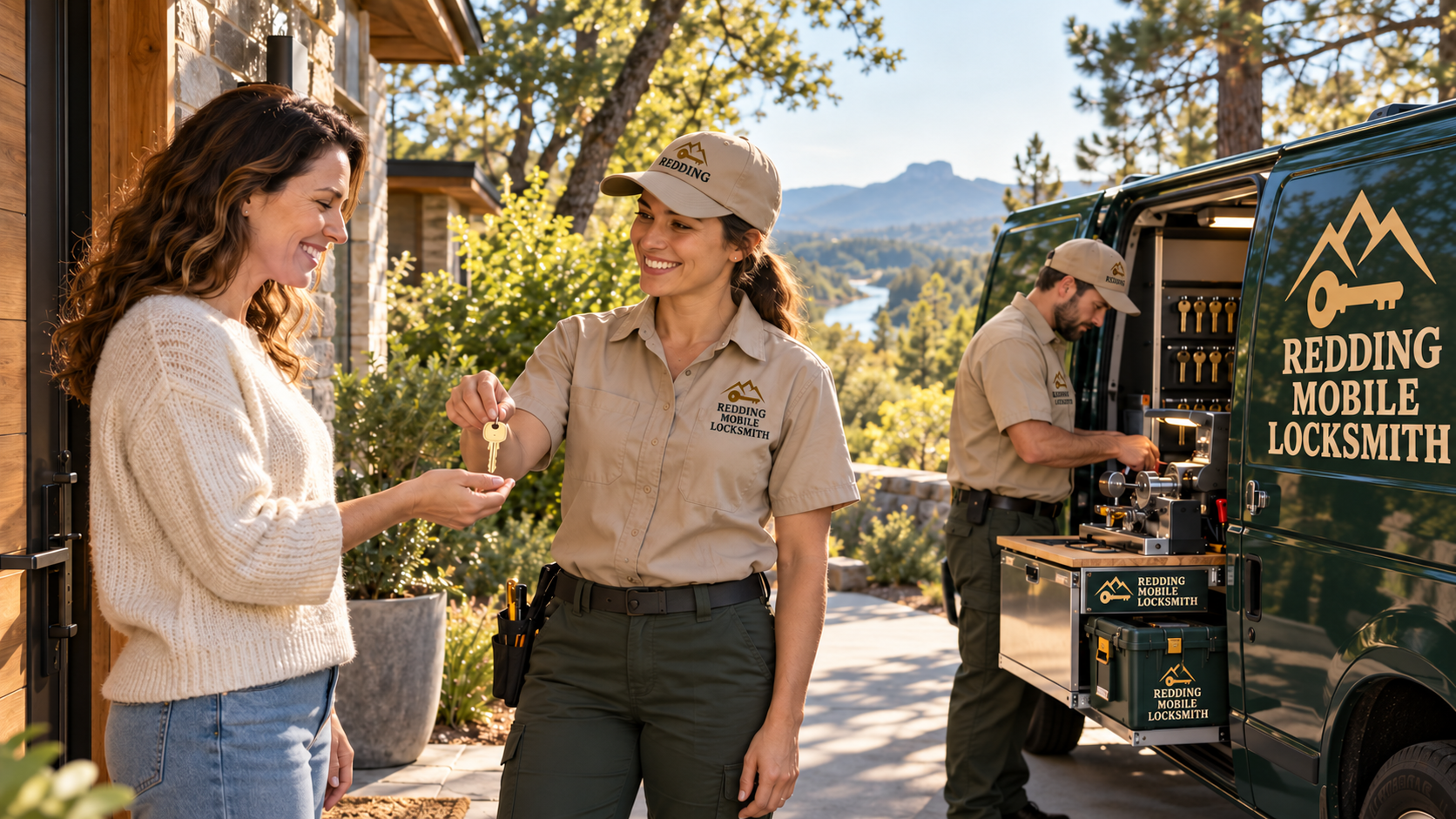
Redding Mobile Locksmith is a 24 hour mobile locksmith serving Fort Jones, Etna and other communities in Siskiyou County and Shasta County. Our team arrives in uniforms with a branded service van that carries professional tools, key cutting and programming equipment, and common hardware.
Use the request form to tell us about your doors. Our phone line is coming soon. Related pages that may help include home lock service in Fort Jones, door hardware for business in Fort Jones and the main Fort Jones page.
Good to know
Common questions
Does a new lock need special preparation of the door?
Yes. The door must be measured, the holes drilled to the right size and distance, the latch plate set flush and the strike aligned with the bolt. A lock fitted to an unprepared door often binds or loosens. Good preparation is most of what makes an installation last.
Why does my new deadbolt not go all the way into the frame?
Usually the strike hole is too shallow, too small or slightly out of line with the bolt. The door may also have shifted. The fix is typically to adjust or deepen the strike opening, or tighten a loose hinge. It rarely means the lock itself is faulty.
How long should the screws in a strike plate be?
On exterior doors, screws long enough to pass through the plate and trim into the solid framing are the aim, often two to three inches. Short screws held only by trim are a common weak point. A locksmith can check your frame and recommend a reinforced strike.
Can you install locks on barns, gates and sheds?
Yes. We install hasps, padlocks, gate latches and door locks on outbuildings. The approach depends on the structure and the material. Describe what you have and send a photo through the request form, and we will talk about what suits it.
Will a new lock work in cold weather?
Yes, if it is installed with proper clearance and the right lubricant. Cold shrinks metal and swells damp wood, so tight fits can bind. We leave sensible tolerances and talk through gloves, levers and keypads. A small adjustment later is normal after a hard cold snap.
Should I rekey or replace instead of installing a new lock?
It depends. Rekeying suits sound hardware with unknown keys. Replacement suits worn, damaged or weak hardware. If your concern is who has keys, rekeying is often enough. If the lock feels loose or the door is poorly prepared, installation is the better path.