
Home / Redding / Key Programming and Fobs in Redding
Redding, keys and fobs
Key Programming and Fobs in Redding: Test Every Function
A replacement key that starts the engine is only half the job. This page for Redding drivers explains what to check before a key is replaced and what to test afterward, so nothing fails you on a dark road.
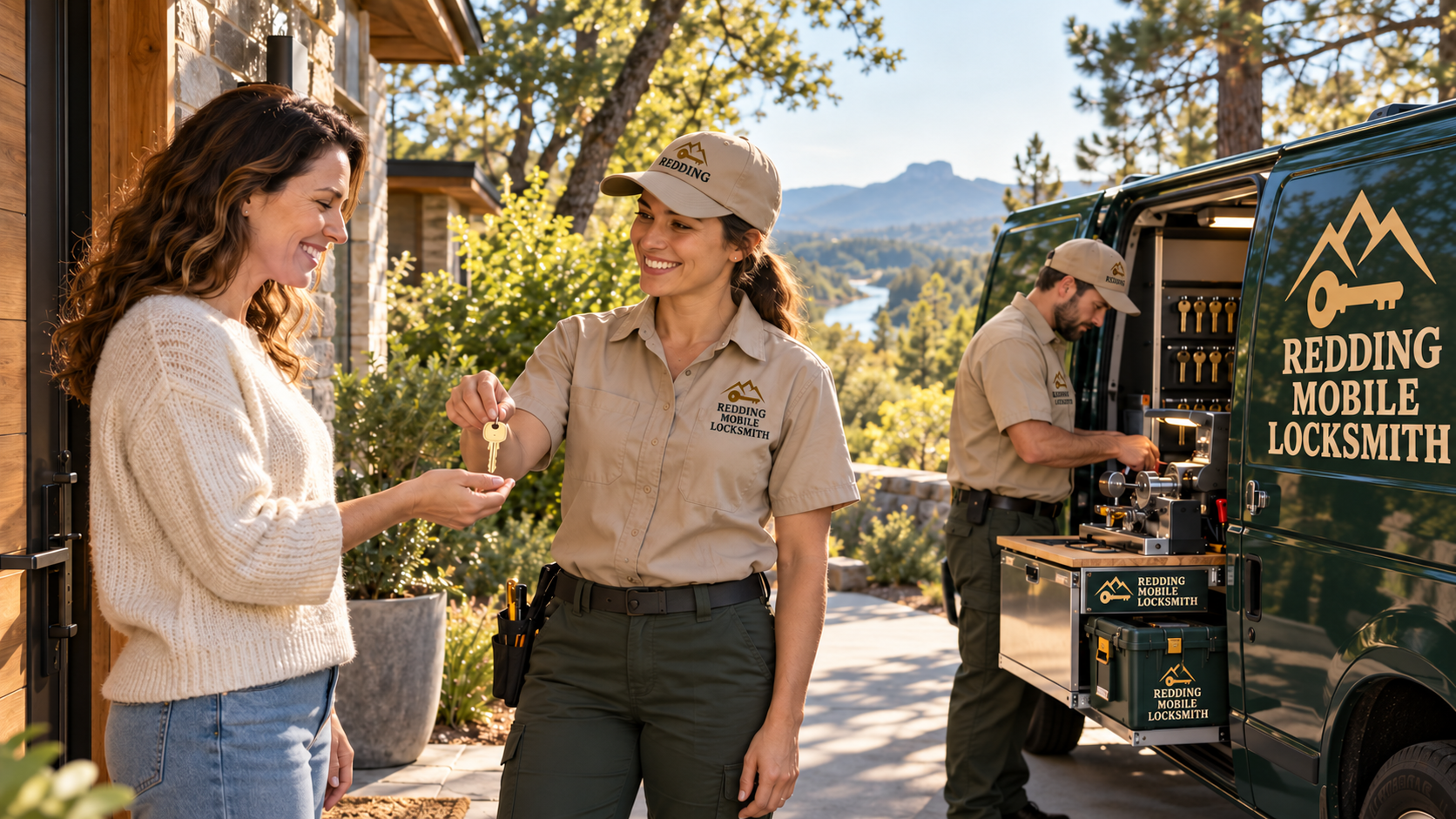
Redding, keys and fobs
The trailhead problem
Imagine a hiker or angler walking back to the car at dusk after a long day near the river. The light is going, the air has turned cool, and the pockets are patted twice with a growing feeling in the stomach. Whether the key fell out on the trail or simply never made it out of the glove box, the situation is the same: a vehicle that will not open, and nobody close by.
That scene is hypothetical, but versions of it play out around Redding all the time, because this is a place where people drive out to water, trails and wooded roads and come back tired. A locksmith who comes to the vehicle can cut and program a replacement on the spot. What happens next is what this page is about, because the quality of the work shows in how thoroughly it is tested.
A new key can open the door and start the engine and still be wrong in small ways. A button may not work, the trunk release may be dead, or the remote start may have been forgotten. The right time to find out is before the technician leaves, not on the next dark evening.
What programming really means
Programming is not a single act. A modern key has at least two separate electronic jobs. One is the transponder chip that lets the engine run, and the other is the remote that locks and unlocks the doors from a distance. Each is introduced to the vehicle in its own way, and a key can be half done without either of you realizing.
To teach the car a new transponder, a technician connects diagnostic equipment to the vehicle, identifies the immobilizer and adds the new key's code to the list the car accepts. Some systems also let a technician remove old codes, which is useful when a key has been lost and you want it to stop working. The remote functions are paired with a separate procedure.
Proximity fobs add one more layer. The car must recognize the fob by radio from inside the cabin and at the doors, and each detection zone has to function. Our general page on key programming and fobs explains the process in more depth, while the guide on whether all car keys need programming covers the question of which vehicles require it.
The same logic applies if you are the person who stayed home. A relative waiting for a hiker or angler to return may be the one who ends up arranging the visit, and it helps if they know the vehicle details, where it is parked and which key problem it is. A calm, specific request leads to a smoother job than an anxious call that begins in the middle of the story.
Before the replacement: what to settle first
A good outcome begins before the first cut. Decide how many keys you want. If you have only one key left, or none, this is the easiest moment to add a spare, since the equipment is already connected and the setup is done. Many people replace one key and discover they have again only a single key to lose.
Settle what type of key you want too. Some vehicles accept a full fob with every button; others can use a simpler key that starts the car and opens the doors without remote functions. Think about how you actually use the car. If you never use the trunk button, a basic key may suit you, but if remote start matters in summer heat, say so.
Tell the technician about anything unusual about the vehicle: an aftermarket alarm, a remote starter added later, or a previous key that was programmed elsewhere. These details change what the car will accept. Our guide on remote start and key questions explains why they matter.
Programming equipment talks to the car through a diagnostic port, which means the technician needs access to the cabin. If you are locked out as well as keyless, the order of work is to open the vehicle first, then connect and program. Knowing that sequence prevents confusion when the visit seems to have two parts.
- Decide how many keys you want before work begins.
- Choose between a full fob and a simpler key.
- Mention any aftermarket alarm or remote starter.
- Locate every key that still works and bring them out.
- Have proof of ownership ready to show.
The test list after programming
Once the new key is programmed, work is not finished until it has been tested end to end. Start with the physical key: does the blade turn smoothly in the driver door and, if the vehicle has one, in the trunk or glove box lock? A blade cut slightly wrong can open one lock and bind in another.
Next, test the ignition. Start the engine, turn it off, and start it again, several times. A key that works once may be marginal. Then try the remote buttons one by one: lock, unlock, trunk or hatch release, panic and, if equipped, remote start and sliding door controls. Each button should produce its normal response from the vehicle.
For proximity systems, walk away and back. Check that the car unlocks when you touch the handle, locks when you walk away or press the sensor, and starts with the push button while the fob is inside. Try the fob in different places in the cabin, such as a jacket pocket or a bag on the back seat, because detection can vary.
Write down what you find. If a button misbehaves, tell the technician before the van leaves; correcting it on the spot is much easier than arranging another visit. Asking to see each function work is not rude, it is exactly how the work should end, and a professional expects it.
- Turn the blade in the driver door lock.
- Start the engine three times in a row.
- Press every button on the remote.
- Test remote start and trunk release if equipped.
- Try the fob from a pocket and from a bag.
Checking the old keys too
A programming session is also the right time to check every other key you own. A technician can often test whether your remaining keys still communicate with the vehicle. Occasionally a key works the doors but has a failing chip, and nobody notices until it is the only one left.
If an old key is lost, ask about removing it from the car's list so that anyone who finds it cannot start the vehicle. Not every system supports this, and the options differ by make and year, but it is a question worth asking. It matters more for a key that was lost at a busy spot than one that fell off the dresser at home.
Label your keys, especially if you now have several that look alike. A bit of colored tape or a simple tag helps you remember which is the spare and which is the daily driver, and it keeps the better fob from sliding into a pocket that gets wet.
Why the second key matters so much
It is tempting to treat the replacement as the end of the story, but the real protection is the spare. A trailhead, a river bank and a parking area at dusk all share one trait: if the only key goes missing, there is nobody nearby to help. A second key kept at home turns that problem into a long walk, not a lost evening.
Do not keep the spare in the car. A key hidden in a magnetic box or under the bumper is a favor to anyone who finds it, and a lot of vehicles are opened that way. Keep it with a trusted person or at home where you can reach it, and make sure the person knows what it is for.
If you hike or fish alone, leave a note about where you parked and when you expect to be back. It has nothing to do with locks and everything to do with safety, but the two ideas belong together. A locked car with no one aware of your plans is the sort of problem we all prefer to avoid.
There is also a case for photographing the new key and noting its markings. Many keys carry a number or code stamped on the head or the blade. That information, stored somewhere safe, makes any later copy simpler. Just make sure it is not kept in a place where a stranger could connect it to your car.
Fob batteries and everyday care
The simplest fix in the whole subject is a battery. A fob that has become unreliable, with a shorter range or a button that needs a hard press, probably wants fresh power. Many fobs use a flat coin cell that opens with a small slot. Note the number printed on the battery so you can buy the right type, and avoid forcing the case.
Water is a common enemy near the river. A fob that took a swim should be opened, dried thoroughly and left to sit before a new battery goes in. Corroded contacts can be gently cleaned. If it still misbehaves after that, replacement is the safer path, since a partly working fob tends to fail at the worst moment.
Keep fobs away from heat. A dashboard in a Redding summer can warp plastic and cook batteries, and a fob left in direct sun will not last as long as one kept in a shaded cup holder. Our guide on a key fob that stopped working walks through the troubleshooting in order.
If you share the vehicle with a partner or a teenager, give each driver a labeled key. Shared habits matter: a fob that lives on a hook by the door is far less likely to be lost on a trail than one passed around between pockets and backpacks. Small routines are the quiet foundation of never needing the emergency visit at all.
When the key is lost entirely
Losing every key is stressful, but it is not the end of the road. A locksmith can often create a key from scratch by working from the vehicle's lock or its identification information, then programming the key to match. Our guide on making a key when you have none explains what is involved.
You will be asked to show that you are the owner or an authorized user, since a key is a way into the vehicle and a way to drive it away. Registration, an ID and a link between the two are the ordinary expectation. Rules vary, so ask what is needed when you request service. This protects you, too, because the same checks apply to anyone trying to make a key for your car.
If your vehicle is stuck at a trailhead or on a back road, say that clearly. Mobile service is designed for places that are not parking lots. If you need the door opened first, our page on being locked out of your car describes that step, and replacement car keys covers the full process.
Redding drivers and the roads they use
Redding is where Interstate 5, Highway 299 and Highway 44 meet, so a lost key can strand a driver in town or far from it. Many residents head out along Highway 44 or Highway 299 for recreation, and the road home always seems longer when something goes wrong. Preparation before the trip is the simplest insurance there is.
Before a long outing, take half a minute to check the fob battery, confirm the spare is somewhere safe and put the keys in a pocket that closes. A zipped pocket beats a loose jacket pocket every time. A small waterproof pouch is a good idea near water.
Redding's local pages each take a different service. For the car side, see cars and trucks in Redding, which looks at vehicle trouble that is really a key problem. For night time trouble, emergency help any hour in Redding covers what to prepare. The city page, Redding, links to the whole set.
Evening trouble deserves a plan of its own. Dusk arrives earlier in winter and the roads look different after dark, so a stranded driver should move to a lit and safe spot if possible, keep the phone charged and avoid wandering off to find help. A locksmith can come to you, so staying put near the vehicle is often the sensible choice.
Asking for service and what to expect
When you are ready, use the request form on the contact page. The phone line is coming soon, so the form is the way in today. Describe the vehicle, the key situation and where the car is parked. The team works around the clock, so a request made at dusk is as welcome as one made at noon.
The visit follows a pattern: confirm the vehicle and your right to the keys, identify the key type, cut and program the new key, then run the test list described above. If anything fails the test, it gets fixed before the technician leaves. Do not hesitate to ask that each function be shown to you.
Nearby towns have the same service. If your outing took you toward Shasta Lake or south along the interstate, the pages for Shasta Lake and Anderson describe the surrounding area. And if you are simply curious about how chips and codes interact, the guide to the transponder chip is short and clear.
Good to know
Common questions
What is the difference between programming a key and cutting a key?
Cutting shapes the metal blade so it turns the lock. Programming teaches the car to accept the electronic chip or remote in the key. Many modern vehicles need both. A key that is cut correctly but not programmed may open the door and still refuse to start the engine, which is why both steps are tested.
How do I test a new fob after it is programmed?
Press every button, start the engine several times, and try the fob from different places in the cabin. Check the trunk release, panic button and remote start if equipped. For proximity systems, walk away and back to confirm the doors lock and unlock. Ask the technician to demonstrate each function before leaving.
Can a lost key be stopped from starting my car?
On many vehicles, a technician can remove old keys from the list the car accepts, so a lost key will no longer start it. Support varies by make and year. Ask when you request service, especially if the key was lost somewhere public, and whether the system you own allows it.
Should I get a spare when replacing a key?
Usually yes. The equipment is already connected and set up, so adding a second key during the same visit is more straightforward than starting over later. A spare kept at home or with a trusted person turns a future lost key into an inconvenience instead of a stranded evening.
What if my fob got wet at the river?
Open it if you can, dry it thoroughly and let it sit before putting in a fresh battery. Clean corroded contacts gently. If it still misbehaves, replace it rather than trusting a half working fob. Water damage tends to return at inconvenient times, so a dependable replacement is wiser.
How do I request service while the phone line is coming soon?
Use the request form on the contact page. Include the vehicle details, where the car is parked and what happened. No phone number is published yet. If anyone is in danger, such as a child or pet locked in a vehicle, call emergency services first and deal with the key afterward.