
Home / Shasta Lake / Door Hardware for Business in Shasta Lake
Business doors, Shasta Lake
Door Hardware for Business in Shasta Lake: Matching Hardware to the Door
A business door is never just a door. The right hardware depends on who walks through it, how often, and what it protects. Here is how to match the two in Shasta Lake, with a few plain rules.
Business doors, Shasta Lake
Start with what the door actually does
Every door in a business has a job, and the job decides the hardware. A front entrance welcomes customers all day and locks tight at night. A back door lets staff carry boxes out to a truck. A supply closet only needs to keep casual hands out. A door to an office with cash or records needs something sturdier than any of those. When people choose hardware before they decide the job, they end up with a handsome lock on a door that does not suit it.
Picture a traveler passing through Shasta Lake on Interstate 5, stopping at a small roadside business for supplies. That person will pull on the front door, maybe push the wrong way, and expect it to open without a fight. They will never see the back door, the storage room or the office. But every one of those doors was chosen by someone, and the front door is the only one the traveler judges. A sticky latch or a loose handle tells a stranger something about the whole building.
So before you buy anything, walk the building and write down each door in one sentence: who uses it, how often, whether it is an exit, and what is behind it. That short list is the most useful tool you will have when you talk to a locksmith. It turns a vague wish for better security into a set of clear, answerable questions, and it keeps you from paying to upgrade doors that were fine while ignoring the one that was not.
- Front entrance: heavy daily traffic, needs a sturdy lock and a closer that works smoothly.
- Back or service door: used by staff, often an exit route, needs hardware that is easy to leave through.
- Storage or supply room: light security, but worth a lock that can be rekeyed.
- Office or records room: tighter control and a clear list of who holds keys.
The main kinds of locks used on business doors
Most business doors use one of a handful of lock types, and knowing the names makes every conversation easier. A cylindrical lever lock is the familiar handle you press down, with the lock built into the knob or lever body. A mortise lock sits inside a deep pocket cut into the edge of the door and is common on older storefronts and heavy commercial doors. A deadbolt adds a solid steel bolt that throws into the frame. Each can be keyed to a standard cylinder that a locksmith can rekey or replace.
The difference matters because the strength lives in the details. A lever lock mounted in a thin hollow door and a mortise lock in a solid door might look similar from the sidewalk, yet they behave very differently when someone leans on them. The locksmith looks at the door material, the thickness, the frame and the existing holes before suggesting anything. Sometimes the answer is a new lock body. Sometimes it is a stronger strike plate and longer screws that anchor into the framing rather than just the trim.
Many business owners also meet the word grade. Commercial hardware is built for more cycles, meaning more lock and unlock actions, than the hardware you find on a bedroom door. Heavier internal parts mean a lock that keeps working through thousands of days of use. If you want the background on what grade means and why it matters, our neighbors ask page on lock grades explains the idea in simple terms, and you can read it before deciding how much to spend on the hardware at all.
Exit hardware and why some doors cannot be locked from the inside
Here is the part of business hardware that surprises people. In a place where customers or staff gather, the door that leads out has to open easily from the inside, without a key and without knowing a trick. That is the reason for push bars, also called panic hardware. You press the horizontal bar, the latch pulls back, and the door swings open. Nobody has to think. In an emergency, thinking is the one thing you cannot rely on, and the hardware is designed with that in mind.
The rules about which doors need this kind of exit hardware vary, and they depend on the building type, how many people it holds and local requirements. We will not guess at them here. If you are not sure whether a door in your building needs panic hardware, ask the local building authority or your property manager, and tell the locksmith what you learn. A professional can then install the right device and make sure the outside of the door still secures properly when the building is closed.
A push bar has two sides to its story. Inside, it is easy to use. Outside, it is often a plain slab or a trim piece with a key cylinder, or a lever that only works when someone has unlocked it. That separation is intentional. People leaving the building can always get out, while people outside cannot simply pull the door open. For a deeper look at how these bars work, see our short guide on push bars and panic hardware.
Closers, the quiet workhorse
A door closer is the hydraulic arm mounted near the top of many business doors. It does one job, which is to pull the door shut after someone passes through, at a controlled speed. Without it, doors stay propped, slam into the frame, or swing open in the wind. With a worn or misadjusted one, the door either crawls so slowly that the latch never catches, or it bangs closed hard enough to rattle the shelves.
Closers have adjustment valves that control two phases: the sweep, which is the main swing, and the latch speed, which is the last bit of travel into the frame. A small turn of a screw can change the way a door behaves, and it is a common cause of the complaint that a lock will not catch. The lock gets blamed, but the closer is the problem. A locksmith checking a stubborn door will often adjust the closer first, then look at the latch and strike if it still misbehaves.
If you want to know more about these devices, our explainer on door closers goes through how they work and what to watch for. For the traveler pulling on the front door of a roadside shop, a properly set closer is the difference between a door that feels solid and one that feels tired. Shop owners tend not to notice until something fails, so it is worth checking the arm for oil leaks and loose screws every so often.
Electric strikes and other ways to control who comes in
Some businesses do not want to hand out keys to every employee or buzz visitors in by hand. An electric strike replaces the metal plate in the door frame with one that can unlock on a signal. A staff member presses a button at the desk, a keypad accepts a code, or a card reader recognizes a badge, and the strike releases so the door can be pushed or pulled open. When power is not applied, the door stays locked, or in some designs it stays unlocked, depending on the strike type.
The choice between those two modes is not trivial. A fail secure strike stays locked when power is lost, which keeps the building protected during an outage but can leave staff with a manual key as the only way in. A fail safe design unlocks when power drops, which is useful for certain exit doors but may leave the building open. A locksmith will ask what you want to happen during an outage and match the device to the answer. Our guide on electric strikes covers the basics.
There are also keypad and smart locks, which let you change access without cutting new keys. They suit small businesses where staff come and go. They do require batteries or power and a plan for who knows the code. A traveler dropping into a roadside shop will never see this, but the owner will feel the difference when a former employee leaves and the code can be changed in a short visit rather than the locks being rekeyed. Each option has a place, and none is right for every door.
- Fail secure strike: stays locked without power, usually used where security matters most.
- Fail safe strike: unlocks without power, used where getting out easily is the priority.
- Keypad lock: changes access without cutting keys, but needs fresh batteries.
- Card or badge reader: tracks who enters, but needs a controller and a power source.
Matching hardware to the building, not the brochure
It is easy to be tempted by whatever hardware looks most impressive. A heavy brass handle on a glass storefront door might look right, but the door may need a narrow stile lock made for aluminum framing instead. A wooden office door and a steel back door do not take the same hardware even if both lead outside. The locksmith will look at the door material, how thick it is, and whether the existing holes match the new part. These details decide whether the install is a clean swap or a new project.
Think also about the neighborhood around your door. Shasta Lake has family homes, rental housing, lake visitors, and many people who commute to Redding. That means a mix of foot traffic across the year, from steady locals to travelers who show up in summer. A business near the lake may see heavy days, with the door opening all afternoon, then very little in winter. The hardware needs to survive the busy season without being so complicated that a seasonal worker cannot operate it.
Weather matters too. Hot dry summers dry out lubricants and fade finishes, while dusty roads and wind carry grit into latches. Keep that in mind when you choose a finish and a mechanism. Many problems blamed on a bad lock turn out to be a dry latch bolt or a sagging door, and a short cleaning and a drop of the right lubricant solves them. Ask your locksmith what suits your particular door, because there is not one answer for every building.
Keys, control and who holds what
Hardware is only half of a security plan. The other half is the key system. A business with one lock and three keys has a very different challenge from one with fifteen doors and a dozen employees. The simplest approach is to give every employee the keys they need and keep a written list of who has what. When someone leaves, you collect the keys, and if you are not sure all of them came back, you rekey the locks that matter.
Larger setups sometimes use a master key system, where different keys open different sets of locks, with one top key that opens them all. It is neat and efficient, but it takes planning. Every level of the system affects security, and a lost master key is a bigger problem than a lost single key. Before you commit, read our explanation of master key systems and think about whether your business is complicated enough to need one.
For smaller shops, a simpler and less costly path is often to use a single key for the whole building, plus one separate key for the office or cash area. The traveler passing through will never know. But the owner, closing at night, will appreciate that the number of keys on the ring is small, and that there is a clear record of who has copies. Keep spare keys somewhere safe, not behind the register or under a mat, and avoid marking them with the business name.
Maintenance that keeps hardware working
Most business hardware fails gradually. A latch starts to drag, a hinge begins to squeak, the closer arm loosens a little, and the door starts to rub on the frame. None of this is dramatic, so it gets ignored, and then one day the lock does not catch and the shop cannot close up. A short routine every few months prevents most of it. Watch the door through a full swing, listen for noise, and check that the latch bolt extends and retracts smoothly.
Tighten the screws on handles, hinges and closer arms, because vibration works them loose over time. Clean the strike plate opening, where dust and bits of paint collect. Use the right lubricant for the part, not whatever is in the drawer, since the wrong product can attract grit and gum up the pins. If the key is hard to turn or sticks, stop forcing it, because a bent or worn key can damage the cylinder. Our page on lock repair and adjustment describes what a locksmith checks.
Also watch for changes in how the door sits. If the gap around the door is uneven, the latch may no longer line up with the strike, and the lock will feel stiff. This is common after the ground settles, after a heavy delivery strains a hinge, or after weather swells the wood. A small adjustment to hinges or strike can solve it, but ignoring it can lead to damaged hardware. If you are in doubt, call a locksmith before the problem turns into a lockout.
What a locksmith visit looks like
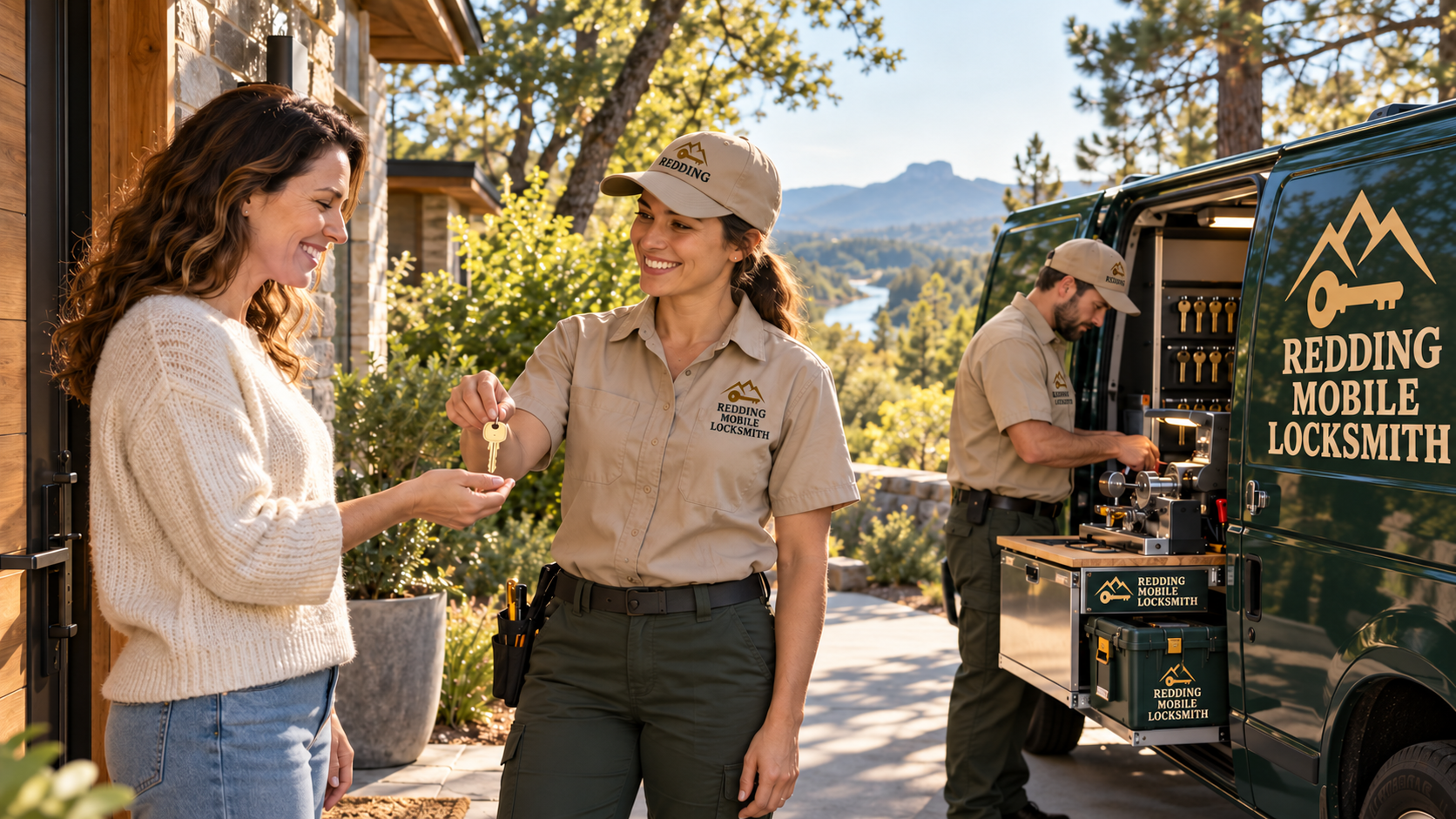
When Redding Mobile Locksmith arrives, it is a branded team in uniforms, working from a branded service van that carries professional tools, key cutting and programming equipment, and common hardware. That means many business door jobs can be handled on the spot, from a rekey to a new lever set to a replacement closer, though specialty items may need to be ordered. The first step is always a conversation about what the door is for and what is not working.
Expect questions. What kind of door is it? Is it an exit? How many people use it daily? Who has keys now? Is there a closer, a strike, a panic bar? The more you can tell the locksmith, the more precisely the work can be scoped. If you can, have the door accessible and the area clear. Take a photo of the existing hardware before the visit if you like, because it can help identify part types. Our guide to what to have ready lists the details that help.
The work itself is straightforward: the locksmith removes old parts, checks the door prep, installs the new hardware, tests the latch, adjusts the strike and closer, and runs the key through a few times. A good installer will also leave you with working keys and a clear sense of how everything operates. If the work involves a bigger project such as new locks across several doors, you can read about business lock service and door hardware for business before you call.
Shasta Lake and the neighbors around it
Shasta Lake is close to Redding, Anderson and Cottonwood, and a lot of business owners work across those towns. If you also run a place in Redding or Anderson, it is worth thinking of the hardware as a set. Using the same style of lock and a consistent key system across locations makes day to day work simpler. Our Shasta Lake page gives a wider view of locksmith needs in the city.
If you are also planning a fresh install, our new lock installation in Shasta Lake page goes through door prep, strikes and alignment, and our emergency help in Shasta Lake page explains what to do if a door fails after hours. Nobody plans to be locked out of a shop, but knowing in advance who to call and what to say takes the stress out of it.
When you are ready, use the request form to describe the door and what you want to change. The phone line is coming soon, and until it is live the form is the way to reach us. Mention the door type, whether it is an exit, and what is going wrong. A clear description helps the team arrive with the right parts and gets the job done properly the first time.
Good to know
Common questions
How do I know which hardware fits a particular business door?
Start with the door itself: its material, thickness, whether it is an exit, and how many people use it each day. A locksmith matches the lock, closer and strike to those facts. Photos of the existing hardware and a short note about how the door is used make the choice much easier and avoid buying parts that do not fit.
Does every business door need panic hardware?
Not every door, and the rules vary by building type and local requirements, so we cannot answer that for you. Ask the local building authority or your property manager which doors in your building need exit hardware. Then tell the locksmith, who can install the right device and make sure the outside still locks.
Why will my door not latch even though the lock seems fine?
Very often the latch and the strike no longer line up, or the closer is set too slow to pull the door fully shut. Sagging hinges and swollen wood can do the same. A locksmith checks alignment, closer speed and the strike opening before blaming the lock itself.
Can one key open several doors in my shop?
Yes. Locks can be keyed alike so one key works on several doors, or set up as a master system with different levels of access. Keyed alike is simpler and suits small shops. Master systems need more planning because a lost top key affects every door it opens.
What is the difference between fail safe and fail secure strikes?
Both are electric strikes that unlock on a signal. A fail secure strike stays locked if power is lost, while a fail safe strike unlocks. Which one you want depends on whether the door is an exit and how you want the building to behave during an outage.
How do I ask for help with a business door in Shasta Lake?
Use the request form on our contact page and describe the door, what is going wrong and when you need someone. The phone line is coming soon. The more detail you give about the hardware and the building, the better prepared the team will be when they arrive.