
Home / Cottonwood / Door Hardware for Business in Cottonwood
Hardware upkeep, Cottonwood
Door Hardware for Business in Cottonwood: Keeping Busy Doors Adjusted and Working
Hardware on a busy door is never finished. It is adjusted, tightened, cleaned and eventually replaced. Here is a maintenance guide for the doors that work hardest on a Cottonwood business property.
Hardware upkeep, Cottonwood
A door that is used a hundred times a day
Imagine a caregiver visiting a relative who runs a small business out of a shop building on a Cottonwood property. Over the course of a morning, the visitor pushes through the same door half a dozen times, carrying bags, holding it for others, letting it swing shut behind. By the third trip the visitor has noticed what the owner stopped noticing long ago: the door drags a little at the bottom, the latch clacks, and the handle has a wobble.
Nobody planned for those faults, and none of them seems serious. But a door that opens a hundred times a day takes a hundred small blows, and hardware that is fine at the start of the week may be loose by the end of the month. Maintenance is the art of catching these changes while they are still inexpensive to fix. It is less about expert knowledge than about paying attention in a steady, calm manner.
This page looks at the parts of a busy door in turn: hinges, latch, strike, closer, handle, exit hardware, and the lock cylinder. For each it explains what wears, what to look for and what an adjustment can achieve. It is meant for business owners, managers and family members who work around doors without being locksmiths. If you can use a screwdriver and a flashlight, you can do the first round of checks yourself. The deeper work, such as replacing a closer or recutting a strike opening, belongs to a professional, and knowing the difference saves both money and frustration.
Hinges: where most door trouble starts
Hinges carry the entire weight of the door, and they do it every time it swings. Over months, the screws that hold them loosen, particularly the top hinge on the hinge side, which bears the pull of the door's weight. When that screw loosens, the door leans out at the top and the whole slab shifts downward. The latch then sits lower than the strike, and the lock appears to fail when the real cause is a hinge.
To check, open the door halfway and lift gently on the handle. If the door moves up and down more than a hair, a hinge is loose or worn. Look for screws that spin without gripping, or hinges where the leaves have gaps. Tightening the screws solves the simple cases, and it takes only a few moments with the right screwdriver, so it is the first thing to try on any door that has begun to rub. If the screw holes are stripped, a locksmith or carpenter can fill them with wood dowels or use longer screws that reach into the framing.
Also listen. A squeak means the pin is dry. A groan or grind means it is worn. A small amount of lubricant on the pin, wiped clean afterward, can quiet things for a time, but a worn hinge needs replacement. Heavy business doors may use ball bearing hinges, which handle weight better than plain ones. Our page about why doors sag explains how a small hinge fault grows into a lock problem.
Latches, handles and the wobble nobody fixes
The handle or lever on a busy door is grabbed constantly, so it loosens. A wobbling handle is more than an annoyance. It means the screws holding the lock together are working loose, and the internal parts are shifting. Left alone, the spindle that connects the handle to the latch can wear, until the handle spins without pulling the latch back. That is how people end up trapped on one side of a door.
Tighten the visible screws gently on both sides of the lock. Some handles have a small set screw or a hidden retaining clip, usually described in the instructions. If the latch is slow to retract or does not extend fully, take it apart if you know how, clean away dust and old lubricant, and apply a small dose of the right product. Avoid oils that attract dirt, particularly on a rural property where dust is constant.
Watch the latch bolt when the door closes. It should snap fully into the strike with a clean sound. If it stops partway, the latch is catching on the edge of the strike or the door is not closing far enough. Sometimes a worn latch has a tired spring and simply needs replacement. A locksmith can swap the latch assembly without replacing the entire lock, and it is often an inexpensive part. See lock repair and adjustment for more.
The strike and the door frame
The strike plate gets overlooked until the latch fails to catch. Over time, a door that has been slammed or has shifted can bend the lip of the strike, enlarge the opening, or loosen the screws. Also, paint and dirt build up around the opening and make it smaller. Look at the strike closely: is it bright and clean along the spot where the latch hits it, with marks showing a clean path? Or are there gouges on one side?
If the marks are off center, the door and frame are no longer aligned. Sometimes moving the strike a few millimeters corrects it, and a locksmith can file the opening slightly to match. If the screws are stripped, fill the holes with dowels or fit longer screws that reach the framing. A strike secured by long screws in solid framing is also a significant security improvement, as explained in our page on strike plates.
Do not forget the other end of the strike's world: the frame itself. Wood frames can crack, swell or rot where moisture lingers, especially near the ground. Metal frames can bend if struck by a cart or vehicle. A damaged frame may need repair before any hardware can do its job. If you are not sure, ask a locksmith to look. A short assessment is worth far more than repeated adjustments on a door that is structurally compromised.
Door closers: set them and check them
A closer is the arm and cylinder at the top of many commercial doors, and it is a classic case of hardware that fails slowly. It contains oil and a spring. With time the oil may leak, the spring may weaken, and the adjustment screws may drift. A closer that is too slow leaves the door open, and the latch never engages. One that is too brisk slams the door hard and wears the hardware.
Most closers have two or three adjustment valves. One controls the sweep, the main swing of the door. Another controls the latch, the last few inches of travel. Some have a back check, which cushions the door when it opens too far. Turn the valves in small steps, a quarter turn at a time, and test the door after each change. Always follow the maker's instructions, because some valves can be damaged by turning them too far.
Look for oil on the arm, the body or the wall below. A leak means the seal has failed and the closer needs replacement. Check that the arm screws and mounting plate are tight, and that the arm moves smoothly without binding. Our page on door closers goes into more detail. For a caregiver or visitor with full hands, a closer that holds the door long enough to pass but still closes it properly is a quiet kindness.
- Sweep speed: the main swing of the door, adjusted so it closes smoothly.
- Latch speed: the final stretch, set so the bolt always catches.
- Back check: cushions the door when it opens wide, protecting walls and hinges.
- Mounting: arm and plate screws should be tight and the arm should move freely.
Exit devices and push bars
Some business doors carry a push bar across the inside. When pressed, it retracts the latch so the door opens easily. These devices are common on doors that serve as exits where people gather, and they are built for heavy use. Even so, they need care. The bar should move freely and spring back. Listen for scraping, look for loose mounting screws, and check that the latch retracts fully when the bar is pressed.
The outside of an exit device is usually a plain pull handle, a trim lever with a key cylinder, or a blank plate. If the outside has a lever, check that it turns the latch when unlocked and does not when locked. Test the key cylinder to make sure it turns smoothly. Our page on push bars and panic hardware explains the idea in simple terms.
Rules about which doors need exit hardware, and how it must be installed, vary by building and by local requirements. Do not assume. If you manage a place where people gather, ask the appropriate local authority or property manager what applies to your doors. A locksmith can then install or adjust devices to suit, and can test that each door opens easily from inside while still securing from outside. Never block or disable exit hardware, no matter how inconvenient it may seem. Propping a door open with a wedge also strains the hinges and the closer, so if a door needs to stay open for deliveries, ask about a proper hold open arm instead of improvising.
Cylinders, keys and the stiff turn
The cylinder is the part where the key goes, and it wears like any moving part. Pins inside rub against the key every time it turns, and grit from the environment accelerates the wear. A cylinder in a Cottonwood shop door may face dust from fields, summer heat that dries out lubricant, and cold mornings that stiffen everything. A key that was once smooth begins to catch and drag.
The simplest remedy is a puff of dry lubricant made for locks, usually graphite or a similar product, applied sparingly. Avoid spraying oil into the keyway, which collects dust and eventually gums up the pins. If a key is worn or bent, replace it with a fresh copy cut from the original, not from a copy. If the cylinder still resists, a locksmith can rekey or replace it. See what lubricant belongs in a lock.
Never force a key. A key that snaps in a cylinder turns a small problem into a larger one. If the key sticks, stop and look at our page on dealing with a stuck key. A cylinder that gets harder to turn every month is giving you notice, and replacing it before it fails costs far less than being locked out of a shop with customers or supplies waiting on the other side.
A simple routine for busy doors
The most dependable maintenance is a short, regular one. Choose a day each season, perhaps at the change of weather, and walk around the building. At each door, open it halfway and feel for play in the hinges. Close it slowly and watch the latch meet the strike. Press the handle several times and feel for roughness. Look at the closer for leaks and the push bar for smooth movement. Take notes on what you find, and photograph anything that looks odd so you can describe it clearly later. Over a year, those notes show which doors are the hardest on their hardware and which ones are fine, and that tells you where a replacement budget is wisely spent.
Use a screwdriver to tighten what is loose, a rag to wipe away dust, and the right lubricant on the moving parts. Don't over tighten, which can strip screws or bind the mechanism. Keep a small kit by the shop: a few screwdrivers, a pencil, a flashlight and a small container of lock lubricant. Keep spare screws in a labeled jar, since they vanish without a trace.
Write down the date and what you did. A short log helps you notice patterns, such as the same door needing attention every month, which is a sign of an underlying fault. It also helps a locksmith understand the history if you need to call. For doors that stay busy all year, a half yearly visit from a professional is a sensible habit. Our page on door hardware for business describes what that includes.
When to call, and what the visit involves
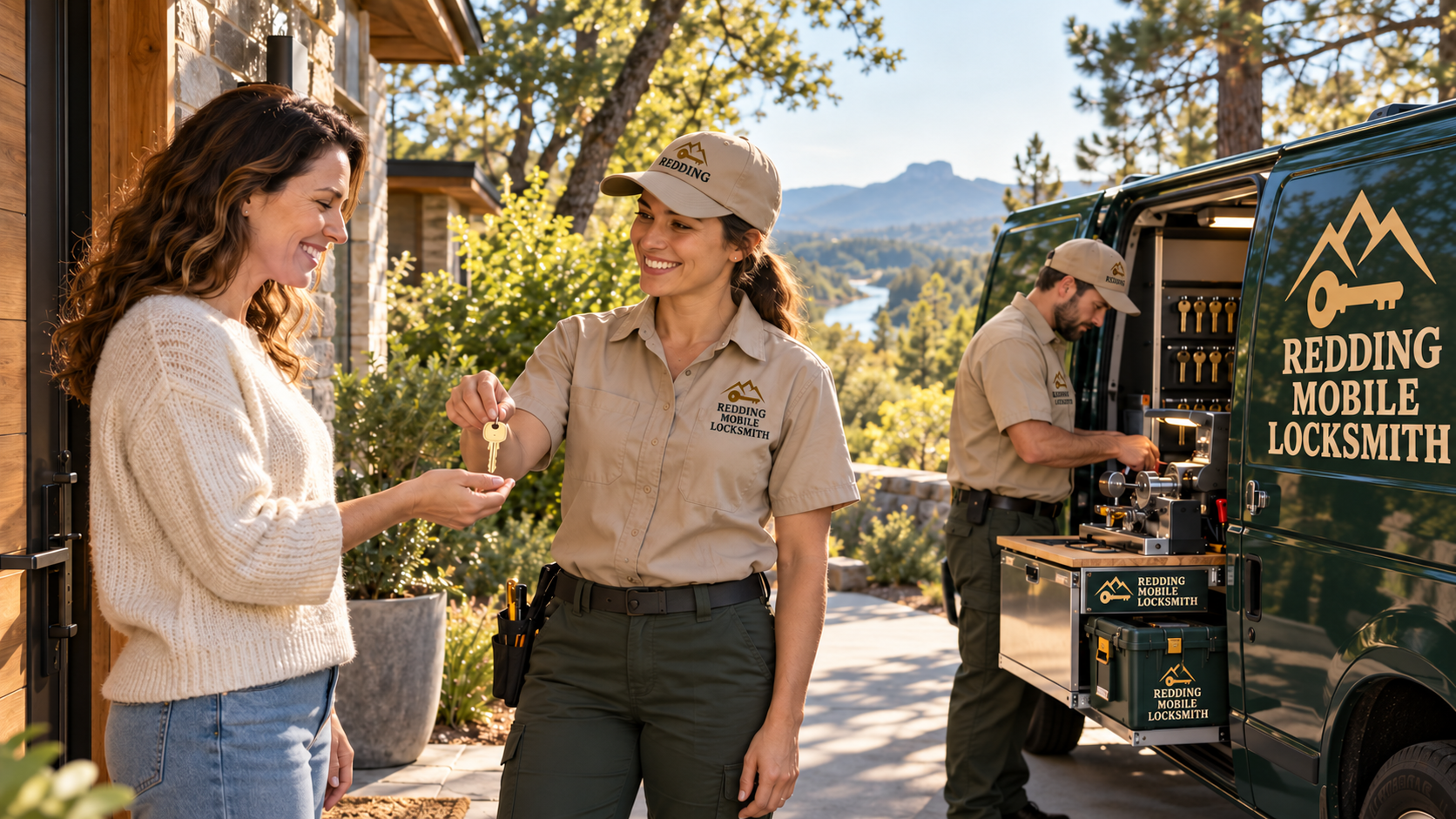
Some problems are beyond a simple adjustment. A latch that will not retract, a closer that leaks, a door that cannot be locked, or a frame that has cracked should be seen by a professional. Redding Mobile Locksmith comes as a branded team in uniforms with a branded service van carrying professional tools, key cutting and programming equipment, and common hardware, so many repairs can be completed during one visit.
Expect the team to look at the whole door, not just the part you pointed to. They will test the hinges, the latch, the strike, the closer and the lock, and tell you what they find. Then they will adjust, repair or replace as needed, test everything again, and explain what they did. If a part needs to be ordered, they will tell you before leaving.
For related reading, see business lock service, new lock installation in Cottonwood and home lock service in Cottonwood. For the area, see the Cottonwood page and the Anderson page. When you are ready, use the request form and describe the door and what it has been doing. The phone line is coming soon.
Good to know
Common questions
How often should I check the hardware on busy doors?
A walk around once each season is a sensible start, with an extra look after severe weather. Check hinges for play, latches for smooth action, closers for leaks and handles for wobble. Doors that open many times a day may deserve a closer look every month.
Why does my door drag at the bottom?
Usually a hinge has loosened, most often the top one, letting the door sag. Swollen wood or a shifted frame can also cause it. Tightening hinge screws solves many cases. If the screw holes are stripped or the frame has moved, a locksmith or carpenter can correct it.
Can I adjust a door closer myself?
Often yes, with small quarter turns on the adjustment valves and testing after each one. Follow the maker's instructions and stop if the valve feels stuck. If the closer leaks oil or the arm is bent, it needs replacement instead.
What lubricant should I use in a lock?
Use a product made for locks, such as a dry graphite type, applied sparingly. Avoid heavy oil or grease in the keyway, because it collects dust and can gum up the pins. Hinges and latch bolts may take a different product, so check the instructions.
Do my business doors need push bars?
That depends on the building, how many people it holds and local requirements, so we cannot say. Ask the local authority or your property manager, then have a locksmith install or adjust the right hardware. Never block or disable an exit device.
How do I ask for hardware repair in Cottonwood?
Use the request form on our contact page, since the phone line is coming soon. Describe which door it is, what the hardware is doing, and how busy the door is. Photos of the latch, strike and closer help the team arrive prepared.