
Home / Dunsmuir / Cars and Trucks in Dunsmuir
Dunsmuir vehicle help
Cars and Trucks in Dunsmuir, Served Where They Sit
When your car or truck will not open or will not start, the repair comes to you. Here is how mobile automotive locksmith service works at a Dunsmuir curb, driveway or trailhead.
Dunsmuir vehicle help
Dusk at the trailhead
Imagine an angler who spent the afternoon along the upper Sacramento River, walking back to the truck as the light turns amber and the canyon starts to cool. Boots are wet, the rod is in pieces, and the keys, which seemed so safe in a jacket pocket, are nowhere. Or perhaps they are sitting on the seat, visible through the glass, mocking the whole evening.
This is a very Dunsmuir sort of problem. The town sits in a canyon along Interstate 5 and the railroad, surrounded by forest, with trailheads and river access points where people leave vehicles for hours. A lost or locked in key is easy to imagine and hard to solve with a long walk back into town.
The good news is that the solution does not involve towing the truck anywhere. A mobile automotive locksmith brings the shop to the vehicle, and that idea is what this page explains in detail.
What mobile actually means
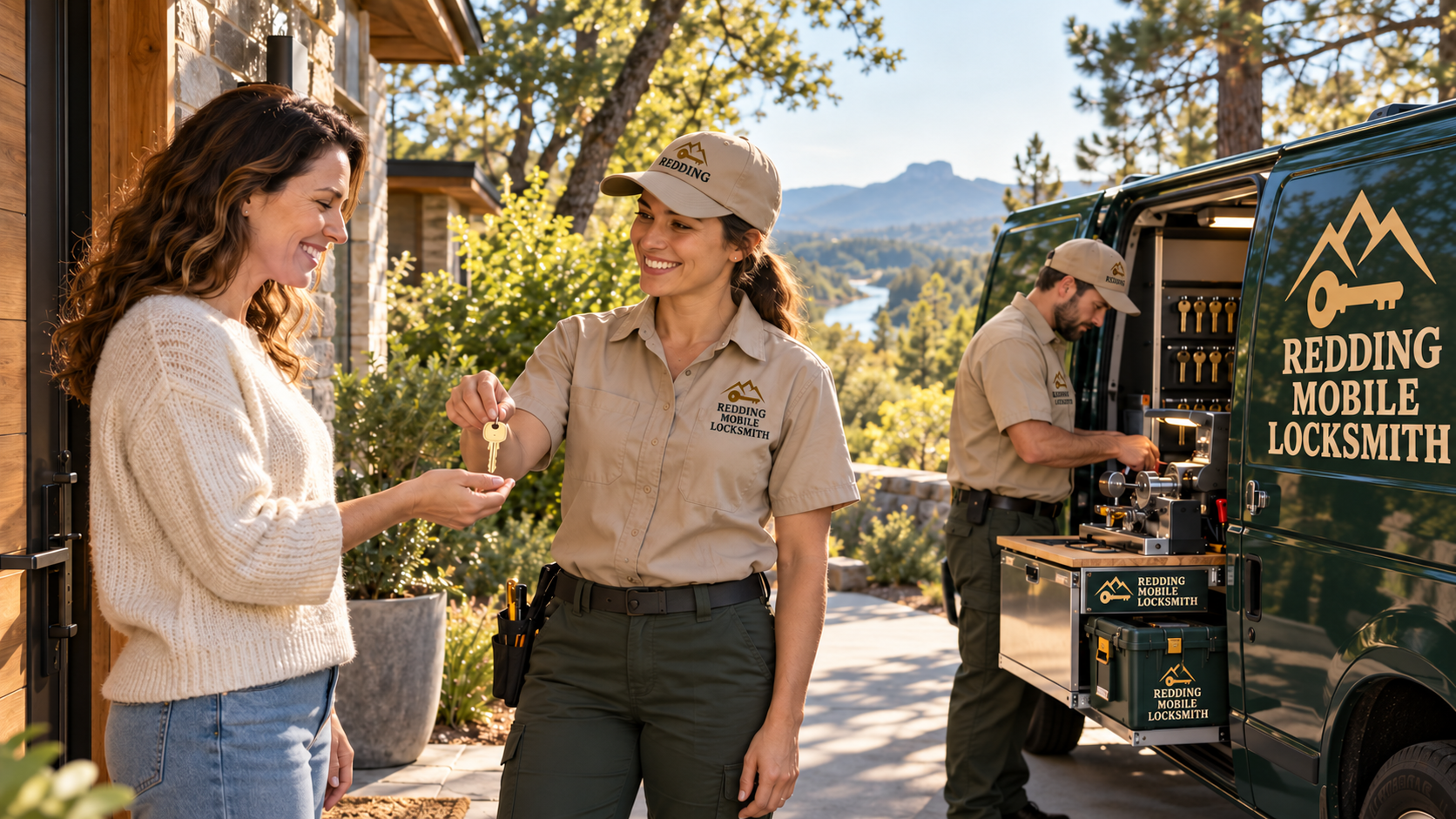
Mobile service means the work happens where the vehicle is parked. Our team arrives in a branded service van, in uniform, carrying professional tools, key cutting equipment and programming equipment. The van is the workshop, and a curb, a driveway or a gravel pullout becomes the bench.
This matters for a few reasons. It spares you a tow, which can be awkward for a vehicle whose keys are lost. It lets the technician work on the vehicle as it stands, which helps when the problem depends on the vehicle's actual condition. And it means the whole job, from opening the door to testing the new key, happens in one place.
There are limits, of course. Some jobs need a clean, level spot, decent light and a reasonable approach for the van. A remote trailhead with rough access may need some planning, and we will talk it through with you. Describing where the vehicle is and how to reach it is part of a good request.
Light matters more than people expect. Programming and key cutting involve small parts and fine detail, and a technician working at dusk relies on lamps and the van's own lighting. If you are at a trailhead, a spot near the road with a bit of open space is better than a tight turnout under trees. Where it is safe to do so, moving the vehicle a short distance can make the whole job calmer.
The services a vehicle might need
Most automotive calls fall into a few groups. Lockouts, where the keys are inside or the door will not open. Lost keys, where there is no working key at all. Broken keys, where part of a key remains in the lock or ignition. And key trouble, where a fob or a chip fails to do its job.
Each one has its own approach. A lockout is about opening the door without damage. Lost keys call for cutting and programming a new key. A broken key requires extraction and often a replacement. Fob trouble may need a battery, a reprogramming session or a new fob.
The pages on locked out of your car, replacement car keys and key programming and fobs go through these in turn, and the cars and trucks service page ties them together.
- A lockout means opening a locked vehicle without harming the door or the paint.
- A lost key job means cutting and programming a replacement for a vehicle with no working key.
- A broken key job means removing the piece in the lock and making a new key.
- Fob trouble can mean a weak battery, a lost programming or a damaged remote.
How a technician opens a vehicle
We will not describe the tricks of the trade in a way that helps someone break into a car, but we can say how a professional thinks. The technician studies the vehicle, picks a method suited to its door and lock design, and works to avoid damage to the paint, the weatherstripping and the wiring and airbags in the door.
The tools are made for the job. They are thin, shaped and padded so that they can reach a latch or a lock without scratching anything. A technician also knows where not to push, because modern doors are crowded with parts.
Our guide on how a car is opened without the key explains the idea in general terms. For the angler at dusk, the point is that a careful opening leaves the truck as it was, with the door closing smoothly and nothing bent.
Afterward, check the door seal and the paint along the edge, and make sure the window still seats properly if it was moved. A professional will usually point these out for you before leaving. If you notice anything odd later, such as a rattle, a draft or a lock that feels different, say so, because a prompt look is easier than a mystery that grows over the winter.
When the key is lost, not locked inside
A lost key is a bigger job than a locked in key. To make a new one, the technician needs the vehicle's key code or must read it from the lock or the vehicle itself, then cut a blade and program the chip. Our guide on making a key when you have none walks through the logic.
For many modern trucks and cars, the vehicle must also be told to accept the new key. That is done with programming equipment connected to the vehicle. Some vehicles are simple, others need more time, and a few have extra security that demands extra steps.
Before any key is made, expect to prove the vehicle is yours. Registration, ID and sometimes a title or rental agreement are the usual items. If your papers are in the glove box you cannot reach, think about photos on your phone, an email from an insurer or a rental company, or anything else that ties you to the vehicle.
It is worth saying that a lost key is rarely truly gone. Check the jacket you wore, the cooler, the tailgate, the riverbank where you changed boots. Retrace your steps calmly before you decide the key is lost, since finding it ends the problem at no cost. If you do find it later, tell us, because a key that turns up after a replacement was made is one you may want to deal with deliberately.
The role of the chip and the fob
Most vehicles built in recent decades use a transponder chip in the key head. When you turn the key, the vehicle sends a signal, the chip answers with a code, and the engine is allowed to run. Without that exchange, the engine may crank but not fire. Our guide on what a transponder chip is describes it.
A fob adds remote functions, such as locking, unlocking, opening the back and, on some vehicles, starting the engine. Smart keys go a step further and let you start the vehicle with a push button while the key stays in a pocket. All of these talk to the vehicle by radio and must be learned by it.
That learning step is why copying a key by cutting a blade is often not enough. A blade that matches the lock but has no programmed chip may open the door and fail to start the truck. Our guide on whether all car keys need programming explains which ones do.
Smart keys deserve a caution. Because they work by proximity, a dead battery can leave you unable to start the vehicle, even though the fob looks fine. Most hide an emergency blade for the door and a spot on the dash or steering column where the fob can be held to start the engine. Find out where yours is before you need it, not while standing in the cold.
Weather, terrain and the Dunsmuir factor
Dunsmuir winters are cold, and canyon nights can be bitter. Cold drains a vehicle battery and makes plastic fobs brittle. A weak battery can interfere with programming, so a truck that has been struggling to start may need a jump or a charge before key work begins.
Snow and ice can also make a job more difficult. A frozen door seal may resist, and a technician needs room to work. If you can move the vehicle to a flat, lit spot safely, that helps. If you cannot, say so, and we will plan around it.
Summer brings its own challenges, with dry heat and dust on trailhead roads. Fine dust can find its way into locks and ignition cylinders, and a gritty key is a sign it is time for cleaning. A dry lubricant made for locks is gentler than a wet spray, which attracts more dust.
Railroad and highway noise are part of the canyon, and they shape how a job goes, too. A technician may need a quiet moment to listen for the click of a lock or the chirp of a fob, and a passing train or a loud truck can be annoying. That is no reason for worry, only a reason for patience, and a good technician simply waits and continues.
What to have ready before the van arrives
A little preparation goes a long way. Know where the vehicle is and how to reach it, including any gates or rough roads. Have the make, model and approximate year ready, plus any proof that the vehicle is yours. If you have a partial key or a damaged fob, keep it.
Tell us what happened in plain terms. Were the keys locked inside, lost somewhere on the trail, or broken in the lock? Is there anyone or any pet inside the vehicle? If a child or a pet is locked in a vehicle, call emergency services first, before anything else.
Our phone line is coming soon, so for now please use the request form on the contact page. A short, clear message is better than a long, confusing one. Our guide on what to have ready when you call a locksmith adds a handy checklist.
- Describe where the vehicle is and how a van can reach it.
- Give the make, model and approximate year.
- Say whether the keys are locked inside, lost or broken.
- Keep any partial key or damaged fob.
- Have proof of ownership where you can reach it.
Trucks, work vehicles and shared keys
Trucks bring their own considerations. A work truck may have toolbox locks, a bed cover lock and a fuel cap lock in addition to the door and ignition. Each may use a different key, and the collection can become confusing.
If your truck is used by more than one person, decide who holds which keys. A labeled spare in a secure place at home or in the office is much more useful than a hidden magnetic box, which is the first place anyone looks. Our guide on a work vehicle lockout and who to tell helps if the truck belongs to an employer.
Used vehicles deserve a word, too. When you buy one, ask how many keys come with it and whether they all work. Our guide on buying a used car and the extra key question covers the sensible questions.
Teen drivers and borrowed vehicles raise the same issue from another angle. A key that moves between hands is a key that gets lost, so think about whether each driver needs a full key or whether a simpler arrangement would serve. Our guide on teen drivers and spare keys talks through it without making a fuss.
Dunsmuir and the towns nearby
The Local Standard serves Dunsmuir and its neighbors, including McCloud, Mount Shasta and Lakehead, along Interstate 5. A vehicle problem in one of these towns looks much like the problem in another, and the same mobile approach applies.
For more about our work in town, visit the Dunsmuir page. If your trouble is a lockout this minute, the emergency help page explains the first steps.
We are Redding Mobile Locksmith, a 24 hour mobile service serving Shasta County and Siskiyou County. Whether you are at a trailhead, in a driveway or beside a road, the idea is the same: the work comes to the vehicle.
Ending the evening well
Back at the trailhead, the angler's evening can still end well. The truck is opened without a scratch, a spare key is made and tested, and the drive home begins with a fresh set of keys and a plan to keep one in a safer place.
Before the technician leaves, test everything. Open and close the door, lock and unlock with the new key, start the engine, and try each fob button. If something seems off, say so right away. It is far easier to correct while the van is still at the curb.
And then, take the lesson home. A spare key kept somewhere sensible is one of the least expensive forms of peace of mind there is. The next time you walk back to a vehicle at dusk, you will be glad you did.
Good to know
Common questions
Do you come to remote trailheads and pullouts?
We serve Shasta County and Siskiyou County, and we will discuss access with you. A van needs a reasonable approach and a safe place to work. Tell us where the vehicle is, what the road is like and whether a gate is involved. Clear details help us plan, and we will say honestly if a spot is hard to reach.
Will opening my truck damage the door?
A careful professional opening should not. Technicians use thin, shaped tools made for the job and choose a method suited to your vehicle. They know where airbags, wiring and weatherstripping sit and avoid them. Improvised tools are what usually cause damage, which is why we advise against trying to open the vehicle yourself.
My key opens the door but the truck will not start. Why?
The vehicle probably does not recognize the chip in the key. A blade can match the lock and still fail if the transponder is missing, damaged or unprogrammed. A technician can test the chip and program a key to the vehicle. Mention the symptoms in your request so the right equipment comes with the van.
What proof of ownership will you ask for?
Usually registration and a photo ID that matches. A title, rental agreement or insurance paperwork can also help. If your papers are locked in the vehicle, photos on your phone or emails from your insurer may do. The check protects you, so please do not be offended. Explain your situation and ask what is acceptable.
Can you make a key for a work truck owned by my employer?
Possibly, with the right authorization. A locksmith will want to confirm that the person asking has the right to have keys made. Speak with your employer first and bring whatever proof they can provide. Our guide on work vehicle lockouts explains who to tell. Describe the situation in the request form.
What should I do if a child or pet is locked in the vehicle?
Call emergency services first, before anyone else. Heat and cold can become dangerous in a closed vehicle sooner than most people expect. Once emergency responders are on their way, you can contact us about the vehicle afterward. Never delay the emergency call to look for a locksmith.