
Home / Dunsmuir / New Lock Installation in Dunsmuir
Dunsmuir new locks
Choosing and Installing New Locks in Your Dunsmuir House
You have the keys to a house in Dunsmuir, but you do not know who else does. Here is how to decide what to replace, what to keep, and how new locks get installed.
Dunsmuir new locks
The keys in your hand and the keys you cannot see
Imagine someone who has just bought an older house in Dunsmuir, a place on a sloping lot with a steep set of stairs, old trees and a view of the canyon. At closing they were handed a small envelope with a few keys. The envelope feels like the whole story. It is not.
The truth is that nobody can say how many copies of those keys exist. Previous owners, tenants, relatives, contractors, a neighbor who watered the plants and a real estate agent may all have held one at some point. Most of them are honest and forgetful in equal measure, and that is exactly the situation in which new locks make sense.
This page is for that newcomer. It walks through how to decide what to change, how to choose the hardware, and what the installation involves, without assuming you know anything about locks beyond turning a key.
A little patience is built into the advice. New owners are often tired, busy with boxes and utility accounts, and tempted to treat locks as one more errand. They are worth a few clear hours of attention, because they decide who can walk into your home when you are asleep or away.
Walk the house and make a list
Before you talk to anyone, walk the house with a notebook. Go to every exterior door, including the one into the garage, the one off the back deck and the one into the basement if there is one. Note what kind of lock each door has, whether it has a deadbolt, and whether the key you were given fits.
Then look at the other openings. Sliding doors, windows, a shed, a workshop and a detached garage all have their own locking arrangements. Some may be padlocked, some may have a simple latch, and some may have nothing at all. Add them to the list, even if you plan to deal with them later.
Finally, write down how you want to live in the house. Do you want one key for everything? Do you want a keypad at the back door for visitors? Do you have children, a dog door or an older relative who needs easy access? These preferences shape the plan before any hardware is chosen.
- List every exterior door, the lock type on it and whether the key works.
- Note windows, sliding doors, sheds and outbuildings that have their own locks.
- Decide whether you want all doors keyed alike or kept separate.
- Think about who needs a key: family, a cleaner, a pet sitter, a contractor.
- Mark any door that sticks, rubs or feels loose.
Rekey or replace: the first decision
The simplest question in a new house is whether to rekey or to replace. Rekeying changes the pins inside the existing cylinders so that a new key works and the old ones do not. It is a good choice when the locks are in decent shape and you mainly want to cancel unknown keys.
Replacement is a better choice when the locks are worn, mismatched, low in quality or simply not what you want. It also makes sense when you want a new style, such as a different finish or a keypad. Replacement involves more work, but it can improve both security and daily convenience.
Our page on rekeying your home and the guide on whether you need to rekey after buying a house cover the first path. The guide on whether to rekey or replace helps you choose between them.
There is also a middle path. You can rekey the doors that have sound hardware and replace only the ones that are worn or missing a deadbolt. That mixed approach is common in older houses, where the front door may be fine and the back door has a lock that predates the last three owners. A technician can look at each door and make the call one at a time.
Whichever way you go, ask for enough keys. A new owner who has one working key and no spare is only one lost jacket away from a lockout. Two or three keys per lock, held in different places, is a calm setup, and extra keys cut at the time of the visit are easier than coming back for them later.
What to look for in new hardware
New locks come in many forms, and the choice can feel overwhelming. A few ideas cut through the noise. Look at how solid the lock feels in your hand. Check that the bolt is substantial and that the cylinder turns smoothly. Ask what grade the lock is, which describes how well it is built for repeated use.
Match the hardware to the door. A front door that sees heavy traffic deserves sturdier hardware than a closet. A door with a glass panel nearby needs a different approach from one set in solid wood. Our guide on what lock grade means explains the ratings in plain language.
Also think about how the lock will be used. A lever handle is easier on arthritic hands than a round knob. A keypad avoids the problem of lost keys but needs batteries. Our guide on smart locks and who needs one is a good place to start if you are curious.
Price is the other thing people worry about, and it helps to say it plainly: a higher price does not always mean a better lock, and a modest one is not always a poor choice. A well built lock of middle quality, fitted to a solid door with a strong strike and long screws, can outperform a showy lock installed carelessly. Our guide on whether expensive locks make a difference unpacks the idea with examples.
How installation goes, step by step
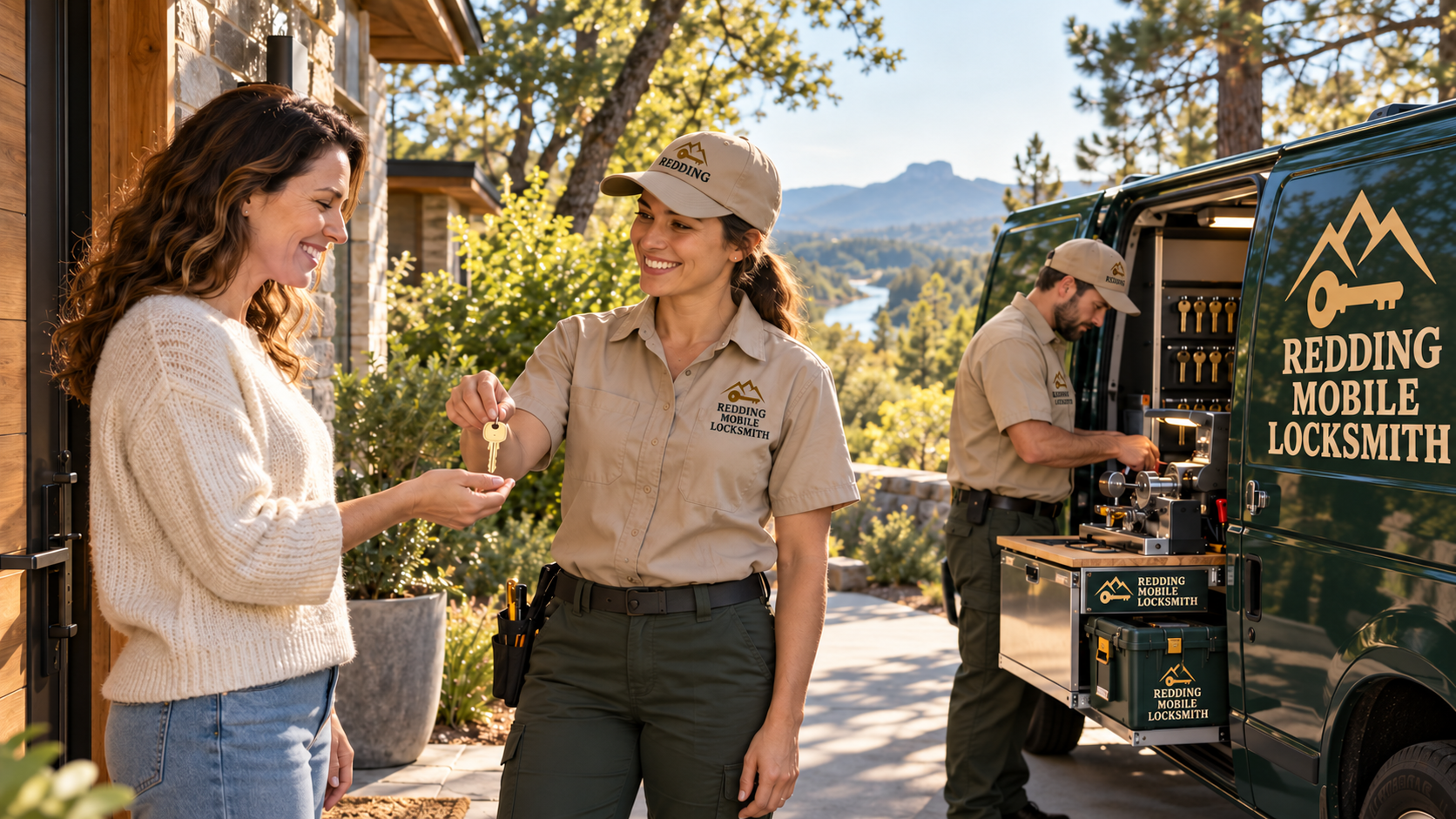
Our team arrives in a branded service van, carrying professional tools, key cutting equipment and common hardware. The technician walks through the doors with you, confirms your plan, and starts with the door that matters most. Old hardware is removed, the door is checked for fit and condition, and any needed preparation is done.
Next comes the new lock. The technician fits the cylinder and bolt, checks that the latch lines up with the strike, and secures everything with proper screws. They operate the lock many times with the door open and closed, adjusting until it works smoothly.
Finally, keys are handed over and tested. If several doors are involved, the technician may key them alike so one key does everything. You should try each lock yourself before the visit ends. Our new lock installation page describes the process in more detail.
Steep lots, old frames and winter
Dunsmuir houses often sit on slopes, with stairs, landings and retaining walls. Over many years, the ground moves, and doors and frames move with it. A door that once hung true may now rub at the top corner or drag at the bottom. New locks do not fix that, and a good installer will point out any hanging problems.
Winter adds its own demands. Snow melt, cold and damp swell wooden doors and frames. Metal contracts and expands, and weatherstripping may harden. A lock that is fitted to a door in summer needs room to cope with these swings, which is another reason to check alignment with the door closed.
Our guides on how weather and seasons affect locks and how locks fit metal, wood and fiberglass doors explain what to expect from your particular doors.
If a door has been neglected, say so. Peeling paint, a swollen edge or a cracked jamb are all things a technician would rather know about before arriving. Some can be fixed on the spot, and others may need a carpenter, in which case an honest recommendation is more useful than a lock fitted on top of a problem.
Beyond the front door
New owners often focus on the front door and forget the rest. A garage entry door, a basement door and a back door are all places where a good lock matters. Our guide on what to do if the lock on a garage entry door fails points out how often this door is overlooked.
Sliding glass doors and older windows are another weak point. Many came with a simple latch that does little. Extra measures can help, such as a bar in the track or a better window lock. Our guides on sliding door security and window locks for older houses offer ideas.
Outbuildings, gates and sheds deserve a look as well, particularly in a town where people keep tools, bikes and gear. A sturdy padlock and hasp are a modest investment, and our guide on shed and garage padlocks covers the common questions.
Mailboxes and other small locks are a last detail. If your mailbox has a lock, find out who has the key and whether it works. Our guide on mailbox lock questions is brief. It is a minor item, but it is the sort of thing that nags at a new owner until it is done.
Settling the rules before you start
If your home is part of a community with shared rules, or if you rent part of it to someone else, check what applies before changing hardware. Rules vary, and we do not give legal advice. The sensible step is to ask the person or group responsible for the property what they require.
If the house was recently sold, you may also want to confirm that you received all the keys, including garage remotes, gate keys and any alarm codes. Ask the previous owner or the agent. Change anything that was shared, and treat codes the way you treat keys.
These small administrative steps keep installation simple and prevent surprises. A short checklist taken to the first visit is much easier than a string of follow up calls.
Garage door openers and gate remotes belong on that checklist too. They are easy to overlook because they are not keys in the usual sense, yet they open the same house. If you received remotes at closing, ask whether the previous owner can reset the codes, or whether the opener should be reprogrammed. Treat each one as a key that needs a fresh start.
What to ask before you say yes
Good questions make good outcomes. Ask what hardware is being recommended and why. Ask how many keys come with each lock and whether doors can be keyed alike. Ask what will be done to the door and frame, and whether any repair is needed.
Ask how the work will be tested, and what you should do if a lock sticks later. And ask what can wait. A reasonable technician will tell you that some items can be done later, which lets you spread the work out as your plans become clearer.
We encourage these questions. Our guide on how to know a locksmith is the real thing goes through what a trustworthy visit looks like, from the uniform and the branded van to the way the technician explains the job.
Dunsmuir and its neighbors
The Local Standard serves Dunsmuir and nearby communities, including McCloud, Mount Shasta and Weed. New owners in those towns face similar questions, and the same approach works.
To see more of what we do locally, visit the Dunsmuir page, or read about home lock service in Dunsmuir, which explains how a home's locks work as a system.
We are Redding Mobile Locksmith, a 24 hour mobile service. Our phone line is coming soon, so please use the request form to describe your house, your doors and what you would like done.
Making the house yours
A new house becomes yours in small steps, and locks are one of the quietest. When the old keys are accounted for, the hardware works smoothly and you know exactly who can come in, the house starts to feel settled.
Take your time, make your list, and do the most important doors first. There is no need to change everything in an afternoon. A calm plan, carried out one door at a time, is better than a hurried one.
And when you are ready, send us the list. We will help you decide what to rekey, what to replace and what to leave alone, so that your first winter in the canyon begins with a house that locks the way you expect.
One more suggestion: keep the receipts and a short note of what was installed, which door got which lock and where the spare keys live. When you sell the house someday, or when a lock needs service years from now, that little record will be a generous gift to your future self, and the next owner will thank you for it too. Store it with the house papers, where you will actually find it when the question comes up again.
Good to know
Common questions
Should I change the locks as soon as I buy a house?
Many new owners do, because they cannot know who holds copies of the old keys. At minimum, consider rekeying the exterior doors so previous keys stop working. If the locks are worn or mismatched, replacement may be better. A technician can look at your doors and suggest a sensible order.
Can all my exterior doors use one key?
Yes, locks can be keyed alike so a single key opens several doors. It is convenient, but losing that key affects every door. Some people key the main doors alike and keep sheds or outbuildings separate. Decide before installation, since it affects which hardware is chosen and how it is set up.
Are keypad locks a good idea for a house?
They can be, especially if you share access with family, cleaners or guests, since codes can be changed without cutting keys. They need batteries and still depend on a solid latch and strike. Many people keep a key as a backup. We can talk through when a keypad suits a particular door.
What if my door does not close properly?
Tell us when you ask for installation. A door that rubs, sags or does not latch will make any new lock feel stiff. The technician can often adjust hinges, shim the door or reposition the strike so the bolt meets its hole squarely. Fixing the door first gives the new lock a fair chance.
Do I need permission to change locks if I rent out part of the house?
Rules and lease terms vary, and we do not give legal advice. If someone else lives in part of the property, check your agreement and speak with them before changing locks. In general, it helps to settle who holds keys and how access works before the work is scheduled.
How should I prepare for the installation visit?
Clear access to each door, a list of the locks you want changed and any keys you currently have. Decide whether you want doors keyed alike and how many keys you need. Mention any doors that stick or rub. If someone else owns or manages the property, have their permission ready.