
Home / McCloud / New Lock Installation in McCloud
McCloud new locks
New Lock Installation in McCloud: Deadbolts, Handles, Keypads and Smart Locks
Choosing a new lock sounds simple until you stand in a hardware aisle with twenty boxes. Here is how to think about what suits which door, with a forest town and its long winters in mind.
McCloud new locks
Arriving at the cabin after weeks away
Imagine a seasonal cabin owner pulling up to a place in McCloud after several weeks away. The road in was snowy, the porch is damp, and the key goes into the lock but turns only with a struggle. The latch has swollen against the frame, the deadbolt feels gritty, and the owner has a car full of supplies and a hope of a warm fire before dark. That is the moment when many people decide that it is time for a new lock.
McCloud is a forest town east of Mount Shasta along Highway 89, with older wood frame homes, cabins and snowy winters. Locks in this kind of place work harder than the packaging suggests. Moisture, temperature swings and long periods of disuse take a toll that a showroom never shows. A lock that is fine in a dry valley can falter here.
This page explains the main choices in new locks, how they fit different doors, and what a mobile locksmith from Redding Mobile Locksmith does when installing one. It is written for a household or cabin owner who wants to understand the options before talking to anyone. You do not need to memorize terms. By the end you should know what to ask for and what to expect.
Start with the door, not the lock
Before you pick a lock, look at the door. A lock is only as good as what holds it. Doors in this area are commonly solid wood, hollow core interior types used by mistake outside, metal clad, or fiberglass. Each material takes screws differently and each has a different thickness. The hole bored for the lock must be the right size, and the edge must be solid enough for the latch.
Check the frame, too. A strong deadbolt thrown into a thin, weathered frame is a weak arrangement. Look for cracks around the strike, soft or rotted wood and loose trim. If the frame is poor, the lock cannot do its job, and a technician may suggest reinforcing the strike area with longer screws or a stronger plate. Our guide on metal, wood or fiberglass doors and how locks fit them goes through the differences.
Also notice how the door moves. If it sticks, rubs or needs a shoulder to close, no new lock will make it pleasant. The hinges may have loosened or the frame may have shifted. A technician can often correct this during the same visit, which spares you buying a lock that blames its tiredness on a problem it did not cause.
Deadbolts, the backbone of a front door
A deadbolt is a solid metal bolt that slides out of the door edge into the frame when you turn the key or thumb turn. Unlike the spring latch in a knob, it cannot be pushed back by pressing on the door edge, because it does not rely on a spring. That is why it offers the real resistance against forced entry, provided it is installed into a strong frame.
Single cylinder deadbolts take a key outside and have a thumb turn inside. Double cylinder ones need a key on both sides, which can trap people inside in an emergency and is a choice that deserves careful thought. Many households prefer the single cylinder for safety. If a door has glass nearby, a technician can talk through the options for keeping both security and a way out.
Some deadbolts also come with a key that is hard to copy, or a cylinder designed to resist common attacks. Grade matters here, because some are built much more sturdily than others. Our piece on what lock grade means explains how to read the labeling, and the one on whether expensive locks make a difference puts it in perspective.
Handles, levers and knobs for everyday use
A handle set handles the daily open and close. A knob needs a twist, which can be hard for wet hands, cold fingers or someone with arthritis. A lever works with a push of a wrist or elbow and is easier for almost everyone. In a house where people carry firewood, groceries or a child, levers tend to make life gentler.
Some handles are passage sets that never lock, used on closets and interior rooms. Others are privacy sets with a push button for bedrooms and bathrooms. Exterior doors need an entry set with a key. A common arrangement is a lever handle with a separate deadbolt above it, which gives you a convenient latch for everyday use and a strong bolt for security.
Finish and material matter in a damp place. Hardware with a poor finish can pit, tarnish or seize as moisture and cold work on it. Ask the technician about finishes that stand up to weather. Solid parts last longer than thin ones, and good internal construction keeps a lock working through temperature swings. You do not need an expensive brand of anything, only a sturdy build suited to the exposure.
Keypads and the key you never lose
A keypad lock replaces or supplements the keyed cylinder with a numbered pad. You enter a code, and the bolt retracts. For a cabin, this has real appeal. There is no key to lose in the snow, you can give a code to a guest or a repair person, and you can change the code when plans change. Many models also keep a key as a backup.
Keypads need batteries, so a plan for replacing them matters. A good one gives warning before the batteries die and has a backup like a key or an external power contact. Cold weather reduces battery performance, so keep fresh ones on hand before winter. The keypad itself should be made for outdoor exposure, which a technician can help judge.
A keypad is not automatically more secure than a key. A code that is easy to guess, shared widely, or never changed can be weaker than a good key. Pick a code that is not a birthday or a simple sequence, and change it when a guest or worker no longer needs it. Our guide on managing locks for vacation homes discusses the habits that matter.
Smart locks: convenience with homework
A smart lock connects to a phone, a hub or a network so you can lock, unlock or share access remotely. Some turn a regular deadbolt into a smart one by replacing only the interior part, and others replace the whole assembly. Features vary, from simple remote control to logs showing who came and when, and temporary codes that expire.
For a cabin that sits empty, these features can be useful. You can let a cleaner in, check that the door is locked from afar, and end access when the visit is over. The tradeoffs are more parts that can fail, a dependency on batteries and connectivity, and a need to keep software updated. In a forest town where cellular coverage and internet service vary, check that the lock still works without a connection.
Ask what happens when the power or signal is out, and always keep a mechanical way in. Our guide on what a smart lock is and who needs one helps you decide, and whether smart locks can be rekeyed speaks to a common question. A smart lock is a good tool for the right household and an unnecessary one for another.
What the installation actually involves
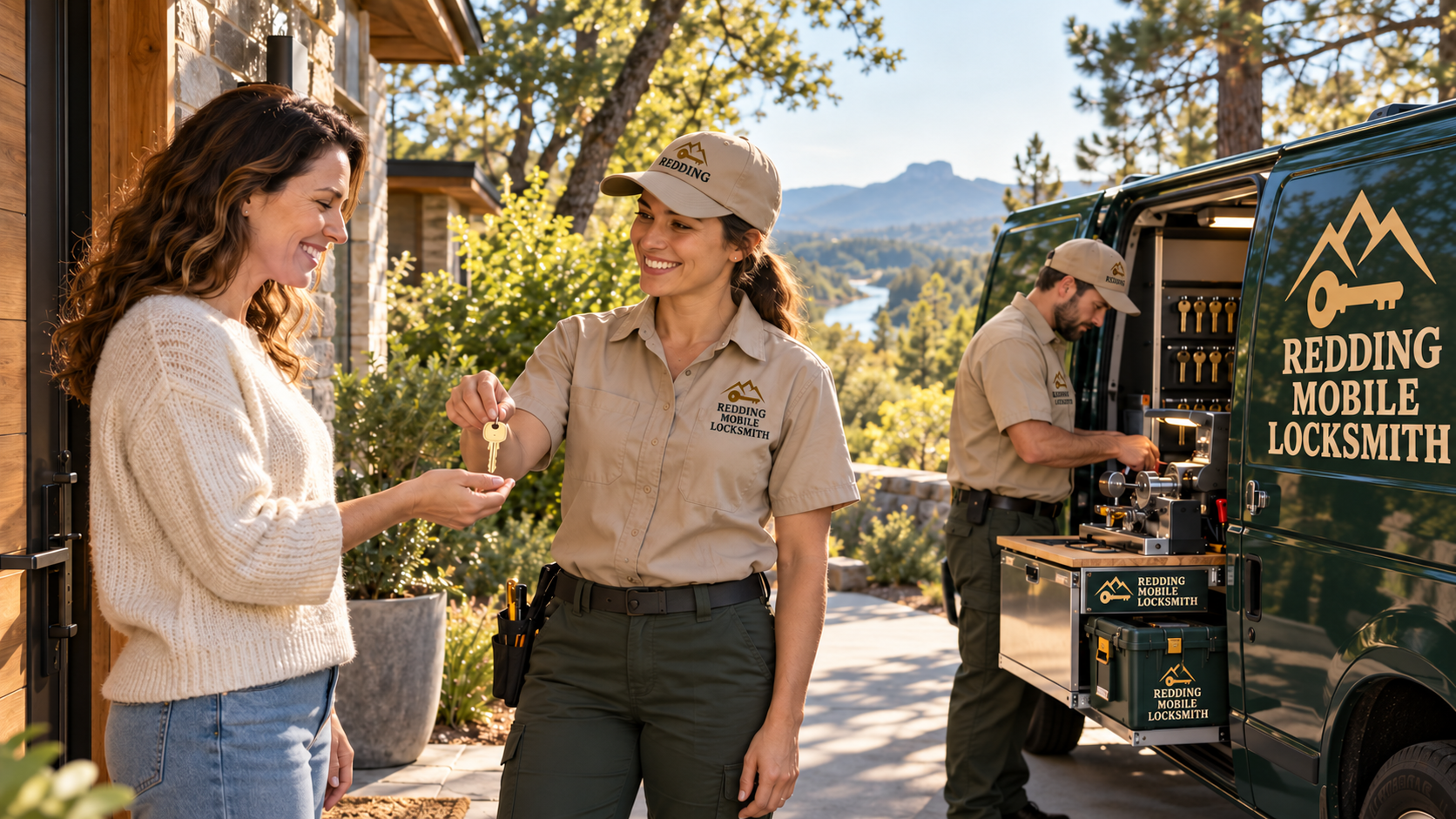
A technician arrives in a branded van carrying professional tools, key cutting equipment and common hardware. The first step is to examine the door and frame, measure the bore holes and decide what will fit. Standard doors have standard hole sizes, but older doors in older houses sometimes do not, and a technician has the tools to adjust the opening carefully.
Installing a deadbolt on a door that has none requires drilling a new hole in the door face and a smaller one in the edge, then mortising the edge for the bolt plate. It sounds simple but a misaligned hole leaves a bolt that drags and wears. A trained hand sets the lock square, installs a solid strike with long screws and checks that the bolt throws freely and fully.
After installation, the technician tests every function with you. The key should turn smoothly, the bolt should extend all the way, and the door should close without effort. You should be given all the keys, and if you want, the new lock can be keyed to match others on the property so one key works throughout. Ask for that when you request service, since it is simpler to do at the start.
Matching locks to the buildings around the house
A property usually has more than the front door. There may be a back door, a garage entry, a shed, a gate on a long driveway, or a separate guest cabin. Each has its own needs. The shed may be fine with a sturdy padlock, while the garage entry deserves a deadbolt like any house door. Think through every opening before you decide.
Consider whether you want all locks keyed alike. One key for the main house and the cabin outbuildings reduces clutter, but it also means that losing that key opens everything. Some owners prefer a few separate keys for more sensitive areas. A technician can explain the choices and set up a system that suits how you actually live. Our guide on gate lock questions for country driveways may help with the outer perimeter.
Do not forget windows and sliding doors, which are common weak spots. A new deadbolt on the front door means little if a patio slider can be lifted off its track. Nothing here has to be done at once, but a walk around the property with a list is a good habit. Plan the work in order of importance, then spread it over time if you need to.
Lighting and landscaping play a quiet part as well. A door hidden behind overgrown shrubs or tucked in deep shadow gives anyone approaching it the cover of privacy, while a well lit entry with a clear view from the street discourages casual attempts. In a forest town where trees crowd the house, trimming back branches and adding a light on a sensor costs little effort and helps every lock on the property do its work. Think of lighting and clear sight lines as part of the lock system, since a lock slows an intruder and light makes the slowing visible.
Finally, consider how the household actually moves through the property in winter. If the usual way in is the side door because the front steps are icy, that side door is the one that needs the sturdiest hardware and the easiest handle. Match your locks to real habits and not only to the house plan, and the whole arrangement will feel natural instead of fussy.
Questions worth asking before the work begins
A good installation starts with a short conversation. Ask the technician what they see in the door and the frame, and whether anything needs to be corrected before the new lock goes in. Ask what the lock is made of, how it is meant to handle moisture and cold, and what the finish is like. A knowledgeable person answers these without hurry, and you learn a lot from how they answer.
Ask also about the keys. How many come with the lock, can more be cut, and does the lock accept a standard blank that any professional can copy, or a restricted one that needs special authorization? Restricted keys are harder to duplicate casually, which some owners like, though replacing a lost one takes more steps. Neither choice is wrong. It depends on how you live and who shares your property.
Finally, ask what to do if the lock misbehaves later. A new lock sometimes needs a small adjustment after the wood settles around it, especially in a damp climate. Knowing whom to call and what to say makes that easy. Keep a note of what was installed, where, and when, since it will help the next time you or a technician needs to work on it. A short record in a drawer is a gift to your future self.
Before and after: closing and reopening a cabin
A cabin that sits empty benefits from a routine at both ends of the season. When you close up, operate each lock, lubricate lightly with a dry lubricant made for locks, and make sure no key is left hidden outside. When you open up, test each lock before bringing in the supplies, so a stiff lock does not catch you out in the dark. Our guide on seasonal closing and reopening of a cabin collects the questions.
A new lock is also a moment to reset who has keys. Past guests, former caretakers and previous owners may still hold copies. Having locks replaced or rekeyed on arrival tells you precisely what exists. It is a cleaner start than hoping nobody kept a copy. The page on home lock service in McCloud explains rekeying and repairs that sit alongside installation.
When you are ready, the request form is the place to begin. Tell the dispatcher about the door, the material and what you hope to improve. The broader new lock installation page covers the topic across the whole service area, and neighboring Mount Shasta and the town page for McCloud are close at hand.
Good to know
Common questions
What kind of lock suits a front door in a snowy town?
A sturdy deadbolt with a solid finish, paired with a lever handle that is easy to use with cold or full hands, suits most front doors. The frame and strike matter as much as the lock. A technician can check both and suggest hardware built to handle moisture and temperature swings.
Is a keypad lock safer than a key?
Not automatically. A keypad avoids lost keys and lets you change codes easily, but a guessable or widely shared code can be weaker than a good key. Choose a code that is not obvious and change it when someone no longer needs access. Keep fresh batteries on hand.
Can a smart lock work without internet?
Many can, because the lock itself works through a keypad or key even if the network is down. Remote features need a connection, though. Ask how the lock behaves when power or signal is lost, and always keep a mechanical way in for the times technology fails.
How long does a new lock take to install?
It depends on the door and the lock. A simple swap on a prepared door is shorter work, while a new deadbolt that requires drilling and fitting a strike takes more care. The technician can tell you what to expect once they have examined the door and frame.
Can all my locks use the same key?
Often yes. A technician can key new locks to match existing ones or to match each other, so one key opens several doors. The tradeoff is that losing that key affects them all, so some owners keep a separate key for the most sensitive doors.
Should I replace my locks when I buy a cabin?
It is wise to at least rekey them, since you cannot know how many keys the previous owner or caretakers handed out. Rekeying makes old keys useless without replacing the hardware. If the locks are worn, replacement during the same visit may be sensible.