
Home / Mount Shasta / New Lock Installation in Mount Shasta
Fitting new locks
New Lock Installation in Mount Shasta: What Suits Which Door
Choosing a new lock is easier when you know what each type does. This page walks through deadbolts, handles, keypads and smart locks, and how a mobile locksmith fits them to doors in Mount Shasta.
Fitting new locks
Starting with a shared rental
Imagine a college student renting a room in a shared house near Mount Shasta. Four people have keys, two of them have moved out, and nobody is quite sure who has copies. The front door has a worn knob and a deadbolt that sticks when it is cold. Everyone agrees something should change, but nobody knows what to ask for.
That made up scene is a handy place to begin because it contains most of the decisions behind a new lock. Who needs access? How many doors are there? What is the door made of? Is the landlord involved? Each answer points toward a different kind of hardware, and the right choice for a shared rental is not the same as for a cabin.
This page works through those decisions in the order a locksmith would. It is not a sales pitch for any product, and we do not name brands. It is a guide to the types, so you can describe what you want and understand what you are offered. Our overview page on new lock installation covers the wider service.
The parts of a door lock, briefly
Most exterior doors carry two pieces of hardware: a latch that holds the door shut against the frame, and a deadbolt that throws a solid steel bar into the frame. The latch lives in the handle or knob and is meant to keep the door closed, not to keep intruders out. The deadbolt is the part that does the security work.
A lock has a cylinder, which is the key operated mechanism; a bolt or latch, which moves; and a strike plate, which is the metal plate on the frame that receives it. All three must line up. A beautiful lock in a poorly fitted door gives little protection, which is why installation matters as much as the hardware. Think of it as a chain: the key turns the cylinder, the cylinder moves the bolt, the bolt enters the strike, and the strike is fixed to the frame. If any link is weak, the whole chain is weak, and a locksmith checks each link rather than just the one you can see.
Understanding these parts makes the next sections easier. When we say a lock is a good fit for a door, we mean its cylinder suits the keys you want, its bolt reaches deep enough into the frame, and the strike and screws are solid enough to take a hard knock without giving way.
Deadbolts: single, double and the in between
A single cylinder deadbolt uses a key on the outside and a thumb turn on the inside. It is the usual choice for houses, because you can leave promptly in an emergency without hunting for a key. A double cylinder deadbolt needs a key on both sides, which is sometimes chosen for doors with glass nearby, though it can slow your escape if there is a fire.
Because of that, many people prefer a single cylinder deadbolt even beside glass, and add other protections such as laminated glazing or a reinforced strike. Rules and local requirements vary, so ask a professional and your landlord or building manager what applies to your door rather than assuming.
Some deadbolts come with a keypad, a touchscreen or a Bluetooth connection, which brings us to the next section. Whatever the type, the key rule is the same: the bolt should extend well into the door frame, and the strike plate should be anchored with long screws that reach the framing behind the trim, not just the thin wood of the jamb.
- Single cylinder deadbolts suit most house doors.
- Double cylinder deadbolts need a key on both sides and need careful thought.
- Strike plates should be anchored with long screws that reach the framing.
- The bolt should extend into the frame by a solid, full throw.
Handles, knobs and levers
The handle on your door does a different job from the deadbolt. A knob or lever lets you open the latch, and it may have a key or button lock. Levers are easier on the hands and on people who struggle with a round knob, which is why many homes choose them for accessibility and comfort.
Handles come in many forms: passage sets that never lock, privacy sets that lock from inside, and entry sets that lock with a key outside. Choosing correctly matters, both for how the door behaves and for how safe the people behind it feel. A bedroom or bathroom wants a privacy set. An exterior door wants an entry set. A closet or hall wants a passage set.
If your handle feels loose, wobbles or sags, a locksmith can often tighten, adjust or replace it. Our page on lock repair and adjustment describes what is involved. Sometimes the cure is a new strike plate or a few longer screws, and no new lock is needed at all.
Keypads and codes
A keypad lock replaces the key with a code. You type the number, the lock checks it, and the bolt moves. For households with several people, or for a rental with changing guests, a keypad can be a relief: no keys to lose, and codes you can change when somebody leaves.
The trade off is the batteries and the electronics. Keypads need power, usually from standard cells, and a failed battery without a backup key can mean a lockout. Most have an override key slot or a way to attach a temporary power source. Keep fresh batteries and know where the override is.
In snowy Mount Shasta winters, ask how a keypad handles cold and moisture. A well made unit is designed for outdoor conditions, but a low grade or poorly fitted one can fail. Choosing a unit that suits an exterior door, and having it installed so the seals sit tight, avoids most trouble.
Think too about who will use the code. A keypad works well for people who find keys fiddly, and for households where someone often arrives with full hands. It works less well if codes are shared casually, because a code passed to a friend can be passed on again. Change codes when circumstances change, and treat them with the same care as a key.
Smart locks and what they add
A smart lock connects to a phone, a hub or both. It may open with a code, a card, a fingerprint or an app. It can send you a message when someone enters, and let you give a visitor temporary access. For an owner of a vacation rental or a cabin, those features can be genuinely useful.
They also introduce new questions. What happens if the phone is dead? What if the network is down? Who can change codes? Many people keep a traditional key as a backup, and that is sensible. A smart lock is better seen as a convenience layered on a mechanical lock, not a replacement for judgement.
Installation matters more with smart locks than almost any other type. The lock must sit square in the door, the bolt must move freely, and the network or app setup must be completed with care. A smart lock fitted to a door that binds will wear its motor out early and leave you wondering why the batteries never last. Fit the door first, then the electronics.
Our neighbors page on what a smart lock is and who needs one goes through the pros and cons. If you rent, check with your landlord before changing anything, because lock changes in rentals often have rules.
Matching the lock to the door
Door material changes the job. Solid wood doors take a standard deadbolt bore well. Metal doors are strong but need careful drilling. Hollow core interior doors are thin, and the hardware must suit their lightness. Fiberglass doors need the right kit to avoid cracking. Glass panels bring their own constraints.
Our neighbors page on metal, wood or fiberglass doors and how locks fit them explains this more fully. In Mount Shasta, where doors swell and shrink with the seasons, the fit between door and frame also matters, since a tight door can bind a new bolt in winter.
Before ordering hardware, measure or photograph the door: its thickness, the size of the existing hole, and the distance from the edge to the center of the hole, which is called the backset. A locksmith can take these measurements on site, but having them ready speeds up a discussion and cuts down on surprises. A phone photo of the door edge, the faceplate and the strike plate is often enough to let a locksmith bring the right parts the first time.
Rentals, landlords and shared houses
If you rent, you may not have the right to replace locks. Rules vary by lease and by situation, so we cannot say what applies to you. Ask your landlord or property manager what is allowed before you buy or book anything, and put the answer in writing. In many cases the landlord will handle the change, or approve a locksmith.
For our imagined student, the practical request is simple: ask the landlord to rekey the locks when a roommate leaves, or to approve a new set. Rekeying makes old keys useless without replacing the hardware, which is often easier to agree to than a new lock.
Our neighbors page on what renters should ask a landlord about lock changes offers a short list of questions. If you are the owner of the rental, a fresh set of keys at each turnover is a sensible routine that protects both you and your tenants.
Shared houses add one more wrinkle. When several adults hold keys, nobody feels personally responsible for the door, and small faults are ignored until they become large ones. Agreeing on one person to talk to the landlord, and one routine for who gets a key and who hands it back, makes everything else easier.
Cabins, gates and outbuildings
Not every door in the area is a front door. Mount Shasta has cabins, workshops, sheds, garages and gates, and each wants hardware that suits its use. A cabin that sits empty for weeks needs a lock that resists weather and does not seize from disuse. A workshop with tools needs a deadbolt and a solid strike. A gate wants a padlock or a gate latch that can take a knock.
For outbuildings, the choice between a keyed deadbolt, a hasp with a padlock and a keypad is often practical rather than aesthetic. A padlock is easy to replace and easy to carry a spare for, but a hasp is only as strong as the screws holding it. Through bolts, carriage bolts and backing plates all help.
Keep a record of which key fits which lock, because the number of small keys on a ring can grow quietly. Where possible, use matching keys across several locks so there are fewer to carry, and mark each in a way only you understand. Our neighbors page on shed and garage padlock questions explains the thinking.
What an installation visit involves
On arrival, the locksmith looks at the door, the frame and the existing hardware. They confirm what you want, check that the new lock suits the door, and explain any extra work such as drilling a new hole, reinforcing a frame or fitting a new strike plate. You agree the plan before work begins.
Installation itself involves removing the old lock, fitting the new, aligning the bolt with the strike, and testing the action many times. The locksmith then gives you the keys, shows you how the lock works and, for a keypad or smart lock, helps you set the codes or app. Everything should operate smoothly before the van leaves.
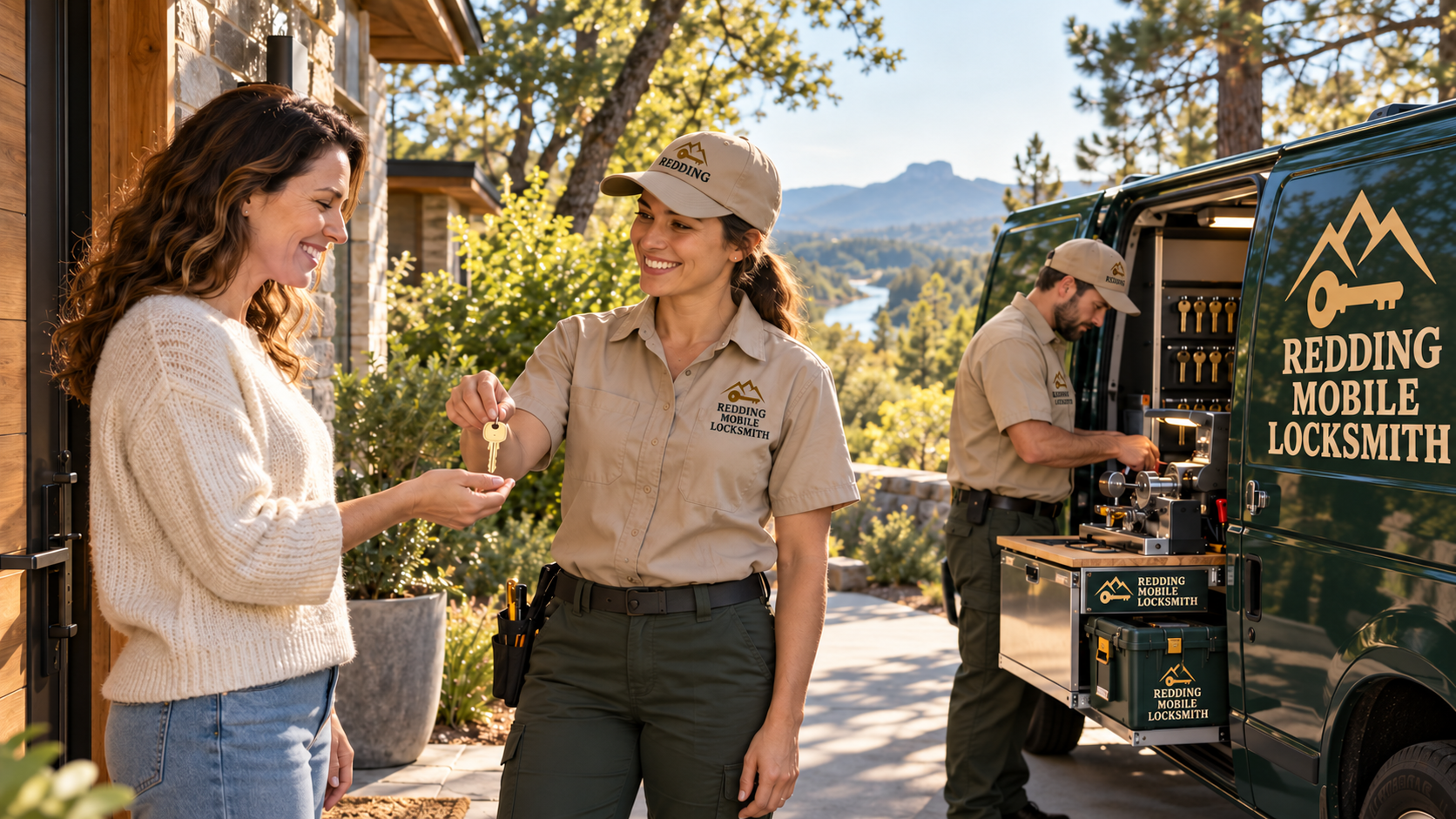
The van carries tools, key cutting equipment and common hardware, so many jobs finish in one visit. If special hardware is needed, we will tell you and arrange it. Our home lock service page for Mount Shasta shows how installation fits with rekeying and repair.
Nearby places and next steps
Installations happen across the county. If you are in Weed, Dunsmuir or McCloud, the same advice applies, and our Mount Shasta neighborhood page links everything for this city.
When you are ready, send the details through the request form on our contact page. Our phone line is coming soon. Tell us how many doors, what they are made of, and what kind of lock you have in mind, and we will help you choose.
The right lock is the one that fits your door, your household and your habits. It does not need to be elaborate, and it does not need to be flashy. It needs to be installed properly and used consistently, which is what a patient, unhurried visit is meant to deliver. If you are unsure where to begin, begin with the door that worries you most and the one you use every day, and we will work outward from there at whatever pace suits you.
Good to know
Common questions
What is the difference between a latch and a deadbolt?
A latch is a spring loaded bolt in the handle that holds the door closed but can be pushed back with force. A deadbolt is a solid bar that you throw by key or thumb turn, and it cannot be pushed back. Most exterior doors benefit from both working together.
Can a keypad lock work in Mount Shasta winters?
Many are built for outdoor use and handle cold and moisture well, though quality and installation vary. Ask about the temperature range and how the unit deals with moisture. Keep spare batteries and know where the override key slot is, because a dead battery without a backup can lead to a lockout.
Do I need to replace the whole lock to change who has keys?
Not usually. Rekeying changes the inside of the cylinder so old keys stop working and new ones are cut, and the lock body stays. Replacement makes sense when the lock is damaged, worn out or no longer matches the security you want. A locksmith can advise on your hardware.
Will a landlord let me install a new lock?
Rules vary by lease and situation, so ask before you buy anything. Many landlords prefer to handle lock changes or approve a locksmith, and some will rekey at turnover. Get the answer in writing, and keep in mind that you may need to give the landlord a key.
How do I choose between a smart lock and a regular deadbolt?
Consider who needs access, how often it changes, and what happens if power or network fails. A regular deadbolt is simple and dependable. A smart lock adds codes and alerts. Many people use a smart lock with a backup key. We can talk through the choice for your door.
How do I book an installation without a phone number?
The phone line is coming soon. For now, use the request form on our contact page and tell us about your doors, materials and the kind of lock you want. If there is an emergency where someone is in danger, call emergency services first.