
Home / Palo Cedro / New Lock Installation in Palo Cedro
New locks
New Lock Installation on Palo Cedro Properties
Acreage means more doors, more gates and more keys than most people realize. This page walks through choosing and installing new locks for houses, shops and outbuildings, and what a technician checks before drilling a single hole.
New locks
Why a property with acreage needs a plan
Imagine the owner of a few acres east of Redding who has just walked the property with a notepad. There is a front gate at the road, a second gate to the back pasture, a house with three exterior doors, a detached garage, a workshop, a pump house and a storage shed. That adds up to more than ten places that might want a lock, and each one has been fitted at a different time with whatever was handy.
The temptation is to buy a bag of identical locks and fit them everywhere. That rarely works well, because every door and gate has a different job. A front door needs a lock that works smoothly many times a day. A pump house needs a lock that survives weather and rarely needs opening. A workshop with tools inside deserves more attention than a shed with garden supplies.
A good installation starts with a simple walk around and a few questions: what is behind each door, who needs to open it, how often, and what happens if someone else gets in. The answers shape the hardware. This page is meant to help you walk that property with a locksmith's eye, even before anyone arrives.
It also helps to sort the doors into three loose groups. The first group is the doors you use every day, where smooth operation matters most. The second is the doors that guard valuable things, where strength matters most. The third is the doors you barely touch, where weather resistance matters most. Once each door has a group, the choice of hardware tends to become obvious, and the shopping list shrinks to something manageable.
Know what you are replacing
Before picking a new lock, look closely at the old one. Is it a knob lock, a lever, a deadbolt, a combination of the two, or a padlock on a hasp? Does it fasten into a hole drilled through the door, or is it a surface mounted unit? Notice the size and shape of the holes, because modern doors follow standard drilling patterns, and that makes replacement simple.
Next, look at the door. Is it solid wood, a hollow door, metal or fiberglass? Is the edge in good condition, or has it been chewed up by earlier locks? A door that has been drilled and patched several times may need a repair before it can hold new hardware properly. A technician will check this before installing anything and will tell you if the door needs attention first.
Finally, look at the frame and strike. A new deadbolt is only as strong as the jamb behind it. If the wood is split, rotted or loose, a better lock will not fix that. Our page on new lock installation explains the whole process, and our guide on how locks fit different door materials goes into the door side.
Choosing between knobs, levers and deadbolts
Each kind of lock has a purpose. A keyed entry knob or lever holds the door shut with a spring latch and locks the handle from turning. It keeps the door closed against wind and casual entry, and it is a convenience more than a barrier. A deadbolt adds a solid bolt that extends into the frame and holds the door shut against force.
For exterior doors we usually suggest both a handle and a deadbolt, or a single set that combines them. The handle gives everyday convenience, and the deadbolt gives real resistance. For interior doors that only need privacy, a simple lock without a key is usually enough.
Handle shape is a personal choice. Levers are easier on the hands, work with an elbow when your arms are full, and are friendlier for children and older relatives. Round knobs are traditional and can look right on an older house. Whichever you choose, check the weight and finish, because a well made handle feels solid in the hand and keeps working for years.
Finish deserves a word of its own in a sunny, dry climate. Some coatings fade or chalk after a few seasons of direct afternoon sun, while solid brass and quality plated finishes hold their color longer. A west facing door on a country porch will show wear sooner than a shaded one, so it is worth choosing a finish that suits the exposure, not just the catalog photo.
- Use a keyed deadbolt on exterior doors that open to the outdoors.
- Choose lever handles where easy use matters most.
- Keep privacy locks on bedrooms and bathrooms, which do not need keys.
- Match the finish on handle and deadbolt so the door looks intentional.
Gates, hasps and padlocks done thoughtfully
A gate is a different animal from a door. It faces weather every day, moves with the ground, and is often built from tubing, wire or timber. The lock is only one piece of a gate system that includes the latch, the hinges, the post and the chain or bar. A strong padlock on a weak latch gives a false sense of security.
Padlocks come in a range of body sizes and shackle styles. A heavier body and a thicker shackle resist cutting and prying better than a light one. A shackle that is shielded by the lock body, or a design that covers the shackle, is harder to reach with a tool. Outdoor padlocks need to cope with rain, dust and heat, and many are built with sealed cores for that reason.
Where several gates exist, a keyed alike set can save a ring of keys. Several padlocks can be set to open with one key, so a ranch hand or a family member carries one key rather than six. That convenience makes sense for gates that all protect the same sort of thing. Keep a separate key for anything more sensitive, such as a shop with equipment.
Think about the latch end of the gate as well. A latch that can be lifted from the other side, or a chain that can be slipped over a post, undoes even a very good padlock. A locksmith can suggest where a lock should sit so that the shackle is not exposed and the hasp cannot be unscrewed from outside. Hidden fasteners and carriage bolts are small details that make a large difference.
Outbuildings and the doors people forget
Sheds, pump houses and workshops often have doors that were never meant to be secure. A hollow door with a thin hasp and a small padlock slows nobody down. If the outbuilding holds tools, fuel containers, equipment or things that matter, it is worth a closer look.
Start with the door and the frame. A solid door with a proper deadbolt, mounted in a frame that has been reinforced where the strike sits, is worth far more than a fancy lock on a flimsy door. Hinges matter too. Pins on the outside of a door can be lifted out, so a locksmith may suggest hinges with fixed pins or a security stud.
Think also about lighting and visibility. A lock is stronger when someone can see it. A workshop door that sits out of sight from the house is easier to tamper with, so lighting and good sightlines add a layer that no lock can supply. These are not locksmith matters strictly speaking, but we are happy to discuss how they work with hardware.
What an installation visit actually looks like
When a technician arrives, the first thing they do is look. They check the door thickness, the existing holes, the condition of the edge and the frame, and how the door hangs. They measure the backset, the distance from the edge of the door to the center of the lock hole, since two common sizes exist and the wrong one will not fit.
Then comes the work. If the holes are standard, the old hardware comes off, the new hardware goes on, and the strike plate is aligned with the bolt. If the door needs new holes, the technician uses a template and specialized drilling tools so the cuts are clean and square. If the strike area needs reinforcing, longer screws are driven into the framing.
Finally, the technician tests everything. Keys are tried in each lock from outside. The deadbolt is thrown and retracted several times. The door is closed and opened as a user would. You should see the bolt slide in smoothly and hear a firm click. If anything drags, it gets adjusted before the technician leaves.
You will also be handed the keys, and we encourage you to try each one yourself. It sounds trivial, but a key that sticks on day one is easier to sort out while the technician is still standing on the porch. Ask what finish care is needed, whether any screws should be checked after the first month, and what to do if the lock ever feels different. A good installer wants those questions.
Keys: how many, and for whom
New locks come with keys, and that is the moment to decide who gets them. Make a short list of everyone who needs to enter: family members, a caretaker, a neighbor who feeds animals when you travel. Then decide whether each person needs access to every door or only to some.
If a property has many locks, consider keying them in groups. For example, the house doors might share one key, the garage and shop another, and the gates a third. That keeps the number of keys manageable without putting the whole property on a single point of failure.
Write down which key opens what, and keep that list somewhere safe, away from the keys themselves. If you add a worker or a renter in the future, you will be glad you did. Our article on gate lock questions for country driveways and the one on shed and garage padlock questions answer common questions in this area.
Smart locks, keypads and the question of batteries
Many people ask about keypad and smart locks when they plan a new installation. These devices replace or supplement the key with a code, a phone or a card. They can be convenient when several people come and go, and a code can be changed without cutting a key.
They also come with trade offs. Electronic locks need power, usually batteries, and batteries run out. A good unit warns you well ahead, and many include a backup way in, such as a key or a terminal for a temporary power source. On a rural property where the nearest help may not be next door, a backup is not optional.
Weather matters too. A keypad exposed to direct sun and temperature swings ages differently from one under cover. We can talk through whether an electronic lock suits a particular door, and whether a mechanical deadbolt would serve you better. Our guide on what a smart lock is and who needs one goes into the details.
A fair rule of thumb is to ask what happens when the power fails, the battery dies or the phone is lost. If the answer is that you stand outside in the dark, choose a different lock. If the answer is that a key still works, the electronics become a pleasant extra rather than a single point of failure.
Fitting installation into a larger plan
New locks do their job when they are part of a plan. If you are buying a property, it is wise to rekey or replace locks as soon as you can, since you do not know who holds old keys. If you are building a shop, plan the door and lock together. If you are tightening things after a scare, start with the doors that matter most.
Our page on home lock service in Palo Cedro covers the upkeep of what you already have, and our door hardware for business in Palo Cedro page is useful if your shop serves customers. Neighbors in Palo Cedro and nearby Millville often combine home and shop work in a single visit.
The point is to do the work in a sensible order. First, make sure the doors and frames are sound. Second, choose hardware that suits each door. Third, set up keys so the people who need access can have it. A property planned that way is simpler to live with and easier to secure.
Requesting an installation visit
To arrange a visit, use the form on our contact page. Our phone line is coming soon. Tell us how many doors and gates you have in mind, what kind of doors they are, and what you hope to change. Photos of existing hardware help us bring the right parts.
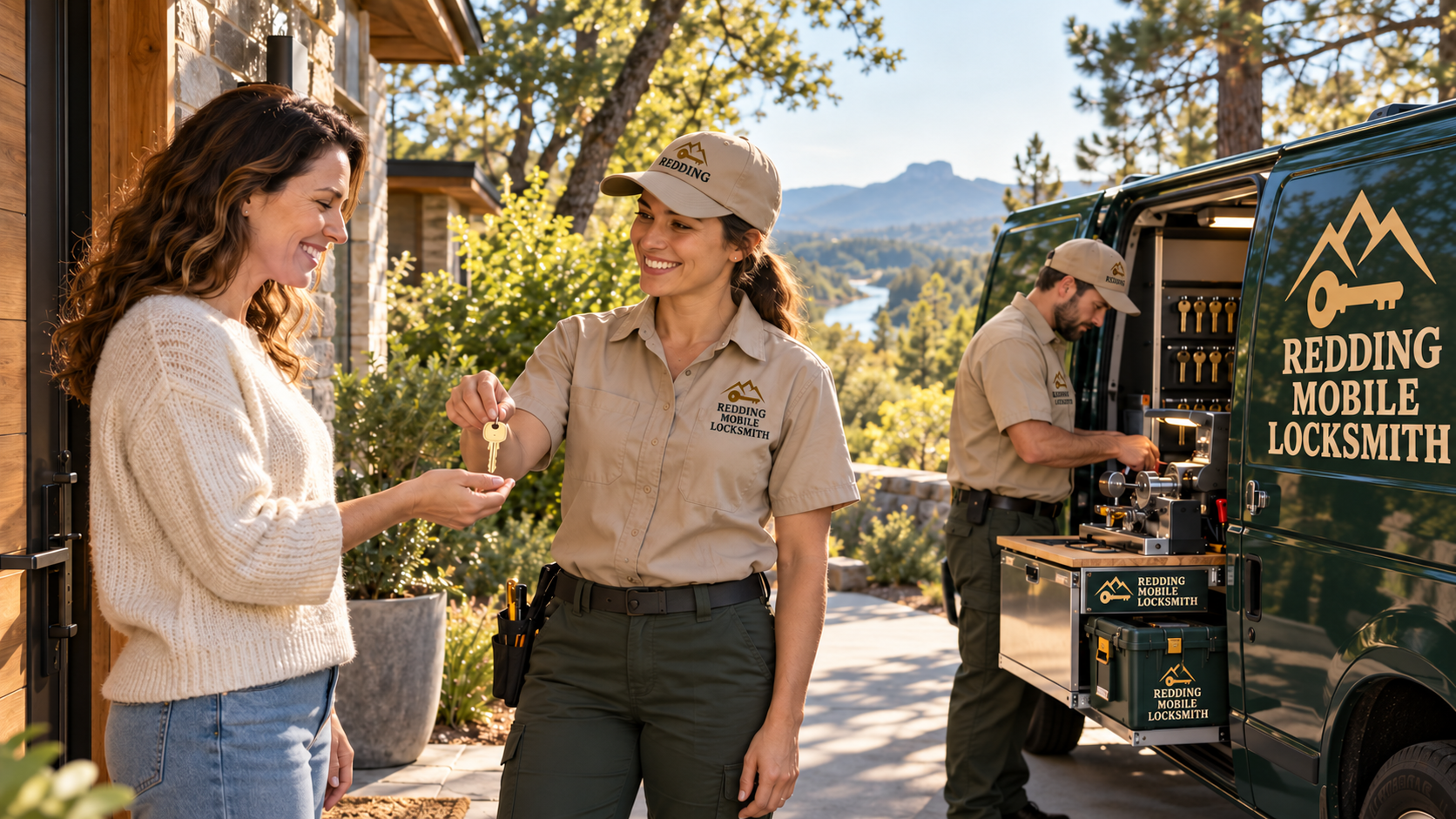
Our team arrives in a branded van and uniform, carrying common hardware and the tools to fit it. If a particular lock is not on the van, we will tell you what is needed and plan a follow up rather than force a poor match. Honest advice is part of the job.
Ask questions as we work. We enjoy explaining why a strike is set a certain way, or why a hinge was changed. A property owner who understands the hardware is better placed to look after it, and that is the real goal of a good installation.
Good to know
Common questions
How do I know which size lock will fit my door?
Doors follow common drilling patterns, but two backset measurements are in use, and the thickness of the door matters. A technician measures these on site. If you plan ahead, photos of your current lock and the edge of the door help us bring matching parts.
Should I put a deadbolt on a shed or workshop door?
If the building holds tools, equipment or items you cannot easily replace, a deadbolt in a solid door and frame is a sensible step. For a simple garden shed, a good padlock on a strong hasp may be enough. Match the lock to what is inside.
Can several padlocks on my property use one key?
Yes. Padlocks can be keyed alike so one key opens several of them. That is convenient for gates that guard similar things. Many owners keep a separate key for anything more sensitive, so a lost key does not open everything.
Are keypad locks a good choice for a country property?
They can be, especially where several people come and go. Remember that they rely on batteries and weather exposure, so choose a unit with a backup way in, such as a key, and replace batteries when the lock warns you.
Do I need to fix my door frame before installing a new lock?
If the jamb is split, soft or loose, a new lock will not make the door stronger. A technician checks the frame and strike area first, and tells you if repair or reinforcement is needed before new hardware goes on.
How do I request an installation visit?
Use the request form on our contact page and describe the doors, gates and locks you have in mind. The phone line is coming soon. Photos of current hardware and a short list of who needs keys will help us prepare for the visit.