
Home / Dunsmuir / Door Hardware for Business in Dunsmuir
Dunsmuir business doors
Door Hardware for Business in Dunsmuir, Explained Over the Counter
Every shop door in Dunsmuir does the same quiet job all day: open easily for a customer, close firmly behind them, and stay secure after dark. Here is how the hardware works, and what to ask when it stops.
Dunsmuir business doors
The door that everyone touches and nobody notices
Think about how many times a commercial door opens in a normal week. A customer pulls the handle, a supplier props it with a boot, a stocker bumps it with a cart, and a closer at the top quietly pulls it shut again. The hardware on that door lives a harder life than anything in a home, and it tends to be ignored until the day it fails. That is why a column about door hardware belongs in a town like Dunsmuir, where a lot of the buildings are older and the doors have been working a long time.
Dunsmuir sits in the upper Sacramento River canyon along Interstate 5, with the railroad running through the same narrow valley. Older buildings sit on steep lots, the forest is close, and winters are cold. Every one of those facts touches door hardware. Cold stiffens grease, damp swells wood, and a steep approach means a door may be hit by wind that a flat valley town never sees.
This page is written for the person who owns or runs a small business here, and just as much for the delivery driver, the rideshare driver or the supplier who has to get through that door on a route. We will walk through the four pieces that matter most, which are closers, exit devices, strikes and handles, and then through what a mobile locksmith from Redding Mobile Locksmith can sort out on site.
Picture a driver on a long route
Imagine a driver working a delivery or rideshare route up the canyon, stopping at a half dozen small businesses in one afternoon. At the first stop the door swings shut so hard it nearly takes the package out of their hands. At the second, the door will not latch, so it hangs open an inch and lets the cold in. At the third, a push bar will not release and the driver has to go around to a side entrance. None of these are exotic failures. They are the everyday symptoms of hardware that needs a small adjustment.
That driver is a useful guide because they see many doors in a short time and feel the difference immediately. A door that opens with one steady push, closes on its own without slamming, and clicks into its strike every time feels invisible. A door that fights you is telling the owner something. If you run a shop, ask yourself how your door feels to a stranger carrying an armful of boxes, because that stranger is a regular part of your day.
It also helps to remember that people who work on the move often leave a vehicle idling or locked while they step in. When a door sticks and a stop runs long, that is more than an annoyance. It is a reason to treat door hardware as part of how a business treats the people it depends on, and it is one of the simpler things a small owner can improve without a big project.
Closers: the quiet muscle at the top of the door
A door closer is a hydraulic or spring assisted arm, usually mounted at the top of the door, that pulls the door shut after someone passes through. Inside the body is a spring and a sealed chamber of fluid with small valves. The spring supplies the closing force, and the fluid slows the motion so the door does not slam. Two adjustment screws usually control the speed of the main swing and the final latching stretch, which is the last few inches where the door has to overcome the latch.
Closers misbehave in predictable ways. Cold weather thickens the fluid, so a door that closed nicely in September may drag in January. A leaking closer leaves an oily streak on the door or floor and loses its dampening altogether. A door that slams, or one that stops just short of the latch, usually needs an adjustment rather than a new closer, and a technician can tell the difference on site. You can read more in our plain guide, what a door closer is and why it matters.
The closer also has a safety job. Doors that are meant to stay shut are often part of how a building controls smoke and keeps heat in, and a door propped open with a wedge defeats that purpose. If you find yourself propping a door because the closer fights you, that is a good time to call, since a properly set closer removes the temptation. Rules about specific doors vary by building and use, so ask who is responsible for your building's requirements.
Exit devices and push bars
An exit device, often called a push bar or panic bar, lets a person leave a building by pressing a horizontal bar instead of turning a knob. Pressing the bar retracts the latch, and releasing it lets the latch spring back out. The point is that anyone, including someone in a hurry or carrying a load, can leave without knowing how a lock works. From outside, the same door may have a keyed trim, a lever, or no outside hardware at all.
Common problems are easy to describe. The bar sticks halfway down, the latch does not fully retract, the door will not catch when closed, or the outside key no longer turns the trim. Often the cause is a door that has sagged slightly on its hinges, so the latch no longer lines up with the strike. Fixing the alignment first usually saves replacing a device that was never broken. Our guide on push bars and panic hardware goes through the types.
If you are a driver or visitor, you can help the owner by noticing and mentioning a sticky bar before it fails, rather than after. If you are the owner, test your exit doors on a regular schedule, pushing the bar and watching the latch move. Whether a particular exit device is required on your door depends on the building and how it is used, so we leave that question to the people who enforce those rules in your area.
Strikes and the little plate that does the heavy lifting
The strike is the metal plate set into the door frame that the latch or bolt catches on. People overlook it, yet it carries most of the load when someone pushes on a locked door. A strike that is screwed only into soft frame wood with short screws gives way easily, while one fastened with long screws into the framing behind the trim holds up far better. Our short piece on what makes a good strike plate explains why.
There is also the electric strike, a strike with a small solenoid that lets a latch release on command from a button or a keypad at the counter. Shops that want to buzz in a delivery or a visitor without leaving the register sometimes choose one. We walk through the idea in what an electric strike is. The tradeoff is simple: they add convenience and another thing that needs power and checking.
Strike trouble also shows up as a door that rattles in its frame, a latch that catches only when you lift the handle, or a bolt that scrapes. Winter makes this worse in canyon towns, because wood frames move as moisture and temperature change. A small shift of a few hairs can be enough to stop a latch from seating. Adjusting or filing a strike opening, or moving the strike, is ordinary work for a technician and rarely needs more than the tools in the van.
Handles, levers and what suits which door
Handles on a commercial door come in a few families. Lever handles are easy to use with a full hand, an elbow or a loaded arm, which is why they are common on public doors. Knobs need grip and twisting. Pull handles paired with a push plate suit glass doors and busy entrances. Each type has a lock option, such as a keyed cylinder, a thumb turn or a blank for doors that never lock from the outside.
The right choice depends on what the door does. A back storeroom door that is always locked can have a plain, sturdy keyed lever. A front door that is open to the public during business hours often wants a latch that can be held back from the inside while the shop is open, then locked at closing. An office with staff coming and going may want a keypad, which lets an owner change access without collecting keys. For a longer look at choosing between the two, see keypad or key for a small shop.
If a handle feels loose, it usually means a set screw has backed out or a mounting bolt has worked loose, and tightening it is a short job. If it feels gritty or gives a clunk, the internal spring or latch may be worn. Handles that have been bent or forced after an attempted break in should be checked, because the damage can go deeper than the surface shows.
What winter and old buildings do to commercial hardware
Cold, damp and age shape door hardware in Dunsmuir more than any catalog does. Moisture causes metal parts to rust and wood to swell, and freezing can lock a damp latch in place. A cylinder that has gone stiff in the cold is a common complaint, and the answer is rarely a heavy oil that attracts dust. A technician uses the right dry lubricant and checks whether the cylinder is simply worn.
Older buildings often carry mixed hardware from several decades of repairs. One door has a modern lever, the next has a surface bolt from long ago, and the back door has a lock nobody has the key to. That patchwork is more than untidy. It means some doors are strong and some are weak, and a thief or a mistake will find the weak one. Surveying every exterior door, one at a time, gives a clear picture.
Steep lots add another quirk. A door may open onto a slope or a landing that is not level, and settling over time can make the door rub the floor or frame. Rubbing wears the latch and strike and can spring a door that once fitted well. Adjusting hinges or shimming them is a reasonable first step before anyone replaces expensive hardware.
How a mobile visit usually goes
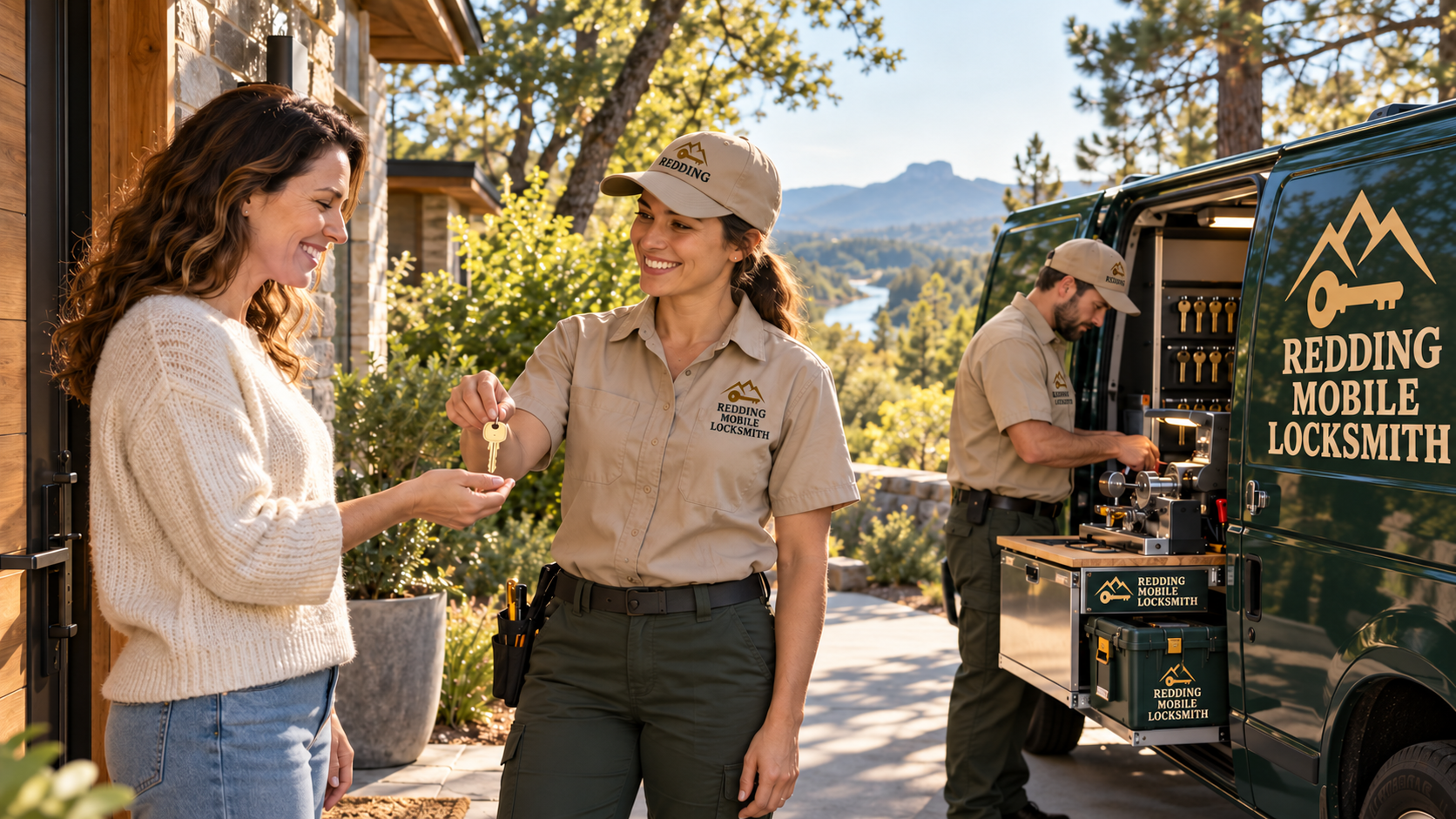
When you request help through the request form, a technician from Redding Mobile Locksmith comes to your door in a branded van that carries professional tools, key cutting and programming equipment, and common hardware. That matters for door hardware because the first diagnosis is often hands on: operate the door, watch the latch, feel the closer, check the strike. A good technician explains what they see before touching a screw.
Many commercial fixes happen on the spot. Adjusting a closer, realigning a strike, changing a cylinder, replacing a worn latch or fitting a new lever can usually be done with parts the van carries. Larger jobs, like a full exit device replacement or an electric strike with new wiring, may need a planned visit and parts to be ordered. A good technician will tell you which kind of job it is rather than guessing.
Before the visit, a few small preparations help. Note which door, which symptom, and when it started. Make sure someone with authority over the building can approve the work. Tell the technician about any alarm, access control or other hardware tied to the door so nothing surprising is disturbed. You can also read our new business owner lock checklist for a broader set of questions.
Planning hardware for the long haul
The easiest time to think about door hardware is before something breaks, and the next easiest is right after. Walk your building at opening or closing and operate every door the way a stranger would. Does it close? Does it latch? Does the lock turn without force? Write down anything that makes you hesitate, and group the notes by door so the work can be done in a single visit.
Keep track of keys as part of the hardware. A shop with several employees over time collects keys in drawers and pockets, and every key you cannot account for is a small open question. Rekeying the locks, which changes the internal pins so old keys stop working, is often more economical than replacing hardware. Our business lock service page covers the choices.
Finally, treat the deeper reference pages as a library. The full door hardware for business service page explains the work in general, and the other local pages, such as emergency help any hour in Dunsmuir, are there for the moment something goes wrong at an awkward time. Neighboring towns like McCloud and Mount Shasta have their own pages as well.
Good to know
Common questions
What is the difference between a door closer and an exit device?
A closer is the arm at the top of the door that pulls it shut and controls how hard it swings. An exit device is the push bar on the inside that releases the latch when pressed. A door may have one, the other, or both, and they work together when a door needs to close, latch and still be easy to leave through.
Why does my shop door slam in winter but drag in other seasons?
Closers use fluid to slow the door, and that fluid changes thickness with temperature. In cold weather it can thicken and make the door drag, while a worn or leaking closer may slam regardless. Often a small adjustment of the speed screws fixes it, but a technician can tell whether the closer itself is failing.
Can a mobile locksmith fix a door that will not latch?
Usually yes. The cause is often the strike, the hinges or the door sagging out of line, and a technician can adjust or replace these on site. They will check the door's alignment first, because replacing a lock does nothing if the latch simply no longer meets the strike plate.
Should a small business use keys or a keypad?
It depends on how many people need access and how often that group changes. Keys are simple and need no power, while keypads let you change codes without collecting keys. Many shops use a key on the front door and a keypad on a back or storeroom door. Our keypad or key guide goes through the tradeoffs.
What should I tell the technician before they arrive?
Tell them which door has the problem, what it does or fails to do, and how long it has been happening. Mention any alarm, access control or electric hardware connected to it, and make sure someone with authority over the building can approve work. Photos described in your request help the technician bring the right parts.
Who decides what hardware my door needs?
Requirements for commercial doors depend on the building, how it is used and the rules where you are, and they vary. The building owner, a landlord or the local authority can tell you what applies. A locksmith can describe options and install hardware, but we do not state what the rules require.