
Home / McCloud / Door Hardware for Business in McCloud
McCloud business hardware
Door Hardware for Business in McCloud: Matching the Hardware to the Door
Every door in a workplace has a different job, and the hardware should match it. A storefront, a storeroom and a back exit each ask something different of a lock, a handle and a closer.
McCloud business hardware
The end of a long shift
Picture someone finishing a long work shift in McCloud, the last one out. The shop has been busy, the light outside is already fading, and the final tasks are small ones: turn off the sign, count the till, and lock up. The door they pull shut behind them is the one thing between a day's stock and the night. If it does not latch cleanly or the key turns stiffly, that person feels it in the cold with tired hands.
That scene says a lot about what business door hardware is for. It is not only security, it is also comfort and confidence. Hardware that works without thought lets people do the day's last job and go home. Hardware that fights back leaves a nagging doubt about whether the door is truly locked, and a worker who doubts a lock may stand in a parking lot trying the handle again.
McCloud is a forest town east of Mount Shasta along Highway 89, with a quiet small town feel and snowy winters. Businesses here are often small, run by owners or a few staff, and the buildings range from older wood structures to more modern ones. This page walks through which hardware matches which door, so an owner or manager can think clearly about each opening. It draws on the work done by Redding Mobile Locksmith across the area.
Start by sorting your doors by purpose
The simplest way to plan business hardware is to list every door and ask what it is for. The main entrance welcomes customers during the day and secures the building at night. A back door may serve deliveries, staff or emergency exit. A storeroom keeps stock or records behind a stricter lock. An office door closes off private space. Each purpose points toward a different set of hardware.
Then ask who uses each door and how often. A door used a hundred times a day needs sturdier parts than one used twice. A door used by the public must be easy to operate for everyone, including people carrying things or with limited strength. A door used only by staff can be more specialized. A door that is rarely used still needs checking, since neglect shows up as a failure at the worst moment.
Finally, ask what happens if the door fails. If the main entrance sticks open, the shop is exposed. If a storeroom lock fails, stock is at risk. If an exit door will not open from inside, people could be trapped, which is the most serious case of all. Ranking doors by what failure would cost helps you decide where to spend attention first. The page on door hardware for business covers the general choices.
The storefront or main entrance
A main entrance does the most demanding work, and the hardware has to be both friendly and tough. During open hours the door must swing freely or be easy to push or pull. At closing it must lock reliably. Many shops use a lever or pull handle with a deadbolt, sometimes a mortise lock set into the edge of the door for added strength. The key cylinder should be of a quality that will last through daily use.
A closer is nearly essential on an entrance door. It keeps the door from swinging open in the wind and pulls it fully shut so the latch catches. In a snowy town, a closer that is set too weakly lets cold air in, while one set too strongly makes the door hard to open. Our guide on weather and seasons and locks explains why settings may need a seasonal adjustment.
Think also about the glass. Many storefront doors have large glass panels, and a lock placed within reach of a broken pane is only as strong as the glass. Hardware choices, such as a bolt that locks at the top or bottom or a lock placed away from the glass, can help. A technician looks at the door as a whole system and can suggest changes that make sense without a major rebuild.
Back doors and service entrances
Back doors get used by staff, delivery drivers and anyone taking out the trash, and they are often the weakest point in a building. They are out of sight from the street, often poorly lit, and sometimes fitted with hardware that has been repaired many times. A sturdy deadbolt, a solid strike and a door that fits its frame closely make a big difference here.
Many back doors also serve as emergency exits, so the hardware has to let people out easily from inside while keeping the door secure from outside. An exit device, commonly called a push bar, does this by letting anyone leave with a single push. From outside the door may have no handle at all, or a keyed trim. Our guide on push bars and panic hardware explains how they work.
Rules for exit doors depend on the building and how it is used, and they vary, so it is wise to ask the property owner or the authority that applies to you before changing anything on an exit route. A locksmith can describe hardware and install it. What is required for your particular building is a question for the people responsible for those standards, not something to guess at.
Storerooms, offices and the doors inside
Interior doors are where business owners often save effort and then regret it. A storeroom holding stock, tools or records deserves a real lock, not a push button privacy set meant for a bathroom. A sturdy keyed lever or a mortise lock fits well, and the door and frame should be solid enough to hold it. A hollow door with a heavy lock is a mismatch.
Offices call for locks that are convenient to staff and still private. A keyed lever that locks from the outside with a key and releases from the inside with a turn is common. If many people need access to many rooms, a master key system may help, where each door has its own key and one key opens them all. Our guide on master key systems explains whether you need one.
Cabinets and file drawers have their own locks and their own keys, which tend to wander. A drawer lock is small and plain in appearance but guards important things such as cash and papers. Check that you have two keys, know where they are and that the locks work. Our piece on cabinet and file locks goes through the typical questions.
Closers, strikes and the small parts that fail
Behind every good door is a handful of small parts doing quiet work. The closer pulls the door shut and controls its speed. The strike, set into the frame, receives the latch or bolt. The hinges carry the weight and keep the door aligned. When any of these wears, the door begins to misbehave, and the lock often gets the blame.
A door that will not close fully may have a closer set wrong, a swollen frame, a worn hinge or a misaligned strike. Each fix is different, and a technician can work out which with a short inspection. Our guide on fixing a door that will not close goes through the common causes. Often the repair is an adjustment rather than a replacement.
Strikes deserve special attention, since they take the force when someone pushes on a locked door. A strike fastened with long screws into the framing behind the trim holds far better than one held by short screws in soft wood. Upgrading this one small part is among the most cost conscious security improvements available to a shop owner, and takes very little time during a visit.
One more habit is worth building: the closing walk. At the end of each day, whoever locks up can test the main door by pulling it after locking, check the back door the same way, and glance at the closers to see that nothing hangs open. It takes a minute and builds a shared sense of responsibility. When a worker notices that the latch no longer catches on its own, mention it that week and not that month, because small door faults grow into large ones as the season turns.
Restrooms, customer areas and doors the public uses
Some doors are used by customers who are strangers to the building, and they deserve extra thought. A public restroom door needs a lock that is simple to operate for everyone, including children and people with limited dexterity, and that can be opened from outside in an emergency by staff. Lever handles with an easy turn or a sliding latch with a clear indicator work well. Avoid tiny knobs or fiddly parts that frustrate people.
Customer facing doors also get more abuse. People lean on them, kick them open with full hands and slam them in a hurry. Heavier duty hardware handles this better than residential parts, which are designed for the gentler life of a family home. If you notice a handle sagging or a latch wearing out much sooner than you would expect, that is often a sign the hardware was never meant for the traffic it sees.
Think about accessibility, too. A handle that can be worked with a closed fist or an elbow, a door that does not need much force to open, and a threshold that does not trip anyone make a shop welcome to everyone. Standards for accessible doors vary by building and use, so ask the property owner or authority what applies. A locksmith can adjust closers to lighter settings and fit lever handles, which are changes many owners overlook until a customer mentions them.
Keypads, keys and who gets access
Business access is a people question as much as a hardware one. Who needs to come in, when, and through which door? A shop with a few long term employees can use keys with little trouble. A business with part time staff, seasonal workers or frequent changes may prefer keypads, which allow codes to be changed without collecting keys.
Whichever you choose, set a policy. Write down who holds keys or codes, record when they are issued, and collect them when someone leaves. A short written key control approach, even a simple one, prevents the situation where nobody knows how many copies exist. Our guides on key control policies and handling keys when an employee leaves describe the basics.
When someone leaves, rekeying the locks they used is a reasonable step if you cannot be sure all copies have been returned. It changes the pins inside, so old keys stop working, and it often costs less trouble than replacing hardware. Rules about what employers must do vary, so check what applies to your business. A technician can rekey several doors in one visit and key them to a plan that suits you.
Winter, damp and older buildings
Business hardware in McCloud works against a backdrop of snow, cold and moisture. Metal parts rust, wood swells, and cold stiffens lubricants. A door that seems fine in summer may drag, bind or refuse to latch in January. These are normal seasonal effects, and a visit in autumn can head off many of them by adjusting closers, lubricating moving parts and checking that frames still align.
Older buildings add their own challenges. Doors may have been replaced over time without matching the frame, and hardware from different decades may sit side by side. The result is sometimes a door that works only because someone has learned the trick of lifting the handle. A technician can tell you which parts are worth keeping and which to replace, and can match new hardware to what is there.
Snow load and dripping eaves also matter. Water running down a door face can seep into the lock case and freeze, and ice along the threshold can jam the bottom of the door. Small fixes such as a drip edge, a sweep or a rain guard help the hardware last. Our local page on emergency help any hour in McCloud is there for the day a door fails at a bad time.
Planning a visit and what to have ready
When you request a visit through the request form, describe each door and its symptom in a sentence or two. Mention which doors are exits, which have closers, and whether anything is electric. Say who has authority to approve work, because a technician needs someone able to say yes. If the building is leased, mention that, since the landlord may need to be involved.
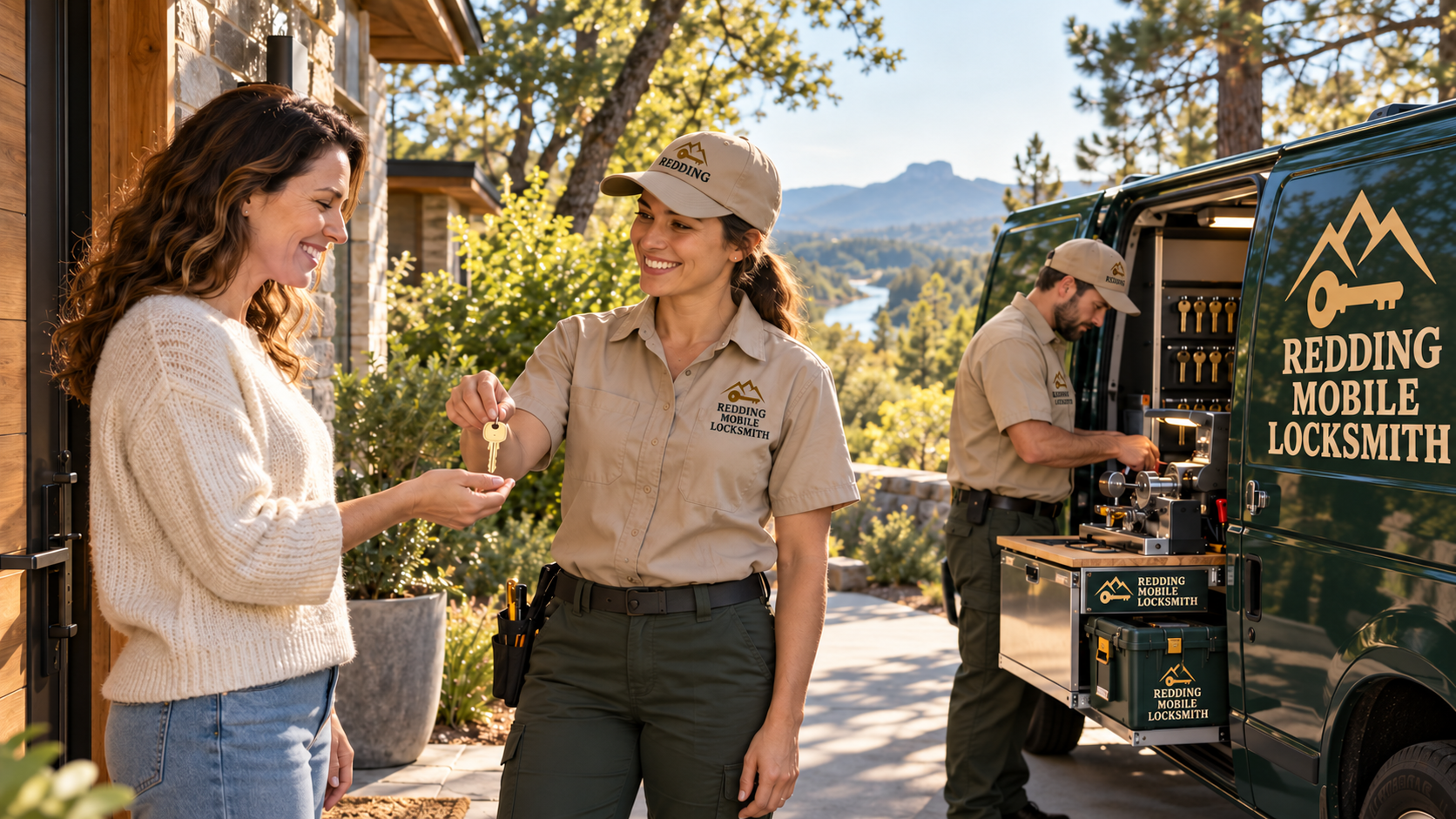
On the day, the technician arrives in a branded van carrying professional tools, key cutting and programming equipment, and common hardware. They look at each door in turn, explain what they find, and suggest options in order of importance. Many repairs happen on the spot with parts from the van, and larger jobs can be planned. Ask for the order of priority if you want to spread the work.
After the work, test the doors yourself with the technician watching. Open, close, lock and unlock each one. Ask about any behavior that seems odd, and keep a note of what was done. Our business lock service page covers the wider picture. Neighboring Dunsmuir and the page for McCloud carry more local detail for owners in this stretch of Siskiyou County.
Good to know
Common questions
Which type of lock suits a shop front door?
A sturdy deadbolt or mortise lock paired with a lever or pull handle suits most storefronts, along with a properly adjusted closer. The right choice depends on the door, the glass and how many people use it. A technician can look at the whole door and suggest hardware that fits.
Do I need a master key system?
Only if many people need access to many doors. A master key lets one key open every lock while each door also has its own key. Small shops often do fine with a simple keying plan. Our master key guide explains who benefits and what the tradeoffs are.
Why does my door not latch in winter?
Cold and damp make wood frames swell and metal parts stiffen, which can push the latch out of line with the strike. A closer set too weakly may also leave the door short of the latch. Adjusting the strike, hinges or closer usually solves it.
Should I rekey when an employee leaves?
It is a reasonable step if you cannot be sure all copies of their keys were returned. Rekeying changes the inside of the lock so old keys stop working. A written key record helps you decide when it is needed. Rules for employers vary, so check what applies.
Can a mobile locksmith install an exit device?
Yes, in many cases. The technician can fit a push bar to a suitable door and adjust it to latch properly. What is required on an exit route depends on the building and how it is used, so ask the property owner or local authority what applies to you.
What should I tell the locksmith before they come?
Describe each door that has a problem, what it does, and when it started. Mention exit doors, closers and any electric hardware. Make sure someone with authority to approve work is available. If the building is leased, say so, since the landlord may need to agree.