
Home / Anderson / Cars and Trucks in Anderson
Anderson, cars and trucks
Mobile Car and Truck Key Service in Anderson, at Your Curb
Mobile automotive service means the work comes to your vehicle. This Anderson page explains what that looks like at a curb or in a driveway, from the first request to the final test, so nothing about the visit is a mystery.
Anderson, cars and trucks
The shop owner at closing time
Imagine a small shop owner in Anderson at closing time. The sign is flipped, the till is counted, the lights go off, and the owner steps to the truck at the curb with arms full of a deposit bag and a box of leftovers. The keys are somewhere, and the truck door will not open. They turn out to be in the shop, locked inside by the same door that just closed.
It is an ordinary kind of misfortune, and it happens to people who are tired and carrying things. The owner does not want to leave the truck, walk through town in the dark or pay for a tow to a shop. The sensible solution is for the work to come to the truck.
That is what mobile automotive service is. A technician arrives with a van full of equipment, and the vehicle stays where it is, at a curb, in a driveway or in a lot. This page describes how that works. Our broader cars and trucks service page covers the full set of automotive work, and this one stays focused on the on site process.
Closing time is a particular hazard for business owners because the day's last tasks arrive in a bundle. Alarm, lights, deposit, lock up, load the truck: any one of them can push the keys out of mind. Recognizing that pattern is half the cure, and the other half is knowing that help can reach you where you stand.
What arrives at your curb
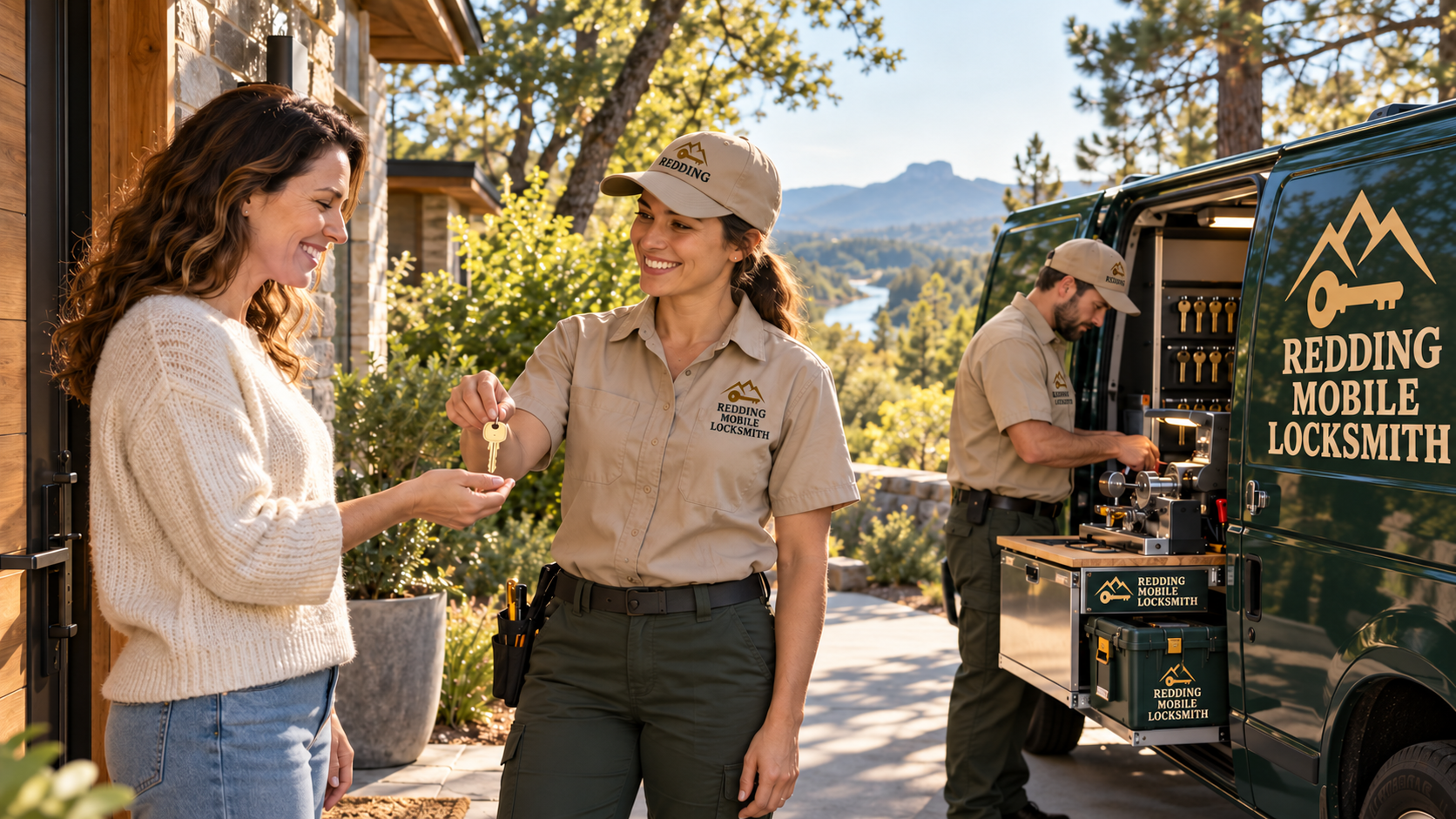
Redding Mobile Locksmith works from a branded service van, and the team wears uniforms. Inside the van are professional tools for opening vehicles, a key cutting machine, programming equipment that talks to a car's computer, blank keys and fobs of common types and a stock of common hardware. It is, in effect, a small shop on wheels.
This matters because most automotive key work is two jobs in one. The physical key has to be cut, and the electronics have to be programmed. In a conventional arrangement, the first happens at a counter and the second at a dealership, which is why people have historically been told to tow the car. A van that holds both capabilities collapses the process into one stop.
The team is based in Redding and serves seventeen communities across Shasta and Siskiyou counties, including Anderson, ZIP 96007. You can see the surrounding set on our page for Anderson.
The van is also a statement about preparation. Because the equipment is on board, the technician does not have to leave the site to fetch a part, a blank or a machine. Common key blanks and fobs are stocked, though a few unusual vehicles may need something special, so give the vehicle details early so the team can say whether anything must be ordered.
The request and what to say
The visit begins with a request. The phone line is coming soon, so the way to start is the form on the contact page. Say where the vehicle is, in plain words, such as the street or the lot and which side of the building. Name the vehicle, with make, model and year if you know them.
Describe the problem clearly. Is it a lockout with keys inside? A lost key? A key that works the doors but will not start the car? A broken key in the ignition? The answer decides what equipment comes out of the van, and the more precise you are, the more prepared the technician will be.
If anyone is in danger, say so, and call emergency services first when a child or pet is inside a closed vehicle. For ordinary cases, include whether you still have any working key, whether the engine is running and whether the vehicle is in an awkward spot. Our guide on what to have ready when you call a locksmith has a fuller list.
Think about timing and lighting when you can. If the vehicle is parked in a dim spot, moving it is rarely possible, but you can switch on a porch light or stand where you are visible. The technician needs to see the lock and the keyhole, and a bit of light speeds the work and keeps everyone safe.
- The exact location of the vehicle in plain words.
- Make, model and year, if known.
- What happened: lockout, lost key, jammed key or no start.
- Whether any working key still exists.
- Whether anyone is in danger or the engine is running.
Arrival and identity checks
When the van arrives, the technician introduces themselves and confirms the details. Expect questions about the vehicle and about you. A responsible locksmith will ask to see something showing that you own or are authorized to use the vehicle, such as registration paired with an ID. It can feel awkward when you are tired, but it protects you.
The reason is simple: the same service that rescues you could be misused to open someone else's truck. A professional checks. If something does not match, they will explain what else is needed. Our guide on how to know a locksmith is the real thing describes what the arrival of a genuine one looks like.
You can ask the technician to explain what they plan to do. A clear explanation, in plain language, is a sign of someone who knows the work. Be wary of anyone who cannot or will not describe the steps.
Some owners worry that the checks mean the locksmith doubts them. They do not. The same questions are asked of everyone, and a genuine owner usually has the answers in a wallet or glove box. If something is missing, such as registration left in the locked truck, say so, and the technician can suggest other ways to show a connection to the vehicle.
Getting the door open
If the vehicle is locked, opening it is the first step. The technician uses tools designed for the purpose, working carefully to avoid damage to the paint, the seals and the wiring inside the door. The exact method depends on the vehicle, and we do not publish how it is done, partly because the details differ and partly because they belong with professionals.
What we can say is that a proper opening leaves no marks. There is no prying at the window or bending of the frame, and the door works as before. Our page on being locked out of your car describes the visit from the owner's side, and the guide on how a car is opened without the key offers a general, safe explanation.
Once the door is open, the visit may be finished, or it may continue into key work if a key is missing or damaged. For the shop owner in our story, the keys are inside the shop, so the technician may simply open the truck, and the owner can retrieve the shop keys another way.
A word about alarms: many vehicles sound an alarm when a door opens without the key. The technician is used to this and has ways to handle it, but it helps to warn neighbors and to mention the alarm when you ask for service. Nobody enjoys a horn going off at closing time, and a little notice goes a long way.
Be honest about the situation. If the truck is a company vehicle, say so, and be ready to explain who authorizes access. If you borrowed a vehicle, explain who owns it. These facts shape what the technician can do, and clear information avoids awkward surprises partway through the job.
Cutting and programming at the vehicle
When a key must be made, the technician identifies what the vehicle uses. Some older trucks take a plain metal key, which can be cut on the spot. Many vehicles carry a transponder chip in the key head, which must be programmed to the car before the engine will run. Newer ones use a proximity fob that the car senses by radio.
The technician cuts the blade, either from the code, from the lock or from an existing key, and then connects programming equipment to the vehicle's diagnostic port, which sits inside the cabin. The equipment teaches the car to accept the new key. For fobs, the remote functions are paired as well.
Our service page on replacement car keys goes through the types, and key programming and fobs explains the electronics. If you want the chip explained, the guide to the transponder chip is short and clear.
Not every vehicle takes the same approach. Older trucks with simple keys can be handled swiftly, while some newer models require more steps and manufacturer specific procedures. The technician will explain which category yours falls into and what to expect. Honesty about the complexity is a good sign, not a bad one.
Testing before the van leaves
No key job is finished until it has been tested. The technician checks that the blade turns smoothly in the door lock and ignition, that the engine starts and that it keeps running. Remote buttons are tried one by one, and so are the trunk release and any other features that rely on the key.
You can and should watch. Ask for each function to be demonstrated. Start the truck, turn it off, start it again. Lock and unlock the doors a few times. A key that works once may be marginal, and it is much easier to fix before the van drives away.
For a business owner, testing is part of keeping the day moving. A truck that starts on the second try in the dark is a problem waiting to happen. If a second key is possible, this is the moment to add it, since the equipment is connected and the setup is done.
If more than one person drives the truck, bring everyone's keys to the vehicle, or at least tell the technician how many exist. Programming equipment can sometimes erase keys that are not presented, depending on the system, so it is better to plan for all of them than to discover one is dead afterward.
Anderson, the interstate and the valley floor
Anderson sits south of Redding along Interstate 5, on the valley floor. That means a good share of local vehicles are working trucks, commuter cars and vehicles heading up or down the interstate. Hot dry summers bake dashboards and fobs, and mild wet winters bring damp that finds its way into key electronics.
Because the service is mobile, the location of the vehicle matters less than you might expect. A driveway, a shop lot, a curb in town or a field gate on a rural parcel can all work. What helps is a level, safe spot with room for the technician to work, and light if it is evening.
Rural parcels around Anderson add the odd situation: a vehicle parked well back from the road, a gate that must be opened or a lane that turns to mud after rain. Mention such details in your request, and the team can plan for them.
Weather is a factor too. A cold, wet evening makes any outdoor job slower and a lockout more miserable. If you can wait inside a shop or a warm place nearby, do so, and let the technician know where you are. Staying comfortable keeps your patience intact, and patience helps the work go well.
Keeping spares and avoiding repeat visits
The surest way to avoid a future emergency is a spare key kept somewhere sensible. Not in the vehicle, not on a hook in the shop where anyone can take it, but with someone you trust or in a secure place at home. For a shop owner, a spare at home and another with a family member is a reasonable arrangement.
Check fob batteries once a year. A weak battery is the most common cause of a fob that stops working, and replacement is simple. Keep a spare battery with the spare key, and note its type. Our guide on what to do when a key fob stops working walks through the order of checks.
Think about habits at closing time. Keys on a lanyard, a pause at the door and a brief pat of the pocket prevent a good share of lockouts. It sounds simple, but tired people forget, and a routine does the remembering for you.
Consider adding a note to your phone with the vehicle year, make and the date the spare key was last tested. A reminder every six months to try the spare, check its battery and confirm it is still where you left it keeps the whole arrangement alive. Neglected spares are the usual reason a prepared owner still ends up stranded.
Related pages and what comes next
For the home side of Anderson, see home lock service in Anderson. For the Redding view of the same topic, see cars and trucks in Redding, which looks at distinguishing key trouble from engine trouble. The guide on a work vehicle lockout and who to tell helps if the truck belongs to the business.
Nearby towns have pages too: Cottonwood, Shasta Lake and Redding are all served by the same team. If you are curious about the services in general, the services page lists them all.
When you are ready, use the request form. The team works around the clock, and a closing time lockout is as welcome as a morning one.
If your business has several vehicles, a short key log is worth keeping, listing each vehicle, who drives it and where the spare lives. The guide on what a key control policy is describes a light version of the idea that suits a small operation.
Good to know
Common questions
What is mobile automotive locksmith service?
It is automotive key and lock work done at your vehicle. A technician arrives in a branded van carrying tools, key cutting equipment and programming equipment, so most jobs, from lockouts to key replacement, can be finished at a curb or in a driveway without towing the vehicle to a shop.
Do I need to prove the truck is mine?
Yes, expect to be asked. A responsible locksmith checks that you own or may use the vehicle, usually with registration and identification that match. This protects you, since the same step stops someone else from having a key made for your truck. Have these documents ready when you request service.
Can a new key be made if my only key is inside the shop?
If the key is only locked away, the vehicle can be opened and you can retrieve the key. If the key is lost entirely, a new one can often be made from the vehicle and programmed on the spot. Say which situation you are in when you ask.
Where can the work be done?
Almost anywhere safe the van can reach: a curb, a driveway, a shop lot or a rural property. A level spot with some room and decent light helps. Mention gates, mud or other access issues in your request so the technician can plan accordingly.
How do I know the key works properly afterward?
Ask the technician to demonstrate. The blade should turn smoothly, the engine should start repeatedly, and every remote button should work. A good technician will test these before leaving and will not mind you watching. If something fails, it should be fixed before the van goes.
How do I request service in Anderson right now?
Use the request form on the contact page. The phone line is coming soon and no number is published yet. Include the location, the vehicle and what happened. If a child or pet is locked in a vehicle, call emergency services first, and use the form afterward for the door.