
Home / Neighbors ask / Do I need a locksmith to change a door handle?
Handle swaps
Do I need a locksmith to change a door handle?
Often you do not. A like for like handle swap on a standard door is a screwdriver job, but a few situations, from odd door preps to locked in key needs, are worth a professional's time.
Handle swaps
Short answer: sometimes, and here is how to tell
If your door has an ordinary handle or knob set and you are replacing it with a similar one, you probably do not need a locksmith. Most residential handles are held on by two screws that you can reach with a common screwdriver, and the pieces slide out and back in. A patient homeowner with a phone for photos can manage it in an afternoon, and we say that with a clear conscience.
The picture changes when there is a lock involved, when the door has unusual holes, when the new handle is a different style, or when you need the new handle to work with an existing key. That is where people run into trouble, and where a locksmith saves headaches. A handle that does not match the door can leave you with a door that will not latch, a lock that will not turn, or a hole that is too large to cover.
So the real question is not whether you need a locksmith in general. It is which kind of handle job you have. Let us sort the jobs into the easy pile, the maybe pile and the call someone pile, so you can look at your own door and decide.
Handle, knob, lever and lockset: the vocabulary
People use the word handle for many things. A knob is the round one. A lever is the one you push down. Together with the part inside the door that holds the latch, they make a latchset when there is no key lock, and a lockset when there is. A passage set has no lock at all and is typical for closets and hallways. A privacy set has a push button or turn button, and is typical for bathrooms and bedrooms. An entry set has a keyed lock.
A deadbolt is separate. It sits above the handle on most front doors, has a key or a thumb turn, and throws a bolt into the frame. Changing a handle does not change the deadbolt, and the two can be on different keys. A handle set sold as a combination, with a lever and a deadbolt in the same finish, is still two separate locks bolted to one door.
Knowing which piece you have matters because the job differs. Changing a passage knob is among the easiest tasks in home hardware. Changing a keyed entry set is a little more involved, because you have to think about keys. Changing a deadbolt is a different job, and our new lock installation page describes how the pros approach it.
- A passage set is a handle with no lock, used for closets and hallways.
- A privacy set has a push or turn button, used on bedrooms and bathrooms.
- An entry set has a key cylinder, used on exterior doors.
- A deadbolt is a separate lock and is not changed by swapping the handle.
The easy job: swapping like for like
Here is what an easy handle swap looks like. You remove two visible screws on the inside handle, pull the two halves apart, and unscrew the latch from the door edge. The old parts come out. The new ones go in the same order. If the new set has the same bore size and backset, it fits. Most hardware stores sell sets labeled for standard doors, and they include a template.
Before you buy, measure the big hole in the face of the door, and the distance from the edge to the center of that hole. Check whether the latch edge has a round or square corner. Take a photo of the old hardware with the door open. These small details are the difference between a one trip job and a three trip job.
A tip from experience: keep the old set on the door until the new set is in hand. Do not leave the door without a latch. And work with the door open or propped, so you cannot accidentally lock yourself out with the parts in your hand. If the door has a lock, hold onto the key until the new set works, and test it several times before you trust it.
The maybe jobs: where it gets tricky
There are common wrinkles. The first is a different finish or style. A round knob replaced with a lever can be an easy swap or a headache depending on how much room there is for the lever to swing. Levers need clearance from the door frame, trim and the wall. A lever that hits a door casing is a recipe for scraped knuckles.
The second is a change in the latch. Many modern sets use a drive in latch with a round faceplate. Older doors may have a square faceplate set into a mortise. If the new latch does not match, you will have gaps, and the faceplate will wobble. A bit of chisel work can fix it, but it takes a steady hand.
The third is worn out surroundings. If the old set was loose for years, the screw holes may be stripped, and the bore may be enlarged. A new handle will not tighten properly in a ruined hole. You may need a repair kit, a plug, or a larger rose to cover the damage. These are the moments when a locksmith can fix the door as well as the handle, which is part of lock repair and adjustment.
When keys are involved
Keyed entry handles bring a complication: matching keys. If you replace a keyed set with another keyed set, you will get a new key or keys, and your deadbolt may still use the old one. People often want one key to work both locks. That is possible, but it requires either buying a matched pair or having the cylinders rekeyed to the same key.
If the new handle comes with its own key and you do not mind two keys, it is simple. If you want a single key, the cylinder can be rekeyed by a locksmith, or you can choose a set that is made to be keyed alike. Our page on rekeying your home explains how that works.
There is also the question of what to do with the old keys. An old key that used to work might still open a lock you left on another door. If you are changing a handle because you lost a key, or you are worried someone has a copy, swapping the handle only helps if the cylinder is also replaced. A new handle with the old cylinder re used does not change who can open the door. Our guide on whether it is better to rekey or replace goes through the choice.
Smart locks, keypads and fancy hardware
Electronic hardware raises the stakes. A keypad deadbolt or smart lock swaps in for a standard deadbolt, and its installation is usually well documented. Still, the hole sizes, the thickness of the door and the position of the strike all matter. Batteries, wiring and the mobile app add a layer of setup that has little to do with the door.
An electronic handle on the inside of the door can also change how the door behaves if the batteries die. Look for an override key or a way to power it from outside. Think about what happens when the power goes out, or when the app on your phone will not connect. A locksmith can walk you through it and explain the backup plan.
If you are curious about smart hardware in general, our guides on what a smart lock is and who needs one and whether smart locks can be rekeyed help sort out the questions before you buy. Handle swaps on these devices are better done once, with care, rather than several times in frustration.
Doors that make it harder
Some doors resist an easy swap. A steel or fiberglass door with factory prepared holes allows only certain hardware. A door with a thick decorative panel may not allow standard levers. An old wood door with odd measurements might need an adapter plate or a custom fit. If you find you are drilling or chiseling, you are probably into the territory where a professional is wise.
Another issue is doors that were painted shut or have layers of paint on the edge. The latch may not fully retract, and the new set will bind. Scraping the edge and sanding the faceplate area can fix it, but you have to be careful not to chip the surface. On historic or valued doors, a careless drill can cause damage you cannot undo.
Our guide on metal, wood or fiberglass doors and how locks fit them goes through these materials in more depth. If you are not sure what your door is made of, tap it. Wood sounds solid, steel rings flat, and fiberglass sounds dull and slightly hollow.
Situations where we would call a pro
There are a few situations where we would say call someone, and we mean it. If the door will not open, the old handle is broken, or the latch is stuck inside, you may need the lock opened or the handle removed in a way that does not damage the door. If the lock is on an exterior door and you are worried about security, a careful installer is worth it.
If the door will not latch after your swap, you may have a misaligned strike, a sagging door, or a latch that is too long. Instead of tinkering, a visit can sort it out. If you are renting, check with the landlord or property manager before changing hardware, since rules about lock changes vary and you may need permission. Our note on what renters should ask a landlord covers what to ask.
And if you simply do not want to do it, that is a fine reason. Plenty of people prefer to have a pro do the job, check the whole door, and walk away with it working. A visit also gives you a chance to ask questions about the other doors in the house, which is often worth more than the swap itself.
Think about timing as well. Handle jobs go smoother in daylight, when the door is not needed for a while, and when you are not hurrying to leave. A door you cannot lock at night is a worry, so plan to finish the swap while you can still test it, and leave yourself time to fix a surprise before bedtime.
What a visit looks like
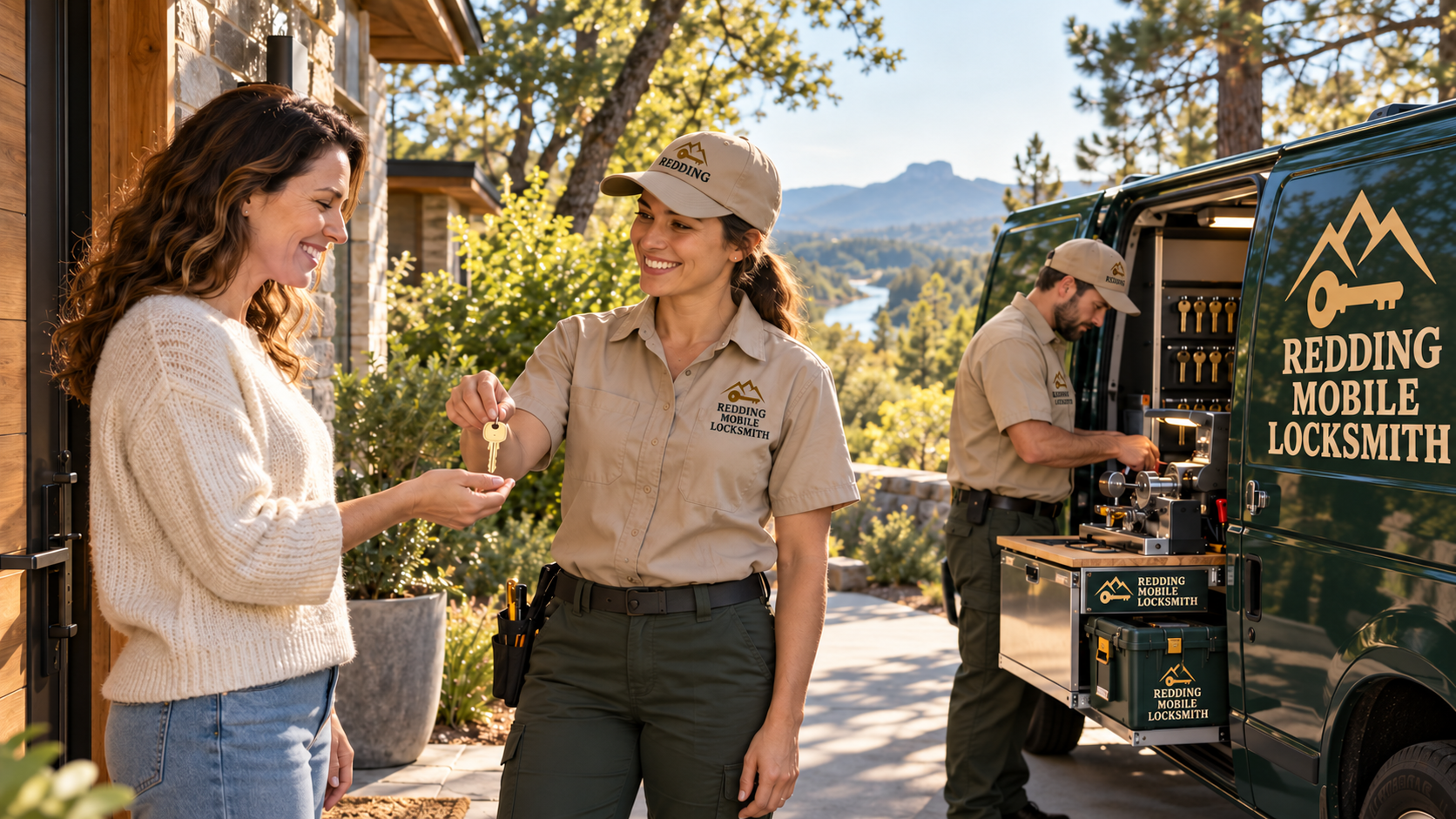
When a technician from Redding Mobile Locksmith comes out for a handle job, they start by looking at the door and the existing hardware. They measure the bore, the backset and the thickness. They test the latch and the strike. Then they remove the old set, check the condition of the holes, and install the new set, adjusting where needed.
The van carries professional tools, common hardware and key cutting equipment, so a handle swap can often include extras, like cutting a key, rekeying a cylinder or adjusting a strike. You get a door that works, rather than a handle that merely hangs on it. If you have several doors to do, the technician can match them so one key operates all of them where that makes sense.
You can request a visit through the request form. Mention the type of door, whether it is interior or exterior, and the kind of handle you want. A photo helps. Our home lock service page describes how we handle houses, and you can find the local page for your community, such as Cottonwood or Palo Cedro, for notes on the area.
A small checklist before you start
Before you pick up a screwdriver, run through a short list. Know what kind of set you have and what you want. Measure the bore and backset. Check that the new set includes the right latch and strike. Confirm that you have the key or keys you need. Make sure someone knows you are working on the door so you are not locked out.
Have a plan for the old hardware. Keep it until the new set works. If you are replacing a keyed set, test every key several times. Test the latch with the door open and closed. Listen for rubbing, and watch the bolt meet the strike. A handle that feels slightly off today will feel worse by the next season.
If any step makes you uneasy, stop. You have not failed, and nobody will judge you. Take photos, note what you found, and reach out. Half finished door jobs are a common reason for calls, and the work is usually easier to finish from where you stopped than to undo.
One more habit worth building is to label what you take off. Drop the screws from each part into a small cup or tape them to the matching piece, and set the latch, the strike and the trim in the order they came off. It sounds fussy, but when a spring pops loose or a screw rolls under the refrigerator, you will be glad the rest of the pile is organized. Handle hardware is simple, yet small parts disappear at the worst moments, especially if kids or pets are helping.
Good to know
Common questions
Can I change a door handle myself?
For a simple like for like swap on a standard interior or exterior door, yes. Most handles are held by two screws, and the pieces fit together in a known order. Measure the bore and backset before buying, photograph the old set, and keep the old one until the new one works.
Will a new handle change who can open my door?
Only if the new handle includes a new key cylinder and you use it. If you keep the old cylinder or deadbolt, the old keys still work. A handle swap alone does not change keys. If you are worried about lost keys, the cylinders should be rekeyed or replaced.
What is the difference between a knob and a lever?
A knob is round and twists, while a lever is a bar you push down. Levers are easier on the hands and are often chosen for accessibility. Levers need room to swing, so check clearance at the frame and wall before you buy one.
Why will my new handle not latch the door?
Common causes include a latch that is the wrong length, a faceplate that does not sit flush, a misaligned strike, or a door that has shifted. Check each in turn. If the latch retracts and extends freely with the door open but not when closed, the strike or the door position is the likely cause.
Do I need permission to change a handle in a rental?
Rules vary by lease and by property, so ask the landlord or property manager before you change any lock hardware. Some leases forbid it, others require a copy of the key. Getting the answer in writing helps avoid disputes later.
When should I call a locksmith instead?
Call if the door is stuck shut, the hole is damaged, the handle is part of a keyed system you want matched, or the door is a steel or fiberglass slab with unusual prep. A visit also makes sense if you want the whole door checked while someone is there.