
Home / Etna / Door Hardware for Business in Etna
Close to Home: Etna
Door Hardware for Etna Businesses
Imagine an angler walking back to the trailhead at dusk, glad to see a lit shop door that still opens smoothly. This page explains closers, exit devices, strikes and handles on Etna business doors.
Close to Home: Etna
The door a stranger notices first
Imagine a hiker or an angler coming off a trail at dusk, boots damp and legs tired, heading toward the nearest lit building in town. The door is the first thing that person touches. If the handle is solid, the door swings shut behind them without slamming, and the lock turns without a fight, they never think about it. If any of that goes wrong, they remember.
That is the quiet job of commercial door hardware. It lets customers in, keeps stock and cash safe, helps staff leave in an emergency and holds up to hundreds of uses every day. Etna has small shops, offices, workshops and service buildings, many in older structures where doors have been patched and hung again over many seasons.
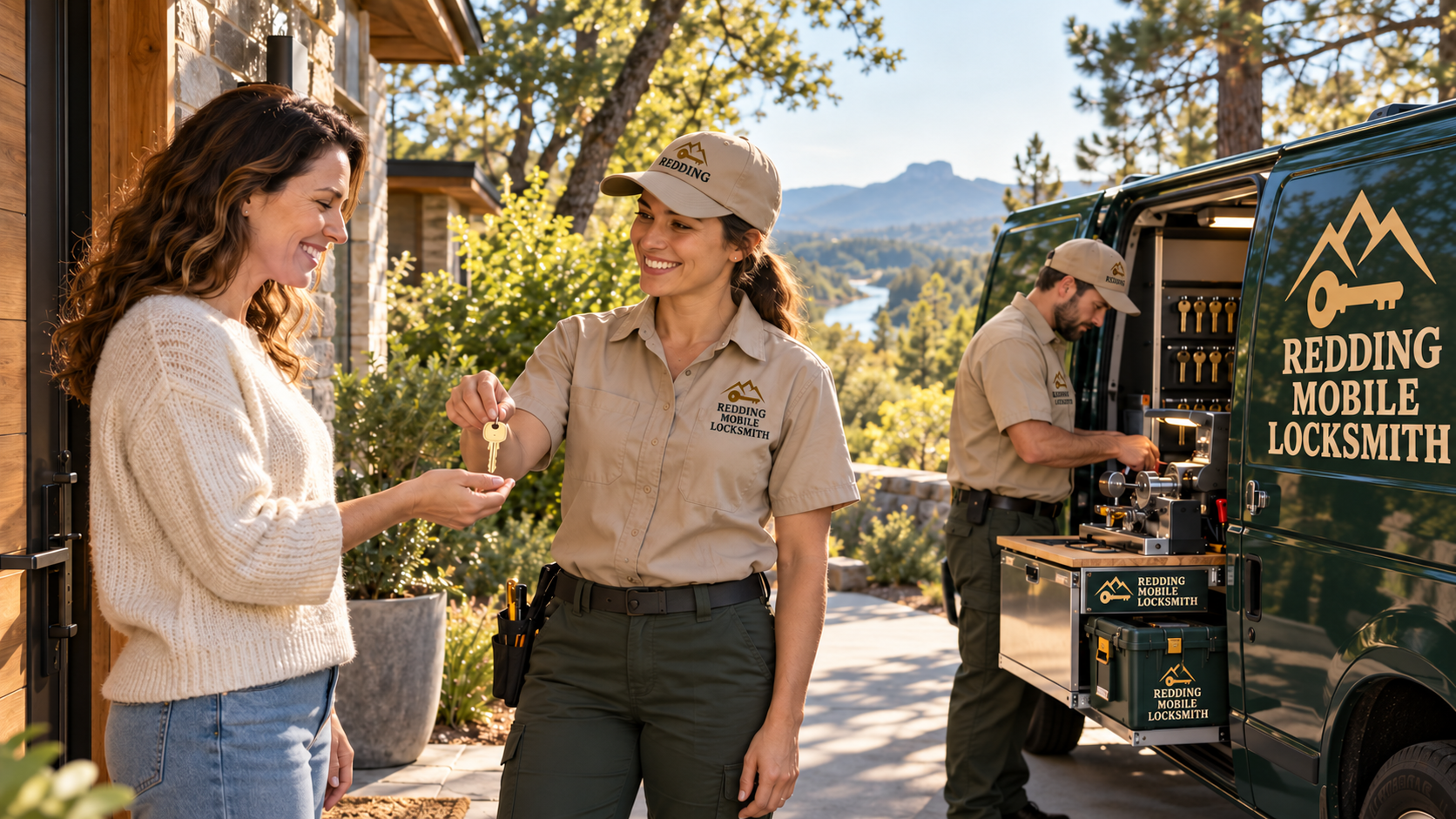
We write this page for the people who run those places. Redding Mobile Locksmith brings a branded team in uniforms and a branded service van with professional tools, key cutting equipment and common hardware to businesses around Siskiyou County. Here is a plain look at the parts that make a business door work, and how we handle them on site.
How commercial hardware differs from home hardware
A house door opens a few times a day. A shop door may open hundreds of times, with deliveries, customers, staff and the occasional sticky afternoon when someone props it open. Commercial hardware is built to handle that load with heavier parts, thicker metal and mechanisms designed for constant use.
The rules of the room also differ. A business door often has to serve two masters at once: it must be easy for the public to use, yet secure after hours. It may need to unlock during business hours while still locking from the outside at night, or let people leave freely without a key. Those needs shape the type of lock and handle.
None of this means every shop needs the heaviest hardware available. Overbuilt hardware can be as poorly matched as undersized hardware, and it often brings its own headaches in the form of heavier doors, stiffer operation and parts that are harder to replace. A small office with light traffic does not need what a busy storefront does. The sensible approach is to look at how the door is used, who uses it and what is behind it. You can find our overview on the door hardware for business page.
Door closers: the quiet workhorse
A door closer is the metal cylinder, usually mounted at the top of the door, that controls how the door swings shut. Inside it, fluid moves through small passages as a spring pulls the door closed, which is why a well adjusted closer glides the door home instead of letting it slam. Without one, doors drift open or bang shut. In a building where heat is expensive to keep, that drifting door is also an open invitation to the cold, which is another reason shop owners in a mountain valley appreciate a well tuned closer.
Closers have adjustments for how swiftly the door travels through its main swing and how firmly it latches at the end. Wind, temperature and a busy foot traffic day can all change how a closer behaves. In cold weather the fluid thickens and the door may close sluggishly, and in warm weather it may close harder. A seasonal tune up often fixes complaints.
A closer that fights people, leaks fluid or lets the door stop short of latching needs attention. A door that does not latch is not locked, no matter how good the lock is. Our guide on what a door closer does goes through the parts in more detail.
Exit devices and panic hardware
An exit device, often called panic hardware or a push bar, is the horizontal bar across the inside of many commercial doors. Push it and the latch retracts, letting people out without turning a knob or using a key. Its purpose is simple: in an emergency, people should be able to leave without stopping to think.
Outside, the door may have a handle or lever that is locked or unlocked with a key, a keypad or an electronic system. Inside, the bar stays ready to push so exit is always possible. Different models handle different door widths and traffic, and the latching can happen at one point or at the top and bottom of the door for extra holding strength. Some include a dogging feature that holds the bar down during the day so the door can be used as a normal push door.
Rules about where exit devices are required vary by building type and local authority, so we do not state them here. If you are unsure whether your door needs one, ask your landlord, a building official or a fire authority. Our guide to push bars and panic hardware explains the idea in everyday words.
Strikes, latches and the frame
Every latch or bolt on a door needs something to catch it, and that something is the strike. On a commercial door, the strike is set into a sturdy frame, often metal, and it has to line up exactly with the latch. When the door sags or the frame shifts, the latch no longer meets the strike, and the door fails to lock properly.
There are different strike styles. Some are plain plates with a hole, while others are adjustable or designed to work with electric release systems. An electric strike lets someone buzz a visitor in without walking to the door, and it can remain locked from the outside until released. Our note on the electric strike describes how it works.
A good strike installation depends on the frame behind it. Metal frames can be filled with grout or reinforced, while wood frames need proper screws. We examine the frame before deciding on hardware, since the strike is only as strong as what holds it in place. In older Etna buildings, frames may have been painted many times, patched after a break in, or shifted slightly as the structure settled, and each of those histories changes what the strike can reliably do. Our piece on what makes a good strike plate offers further reading.
Handles, levers and locksets for business doors
The handle is what people actually touch. Lever handles are common on commercial doors because they are easy to operate with a full hand, an elbow or a bag in the other hand. Knobs can be harder for people with limited grip, which is one reason levers are widely used where the public comes and goes.
Behind the handle sits the lockset, which decides how the door locks. Some are always locked from outside but open to anyone leaving from inside. Others have a function switch so the door can be left open for customers during the day. There are also storeroom functions that keep a door locked on the outside at all times, with the key needed to enter.
Choosing the right function matters more than the finish. A door that is supposed to be locked but has a knob that turns freely is no help. Our team can talk through function names, which sound dull but are quite practical, and help you pick a set that fits how your business actually runs. A good conversation here avoids the common mistake of installing a handsome lever that can be locked from the wrong side, leaving staff fumbling for keys at closing time.
Keys, access and who holds what
Business keys multiply. There is the owner's, the manager's, the cleaner's, the delivery contact's and an old one that nobody can account for. Without a plan, the number of people who can open the door slowly grows, and nobody is quite sure who has what. A simple record of key holders is worth the effort. It can be a page in a drawer, with names, dates and which doors each key opens. When something goes wrong, that page turns a vague worry into a short list of people to talk to.
A master key system can help. It lets different keys open different groups of doors, with one top key opening all. It can bring order to a building with many rooms, though it also needs careful planning so the system remains secure. Read our guide on master key systems for the basics.
When someone leaves the business, think about the keys they held. Our guide on handling keys when an employee leaves explains the options, and the note on key control policies shows how a small business can keep this tidy without much paperwork.
Keypad or key for a small shop
Many small businesses wonder whether to switch to keypads. A keypad removes the need to hand out metal keys, and codes can be changed when staff change. It also introduces a different kind of upkeep: batteries, code management and the habit of not sharing codes casually. For some shops that trade is worth it; for others, a good key system is simpler.
The answer depends on staff turnover, how many people need access and how comfortable your team is with the technology. A shop with a few trusted people may do well with keys. A busy place with changing staff may prefer codes. Our guide on keypad or key for a small shop talks through the choices.
Whichever you choose, keep a mechanical backup in mind. Electronic hardware can fail when power drops, batteries die or a component wears out. A hidden failure at dusk, with a customer waiting outside, is a poor moment to discover that nothing opens. We help set up systems with sensible fallbacks, such as a keyed override on an electronic lock or a mechanical bypass for emergency access. The aim is a door that still works on the worst day, not only on an easy one.
Weather, wear and seasonal checks
Etna sits in a valley with cold winters and warm dry summers. Business doors take the full range. Metal expands and contracts, closers change speed with temperature, and wood doors swell and shrink. A door that closes perfectly in July may drag in January, and the cause is often not the hardware but the opening around it.
A seasonal walk around your doors is a modest habit with a good payoff. Open and close each one slowly and listen. Check that the closer brings the door fully latched, that the handle feels firm and that the lock turns without effort. Look for loose screws, fluid stains below the closer and gaps around the frame.
Our guide on weather and seasons and locks explains the pattern, and the piece on a door that will not close covers the common causes. Catching small problems early often means a simple adjustment instead of a replacement. It also keeps the doors comfortable for customers and staff, who will rarely say a word about a door that works but will notice the moment one does not.
When a business door fails after hours
Sometimes the problem arrives at the worst possible time: a door that will not lock when you are closing, or will not open when you arrive. Our team dispatches around the clock, and a locksmith can often repair or adjust hardware on site. If the building cannot be secured, say so right away so the technician can prioritize it.
Tell the dispatcher what door is involved, what the hardware looks like and what the door is doing. If you can, mention whether it is a push bar, a lever handle or a knob, and whether the door has a closer. Photos help. For the around the clock service, see our emergency help any hour in Etna page.
If the failure involves a break in or forced entry, contact the proper authorities first. After they have what they need, a locksmith can help secure the opening and repair or replace damaged hardware. Our guide on locks after a break in offers a sensible order of steps.
Getting your hardware looked at
If you want an opinion on your doors, we can walk through the openings with you and explain what we see. We look at closers, exit devices, strikes, handles and the condition of frames. You do not have to commit to anything, and we will tell you what is working and what is not. Some visits end with a short list of small fixes, and some end with the reassurance that your doors are in better shape than you feared. A new business owner may find our new business owner lock checklist helpful.
Because our phone line is marked coming soon, please use the request form on our contact page. Tell us about the building, the doors and what you hope to improve. We do not publish prices on these pages, and we will discuss the work with you before beginning.
For wider context, see our business lock service overview, and the pages for Etna and nearby Fort Jones. A well maintained door is something customers rarely notice, which is exactly how it should be.
Good to know
Common questions
What is the difference between a door closer and a door latch?
A closer controls how the door swings shut, using a spring and fluid inside a cylinder. A latch or bolt holds the door in the frame once it arrives. Both are needed. A strong latch cannot help if the closer leaves the door ajar, and a good closer cannot lock the door by itself.
Does my shop door need panic hardware?
It depends on the building type, occupancy and local requirements, which vary. We do not state rules here. Ask your landlord, building authority or fire authority what applies to your space. We can supply and install suitable exit hardware once you know what is required.
Can a mobile locksmith adjust a door closer?
Yes. Closers have adjustment valves for swing speed and latching force, and a technician can tune them on site. If the closer leaks fluid or is worn, replacement may be better. We can look at the door and tell you which route makes sense.
Is a keypad lock a good idea for a small business?
It can be, especially with changing staff, since codes can be changed instead of collecting keys. The trade offs are batteries, code management and a need for a sensible backup. A technician can talk through whether keys, keypads or a mix suit your situation.
What should I do if an employee leaves with keys?
Count which doors that key opened and decide whether those locks should be rekeyed. Rekeying changes which keys work without replacing the hardware. A written list of key holders makes the decision clearer. We can rekey or replace cylinders and give you a fresh set of keys.
Can you help with an older storefront door that sticks?
Often. Sticking can come from a sagging door, a shifted frame, a worn closer or swollen wood. A technician inspects the opening, adjusts the hardware and recommends further work if the frame or door needs attention. We explain what we find before making any changes.